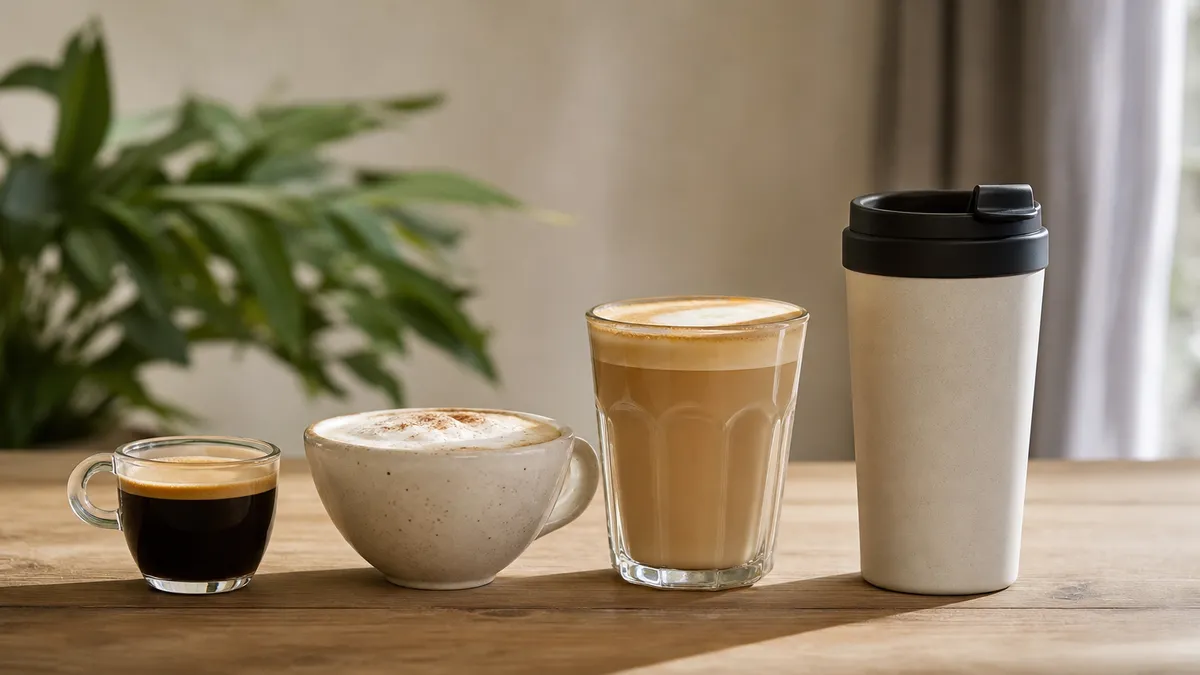
Choose coffee cups, glassware and travel mugs to match the size of your drink, how soon you will drink it and whether it needs to travel. Ceramic is a practical starting point for drinking at a desk or table, heat-resistant glass makes the drink visible, and a sealed, vacuum-insulated mug suits carrying coffee and keeping it hot.
In short
- Match the vessel to your usual recipe, rather than adding extra milk or water to fill a large cup.
- Espresso needs a small cup: the Italian Espresso National Institute specifies a capacity of 50 to 100 ml for its certified style.
- Preheat a cup when retaining heat matters, particularly for a small drink in a substantial ceramic vessel.
- Double-walled glass and vacuum-insulated steel are different constructions. Check the individual product’s insulation and care instructions.
- A reusable cup with a splashproof lid is not necessarily suitable for carrying loose in a bag.
Which coffee cup size suits each drink?
Start with the finished drink, not the name printed on the cup. A flat white, cappuccino or latte can mean different quantities in different cafés, so choose around the recipe you actually enjoy.
The following are useful shopping starting points, not universal drink definitions. They combine the Italian Espresso National Institute’s guidance with published vessel capacities from Loveramics and KeepCup.
| Drink or use | Vessel capacity to consider | What the size is based on | Best suited to |
|---|---|---|---|
| Espresso | 50 to 100 ml | Italian Espresso National Institute cup specification | A small black coffee with room above the drink |
| Flat white | 150 ml | Loveramics Egg flat white cup | A compact milk drink |
| Cappuccino | Approximately 160 ml or 200 ml | Italian certified style or Loveramics Egg cappuccino cup | Choose according to your milk recipe |
| Latte | 300 ml | Loveramics Egg café latte cup | A larger milk drink |
| Filter coffee or Americano | Around 340 ml | A published KeepCup reusable cup size | A longer drink, with room left below the rim |
| Larger or iced drinks | Around 454 ml | A published KeepCup reusable cup size | Drinks needing additional space, including ice |
Capacity is not a brewing instruction. Buying a larger latte glass does not mean you should automatically increase the milk, and buying a small cup does not tell you how much espresso to extract.
Also distinguish brim capacity, the amount held right to the top, from a comfortable serving quantity. Before buying, check how the manufacturer defines capacity and whether a travel mug has a maximum fill level.
For an office machine, measure the available height beneath the outlet, including any space occupied by the drip tray. Check the cup’s outside dimensions as well as its volume: a tall travel mug may hold the right amount but still be awkward to fill.
For the wider equipment checklist, start with brewing accessories.
Ceramic versus glass: choose the whole vessel
Material matters, but it does not determine performance on its own. Wall thickness, vessel mass, shape, starting temperature and whether there is a lid all influence heat transfer.
Ceramic cups
A ceramic cup is my default recommendation for coffee drunk at a table: choose a comfortable handle, a pleasant rim and a size that matches the drink. This is a practical preference, not a claim that ceramic always produces better flavour.
A substantial cold ceramic cup needs heat to warm up, and some of that heat comes from the coffee. Preheating reduces this initial transfer. Once warm, the vessel and coffee cool together, with the outcome depending on the complete design rather than simply the word “ceramic”.
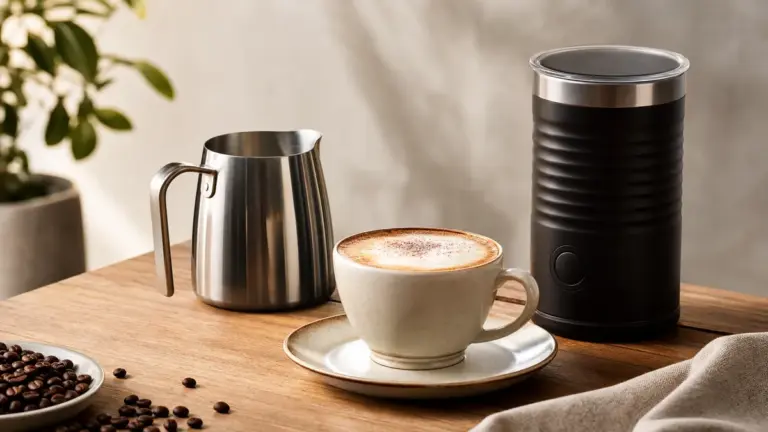
For milk drinks, consider access as well as appearance. If you want to practise pouring patterns, choose a cup you can tilt comfortably and reach with the pitcher spout. Milk preparation itself belongs in milk frothers and milk pitchers.
Single-walled glass
Clear glass lets you see the drink: useful if you enjoy watching espresso settle or want to inspect the appearance of a milk drink. Choose glassware expressly intended for hot beverages, with care instructions covering your intended use.
Do not assume that every drinking glass is suitable for hot coffee, microwave reheating or dishwasher cleaning. These are product-specific permissions, not properties to infer from transparency.
A handle is worth considering if you dislike holding a warm vessel directly. Before choosing a handleless glass, think about how you will pick it up when full, not just how it looks empty.
Double-walled glass
Double-walled glass has an inner and outer wall separated by an insulating gap. It can combine a visible drink with a cooler outer surface, but it should not be treated as equivalent to a vacuum flask.
Bodum’s published double-wall glass information, for example, describes borosilicate glass and a silicone vent that equalises pressure between the walls. Follow the exact product’s instructions, including any guidance about that vent.
The trade-off is another construction detail to look after. Check dishwasher and microwave permissions before use, avoid crowding delicate glassware against other items, and inspect it if it develops damage. A manufacturer permitting dishwasher use for one range does not establish that all double-walled glasses are dishwasher-safe.
Preheating: when it helps and how to do it
Preheating is most useful when your priority is keeping a small coffee warm. A cold vessel takes heat from the drink as their temperatures move towards each other; warming the vessel first reduces that initial temperature difference.
It is not compulsory. If you want to drink immediately and usually find coffee too hot, choose the routine that gives you a comfortable drinking temperature rather than pursuing maximum heat retention.
A simple preheating routine
- Check the instructions. Confirm that the cup or glass is suitable for hot drinks and any relevant temperature changes.
- Warm it with hot water. For an ordinary cup, use enough to warm the interior, without filling to an awkward carrying level. There is no single necessary water volume or waiting time for every vessel.
- Follow a specified time where one exists. KINTO recommends preheating its Travel Tumbler with a little hot water for 1 to 2 minutes.
- Empty it before brewing or filling. Do not leave warming water in the bottom and unintentionally dilute the coffee.
- Fill and handle carefully. An insulated mug can remain cool outside while its contents are still very hot.
Avoid using extra-hot brewing as a substitute for a suitable vessel. Treat the brewing recipe and the serving arrangement as separate decisions.
Travel mugs: insulation, lids and everyday fit
Choose a travel mug against four criteria: heat retention, closure, cleaning access and physical fit. A generous capacity is of little use if the mug is difficult to clean or will not fit your machine.
Understand insulation claims
Vacuum-insulated mugs use a gap with very little gas between their walls to reduce heat transfer. The lid and opening still matter, so “double-walled” alone is not a useful promise of a particular holding time.
As a manufacturer-published example, KINTO claims that its 350 ml Travel Tumbler keeps a drink at 65°C or above for six hours under its stated test conditions. That is a laboratory claim, not a guarantee that every partly filled mug, repeatedly opened during a commute, will perform identically.
Read the test conditions rather than comparing the headline hours alone. Also ask whether you actually want prolonged heat retention: a mug that preserves heat effectively may need opening and careful cooling before you can drink comfortably.
Splashproof is not leakproof
A splashproof lid is intended to reduce splashes, not necessarily to withstand being tipped upside down in a bag. KeepCup explicitly distinguishes its splashproof press-fit reusable cups from its leakproof travel mug range.
For bag carrying, look for an explicit manufacturer statement covering that use. Check the closure procedure, fill limit and seal position. Even where a product has a secure closure, follow any instruction to transport it upright.
Choose something you can clean properly
Before buying, find out whether the lid comes apart and whether replacement seals are available. A simple opening you can reach with a brush may be preferable to a complicated drinking mechanism you struggle to inspect.
Follow the manufacturer’s washing instructions. KINTO’s Travel Tumbler, for example, is not dishwasher-safe, despite being made principally from stainless steel.
After use, empty the vessel, wash the permitted parts, rinse thoroughly and let everything dry. If a cleaning treatment involves soaking, follow the product-specific method and do not seal a hot cleaning solution inside the mug.
Reusable cups: make repeat use practical
A reusable cup does not have to keep coffee hot for hours. For walking from a coffee shop to a nearby desk, a washable cup with a splashproof lid may be a better fit than a substantial insulated flask.
Choose something you will reliably carry, wash and reuse. Check the cup’s dimensions against your bag pocket or holder, and consider whether you prefer drinking through the lid or removing it once seated.
Environmental comparisons need more care than a “reusable” label. UNEP’s review of life-cycle assessments found that results depend on factors including material, manufacturing, number of uses, washing and disposal assumptions. There is no single defensible reuse count covering every cup and every environmental impact.
The practical recommendation is to keep using a suitable cup you already own, maintain it and replace worn components where possible. Do not assume that collecting additional reusable cups necessarily improves the outcome.
Troubleshooting the drinking experience
Use the symptom to identify the likely problem before replacing the vessel.
| Symptom | Likely cause | What to try |
|---|---|---|
| A small coffee cools sooner than you want | Cold vessel taking heat from the drink; unsuitable serving size | Preheat and use a smaller vessel |
| Coffee stays uncomfortably hot | Effective insulation and a closed lid | Open carefully and allow cooling before sipping |
| A mug leaks around the closure | Incorrectly seated seal, incomplete closure or overfilling | Check the manual, seal and fill limit |
| An unpleasant smell remains after washing | Residue in the body, lid or accessible seal recesses | Dismantle permitted parts and follow the cleaning instructions |
| A cup fits the drink but not the machine | Outside height or width was overlooked | Measure the filling space before choosing a replacement |
Does cup shape or colour really change flavour?
A vessel can change the drinking experience without changing the coffee’s recipe. In controlled sensory experiments published in Flavour, researchers found that mug colour influenced some ratings of the same style of coffee.
The evidence needs proportionate interpretation. The study involved particular mugs and participants, and some vessels differed slightly in texture and shape as well as colour. It does not establish that a certain colour makes every coffee taste better.
For your own comparison, use the same batch of coffee and compare at similar drinking temperatures. Treat the result as a personal preference test, not a measurement of extraction. Measuring dissolved coffee concentration is a different task, covered in coffee refractometers.
Choose coffee cups, glassware and travel mugs for a comfortable rim, an appropriate serving size and the way you actually drink. Those are more useful buying criteria than an unsupported promise that a particular shape will transform flavour.
FAQ
Can I put a double-walled glass in the microwave?
Only if the manufacturer explicitly permits it for that particular product. Bodum has published microwave-safe instructions for some double-walled glass ranges, but that permission should not be extended to other products. Check the current instructions, including restrictions involving temperature, decoration, accessories or damage, before reheating.
Should I buy a reusable cup or a travel mug?
Choose a reusable cup for short, upright journeys and a suitably sealed travel mug when secure carrying matters. Product names alone are not enough: check whether the closure is described as splashproof or leakproof. Then consider insulation, cleaning access and whether the vessel fits beneath your coffee machine.
What if a new travel mug does not do what its description promises?
Contact the retailer and explain the fault or mismatch with the description. UK consumer guidance says goods should be satisfactory, fit for purpose and as described. Keep the product description and care instructions, and distinguish a consumer purchase from workplace procurement: business purchases do not automatically receive the same consumer protections.
Where to go next
Read Brewing Accessories for the wider equipment checklist, or Milk Frothers and Milk Pitchers if your next step is improving milk drinks. Coffee Refractometers explains how measuring coffee concentration differs from judging it by appearance or by the vessel it is served in.
Sources
-
Italian Espresso National Institute, The Certified Italian Espresso and Cappuccino, undated booklet. Cup specifications and certified cappuccino guidance.
-
Loveramics, Egg Professional Coffee Cups, product presentation containing 2023 sponsorship information, publication date not stated. Manufacturer-published capacities.
https://pm.loveramics.com/pp/egg_en_pp_landscape.pdf -
KeepCup, Size Guide, undated, current page retrieved November 2026. Manufacturer-published capacities and external dimensions.
https://us.keepcup.com/pages/size-guide -
Bodum, Collection 2018, 2018. Double-wall construction and range-specific care information. Historical manufacturer document, not a substitute for current product instructions.
https://prod-bodum-media.s3.eu-west-1.amazonaws.com/media_production/downloadable/catalog_2018.pdf -
KINTO Europe, Travel Tumbler 350 ml, undated, current page retrieved November 2026. Manufacturer-published insulation claim, preheating guidance and care instructions.
https://kinto-europe.com/products/20931 -
KeepCup, Reusable Coffee & To-Go Cups, undated, current page retrieved November 2026. Distinction between splashproof cups and leakproof travel mugs.
https://us.keepcup.com/collections/reusable-cups -
KINTO Europe, How Should I Clean My Tumbler?, undated, current guidance retrieved November 2026. Cleaning and open-lid soaking precautions.
https://support.kinto-europe.com/hc/en-us/articles/6483471995165-How-should-I-clean-my-tumbler -
United Nations Environment Programme, Single-use Beverage Cups and Their Alternatives: Recommendations from Life Cycle Assessments, 2021.
https://www.lifecycleinitiative.org/wp-content/uploads/2021/03/UNEP-D002-Beverage-Cups-Report_lowres.pdf -
University of Waterloo, Centre for Advanced Science Education, Understanding Heat Flow from a Coffee Cup, 2019. Heat-transfer model and relevant vessel variables.
https://uwaterloo.ca/centre-advanced-science-education/news/understanding-heat-flow-coffee-cup -
Van Doorn, Wuillemin and Spence, Does the Colour of the Mug Influence the Taste of the Coffee?, Flavour, 2014. Original sensory experiments and limitations.
https://link.springer.com/article/10.1186/2044-7248-3-10 -
GOV.UK, Consumer Rights Act 2015, 2015, current guidance retrieved November 2026.
https://www.gov.uk/government/publications/consumer-rights-act-2015/consumer-rights-act-2015
This article was researched from manufacturer specifications and care guidance, an original sensory study, university teaching material, UNEP’s life-cycle assessment review and UK government consumer guidance; no first-hand product testing is claimed.
Last checked: November 2026