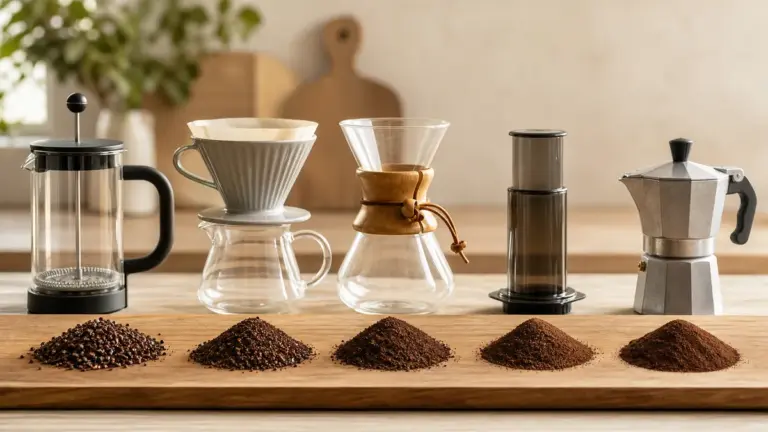
Grind consistency affects coffee’s taste because differently sized particles extract at different rates and change how water moves through the grounds. A controlled particle distribution makes brewing more predictable, but “fines taste bitter, boulders taste sour” is only a rough troubleshooting shortcut, not a rule.
In short
- Grind size describes how fine or coarse the grounds are; consistency describes the spread of particle sizes.
- Small particles can extract quickly, but their effect on water flow can matter as much as their extraction rate.
- Large particles can contribute to insufficient extraction, but sourness alone cannot diagnose an inconsistent grind.
- Espresso and pour-over depend on flow through a coffee bed; immersion brewing does not behave in exactly the same way.
- Sifting is useful for investigating a problem, not a guaranteed route to better-tasting coffee.
What grind consistency actually means
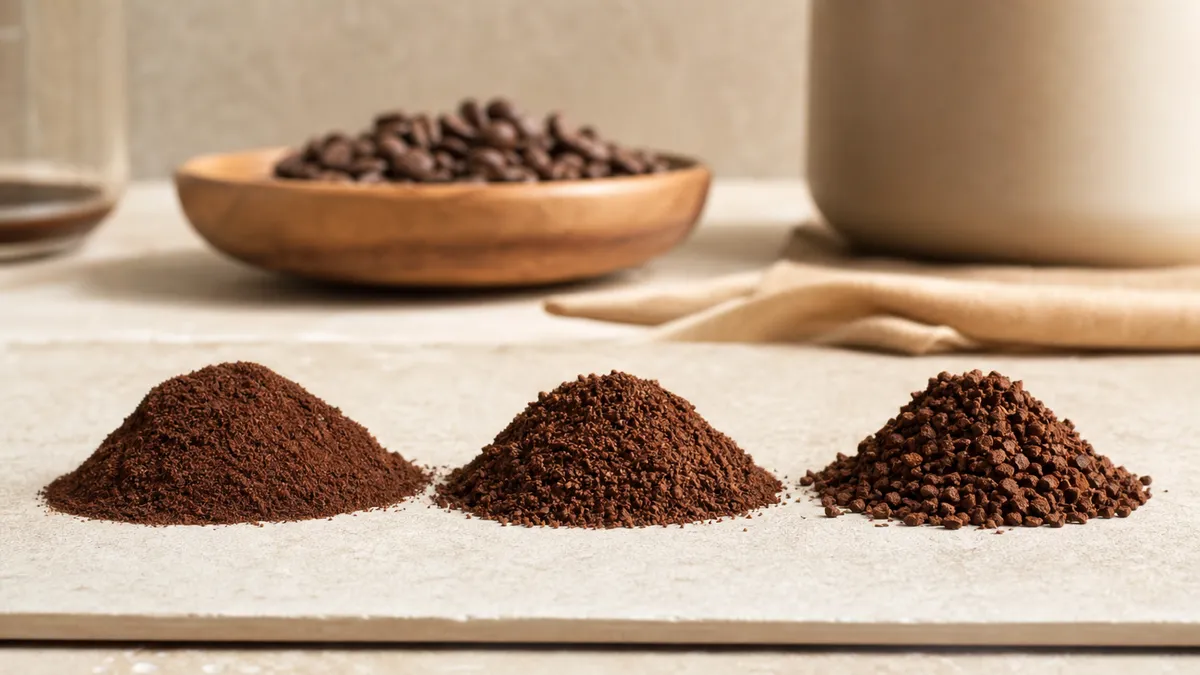
A grinder does not turn beans into identical fragments. It produces a particle size distribution, meaning a mixture of sizes and the relative amount of each.
Within that mixture, fines are the smallest fragments, while boulders is an informal name for unusually large pieces. Neither term has a universal boundary across every brewer and measurement method. One espresso study defined fines as particles smaller than 100 micrometres, but that research definition is not a universal brewing standard.
Two samples can have the same average size yet behave differently. One might contain mostly medium particles; another might combine abundant dust with conspicuous chunks. Calling both “medium grind” hides a useful distinction.
There is also a difference between consistency within a dose and repeatability between doses. A grinder that produces the same distribution each morning is repeatable, even if that distribution contains a substantial fine fraction.
For the wider relationship between grinder settings and brewing, start with grind size and extraction. Here, the question is what the mixture of particles does to the cup.
Why different particles extract differently
Extraction is the movement of soluble material from roasted coffee into water. Particle size influences both the accessible surface and the distance dissolved substances must travel from inside a fragment.
Smaller particles generally offer more surface relative to their volume and shorter internal travel distances. Larger particles have longer routes from their interior to the surrounding water. Under otherwise comparable conditions, these differences can produce unequal extraction.
That does not mean every fine particle becomes unpleasant while every large fragment remains sour. Extraction depends on water access, contact time, temperature and the surrounding brew, not size alone.
In a flowing coffee bed, the problem becomes more complicated. Small fragments can occupy spaces between larger ones, changing the bed’s permeability, or how easily water passes through it. Altering the distribution therefore changes both the particles being extracted and the conditions under which extraction happens.
This is why “grind finer” can improve one brew but make another less predictable.
Fines and bitterness: a useful warning, not a diagnosis
The simple explanation runs like this: fines extract quickly, so they over-extract and make coffee bitter. The first part has a sound physical basis; the second jumps too quickly from extraction behaviour to flavour.
Controlled sensory research on drip coffee shows that bitterness, sourness, sweetness and other attributes respond to brew strength, extraction yield and roast. There is no reliable one-to-one translation from particle size to a single taste.
A fines-rich grind may contribute to a harsh cup through several routes. It may alter extraction, restrict flow or make an existing brewing problem harder to control. Yet fines are not an ingredient that can be assigned a fixed bitter flavour independently of the recipe.
They are also a normal part of espresso grounds. Removing them changes the coffee bed rather than simply removing something undesirable.
The practical rule is to investigate fines when bitterness arrives alongside a marked change in flow or repeatability. Do not condemn them merely because the cup tastes bitter. The distinction between flavour symptoms and extraction is explored further in over-extraction versus under-extraction.
Boulders and sourness: the other oversimplification
Large fragments can extract more slowly, leaving a brew insufficiently developed under a recipe that gives them too little opportunity to release soluble material. A cup that tastes sharp and thin may therefore justify investigating an excessively coarse grind or an unusually broad distribution.
But sourness is not proof of boulders. Controlled sensory work shows that perceived sourness also depends on strength, extraction and roast. A taste description cannot reveal the particle distribution by itself.
Uneven extraction can further confuse diagnosis. Different parts of a coffee bed may receive different amounts of flowing water, while differently sized particles respond at different rates. A cup can consequently be difficult to balance without fitting neatly into “too coarse” or “too fine”.
Before changing several settings, check whether the result repeats. A single disappointing cup is a weak basis for judging a grinder.
Why the brewer changes the effect
Particle distribution matters across brewing methods, but the mechanism and the useful response differ.
| Brewer | What the distribution changes | What to investigate first |
|---|---|---|
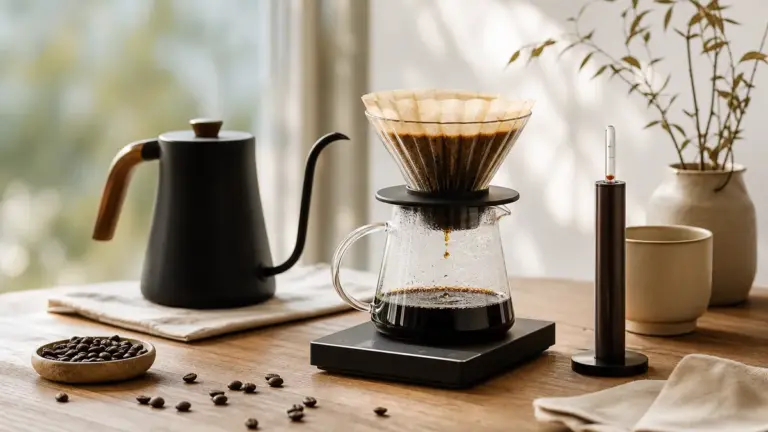
| Paper-filter pour-over | Extraction and resistance through the bed and filter | Whether slow drainage repeats with the same pouring routine |
| Espresso | Puck permeability, flow and extraction | Whether finer grinding improves taste or instead reduces repeatability |
| Cafetière | Extraction during immersion and separation at pouring | Whether the problem is flavour, suspended sediment or both |
| Immersion brewer drained through paper | Steeping behaviour followed by a separate drainage stage | Whether the difficulty occurs during extraction or only when draining |
Pour-over and fines migration
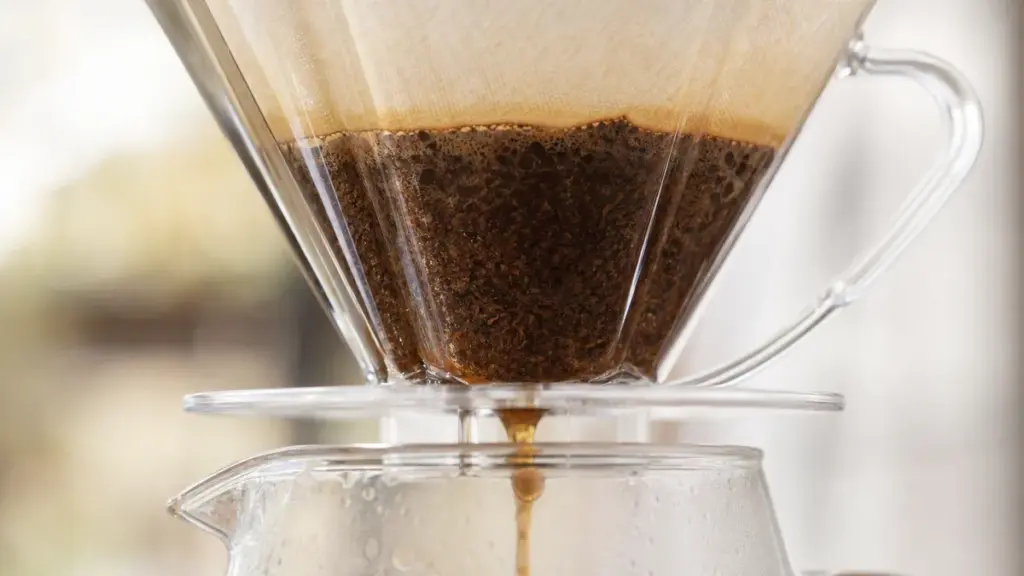
Fines migration means small fragments moving within the coffee bed. Accumulation near a filtering boundary is a plausible contributor to restricted drainage, often called clogging or stalling.
The evidence needs careful wording. Espresso modelling supports a mechanism in which moving fines become trapped and increase resistance. That does not establish that every slow pour-over has the same cause, or that a muddy-looking surface proves migration has occurred.
A useful diagnostic trial is to keep the grind unchanged and use gentler, more repeatable agitation. Treat any improvement as a clue about your brewing system, not as proof that you have measured fines movement.
Espresso and channelling
In espresso, grinding finer does not always increase extraction. A study combining mathematical modelling with experiments found lower extraction at very fine settings than the simple uniform-flow model predicted.
The researchers interpreted this as evidence of uneven flow. Channelling, where water favours some routes through the puck, can leave other regions less effectively contacted.
Do not keep grinding finer solely because a shot tastes insufficiently extracted. Look at distribution and preparation as well as the grinder. Our guide to extraction time and grind size explains why the clock cannot diagnose the whole shot.
Immersion brewing
In immersion, the grounds steep in a shared body of water rather than relying throughout on fresh water flowing through a packed bed. Size still affects extraction, but an espresso-style flow explanation cannot simply be transferred unchanged.
Research on immersion cold brewing found faster extraction with smaller grounds under the tested conditions. The authors also discussed contrasting results from brewing in filter bags, where confinement can restrict movement and mass transfer. Equipment and particle distribution interact.
What burr quality can and cannot tell you
Burrs are the cutting and crushing surfaces inside a burr grinder. Their design and installation help determine the distribution produced, but a “burr grinder” label does not promise identical particles.
Manufacturer guidance supports checking cleanliness and correct seating. Mazzer specifies clean burr support surfaces when fitting replacements; Baratza’s operating instructions likewise describe correct positioning and routine cleaning.
For an unexpectedly inconsistent grind:
- Unplug the grinder before opening or cleaning it.
- Follow its manual to remove accessible retained grounds.
- Check that removable burr components are seated correctly.
- Ask the manufacturer about suspected damage or wear rather than improvising an alignment procedure.
Burr quality is best judged by controlled brewing results and relevant measurements, not by appearance alone. Flat or conical geometry, burr material and size are incomplete descriptions of a whole grinder. Without comparable evidence, none should be treated as a universal guarantee of better flavour.
Sifting: a useful experiment with trade-offs
Sifting separates grounds according to which sieve openings they pass through. A stacked system can retain large fragments above one screen, collect an intermediate fraction and allow smaller material into a lower chamber.
That makes it useful for seeing what “inconsistent” means in a particular sample. However, removing particles changes the distribution and may change drainage as well as extraction. A sifted brew is not simply the original brew with its defects removed.
Try this comparison:
- Keep a control. Reserve unsifted grounds from the same coffee and grinder setting.
- Record the separation. Note the sieve openings and use the same shaking routine whenever repeating the test.
- Weigh the retained brewing dose. Do not accidentally compare a full unsifted dose with a smaller sifted one.
- Hold the recipe steady. Keep coffee and water masses, water source, temperature and brewing routine unchanged.
- Compare flow and flavour separately. Record drainage behaviour, then taste both coffees at similar drinking temperatures.
Repeat before deciding. If sifting helps, the useful finding is that changing this distribution improved this recipe. It does not establish that every fine particle should be removed.
Sifting also adds handling and leaves separated coffee to deal with. It is therefore better treated as an investigative tool than a compulsory daily step.
What the evidence supports
The strongest evidence concerns physical behaviour: particle distributions influence extraction kinetics and resistance to water flow. Mathematical models explain possible mechanisms, while brewing experiments test whether those mechanisms fit measured results.
Evidence for a universally tastier distribution is weaker. In the 2024 espresso fines study, adding fines chiefly changed permeability within the tested conditions; their extra surface area had only a marginal additional effect on extraction efficiency. Its sensory assessment was explicitly not a systematic double-blind test.
That finding does not contradict the principle that smaller particles can extract faster. It shows that, in that flowing system, the indirect effect through brewing time and permeability dominated.
The sensible aim is therefore a repeatable distribution that suits the brewer and produces the flavour you prefer, not perfect uniformity at any cost. Judge grind consistency and taste together, while holding the rest of the recipe steady.
FAQ
Can I judge grind consistency by looking at the grounds?
You can spot obvious dust and large fragments, but visual inspection cannot fully characterise a particle distribution. Small particles are difficult to assess by eye, and an average-looking sample may contain a substantial fine fraction. Use appearance to identify a question, then investigate it through repeatable brewing or controlled sieving rather than treating a photograph as a measurement.
Should I remove all fines before making espresso?
No, removing all fines is not an evidence-based general rule for espresso. Fines influence puck resistance, so removing them changes how the shot flows and may require a different recipe. Research supports considering the fine fraction alongside the larger particles, not assuming that the lowest possible fine content must produce the best cup.
Does a coffee refractometer measure grind consistency?
No, a refractometer measures the concentration of dissolved material in the beverage, not the sizes of the grounds. Combined with appropriate mass measurements, it helps estimate overall extraction yield. That average cannot show whether different particles or regions of a coffee bed extracted equally, so it cannot independently diagnose grind consistency or channelling.
Where to go next
Read Impact on Brewing to connect particle distribution with the behaviour of different brewers, then Extraction Time and Grind Size to interpret timing changes. Over-Extraction vs Under-Extraction helps separate flavour clues from firm diagnoses, while Brewing Ratios and Temperature covers the other variables to hold steady when comparing grind consistency and taste.
Sources
-
Zurich University of Applied Sciences, Smrke, Eiermann and Yeretzian. The role of fines in espresso extraction dynamics. Scientific Reports, 2024. Controlled espresso experiments and explicitly limited sensory assessment.
https://www.nature.com/articles/s41598-024-55831-x.pdf -
Moroney and colleagues, PLOS ONE. Analysing extraction uniformity from porous coffee beds using mathematical modelling and computational fluid dynamics approaches. 2019. Particle distributions, extraction kinetics and flow uniformity.
https://journals.plos.org/plosone/article?id=10.1371/journal.pone.0219906 -
Cameron and colleagues, Matter. Systematically Improving Espresso: Insights from Mathematical Modeling and Experiment. 2020. Author manuscript retrieved through the US Department of Energy’s OSTI repository.
https://www.osti.gov/servlets/purl/1973594 -
Ellero and Navarini, Journal of Food Engineering. Mesoscopic modelling and simulation of espresso coffee extraction. 2019. Publisher abstract retrieved for the fines-migration mechanism and its modelling basis.
https://www.sciencedirect.com/science/article/pii/S0260877419302468 -
University of California, Davis, Frost, Ristenpart and Guinard. Effects of brew strength, brew yield, and roast on the sensory quality of drip brewed coffee. Journal of Food Science, 2020. Controlled descriptive sensory research.
https://ift.onlinelibrary.wiley.com/doi/10.1111/1750-3841.15326 -
Wang and Lim, Applied Food Research. Effects of grind size, temperature, and brewing ratio on immersion cold brewed and French press hot brewed coffees. 2023. Controlled immersion extraction research.
https://doi.org/10.1016/j.afres.2023.100334 -
Mazzer. Burrs tutorial. Undated manufacturer guidance, retrieved November 2026. Used for installation and cleaning instructions, not independent performance rankings.
https://www.mazzer.com/en/burrs-tutorial/ -
Baratza. Encore Operations Manual. December 2022, version 4.3. Manufacturer safety, cleaning and burr-seating instructions.
https://assets.breville.com/ZCG485/manual-encore-en-v4-3-120122.pdf -
KRUVE. Next Level. Undated manufacturer explanation, retrieved November 2026. Used only to establish the stacked-sieve procedure, not its promotional flavour claims.
https://www.kruveinc.com/pages/nextlevel
This article was researched using primary extraction and sensory studies, with manufacturer documents used for equipment procedures; the comparison exercise is an editorial diagnostic method, not a reported first-hand test.
Last checked: November 2026