Extraction time and grind size are linked because smaller coffee particles generally release soluble material faster and create more resistance when water flows through a coffee bed. In espresso and pour-over, grinding finer therefore usually lengthens brewing as well as changing extraction; in immersion brewing, such as a cafetière, you choose the steeping time separately.
In short
- Distinguish extraction speed from water speed. Finer particles can extract faster while making water pass through the coffee more slowly.
- Use recipe times as reference points. The SCAA’s two-cup pour-over guidance gives 2 minutes 30 seconds to 3 minutes, but that belongs to its particular recipe.
- For espresso, compare the same dose and drink weight. Otherwise, a longer shot may simply contain more water rather than reveal a useful grind adjustment.
- For immersion, change grind or steeping time first, not both. Smaller particles accelerate early extraction, but the difference can narrow during longer steeping.
- Finer is not always better. Experimental espresso research found that very fine settings could reduce extraction and repeatability.
How extraction time and grind size interact
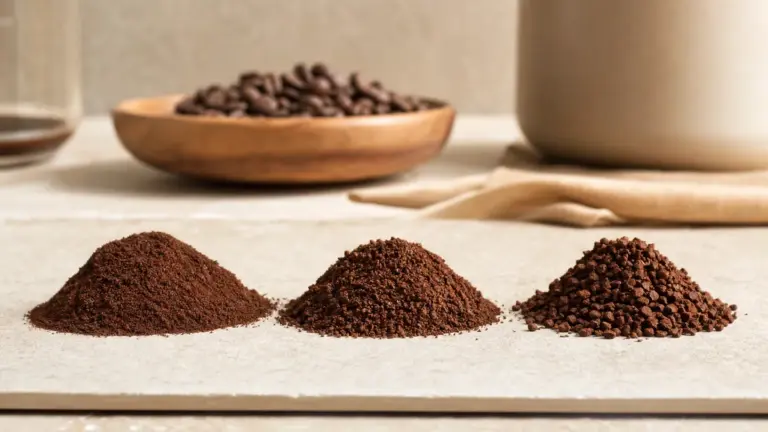
Extraction means dissolving soluble material from ground coffee into water. Grinding changes how easily water can reach that material: smaller particles expose more surface relative to their volume and shorten the distance dissolved substances must travel out of the particle.
Research modelling, checked against extraction experiments, distinguishes relatively rapid release from exposed surfaces from slower movement through the pores inside particles. This explains why a coarse grind can need more contact time without implying that every flavour follows a simple, fixed timetable.
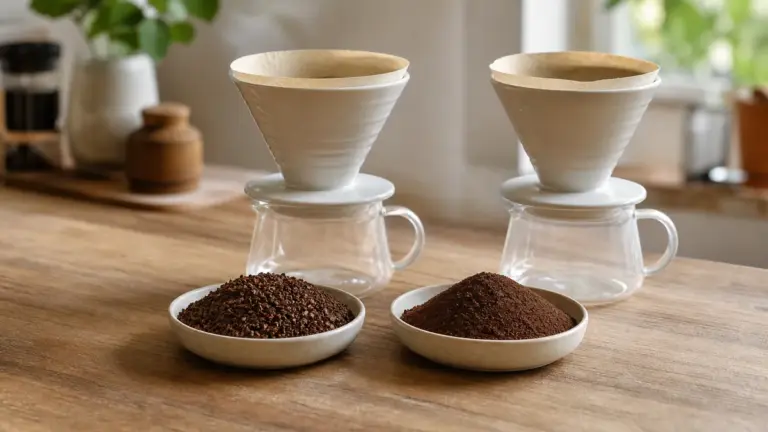
There is another process happening alongside dissolution: water moving through the spaces between grounds. A finer coffee bed generally offers greater resistance to flow. In a pour-over, gravity drives that flow; in espresso, the machine supplies pressure.
These effects are easy to confuse. “Finer extracts faster” describes material leaving the particles. “Finer brews more slowly” describes water travelling through the bed. Both can be true in the same brew.
The parent guide to grind size and extraction sets out the wider subject. Here, the useful question is narrower: when you move the grinder, what should you expect the timer to tell you?
The relationship changes with the brewing method
The following comparison separates the main methods by what controls their timing. The quoted times are published recipe examples, not interchangeable targets.
| Method | What usually happens when you grind finer | Published timing reference | What to compare |
|---|---|---|---|
| Espresso | Resistance generally rises, extending the time needed to reach a fixed drink weight | One manufacturer’s double-shot preset is 30 seconds, including pre-infusion | Same dose, drink weight and timing convention |
| Pour-over | Extraction from particles accelerates, while drainage can slow | SCAA two-cup recipe: 2 minutes 30 seconds to 3 minutes | Same dose, water, filter and pouring sequence |
| Cafetière | Extraction accelerates without setting a drainage time | Fellow’s guide plunges at 4 minutes | Same steeping time, temperature and stirring |
| AeroPress | Grind affects extraction during steeping and resistance during pressing | Manufacturer instructions include a 30-second wait for freshly ground coffee | Steeping and pressing recorded separately |
Sources: espresso manufacturer instructions; SCAA brewing guidance; Fellow and AeroPress brewing guides; extraction research.
Espresso: grind strongly influences flow
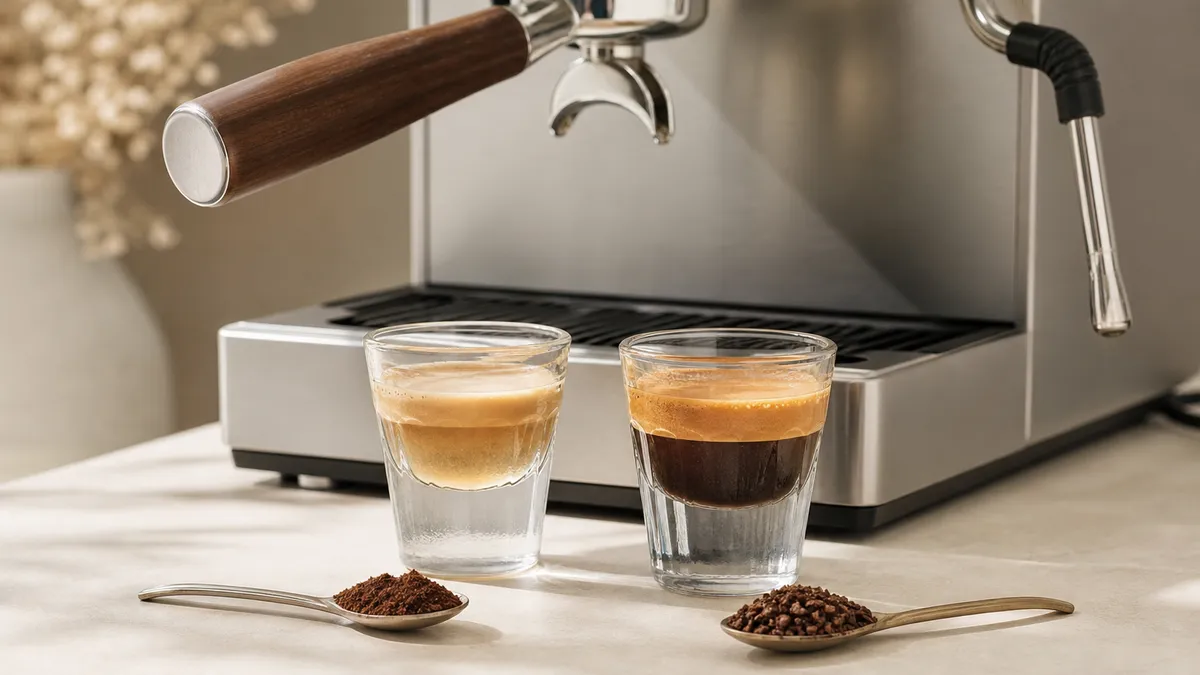
With a conventional espresso recipe, keep the dry dose and final drink weight fixed while adjusting grind. A coarser setting generally lets water through faster; a finer setting generally slows it. This makes shot time a useful observation, provided you are comparing like with like.
For example, 18 g in and 36 g out is a 1:2 dose-to-yield ratio by weight. Stop at the chosen yield and record how long it took, rather than running every shot for the same duration and accepting whatever drink weight appears. The distinction matters because beverage mass itself substantially affects the amount extracted.
This advice concerns conventional flow-through espresso. Do not assume that the same stopwatch rule transfers unchanged to every machine programme or brewing system.
Pour-over: pouring is part of the clock
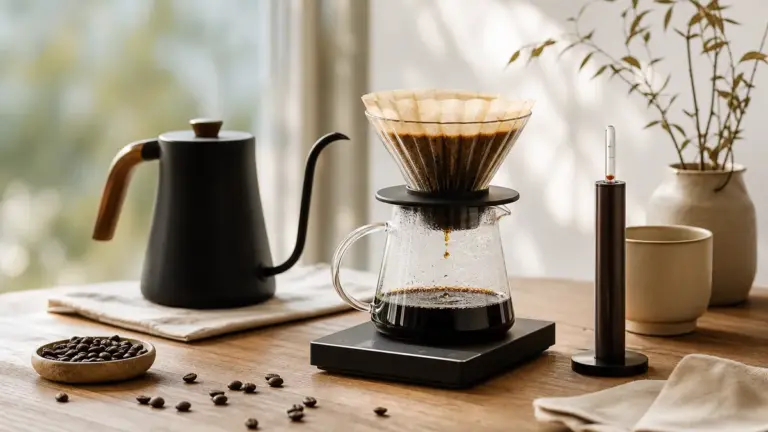
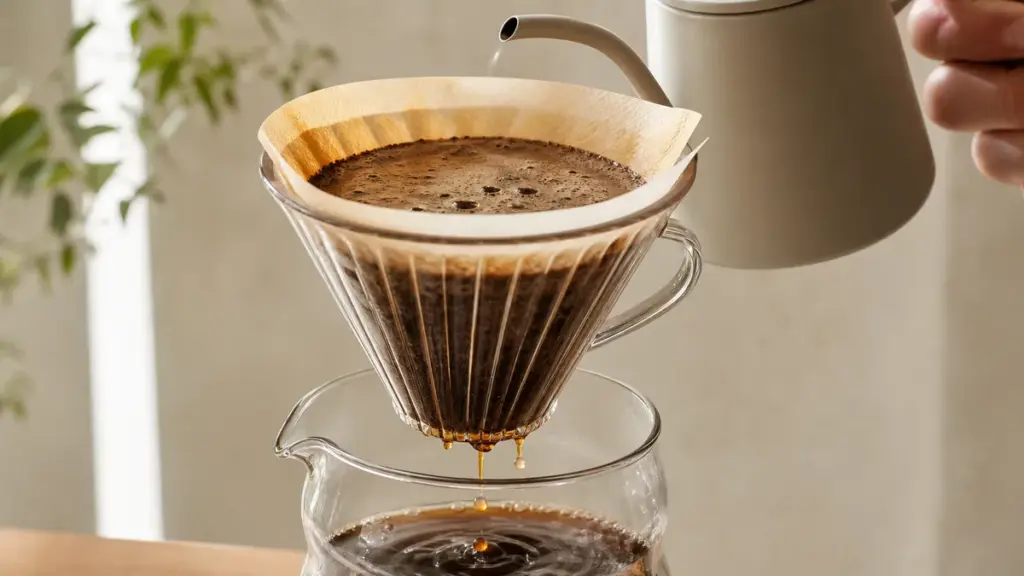
A pour-over’s total time combines your water-delivery schedule with the coffee bed’s drainage. A grind adjustment changes the bed, but a different pouring sequence also changes the experiment.
For a clear comparison, keep the same filter and repeat the same pours. Record both when the final pour ends and when you remove the dripper. This separates a deliberately longer pouring schedule from slower drainage.
The grind size chart provides a starting description, but your existing recipe is the better reference for deciding which direction to move next.
Immersion: time is a more independent control
In a cafetière, the grounds steep together in water rather than having the whole brew drain through a filter bed. Grinding finer changes extraction speed, but it does not automatically extend your chosen steep.
Controlled immersion experiments found faster early extraction with finer grounds, while differences between grind sizes narrowed with longer contact. That supports a useful distinction: grind has a strong influence on how quickly extraction develops, not an unlimited influence on how much will eventually dissolve under fixed conditions.
The AeroPress adds a pressing stage after its steep. Its manufacturer advises gentle, constant pressure rather than pushing hard, so do not treat a difficult press as an instruction to force the plunger.
Why target times are guides, not goals
Published recipes demonstrate why a universal target is misleading. HARIO publishes a recipe from Pete Licata with a time of 2 minutes 30 seconds, while its Scott Rao recipe gives 4 minutes to 4 minutes 30 seconds. These are different recipes, not conflicting verdicts on the only acceptable pour-over time.
A target is most useful as a warning that something has changed. If your familiar brew suddenly finishes much earlier, investigate the preparation before deciding that the coffee needs a new recipe.
Also define what your timer measures:
- For espresso, specify whether timing starts at pump activation or first liquid. A manufacturer’s preset can include pre-infusion, the initial wetting stage.
- For pour-over, start at first water contact and use a repeatable finishing point. The SCAA recipe starts its timer as pouring begins.
- For immersion, distinguish steeping time from any later pressing or filtering stage.
Time is therefore often a result of the recipe, especially in espresso and pour-over, rather than a quality score. In immersion, it is more directly an input you choose.
A controlled way to adjust grind and time
Use this short comparison exercise rather than changing several settings until the stopwatch looks right.
- Write down the baseline. Record coffee dose, water input or espresso yield, temperature, grind setting, method and timing convention.
- Keep the recipe fixed. For a filter example, the SCAA guidance uses 22 g of coffee, 400 g of water and 93.5°C, with a stated brewing time of 2 minutes 30 seconds to 3 minutes. Those quantities define that example, not a universal requirement.
- Taste before adjusting. Write a concrete description: thin and sharp, pleasantly sweet, drying, or simply too concentrated. Manufacturer guidance recommends changing factors individually to find your preferred balance.
- Move grind slightly in one direction. For a fast, underdeveloped espresso, try finer; for a severely restricted shot, try coarser. Keep dose and yield unchanged so the comparison remains useful.
- For immersion, test a longer steep separately. Keep grind fixed for that comparison. Changing both prevents you from knowing which adjustment helped.
- Record taste alongside time. Keep the adjustment because you prefer the cup, not merely because it matches a printed number.
Water should remain consistent too. The SCA explains that alkalinity changes how coffee acidity is expressed, so a flavour change need not originate at the grinder.
Troubleshooting the comparison
These are working hypotheses, not diagnoses based on time alone.
| Symptom | Likely cause to investigate | First useful fix |
|---|---|---|
| Espresso runs quickly and tastes thin or underdeveloped | Grind may be too coarse | Try slightly finer with the same dose and yield |
| Espresso barely flows | Excessive resistance at a fine setting | Try slightly coarser rather than extending the shot indefinitely |
| Pour-over takes longer after changing the pouring sequence | Water delivery changed as well as possible drainage | Repeat the original pours before changing grind |
| Cafetière tastes underdeveloped at the chosen steep | Extraction may need more time or smaller particles | Test a longer steep first, then test grind separately |
| AeroPress becomes difficult to press | Greater resistance during filtration | Keep pressure gentle and reassess the grind |
The espresso and AeroPress suggestions follow manufacturer guidance; the pour-over and immersion suggestions are practical comparisons based on brewing mechanics and extraction experiments.
When grinding finer stops helping
The simple rule has a limit. Cameron and colleagues combined mathematical modelling with espresso experiments and found that extraction yield peaked, then fell at very fine settings. Their results strongly suggested uneven flow through the coffee bed.
The distinction matters: extraction yield is the proportion of dry coffee mass dissolved into the drink, not the number of seconds on the timer. A slower shot can therefore extract less overall if water reaches the grounds unevenly.
Separate controlled espresso research also found interacting effects of flow, grind and temperature. Its results caution against treating duration as an isolated explanation for what ends up in the cup.
For practical brewing, stop assuming that every disappointing shot needs a finer setting. If extraction becomes less repeatable as you grind finer, step back and examine preparation as well as grind. See grind consistency and taste for the related question of particle variation.
The useful relationship between extraction time and grind size is not “longer equals better”. It is a controlled comparison: the same recipe, a deliberate adjustment, a recorded time and a cup you actually prefer.
FAQ
Can I compensate for coarse coffee by brewing longer?
Often partly, especially in immersion brewing. Smaller particles release soluble material faster initially, while longer steeping can narrow the difference between grind sizes. However, research under particular immersion conditions does not establish that any coarse grind can reproduce any fine-ground recipe. Keep the other variables fixed and compare the resulting cups.
Should I stop espresso at a set time or a set weight?
For a grind comparison, stop at the chosen drink weight and record the time. Keeping dose and yield fixed helps separate a grind change from a change in beverage quantity. If you instead stop every shot at the same second, different grind settings may produce different drink weights, making the comparison harder to interpret.
Does a pale espresso prove that extraction was too fast?
No, appearance alone is not enough to establish extraction quality. Manufacturer guidance associates coarse, fast-flowing shots with weak colour and flavour, but also recognises that beans, roast, freshness and grind affect the result. Treat colour as an observation alongside dose, yield, flow and taste, not as a measurement of extraction.
Where to go next
Read Coffee Grind Size Chart for a starting grind description, then Impact on Brewing for the wider effects of changing it. Use Over-Extraction vs Under-Extraction to investigate flavour problems, and Grind Consistency and Taste when repeated brews behave differently.
Sources
-
Specialty Coffee Association of America, Guidelines for Brewing with a Two Cup Pour-Over Brewer, revision 2 April 2016.
https://scagermany.coffee/wp-content/uploads/2021/02/best-practices-two-cup-pour-over-brewer.pdf -
Moroney and colleagues, Journal of Mathematics in Industry, Coffee extraction kinetics in a well mixed system, published online 2016, volume 7, article 3, 2017.
https://pages.uoregon.edu/chendon/coffee_literature/old_literature/2017%20J.%20Math.%20Ind.%2C%20Extraction%20modelling.pdf -
Cameron and colleagues, Matter, Systematically Improving Espresso: Insights from Mathematical Modeling and Experiment, 2020.
https://pages.uoregon.edu/chendon/publications/2020/74.%20Matter%2C%20Espresso%20extraction.pdf -
Wang and Lim, Applied Food Research, Effects of grind size, temperature, and brewing ratio on immersion cold brewed and French press hot brewed coffees, 2023.
https://doi.org/10.1016/j.afres.2023.100334 -
Schmieder and colleagues, Foods, Influence of Flow Rate, Particle Size, and Temperature on Espresso Extraction Kinetics, 2023.
https://pmc.ncbi.nlm.nih.gov/articles/PMC10418593/ -
Sage Appliances, The Oracle, BES980 Instruction Book, undated retrieved edition.
https://assets.breville.com/Instruction-Booklets/USCM/BES980_Instruction_Manual.pdf -
Fellow, Brewing how to: French Press, undated live guide.
https://fellowproducts.com/pages/how-to-french-press -
AeroPress, Getting Started With the AeroPress Coffee Maker, undated live instructions.
https://aeropress.com/pages/how-to-use -
HARIO Europe, Pete Licata: V60 Ambassador Q&A and V60 Recipe, undated live page.
https://www.hario-europe.com/blogs/hario-community/v60-ambassadors-pete-licata -
HARIO UK, Hario V60 Recipe & Interview with Hario Ambassador Scott Rao, 2022.
https://www.hario.co.uk/blogs/hario-ambassadors/hario-v60-recipe-interview-with-hario-ambassador-scott-rao -
Specialty Coffee Association, Marco Wellinger, Water and Coffee Acidity: How to Adapt Your Water for Different Extraction Methods, 25 Magazine, issue 9, undated retrieved page.
https://sca.coffee/sca-news/25/issue-9/english/water-and-coffee-acidity-how-to-adapt-your-water-for-different-extraction-methods-25-magazine-issue-9-pxjby
This piece was researched using peer-reviewed extraction studies, association guidance and manufacturers’ published recipes; the adjustment exercises are practical applications, not claims of first-hand testing.
Last checked: November 2026