The best coffee machine for a small office is the simplest system that can make the drinks your team wants without queues or neglected cleaning. For teams of roughly up to 20 people, shortlist compact commercial bean-to-cup machines for freshly ground individual drinks, capsules for occasional use and easy drink changes, or filter machines for shared rounds of black coffee.
In short
- Count coffee drinkers actually attending, not everyone on the payroll.
- Check daily drinks and the busiest short burst separately.
- Choose automatic milk drinks only when someone owns the cleaning.
- Measure the working space, including refill access, milk storage and waste handling.
- Ask for written confirmation of workplace warranty cover, servicing and any consumables commitment.
Start with demand, not headcount
“Up to 20 people” describes this guide’s starting audience, not a machine capacity boundary. A small team drinking frequent large coffees can place more demand on a machine than a larger team with low attendance.
Before shortlisting, keep a simple tally over a representative working week. Record attendance, coffee drinkers, drinks made, drink sizes and how many people arrive together.
The following matrix is an illustrative planning exercise, not a survey of office consumption. It assumes every person attending drinks either one or three coffees daily, with no visitors or discarded drinks.
| People attending | At one coffee each daily | At three coffees each daily | What to investigate |
|---|---|---|---|
| 5 | 5 drinks | 15 drinks | Whether individual brewing suits irregular use |
| 10 | 10 drinks | 30 drinks | Refilling, emptying and milk-cleaning ownership |
| 15 | 15 drinks | 45 drinks | Consecutive drink speed and daily rating |
| 20 | 20 drinks | 60 drinks | A higher-capacity machine or shared batch brewing |
Add visitors and meeting demand separately. If your requirements outgrow compact equipment, use medium-sized office guidance rather than stretching a smaller machine beyond its manufacturer’s recommendation.
Test the busiest burst
A daily output recommendation does not tell you how long colleagues will queue. Ask the supplier to demonstrate your actual drink sequence, including milk drinks, hot-water additions and any intervening rinses.
For example, an assumed sequence of eight drinks taking 90 seconds each occupies 12 minutes before users change cups or refill anything. Those are demonstration assumptions, not a claimed machine performance figure.
For broader workplace choices, start with coffee for every workplace.
Compare coffee machines for small offices
Use the same criteria for every option: drink suitability, peak workflow, cleaning responsibility, installation and consumables flexibility. The recommendations below are editorial judgements about those criteria, not results from comparative machine testing.
| System | Best suited to | Main advantage | Main limitation | Check before choosing |
|---|---|---|---|---|
| Compact commercial bean-to-cup | Regular individual coffees, with milk automation if needed | Grinds whole beans for each preparation | Grounds, rinses and milk systems need attention | Daily recommendation, consecutive drinks and cleaning procedure |
| Capsule | Irregular attendance and individual drink selection | Change coffee or decaf between preparations | Compatibility restricts capsule choice | Workplace warranty, availability and business waste route |
| Filter with thermal jug | Teams sharing rounds of black coffee | Several people can pour from one batch | Does not make espresso or textured milk | Useful mug yield, batch size and workplace suitability |
Bean-to-cup: choose the milk system deliberately
Bean-to-cup means the machine grinds whole beans and brews automatically. It is my preferred starting point for a team wanting regular espresso-style drinks, provided the daily maintenance has an owner.
Separate black-coffee requirements from automatic cappuccino requirements. Ask suppliers to quote a black-coffee-only arrangement alongside a milk-equipped alternative, rather than assuming every office needs a milk circuit.
As a specification example, JURA’s published W8 information recommends a maximum daily output of 50 cups and lists a 3-litre water tank, 500 g bean container and grounds container holding up to 25 portions. These are manufacturer claims, checked in November 2026, not independently measured performance.
That makes it worth investigating for an appropriate demand profile, not an automatic winner. Check the exact UK version, your drink sequence and the complete installation footprint.
Capsules: favour flexibility over unnecessary complexity
Capsules deserve consideration when attendance is unpredictable or colleagues want different coffees. Ask which capsule system the machine accepts, whether alternatives are permitted and how supplies are ordered.
Do not confuse straightforward brewing with maintenance-free ownership. Request the cleaning and descaling instructions before choosing, and check any separate milk frother’s requirements too.
Filter: match the jug to your mugs
Filter is my preferred starting point when most people want black coffee at similar times. A thermal jug lets colleagues serve themselves from a prepared batch, rather than each initiating a separate brew.
Check litres rather than advertised “cups”. Moccamaster describes its KBGT’s approximately 1.25-litre batch as ten cups. Dividing that stated volume into assumed 250 ml servings gives five servings, not ten large mugs. Actual usable yield should be checked in a demonstration, along with warranty cover for office use.
Decide between a tank and plumbing
A tank-fed machine avoids a permanent water connection, but someone must refill it. Estimate demand from your actual recipes, allowing for rinsing and cleaning rather than treating the tank’s nominal capacity as entirely available for drinks.
For illustration, 20 drinks containing 150 ml of supplied water require 3 litres before any maintenance water. Milk volume is separate. This calculation explains why a compact machine may need refilling even when its daily drink recommendation appears adequate.
Plumbing may suit frequent use, but obtain an installation survey. Ask about water treatment, isolation, backflow protection, drainage and leak management. A mains water connection does not automatically mean the drip tray drains away.
In England and Wales, the Water Supply (Water Fittings) Regulations 1999 require adequate backflow protection. Have the installer identify the applicable arrangements elsewhere in the UK rather than treating those regulations as UK-wide.
Also ask whether the proposed machine falls within pressure-systems requirements. HSE’s Great Britain guidance includes steam at any pressure as a relevant fluid; the supplier should establish what applies to the actual equipment.
Check water and working space
Use the local water supplier’s published information, then follow the machine manufacturer’s water-testing and treatment instructions. Thames Water, for example, provides a postcode-based water-quality checker. There is no office postcode supplied here, so no local hardness figure can responsibly be assumed.
Measure more than the machine’s closed dimensions. Check access for removing the tank, opening the bean lid, pulling out the drip tray and servicing the machine. Include any milk cooler, cleaning container, cup storage and waste caddy.
Assign cleaning before ordering
Nominate a primary owner and a deputy. Put the daily tasks into the office routine, including arrangements for holidays, early departures and quiet days.
Ask the supplier to demonstrate the complete procedure, not merely show the cleaning button. Establish:
- What users must rinse, empty or dismantle.
- Which cleaning agents and replacement parts are required.
- What happens after milk has been used.
- How filter changes and descaling are scheduled.
- Which tasks remain yours under a service agreement.
Automatic rinsing and milk-system cleaning are not interchangeable. For example, the JURA W8 manual specifies daily milk-system cleaning when milk has been prepared, separately from its milk rinse.
If nobody can reliably complete the procedure, my recommendation is to simplify the equipment. Choose black coffee with separately managed milk, or another arrangement whose maintenance the team will actually perform.
Compare buying routes without overlooking commitments
Start with the least complicated system that meets the measured demand. Compare outright purchase with a supplier-managed arrangement, but do not assume either route includes installation, routine cleaning or comprehensive servicing.
A refurbished commercial machine is another route to investigate. Require written details of its condition, service history, warranty, available parts and responsibility for faults.
Ask every supplier for an itemised written quotation covering the machine, installation, water treatment, milk equipment, consumables, servicing, training and end-of-contract obligations. Identify minimum orders, exclusivity requirements and cancellation terms.
To calculate your workplace’s own cost per served drink:
- Choose a comparison period and expected attendance.
- Calculate served drinks from measured demand.
- Estimate beans from the programmed dose, or capsules from preparations required.
- Add milk, discarded coffee, cleaning materials, filters, energy and staff maintenance time.
- Add equipment, installation and service commitments for the same period.
- Divide the total by drinks actually served, using a consistent VAT basis.
Coffee and ordinary dairy milk bought as food are generally zero-rated. Hot drinks supplied in catering are generally standard-rated, but HMRC separately addresses refreshments provided free to employees. Ask suppliers to identify VAT treatment item by item, and have your accountant confirm the appropriate basis for comparison.
Include coffee waste in the decision
As checked in November 2026, England’s Simpler Recycling requirements have applied to workplaces with 10 or more full-time-equivalent employees since 31 March 2025. Micro-firms with fewer than 10 have until 31 March 2027.
The count covers the whole business, not just the office where the machine stands. A small branch of a larger employer cannot assume the micro-firm extension applies.
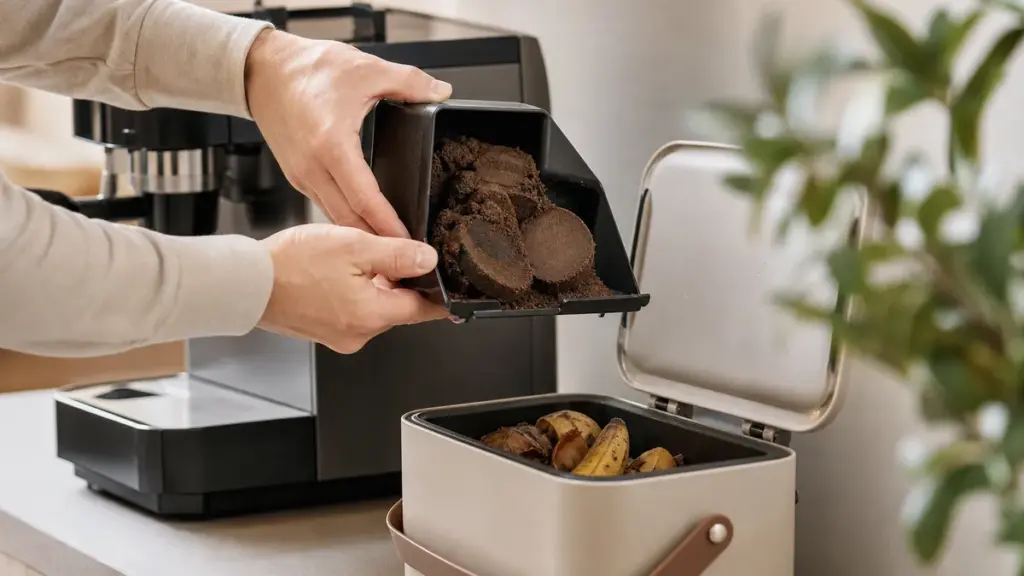
DEFRA explicitly includes coffee grounds as food waste. Its guidance says compostable or biodegradable packaging cannot go into the food-waste collection, so do not put compostable pods there. Arrange an appropriate dedicated route where available.
These dates apply to England. Confirm the relevant arrangements for premises in Scotland, Wales or Northern Ireland, and ask any capsule collection scheme whether it accepts your business waste.
Build a shortlist you can defend
Reject unsuitable machines before comparing extra features. Require written answers on:
- Demand: recommended daily output and a demonstrated peak sequence.
- Drinks: acceptable results in your actual cups, including decaf requirements.
- Installation: usable footprint, water arrangements and access.
- Ownership: daily cleaning, staff training and workplace warranty.
- Support: service coverage, response arrangements and breakdown contingency.
If growth means several tea points or more complex support needs, move to large-office planning. For coffee machines for small offices, a manageable daily routine matters more than a long drinks menu.
FAQ
Can a domestic coffee machine work in a small office?
Possibly, but obtain written confirmation that the intended workplace use is covered. A machine’s size or drink menu does not establish its suitability for shared use. Give the supplier your daily demand and busiest sequence, then check warranty conditions, maintenance access and repair arrangements before buying.
How should a small office handle decaf?
Choose a method that keeps decaf preparation clear and manageable. Capsules allow selection between preparations, while some bean-to-cup machines offer a separate ground-coffee route. Check the exact machine’s instructions and limitations. Do not assume a second bean container means two independently selectable grinders or a dedicated decaf pathway.
What should we do when the machine breaks down?
Agree a temporary coffee arrangement before a breakdown occurs. Ask whether the supplier offers a replacement machine, which faults are covered and what response arrangements apply to your location. Keep the contact details and machine identification accessible to both cleaning owners, rather than relying on the person who placed the order.
Where to go next
Read Coffee for Every Workplace to compare this small-office approach with other settings. Use Coffee Machines for Medium-Sized Offices when demand exceeds compact equipment, and Coffee Machines for Large Offices when planning multiple machines or tea points.
Sources
- JURA, W8 technical overview, January 2024 manufacturer sheet, retrieved through JURA’s document address. Used for claimed capacity and container specifications. URL: https://www.jura.com/-/media/global/pdf/produktblaetter/W8/download_produktblatt_w8_ea.pdf
- JURA, W8 (EA/SA/INTA) Instructions for Use, undated retrieved edition, chapters on maintenance and preparation. URL: https://uk.jura.com/-/media/global/pdf/manuals-global/professional/W8/W8-EA/download_manual_w8.pdf
- Moccamaster, KBGT, undated product page, retrieved November 2026. URL: https://www.moccamaster.eu/coffeemachines/kbgt
- UK legislation, The Water Supply (Water Fittings) Regulations 1999, SI 1999/1148, Schedule 2, paragraph 15. URL: https://www.legislation.gov.uk/uksi/1999/1148/schedules/made/data.xht
- Health and Safety Executive, Pressure Systems Safety Regulations 2000 (PSSR), undated guidance, retrieved November 2026. URL: https://www.hse.gov.uk/pressure-systems/pssr.htm
- Thames Water, Check your water quality, undated postcode lookup, retrieved November 2026. URL: https://www.thameswater.co.uk/help/water-and-waste-help/water-quality/check-your-water-quality
- HM Revenue & Customs, Food products (VAT Notice 701/14), live edition retrieved November 2026, section 3.7. URL: https://www.gov.uk/guidance/food-products-and-vat-notice-70114
- HM Revenue & Customs, Catering, takeaway food (VAT Notice 709/1), updated June 2026, including section 5.8. URL: https://www.gov.uk/guidance/catering-takeaway-food-and-vat-notice-7091
- Department for Environment, Food & Rural Affairs, Simpler recycling: workplace recycling in England, updated October 2025, live edition retrieved November 2026. URL: https://www.gov.uk/guidance/simpler-recycling-workplace-recycling-in-england
This guide was researched using manufacturer documentation, official UK guidance and legislation; calculations are labelled planning examples, and no first-hand machine testing is claimed.
Last checked: November 2026