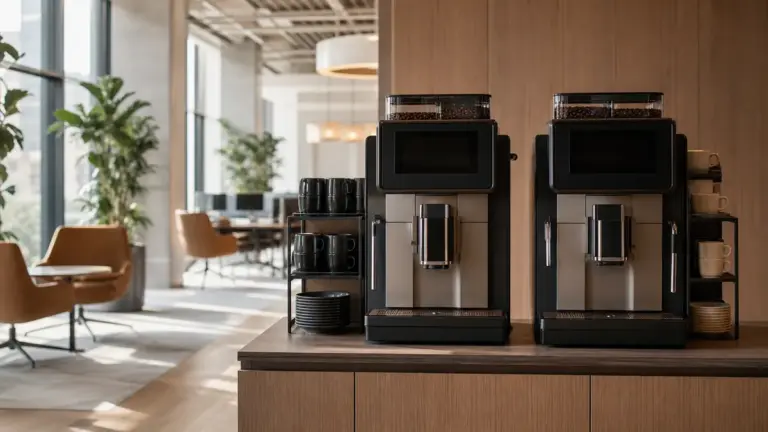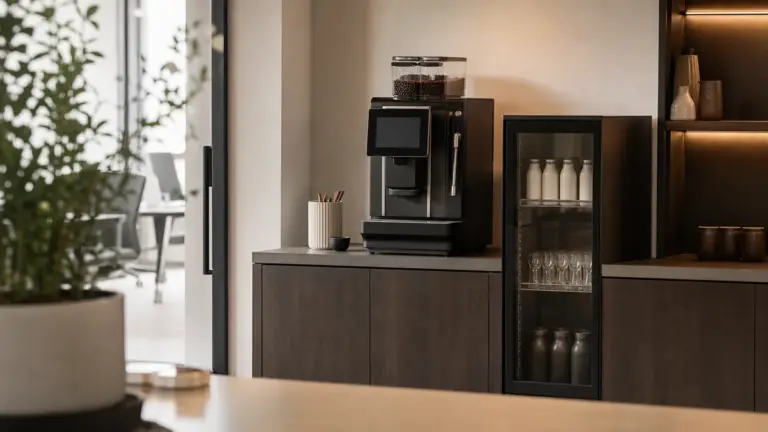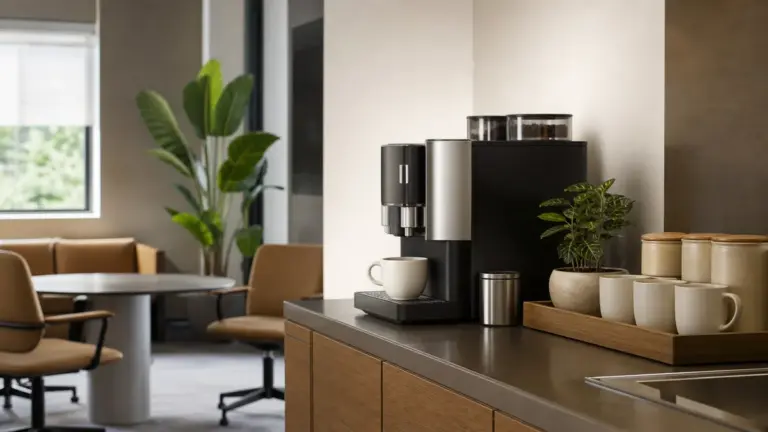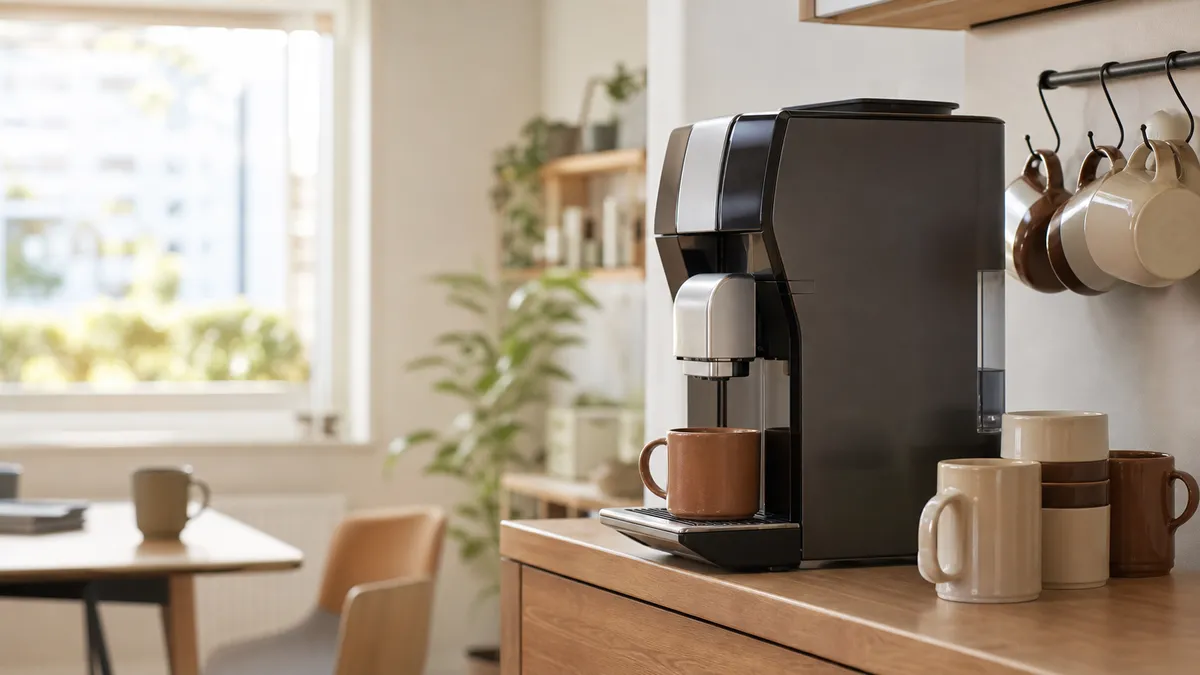
Coffee machines for schools and universities should be chosen around who can use them, how many drinks are needed during the busiest break, and who will clean them. A staff room, an adult student self-service point and a graduation reception need different arrangements, even within the same institution.
In short
- Separate staff provision, school-pupil access and adult university use before choosing equipment.
- Specify drinks per break as well as drinks per day, then test the proposed machine with your actual menu.
- For student-facing machines, include payment, allergen information, accessibility and fault reporting in the specification.
- Assign cleaning and holiday shutdown duties to named people, with cover for absence.
- Compare itemised written quotations over the same operating period, including installation, consumables, servicing and term-time closures.
Choose the set-up before the machine
Assess each location against five criteria: permitted users, peak demand, drink menu, available utilities and daily operator time. These are more useful starting points than the institution’s total headcount.
A bean-to-cup machine grinds whole beans and prepares individual drinks automatically. It is a sensible candidate where users want espresso-based coffee without operating a traditional espresso machine themselves. However, fresh-milk drinks add refrigeration, cleaning and allergen-management responsibilities.
The following are procurement recommendations, not universal capacity ratings.
| Setting | Set-up to consider | Who it suits | Main limitation |
|---|---|---|---|
| Staff room with modest demand | Commercial tank-fed bean-to-cup machine | Staff-only areas without a convenient water connection | Someone must refill water and empty waste |
| Busy central staff room | Plumbed-in commercial bean-to-cup machine | Staff sharing concentrated breaks | Plumbing does not remove cleaning or waste-emptying duties |
| Adult student self-service point | Commercial machine with compatible payment and controlled settings | Libraries, learning centres and student facilities | Requires clear operating ownership and a fault-response plan |
| Meetings and occasional events | Batch brewer with insulated servers, alongside other drinks | Groups needing coffee at roughly the same time | Less individual drink choice |
| Staffed university café | Commercial bean-to-cup or traditional espresso equipment | A catering team with an appropriate service model | Requires a separate hospitality specification |
For staff rooms, prioritise a short menu, straightforward controls and access for cleaning. Ask whether black coffee with separately managed milk would meet demand before specifying an integrated fresh-milk system.
For events, specify refreshment provision separately rather than expecting the everyday staff machine to absorb every open evening. See meeting and reception provision for that use case.
The parent guide to coffee for every workplace provides the wider workplace context.
Separate school pupils, older learners and adults
A staff-only machine should remain staff-only in practice, not merely on a purchasing form. Consider its location, access controls and use during lettings, clubs and public events.
Sixth-form and further-education users may include under-18s. University populations also include younger students and visitors, so “student-facing” should not automatically mean “adults only”.
What England’s School Food Standards actually say
England’s Department for Education practical guide lists tea and coffee among permitted drinks. It is therefore incorrect to describe the current English standards as a blanket ban on caffeinated drinks for pupils, or to claim that school coffee machines are legally restricted to staff rooms and sixth forms.
Permission is not a recommendation to encourage children to drink coffee. Approve pupil access through the institution’s food, wellbeing and safeguarding policies, checking the complete drink recipe rather than assuming every syrup-based machine drink complies.
Nor should a school assume its sixth form sits outside school-food requirements simply because learners are older. Check the provision’s legal setting. Scotland, Wales and Northern Ireland have separate school-food frameworks; England’s guidance is not a UK-wide rule.
Caffeine guidance is not a serving target
EFSA’s 2015 scientific assessment proposed 3 mg of caffeine per kg of body weight per day as a level of no safety concern for children and adolescents. This is a scientific risk-assessment benchmark, not advice for schools to calculate coffee allowances.
For healthy, non-pregnant adults, EFSA found no safety concern with habitual intake up to 400 mg daily, spread through the day. Individual sensitivity varies. The NHS advises no more than 200 mg daily from all sources during pregnancy.
Offer decaffeinated coffee and non-coffee alternatives, and avoid presenting extra shots as a study aid. Ask a GP, pharmacist or midwife about personal medical circumstances.
As checked in November 2026, England’s announced high-caffeine energy-drink restrictions expressly exclude tea and coffee. The government intends commencement on 6 April 2027, subject to Parliamentary scrutiny. That policy is not a coffee-sales ban.
Size coffee machines for schools and universities around breaks
Count likely users at each service point, not everybody enrolled or employed. Then estimate drinks per user and record how many orders arrive together.
This matrix illustrates the method. Its assumptions are planning examples, not measured consumption or machine recommendations.
| Service point | Assumed daily users | Assumed drinks per user | Calculated daily drinks | Separate peak assumption |
|---|---|---|---|---|
| Small staff room | 20 | 2 | 40 | 15 drinks in 15 minutes |
| Central staff room | 60 | 2 | 120 | 40 drinks in 15 minutes |
| Adult student point | 150 | 1 | 150 | 50 drinks in 20 minutes |
| Departmental common room | 40 | 1.5 | 60 | 20 drinks in 15 minutes |
Daily drinks equal users multiplied by drinks per user. Replace both assumptions with observations or transaction records where available.
For example, 40 drinks in 15 minutes requires an average of 2.67 completed drinks per minute during that period. That excludes spare capacity for interruptions.
Ask suppliers to demonstrate your intended sequence of black coffees, milk drinks, hot water and decaffeinated orders. Include payment, cup placement, rinsing and replenishment in the demonstration, rather than timing brewing alone.
Manufacturer ratings need careful interpretation. Franke’s UK page claims an average daily capacity of up to 200 cups for its new A600. That is a manufacturer specification, not independent evidence that it will clear your particular break-time queue.
Specify a maximum acceptable waiting time and ask the supplier to demonstrate it. If the proposed single machine cannot meet the requirement, compare distributed service points or a separate batch-coffee station.
Make student self-service a managed service
For adult student areas, put payment arrangements in the specification from the start. Require written confirmation that the exact machine, payment terminal and campus system work together.
Consider:
- Contactless payment for visitors.
- Campus-card access or accounts where supported.
- Staff entitlements kept separate from public sales.
- Transaction reporting and reconciliation.
- A clear process for failed payments and drinks not dispensed.
- Behaviour during network or payment-terminal outages.
These are requirements to verify, not features to assume.
Test the complete journey with users who have different access needs: approaching the counter, reading the menu, reaching controls, positioning a cup and collecting a hot drink. Check that queues do not obstruct circulation routes.
Display an obvious way to report faults. A machine that accepts payment but cannot dispense needs an agreed response, not a handwritten apology discovered later.
For staffed campus outlets, use the separate guide to hospitality coffee machines.
Give hygiene and allergens named owners
Allocate opening checks, replenishment, cleaning and closing duties to named roles, with absence cover. An automatic cleaning programme still needs somebody to complete the manufacturer’s required manual tasks.
Require the supplier to demonstrate:
- Coffee-system and milk-system cleaning.
- Removal and cleaning of user-serviceable components.
- Milk storage and refrigeration checks.
- Grounds and wastewater disposal.
- Cleaning-product storage and safe handling.
- The process when a cleaning cycle fails.
For student-facing catering, provide accurate, accessible allergen information for each drink as served. Include milk alternatives, powders and additions, not just the coffee.
A plant-based selection is not automatically suitable for someone with a milk allergy. Assess shared tubes, outlets and utensils, and do not promise an allergen-free drink without adequate controls. Update information whenever ingredients change.
Include waste arrangements in the installation plan. In England, Simpler Recycling has required workplaces with at least 10 full-time-equivalent employees to separate food waste since 31 March 2025; smaller organisations have until 31 March 2027. The employee count is organisation-wide, not per staff room.
Coffee grounds count as food waste. Compostable packaging cannot ordinarily join that stream under the guidance. Other UK nations have separate arrangements.
Plan holiday shutdown and reopening
A six-week summer closure needs a written, model-specific procedure. Do not simply leave the machine untouched until the first inset day.
Use this checklist to agree responsibilities with the supplier:
- Complete the prescribed coffee and milk-system cleaning before isolation.
- Remove milk and ingredients as instructed; clean and dry the specified removable parts.
- Empty and clean user-accessible water and wastewater tanks where the manual requires it.
- Isolate electricity and water in the manufacturer’s stated sequence.
- Arrange filter treatment, flushing and recommissioning before reopening.
Do not instruct caretakers to drain internal boilers as a universal precaution. Obtain written confirmation of whether draining is required and who is authorised to do it.
WMF’s published pause guidance distinguishes tank and mains-fed arrangements and specifies filter precautions on restart. This illustrates why one generic shutdown routine is insufficient.
Book recommissioning early enough to identify faults before users return. Record who completes the cleaning, flushing and functional checks.
Check the room, water and servicing arrangements
Measure the complete installation: machine, milk refrigerator, payment equipment, cup storage, ventilation clearance and access for servicing. Confirm electrical supply, drainage and any counter openings with the installer.
Use the local water supplier’s published information and the machine manufacturer’s requirements to specify treatment. Do not adopt one assumed hardness value for the whole UK.
In England and Wales, plumbed-in installations must comply with the Water Supply (Water Fittings) Regulations 1999, including appropriate backflow protection. Have the installer confirm the requirements for the particular installation.
For steam-boiler equipment in Great Britain, check applicability of the Pressure Systems Safety Regulations with the supplier and HSE guidance. Routine servicing is not a substitute for any required written scheme of examination.
Build the budget around the whole service
Request itemised written quotations using the same drink assumptions and comparison period. Include:
- Equipment and installation.
- Water treatment and replacement filters.
- Beans, milk, alternatives and cleaning products.
- Cups, washing and waste handling.
- Staff cleaning and replenishment time.
- Energy use and standby arrangements.
- Preventive servicing, repairs and replacement provision.
- Payment processing and connectivity.
- Holiday shutdown and recommissioning.
- Minimum supply commitments and end-of-agreement obligations.
To calculate your own cost per cup, add the relevant fixed and operating costs for the chosen period, then divide by the number of drinks actually dispensed. Use expected operating days rather than assuming year-round term-time demand. Record bean dose and milk use per recipe, including cleaning losses.
Have finance confirm the VAT basis. Coffee and milk bought as food are generally zero-rated, while ordinary hot-drink sales are normally standard-rated. Education-related catering can receive different treatment depending on the supplier and arrangement; campus location alone does not establish exemption.
Choose coffee machines for schools and universities against the demonstrated service requirement, not the longest drinks menu.
FAQ
Can a domestic coffee machine be used in a staff room?
Do not assume a domestic machine is suitable for workplace use. Ask the manufacturer to confirm permitted use, warranty terms and suitability for your expected demand. Assess replenishment, cleaning and service support alongside drink quality. A quiet departmental room and a central staff room should not automatically receive the same equipment.
Should students be allowed to use reusable cups?
Reusable cups can be included if the operating procedure supports them. Check cup clearance, stability and the selected drink volume, and prevent cups touching dispensing outlets. Ask the supplier to demonstrate the intended arrangement. Keep an alternative available for users whose cups do not fit or cannot be used safely.
Should the machine stay available during university holidays?
Base availability on actual occupancy and operating cover. Some buildings may still need drinks for researchers, summer schools or events, while others can close their service point. Do not leave an accessible machine without cleaning and replenishment cover. Where use stops, follow its shutdown and restart instructions.
Where to go next
Coffee for Every Workplace helps place education provision within a wider workplace plan. Read Coffee Machines for Meeting Rooms and Reception Areas for visitor refreshments, or Coffee Machines for Hotels, Restaurants and Cafés when a staffed campus café needs its own specification.
Sources
-
Department for Education, School food standards: practical guide, current guidance retrieved November 2026.
https://www.gov.uk/government/publications/school-food-standards-practical-guide-and-resources-for-schools/school-food-standards-practical-guide
Supports the permitted-drinks list and application to vending provision. -
UK legislation, The Requirements for School Food Regulations 2014, SI 2014/1603, Schedule 1.
https://www.legislation.gov.uk/uksi/2014/1603/pdfs/uksi_20141603_en.pdf
The statutory food groups include tea and coffee. -
European Food Safety Authority, Caffeine, explanation of the 2015 scientific assessment, current page retrieved November 2026.
https://www.efsa.europa.eu/en/topics/topic/caffeine
Supports the population-specific caffeine benchmarks. -
NHS, Foods to avoid in pregnancy, current guidance retrieved November 2026.
https://www.nhs.uk/pregnancy/keeping-well/foods-to-avoid/
Supports the pregnancy caffeine limit. -
Department of Health and Social Care, Banning the sale of high-caffeine energy drinks to children: consultation outcome, 2026.
https://www.gov.uk/government/consultations/banning-the-sale-of-high-caffeine-energy-drinks-to-children/outcome/banning-the-sale-of-high-caffeine-energy-drinks-to-children-consultation-outcome
Supports the tea and coffee exclusion and intended commencement. -
Franke Coffee Systems, The Franke A600 coffee machine, UK manufacturer page, current specifications retrieved November 2026.
https://www.franke.com/gb/en/coffee-systems/products/fully-automatic-coffee-machines/a600-coffee-machine.html
Supports the manufacturer’s daily-capacity claim only. -
Food Standards Agency, Food allergen labelling and information requirements technical guidance, updated 29 October 2026.
https://www.gov.uk/government/publications/food-allergen-labelling-and-information-requirements-technical-guidance/food-allergen-labelling-and-information-requirements-technical-guidance
Supports allergen-information duties and cross-contact controls. -
Defra, Simpler recycling: workplace recycling in England, current guidance retrieved November 2026.
https://www.gov.uk/guidance/simpler-recycling-workplace-recycling-in-england
Supports commencement dates, employee counting and food-waste requirements. -
WMF, Steps to shut down your WMF coffee equipment for a period time and Operating Pause for WMF Professional Coffee Machines, undated manufacturer documents retrieved November 2026.
Supports model-dependent cleaning, isolation, tank and filter precautions. -
UK legislation, The Water Supply (Water Fittings) Regulations 1999, SI 1999/1148, Schedule 2.
https://www.legislation.gov.uk/uksi/1999/1148/pdfs/uksi_19991148_en.pdf
Supports backflow-protection requirements in England and Wales. -
Health and Safety Executive, Pressure Systems Safety Regulations 2000 and Introduction to pressure equipment, current guidance retrieved November 2026.
https://www.hse.gov.uk/pressure-systems/pssr.htm
https://www.hse.gov.uk/pressure-systems/about.htm
Supports pressure-system assessment and examination requirements. -
Thames Water, Water quality, current supplier guidance retrieved November 2026.
https://www.thameswater.co.uk/help/water-and-waste-help/water-quality
Provides access to postcode-specific water information, not a UK-wide hardness assumption. -
HMRC, Food products, VAT Notice 701/14; Catering, takeaway food, VAT Notice 709/1; and Education and vocational training, VAT Notice 701/30, current notices retrieved November 2026.
https://www.gov.uk/guidance/food-products-and-vat-notice-70114
https://www.gov.uk/guidance/catering-takeaway-food-and-vat-notice-7091
https://www.gov.uk/guidance/vat-on-education-and-vocational-training-notice-70130
Supports the distinction between ingredients, ordinary hot-drink sales and qualifying education-related catering.
This article was researched from retrieved official guidance, legislation and manufacturer documents; procurement recommendations and illustrative calculations are identified separately from verified specifications.
Last checked: November 2026