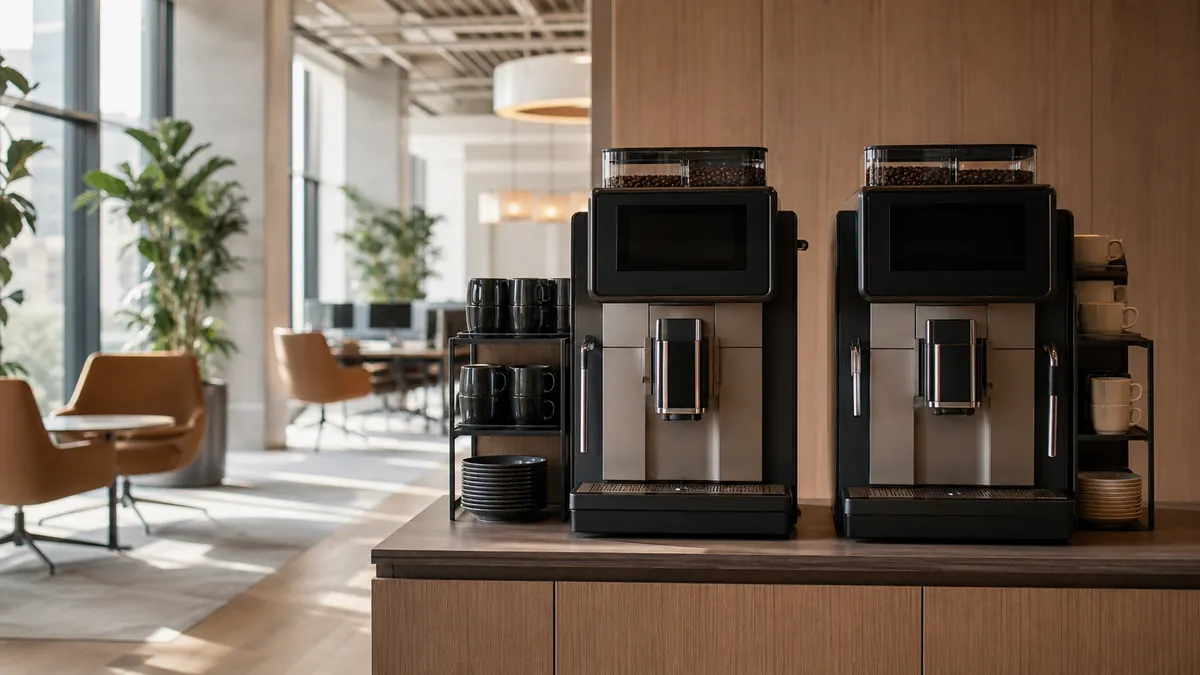
Coffee machines for large offices should be planned as a distributed service, not simply as one bigger machine. For workplaces of 100 or more people, a sensible starting point is multiple commercial bean-to-cup stations, batch-brew support where demand justifies it, and named responsibility for cleaning, replenishment and breakdowns.
In short
- Size the installation for the busiest occupied day and busiest break, not total payroll alone.
- Assess each floor separately: spare capacity elsewhere is only useful if people can reach it conveniently.
- Treat manufacturers’ daily cup ratings as selection guides, not promises about queues.
- Require separate commitments for fault acknowledgement, engineer attendance and restored service.
- Compare complete, itemised written quotations, including labour, water treatment, servicing and contingency provision.
Size coffee machines for large offices around actual demand
Start with attendance records, existing drink counts and a short staff survey. Record coffee demand separately from tea, hot water and visitors’ drinks, then identify where and when people collect them.
Use this planning equation:
Daily coffee demand = people present × proportion drinking coffee × coffees per coffee drinker, plus visitor demand.
The following matrix is illustrative, not a consumption benchmark. It assumes everyone present takes two coffees daily, with no visitor demand.
| Total headcount | Cups at 60% attendance | Cups at 90% attendance | Distribution to investigate |
|---|---|---|---|
| 100 | 120 | 180 | Two service points if queues or layout justify them |
| 200 | 240 | 360 | Stations serving the busiest floors or departments |
| 400 | 480 | 720 | A distributed fleet, with batch support at gathering points |
For example, 200 × 90% × 2 = 360 coffees daily. Replace both attendance and consumption assumptions with your own evidence.
Do not average away compulsory office days, training sessions or all-staff meetings. Ask suppliers to demonstrate how their proposal handles your busiest credible day, then check whether quieter days need fewer active stations.
For the wider workplace selection process, start with workplace coffee planning. Smaller satellite offices need their own assessment, rather than a scaled-down copy of headquarters.
Choose the station layout before choosing machines
Compare proposals against four criteria: peak throughput, walking distance, continuity during faults and the work needed to operate them.
| Set-up | Best suited to | Main advantage | Main limitation |
|---|---|---|---|
| Two high-capacity machines together | A large, central breakout area | Parallel service and an alternative during a machine fault | Both depend on the same location |
| Stations distributed across floors | Teams spread through a building | Coffee close to users | More locations to replenish and clean |
| Bean-to-cup stations plus batch brew | Strong black-coffee demand or scheduled breaks | A separate route for filter coffee | Requires batch preparation and holding control |
| Staffed central service plus self-service satellites | An office with hospitality staff | Staff support alongside distributed access | Needs staffing cover and clear responsibilities |
Our preferred starting point is distributed self-service, adding batch brew where observed demand supports it. That is a planning judgement, not a universal machine-to-headcount rule.
For multiple floors, map attendance, accessible routes, water, drainage, electricity and cleaning access at each proposed station. Avoid assuming that everyone will use a distant machine simply because it has unused capacity.
Keep cups, milk collection and waste disposal out of the ordering position. Provide usable controls and collection space for colleagues with different access needs, and have the layout checked before installation.
Visitor hospitality deserves separate planning. See meeting-room and reception provision rather than allowing a scheduled meeting to consume the staff station’s available capacity.
Check high-capacity claims and predict queues
A daily cup rating describes a different requirement from serving a crowded morning break.
For context, WMF publishes a recommended output of up to 350 cups daily for its 9000 S+. Its specifications separately list hourly outputs under DIN 18873-2, including 150 single cappuccinos or 238 cappuccinos when dispensing two together. These are manufacturer claims under stated conditions, not measured office performance.
Ask for a demonstration using your actual drink sizes, milk recipes and expected drink mix. Include selection time, cup placement, collection, rinses and replenishment interruptions, not just liquid dispensing.
A simple queue stress test
Assume, purely for illustration:
- 30 people arrive evenly over 10 minutes.
- One station serves two completed drinks per minute.
- Service runs continuously, without interruptions.
- Everyone orders one drink.
Demand is three drinks per minute, but service is two. After 10 minutes, approximately 10 drinks remain outstanding, requiring another five minutes to clear if no further customers arrive.
This simplified calculation is not a precise queue forecast. Real arrivals bunch together and drinks take different times. Use it to reject obviously undersized proposals, then observe a realistic demonstration or workplace trial.
Ask suppliers to record both average and longest waits. Specify an acceptable waiting-time objective before comparing proposals.
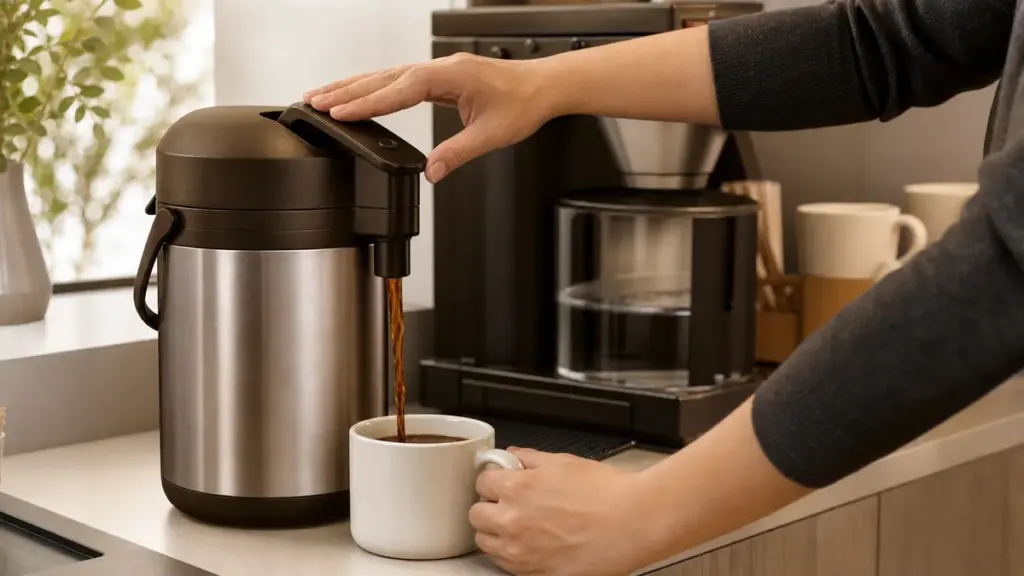
Use batch brew as support and contingency
Batch brewing prepares several servings of filter coffee together for dispensing from a server. It deserves consideration where many colleagues want black coffee or where a scheduled break produces concentrated demand.
Marco’s published JET specification offers a 6-litre single brewer and a twin arrangement with 6 litres per urn. At an assumed 250 ml serving, 6 litres provides 24 servings before allowing for residual liquid or waste.
Use insulated servers and agree a holding policy based on tasting the coffee through the intended service period. Plan smaller batches on quiet days rather than routinely discarding an oversized brew.
A batch station needs its own grinder or suitable prepared coffee, filters, preparation space and cleaning allocation. It is not an unattended reserve simply because dispensing is straightforward.
For contingency, identify which remaining station can accept displaced demand and what service will be reduced. Keep an agreed alternative, such as batch coffee or instant coffee, with the equipment and supplies needed to use it safely. Two machines sharing one failed water supply do not provide independent resilience.
Specify service SLAs and useful telemetry
An SLA, or service-level agreement, should define what happens when service deteriorates, not merely promise “support”.
Request written commitments covering:
- Acknowledgement: when the supplier confirms receipt of a fault.
- Attendance: when an engineer should arrive, including operating-hour exclusions.
- Restoration: when working coffee provision should return, including temporary equipment.
- Coverage: parts, labour, travel, planned maintenance and named exclusions.
- Escalation: who acts when the target is missed or faults recur.
Ask how local engineer coverage and spare-parts availability support those commitments. Maintenance visits and emergency repairs should be described separately.
Telemetry means machine information sent remotely to a dashboard. WMF’s CoffeeConnect documentation describes fleet status, operator-action messages and pending cleaning notifications. Its UK FAQ also distinguishes reports updated daily from machine events reported within a stated maximum of five minutes.
Specify what data you receive, its update frequency, export access and who responds. Have IT approve connectivity and access permissions.
Use drink counts by station and time to reconsider placement and replenishment rounds. Do not accept “remote monitoring” as a substitute for an engineer commitment or an on-site person able to act.
Decide who maintains the stations
Choose the operating model alongside the equipment.
Trained workplace staff can run stations where duties are formally allocated and covered during absence. Give each station an owner, a deputy and scheduled time, rather than relying on whoever notices a problem.
Facilities or vending contractors can manage replenishment and cleaning rounds. Specify visits around your demand pattern, the tasks included and who handles problems between visits.
Hospitality staff suit workplaces already providing an attended service. Define their responsibilities for self-service satellites and their cover during meetings, breaks and leave.
Require the supplier to demonstrate the complete operator workload. Automatic cleaning features do not constitute a full staffing plan: someone must still follow the model’s instructions, replenish supplies and complete the applicable manual tasks.
Create a station checklist covering opening checks, beans, milk, grounds, drip trays, cleaning and fault reporting. Keep technical repairs outside untrained operators’ duties.
If different organisations share responsibility for the equipment, shared-workspace coffee planning covers the additional ownership questions.
Budget for the whole service
Request itemised written quotations against the same attendance assumptions, drink menu, service period and operating responsibilities.
Include equipment and installation, electrical and plumbing work, water treatment, ingredients, cleaning products, servicing, replacement parts, telemetry, operator labour, energy, waste collections and temporary provision during breakdowns. Ask about contractual minimums, consumable restrictions, termination and removal.
Build your own per-cup calculation
For a non-monetary workload example, assume:
- 200 employees, with 75% attendance.
- Two coffees per attending employee.
- 220 operating days annually.
- A 10 g coffee dose for every drink.
- Milk in 60% of drinks, using 120 ml each.
- No visitors, cleaning consumption or wastage included.
That produces 300 drinks daily and 66,000 annually. Coffee demand is 3 kg daily, or 660 kg annually; milk demand is 21.6 litres daily, or 4,752 litres annually.
These are arithmetic assumptions, not recommended recipes. Replace them with the proposed machine recipes and observed demand, then add cleaning consumption and wastage separately.
Apply your written quotations to those quantities. Add all service expenditure over one consistent period and divide by drinks actually served, not machine-rated capacity.
State whether your comparison includes VAT or excludes recoverable VAT. Coffee and milk supplied as groceries are generally zero-rated, while catering supplies, including hot drinks, are generally standard-rated. Have finance confirm the treatment of the actual contract and each quoted item.
Confirm installation and compliance before signing
Ask for a site survey that checks the complete installed footprint, including refrigeration, filters, service clearances and space to refill hoppers.
Use the local water supplier’s postcode report, followed by installer testing, rather than a UK-wide hardness assumption. Thames Water, for example, provides postcode-based water-quality information. Record hardness units clearly, preferably mg/L as calcium carbonate, and obtain the machine maker’s written water requirements.
SCA’s Coffee Standards, revised 2018, gives brewing-water guidance including calcium hardness of 50 to 175 ppm as calcium carbonate. This is brewing guidance, not permission to disregard a manufacturer’s equipment-protection requirements.
For UK installations:
- Great Britain: HSE identifies drinking water and rest facilities as workplace requirements. Coffee provision is separate from those basic welfare duties.
- England and Wales: the Water Supply (Water Fittings) Regulations 1999 require appropriate backflow protection. Have the installer confirm the proposed arrangement.
- Great Britain: check steam-boiler machines with the supplier and HSE pressure-systems guidance, including any required written scheme of examination.
- England: workplace food-waste separation requirements have applied since 31 March 2025, subject to the micro-firm exemption until 31 March 2027. Coffee grounds are included.
Do not apply England-only waste guidance or England-and-Wales water regulations across the UK without checking the relevant national requirements.
FAQ
Should we provide decaf at every station?
Provide decaf where demand and access justify it, rather than automatically duplicating every option everywhere. Ask suppliers to demonstrate the proposed decaf route and explain how users select it. Include decaf in the demand survey, replenishment plan and trial, so colleagues do not have to cross the building for a suitable drink.
Can we start with fewer stations and expand?
Yes, provided the initial installation has a credible expansion plan. Ask the supplier to identify future connection points, counter space, electrical requirements and how additional machines would join the service agreement. Agree what evidence would trigger expansion, such as repeated waiting-time failures, rather than relying on an unspecified promise to review things later.
What should a supplier proposal contain?
It should explain the complete service, not just name machines. Request demand assumptions, station locations, manufacturer specifications, a representative throughput demonstration, installation requirements, operator tasks, service commitments and itemised written quotations. Ask suppliers to identify what remains available during a machine failure and who is responsible for every recurring task.
Where to go next
Read Coffee for Every Workplace to place your large-office plan within a wider workplace strategy, and Coffee Machines for Medium-Sized Offices when assessing smaller branches. Coffee Machines for Meeting Rooms and Reception Areas helps separate visitor demand, while Coffee Machines for Shared Workspaces addresses shared operating responsibilities.
Sources
-
WMF, WMF 9000 S+: Specifications & downloads, undated live specification, checked November 2026. Manufacturer-claimed daily and hourly outputs, water connection and cleaning features.
https://www.wmf-coffeemachines.com/en_com/products/fully-automatic-coffee-machines/wmf-9000-s-plus/specs/ -
Marco Beverage Systems, JET, global specification sheet, 2024 edition, hosted February 2025. Manufacturer-claimed batch capacities and insulated urn arrangement.
https://marcobeveragesystems.com/wp-content/uploads/sites/2/2025/02/MARCO_GBL_2024_JET.pdf -
WMF, Support WMF CoffeeConnect, undated UK live FAQ, checked November 2026. Fleet status, operator notifications and data-update intervals.
https://prod.wmf-coffeemachines.com/en_uk/support/wmf-coffeeconnect-faq/ -
HMRC, Food products (VAT Notice 701/14), updated June 2026. Grocery coffee and milk VAT treatment.
https://www.gov.uk/guidance/food-products-and-vat-notice-70114 -
HMRC, Catering, takeaway food (VAT Notice 709/1), updated June 2026. Catering contracts and hot-drink supplies.
https://www.gov.uk/guidance/catering-takeaway-food-and-vat-notice-7091 -
HSE, Workplace facilities: What you must provide, undated live guidance, checked November 2026. Drinking water, rest facilities and safe workplace arrangements.
https://www.hse.gov.uk/simple-health-safety/workplace-facilities/welfare.htm -
UK legislation, The Water Supply (Water Fittings) Regulations 1999, SI 1999/1148, Schedule 2, paragraph 15. England-and-Wales backflow requirements.
https://www.legislation.gov.uk/uksi/1999/1148/pdfs/uksi_19991148_en.pdf -
HSE, Pressure Systems Safety Regulations 2000 (PSSR), undated live guidance, checked November 2026. Qualifying systems, steam and examination requirements.
https://www.hse.gov.uk/pressure-systems/pssr.htm -
DEFRA, Simpler recycling: workplace recycling in England, updated October 2025. Implementation dates, micro-firm exemption and coffee grounds.
https://www.gov.uk/guidance/simpler-recycling-workplace-recycling-in-england -
Thames Water, Water quality, undated live guidance, checked November 2026. Postcode-based local water information.
https://www.thameswater.co.uk/help/water-and-waste-help/water-quality -
Specialty Coffee Association, Coffee Standards, revised 2018, section 4.1, “Water for Brewing Standards”. Brewing-water calcium-hardness guidance.
This guide was researched from retrieved manufacturer specifications, official UK guidance, legislation and SCA material; planning examples are explicitly assumed calculations, not first-hand machine tests.
Last checked: November 2026