The best coffee machines for meeting rooms and reception areas make the drinks guests actually want, fit the complete serving space and handle arrivals without interrupting conversation. Shortlist a professional capsule machine for occasional, straightforward service, or a compact commercial bean-to-cup machine for regular use and a broader drinks menu, then test your busiest arrival period before choosing.
In short
- Judge capacity by the drinks needed before a meeting starts, not just the daily total.
- Listen to grinding, brewing, milk preparation and rinsing from the seats guests will occupy.
- Measure the whole station, including cups, milk storage, waste containers and maintenance access.
- Ask suppliers to demonstrate your chosen drinks in your own cups.
- Give one person responsibility for readiness and cleaning, with a named backup.
Choose around the guest experience
Start with a simple question: will guests help themselves, or will someone serve them? For self-service reception, prioritise obvious controls, a short menu and easy cup positioning. For hosted meetings, prioritise reliable preparation and a layout that lets the host serve without turning their back on guests repeatedly.
Our editorial preference is to put the machine outside the meeting room when practical, particularly where calls, presentations or confidential discussions take place. Prepare drinks at a nearby refreshment point and bring them in, rather than making coffee compete with the conversation.
A reception machine needs a slightly different assessment. Test whether guests can understand it without an explanation, and whether the receptionist can use it while still overseeing arrivals.
For the broader differences between settings, start with coffee for every workplace. This guide concentrates on guest service rather than sizing an entire staff coffee provision.
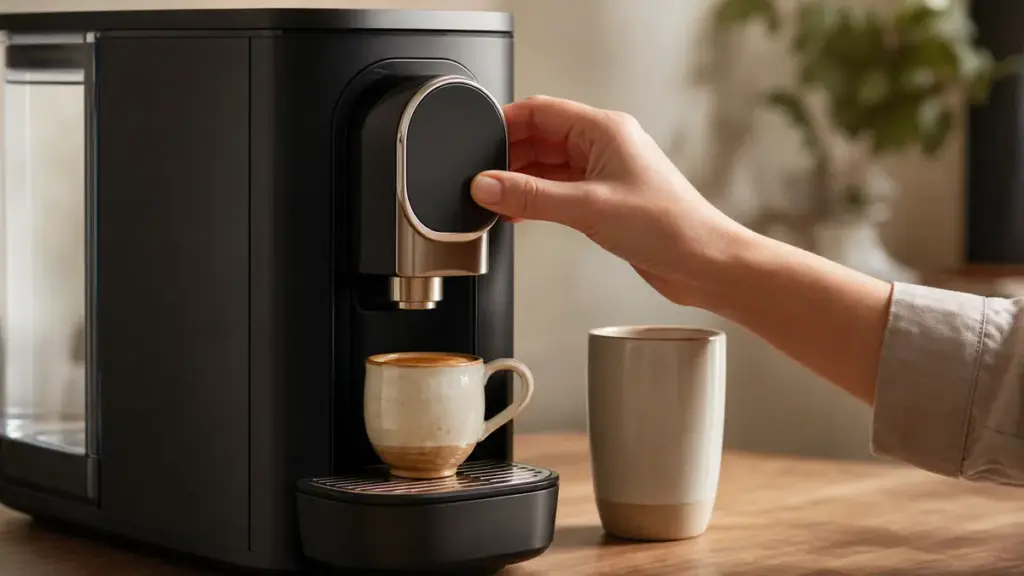
Capsule versus compact bean-to-cup coffee machines
A capsule machine brews a prepared portion of ground coffee held in a capsule. A bean-to-cup machine grinds whole beans and automatically prepares the drink. Neither format guarantees good flavour, fast service or acceptable noise.
Use the following criteria before comparing individual models. These are selection judgements, not universal performance ratings.
| Criterion | Professional capsule machine | Compact commercial bean-to-cup |
|---|---|---|
| Occasional guest service | A sensible shortlist for a small, controlled menu | Worth considering when guests also expect milk drinks |
| Coffee choice | Check the compatible capsule range, including decaf | Check bean choice, recipe adjustment and the decaf arrangement |
| Noise assessment | No bean-grinding stage, but test brewing and other operating sounds | Test grinding, brewing, milk preparation and rinsing |
| Routine attention | Check capsule disposal, tank filling and cleaning | Check beans, grounds, water and any milk-system cleaning |
| Presentation | Demonstrate the intended drink sizes and cups | Demonstrate spout clearance, portions and milk texture |
Do not assume a small domestic machine is approved for workplace use. Ask the manufacturer to confirm the intended application, warranty conditions and servicing arrangements in writing.
As a capsule example, Nespresso Professional describes its Zenius as suitable for meeting rooms and reception areas, with three programmable cup sizes and a hot-water function. That establishes its intended use, not an independently verified verdict on speed, noise or drink quality.
For a bean-to-cup size reference, JURA’s UK W8 specification claims a recommended maximum daily output of 50 drinks, a 3 litre water tank and dimensions of 295 mm wide, 446 mm deep and 443 mm high. These are manufacturer specifications checked in November 2026, not our measurements. The daily recommendation does not establish how quickly it will serve a particular meeting.
Size for capacity bursts, not building headcount
Count everyone using this particular station, including hosts and staff collecting drinks between visitor appointments. Then record the busiest arrival period: how many drinks, which recipes and how long you can reasonably allow.
The matrix below contains illustrative planning scenarios, not manufacturer ratings or recommended capacity bands. Replace them with your own booking and consumption records.
| People using the station daily | Assumed drinks per person | Illustrative daily cups | Burst to demonstrate | Shortlist to investigate |
|---|---|---|---|---|
| 6 | 1 | 6 | 6 drinks before one meeting | Professional capsule or compact bean-to-cup |
| 12 | 2 | 24 | 10 mixed drinks together | Either format, subject to demonstration |
| 25 | 2 | 50 | 15 drinks before a presentation | Commercial bean-to-cup or separate preparation point |
| 40 | 2 | 80 | Overlapping room arrivals | Higher-capacity station outside meeting rooms |
Ask the supplier to reproduce the burst with your expected mix of black and milk drinks. Include changing cups, capsule handling where relevant, any rinse interruptions and the final drink reaching the tray. A brewing-only demonstration leaves out part of the service.
For illustration, if a complete serve-and-reset cycle took 60 seconds, ten sequential drinks would take ten minutes. This is arithmetic using an assumed cycle time, not a claim about either machine format.
If several rooms regularly start together, consider central preparation rather than a machine in every room. Larger office systems cover the wider capacity question; the meeting-room decision is where and how those drinks reach guests.
Assess noise in the actual room
Do not accept “quiet” as a complete specification. Ask which operating stage was measured, at what distance, under which conditions, and whether competing figures use the same method. Without comparable evidence, do not rank machines by a claimed decibel figure.
Arrange a demonstration on the intended sideboard, with the room otherwise quiet. Listen from the nearest chair, the presentation position and the reception desk. Include waking from standby, making the first drink and completing any rinse.
For an informal acceptance check, hold a normal conversation while the machine operates. Decide whether the interruption is acceptable for that room. This is a practical listening exercise, not a calibrated acoustic test.
If noise is intrusive, first reconsider location. Any supporting mat or isolation accessory should be approved by the supplier and must not compromise stability, ventilation or cleaning.
Measure the complete footprint
Machine dimensions are only the starting point. Before ordering, mark out the full station with removable tape and check:
- clearance for opening lids and filling beans;
- the route for removing the water tank, grounds drawer and drip tray;
- manufacturer-required ventilation and access;
- space for clean cups, used cups and a serving tray;
- any milk refrigerator, tubing, filter and waste containers;
- safe cable routing and access to the electrical supply.
Try the maintenance movements rather than simply measuring them. Can someone remove a full drip tray without moving the machine? Can the tank reach the nearest suitable filling point without an awkward carry?
For self-service, check reach, visibility and cup placement with the people likely to use the station. Keep the route clear of stored supplies and provide a straightforward way to request assistance.
Where several organisations share reception, agree who owns replenishment, cleaning and fault reporting. The operational issues are covered more fully in shared workspace machines.
Make drink quality and cup presentation repeatable
Taste the actual recipes you intend to offer, using the proposed beans or capsules, water and milk. Assess the espresso, the longer black coffee and the most frequently requested milk drink separately. A successful espresso demonstration does not answer whether you like the machine’s longer coffee.
For guest service, our preference is a short, well-set menu over a long list of untested recipes. Keep decaf easy to request and make sure the host understands how it is prepared.
Use the intended crockery during the demonstration. Check that espresso does not disappear into an oversized mug, that a long drink leaves comfortable carrying space, and that milk drinks fit beneath the outlet without tilting the cup.
Ask for several consecutive servings. Compare fill levels, flavour and appearance, then ask the supplier to explain any variation. For milk drinks, judge whether the texture is smooth enough for the recipe rather than accepting a tall layer of coarse bubbles.
Retain ingredient information and establish a procedure for allergy requests. Do not promise that changing the milk container makes a shared milk circuit suitable for someone with an allergy.
Plan water, cleaning and UK responsibilities
Water and daily readiness
Obtain the premises’ water supplier report and follow the machine manufacturer’s testing and treatment instructions. Thames Water, for example, provides a postcode-based water-quality lookup, but its service area is not a substitute for checking your own supplier.
Hardness describes dissolved calcium and magnesium. Where a report uses mg/L as calcium carbonate, keep that basis when discussing treatment with the installer. The SCAE water research distinguishes total hardness from alkalinity, the water’s acid-buffering capacity, and considers both flavour and equipment protection.
For a tank-fed machine, demonstrate the complete meeting burst without assuming all tank water becomes drinks. Check the allowance for rinsing and the usable capacity specified by the manufacturer.
Assign responsibility for filling, emptying and cleaning before guests arrive. For milk systems, follow the exact cleaning instructions and provide suitable chilled storage. Choose a simpler coffee-only arrangement if nobody can reliably manage the milk routine.
Installation and waste
In Great Britain, HSE guidance requires access to drinking water and somewhere to rest and eat. Guest coffee should be planned alongside those welfare arrangements, not treated as their replacement.
For a plumbed-in installation in England and Wales, the Water Supply (Water Fittings) Regulations 1999 require appropriate backflow protection. Scotland and Northern Ireland have separate instruments. Ask the installer to confirm the applicable requirements and any notification needed.
Machines with steam systems can fall within the Pressure Systems Safety Regulations 2000 in Great Britain. Ask the supplier to confirm applicability and examination requirements against HSE guidance rather than judging from the machine’s size.
In England, Simpler Recycling includes coffee grounds in food waste. The workplace requirements began on 31 March 2025, with the exemption for businesses with fewer than ten full-time-equivalent employees ending on 31 March 2027. That count concerns the business, not just this reception area. Compostable packaging, including pods, must not automatically go into food waste; follow the collection rules. Other UK nations have different arrangements.
Compare complete written quotations
Request itemised written quotations covering the machine, installation, water treatment, consumables, cleaning materials, servicing, training, waste arrangements and any milk refrigerator. Ask what happens during a breakdown and which responsibilities remain with your team.
To compare ongoing provision, use the same consumption assumptions for every quotation. For example, assume 20 drinks daily over 20 working days: that is 400 drinks. At an assumed bean dose of 10 g per drink, the coffee requirement is 4 kg before waste; if 12 daily drinks each use 120 ml of milk, the monthly milk requirement is 28.8 litres.
These are calculation assumptions, not recommended recipes. Substitute the demonstrated dose and milk quantity, include cleaning and waste allowances, then divide the complete expenditure for the chosen period by drinks actually served.
Ask suppliers to state VAT treatment separately. Coffee and milk supplied as food are generally zero-rated; hot drinks supplied in the course of catering are standard-rated under HMRC guidance. Do not assume every line in a bundled agreement has the same treatment.
Make the final selection conditional on the burst demonstration, acceptable noise, cup fit and a workable cleaning handover. Those checks matter more than how smart the machine looks in an empty room.
FAQ
Can one machine serve both reception and a meeting room?
Yes, provided the combined demand and location work in practice. Include reception drinks in the same arrival-burst demonstration as meeting refreshments, and decide who has priority when both need service. Our preference is a nearby shared refreshment point rather than a machine inside a room that becomes inaccessible during meetings.
Should guests make their own coffee?
Self-service is reasonable when the controls, cup positioning and support arrangements pass a practical trial. Invite someone unfamiliar with the machine to make the intended drink without coaching, while a host supervises. If they hesitate over cup size, milk selection or waste handling, simplify the menu or use hosted service.
How should we provide decaf?
Choose a clearly defined decaf procedure before ordering. For capsules, confirm the compatible decaf option; for bean-to-cup, ask the supplier to demonstrate the machine’s supported method and explain any shared coffee path. Do not assume that a second selection on the menu means a separate grinder or preparation circuit.
Where to go next
Use Coffee for Every Workplace to place coffee machines for meeting rooms and reception areas within the wider workplace plan. Read Coffee Machines for Large Offices when simultaneous meetings affect capacity, and Coffee Machines for Shared Workspaces when several teams share responsibility. For staffed guest service beyond occasional meetings, continue to Coffee Machines for Hotels, Restaurants and Cafés.
Sources
-
JURA, W8, Dark Inox (INTB), product code 15786, UK manufacturer specification, model year 2026.
https://uk.jura.com/en/professional/machines/w8-dark-inox-intb-15786
Used for claimed dimensions, capacity, grinder and intended applications. -
Nespresso Professional UK, Professional coffee subscription, current manufacturer page, undated.
https://www.nespresso.com/pro/uk/en/professional-coffee-subscription
Used only for the Zenius’s stated applications and functions, not commercial terms or performance endorsement. -
Nespresso Professional, Momento 100 User Manual, undated manufacturer instructions.
https://www.nespresso.com/shared_res/manuals/momento/Momento_100_EN_A5_US.pdf
Used for capsule-machine operating tasks, including water, capsule handling and cleaning; not UK model specifications. -
Speciality Coffee Association of Europe, The SCAE Water Chart, research report, 2016.
Used for hardness, alkalinity and the distinction between sensory and technical water requirements.
-
Thames Water, Water quality, current supplier guidance, undated.
https://www.thameswater.co.uk/help/water-and-waste-help/water-quality
Used for the postcode lookup and explanation of hard-water minerals. -
Health and Safety Executive, Have the right workplace facilities: What you must provide, current guidance, undated.
https://www.hse.gov.uk/simple-health-safety/workplace-facilities/welfare.htm -
UK legislation, The Water Supply (Water Fittings) Regulations 1999, SI 1999/1148, Schedule 2, paragraph 15; Water Regs UK, Introduction, current jurisdictional guidance, undated.
https://www.legislation.gov.uk/uksi/1999/1148/pdfs/uksi_19991148_en.pdf
https://www.waterregsuk.co.uk/topics/introduction/ -
Health and Safety Executive, Pressure Systems Safety Regulations 2000 (PSSR), current guidance, undated.
https://www.hse.gov.uk/pressure-systems/pssr.htm -
Department for Environment, Food & Rural Affairs, Simpler recycling: workplace recycling in England, updated 3 October 2025.
https://www.gov.uk/guidance/simpler-recycling-workplace-recycling-in-england -
HM Revenue & Customs, Food products (VAT Notice 701/14) and Catering, takeaway food (VAT Notice 709/1), both updated 8 June 2026.
https://www.gov.uk/guidance/food-products-and-vat-notice-70114
https://www.gov.uk/guidance/catering-takeaway-food-and-vat-notice-7091 -
Food Standards Scotland, CookSafe Food Safety Assurance System, September 2021, allergen-management house rules.
https://www.foodstandards.gov.scot/downloads/CookSafe_Manual_Complete_September_2021.pdf
Used for allergen-residue and cross-contact considerations.
This article was researched using manufacturer documentation, coffee-water research and official UK guidance; selection advice is editorial judgement, and no first-hand machine testing is claimed.
Last checked: November 2026