Coffee machines for healthcare settings should be chosen around who will use them, where they will sit and who will clean them, before comparing drink menus. A staff-room machine, a hospital visitor dispenser and a care-home resident service need different arrangements: local infection-prevention approval, safe access and dependable support should determine the shortlist.
In short
- Separate staff refreshments from patient and resident beverage services in the purchasing specification.
- Get the proposed location and water connection approved before ordering, not after installation.
- Specify cleaning responsibilities for every shift, including milk systems, touchpoints and removable parts.
- Assess hot drink safety individually: a temperature setting or locked ingredient cupboard is not a complete safeguard.
- Size equipment for the busiest break or drinks round, then agree repair cover and a workable backup.
Start with the users and the location
Write separate requirements for staff-only refreshments, visitor self-service and patient or resident drinks. They may share a supplier, but should not automatically share equipment, access rules or cleaning arrangements.
For a staff room, prioritise straightforward operation, shift coverage and a cleanable installation. For patients and residents, involve the care or catering team so that beverage provision follows individual support needs rather than the machine’s default menu.
Ask the infection prevention and control team, usually shortened to IPC, to approve any proposed clinical or patient-facing location. A spare worktop is not sufficient justification. In England, HTM 04-01 specifically says vending, chilled-water and ice-making machines should not be installed in augmented care areas, where patients need particularly protective care.
As a procurement rule, keep coffee preparation out of treatment spaces, clean preparation areas and dirty utility rooms unless the relevant local teams explicitly approve the arrangement. Keep clinical handwashing sinks clear: current adult social care guidance for England says they are for handwashing, not disposing of drinks or cleaning beverage equipment.
The wider workplace coffee guide helps establish the general brief. Healthcare adds a further question: can this particular service operate safely in this particular place?
Which coffee machines suit healthcare settings?
Use these criteria before considering brands: approved location, cleanability, safe operation, peak demand, decaf provision and service cover. The following are purchasing judgements, not claims that one machine class is universally safer.
| Setting and users | Option to investigate | Main advantage | Limitation to resolve |
|---|---|---|---|
| Small clinic staff room | Compact commercial bean-to-cup machine, with or without integrated milk | Individual drinks without a separate brewing station | Confirm who refills, cleans and covers absences |
| Hospital staff refreshment point | Plumbed commercial bean-to-cup machine | Worth investigating where repeated manual filling would interrupt service | Water approval, peak throughput and cleaning downtime |
| Care-home resident service | Staff-operated machine in an approved kitchen or pantry | Allows assistance and drink preparation to follow care plans | Requires staff availability and safe transport to residents |
| Hospital visitor area | Commercial self-service dispenser | Can provide a defined menu without a staffed counter | Accessible controls, spill management and public access safeguards |
| Scheduled drinks rounds | Batch brewer with suitable insulated servers | Worth comparing when many similar drinks are required together | Handling, holding arrangements and cleaning of servers |
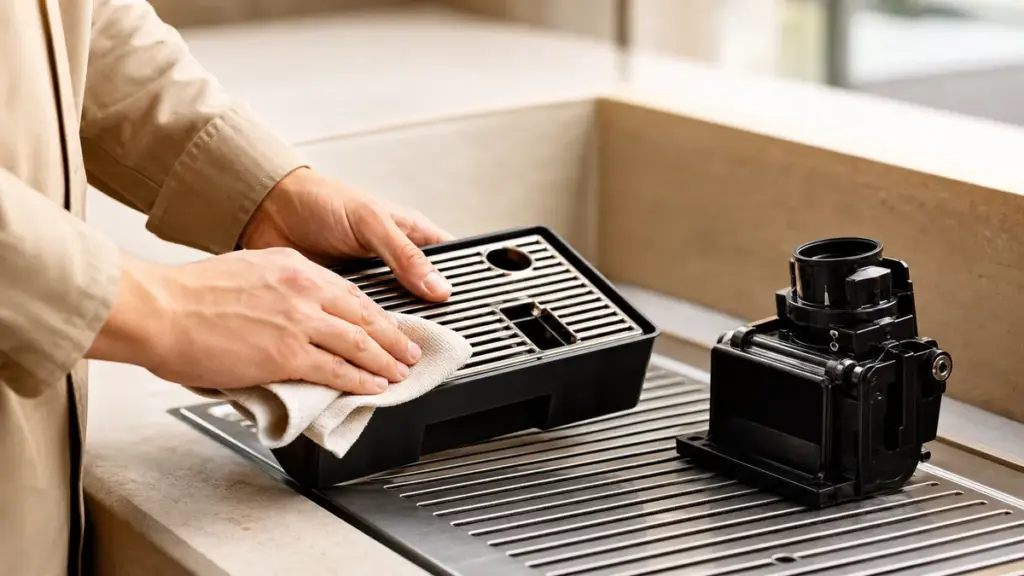
Fresh milk should be a deliberate choice, not an automatic upgrade. Require the supplier to demonstrate the complete cleaning process, including any parts that staff remove, wash and reassemble. Franke’s published cleaning resources, for example, distinguish routines by machine and milk-system configuration, illustrating why generic cleaning promises are insufficient.
If a hospital café is the actual requirement, use the separate hospitality machine guide. A staffed café and a ward staff room should not inherit the same specification.
Infection control and cleaning: assign the work
Healthcare cleaning guidance emphasises defined responsibilities, methods and frequencies. Turn that into a machine-specific schedule agreed by IPC, catering or facilities, and the manufacturer. Do not assume that a coffee machine is a medical device or apply patient-care equipment rules without considering its actual role.
The purchasing demonstration should become a written operating procedure:
- Before service: check the cleaning record, supplies, visible condition and any fault messages. Confirm that required cleaning cycles have completed.
- During service: deal with spills promptly and clean external touchpoints at the locally agreed frequency, using products compatible with the machine.
- At the manufacturer’s specified intervals: complete the prescribed coffee and milk-system cleaning, including removable components. Treat an automatic rinse as a separate function unless the manual explicitly identifies it as the required cleaning process.
- At handover: record completion, outstanding faults and the person taking responsibility. Include weekend, night and agency staff in training.
- After contamination or an outbreak instruction: withdraw the machine if necessary and obtain local advice before returning it to use.
This is a framework for a local procedure, not a substitute for the manufacturer’s instructions. Ask for the required chemicals, contact times, manual tasks and machine downtime in writing.
For fresh milk, specify refrigerated storage, temperature checks and action after a refrigeration failure. The Food Standards Agency recommends setting refrigerators at 5°C or below and checking that they remain cold enough; follow any stricter product or equipment instructions.
Touchless and antimicrobial options
Touchless ordering is an available manufacturer feature: Franke, for example, advertises phone-based ordering without an app. Assess it as an interface option, not evidence that the whole machine prevents infection. Cups, collection areas and other surfaces still need their agreed cleaning arrangements.
If a supplier offers an “antimicrobial” surface, ask what was tested, against which organisms, under what conditions and after which cleaning products. Do not reduce the cleaning schedule on the strength of that description alone.
Water safety and backflow: resolve the Category 5 question
Backflow is water flowing in the wrong direction and potentially carrying contamination into a supply. Fluid categories describe the associated health hazard.
The claim that every healthcare coffee machine automatically needs Fluid Category 5 protection is too broad. Water Regs UK describes drinks vending machines as typically Category 3, while HTM 04-01 recognises Category 5 risks within healthcare premises and the possible need for protection at different levels of the installation. These statements address different risks, rather than establishing one universal coffee-machine rule.
Have estates, a competent installer and the local water undertaker confirm the arrangement for the exact machine and location. Do not assume a double-check valve is sufficient where a higher risk has been identified.
Include the machine in the site’s water safety arrangements. HTM 04-01 addresses vending equipment approval and hygienic hand-filling; England’s adult social care guidance also calls for water safety plans covering risks such as Legionella. A refillable tank does not remove the need for water hygiene procedures.
Ask the water-safety lead to specify low-use and closure procedures, filter maintenance and recommissioning after isolation. Agree water treatment with that lead and the manufacturer, rather than fitting a generic office filter.
The NHS and adult social care guidance cited here is England-specific. Sites elsewhere in the UK should use their national healthcare guidance and applicable water regulations or byelaws.
Hot drink safety and accessible use
Assess the whole journey: selecting the drink, placing the cup, dispensing, carrying it and drinking it. HSE identifies people with reduced mobility, mental capacity or sensory awareness among those especially vulnerable to scalding.
For vulnerable patient or resident services, consider:
- staff-assisted dispensing where independent operation is unsafe;
- controlled beverage settings and cup volumes, checked during commissioning;
- secure access to cleaning chemicals and service controls;
- a staff-only location or dispensing lockout where the individual risk assessment requires it;
- suitable cups, stable placement and an unobstructed carrying route.
A lock on the ingredient cabinet does not prevent someone pressing the hot-water button. Ask the supplier to demonstrate precisely what each lock or access control prevents. Avoid blanket restrictions based only on a dementia diagnosis: safeguards should be proportionate and preserve independence where possible.
Do not use bathing guidance as a coffee serving specification. HSE’s 44°C maximum concerns vulnerable people during whole-body immersion, not a universal safe temperature for drinks. Agree beverage handling and serving arrangements through the local assessment.
Accessibility should also be tested before purchase. In Great Britain, service providers must anticipate reasonable adjustments for disabled users; Northern Ireland has a separate disability discrimination framework.
Trial the proposed installation with users: can they approach it, reach the controls, read the menu, position a cup and retrieve the drink without stretching over hot outlets? Keep an assisted or non-phone route available when considering touchless ordering.
Decaf choices and patient-specific drinks
Specify decaf as a normal menu choice, with clear identification and a dependable replenishment process. Ask whether the proposed configuration uses a separate grinder, a ground-coffee bypass or another route, and how staff prevent selection errors.
Decaffeinated coffee still contains some caffeine. Do not label it caffeine-free or assume it meets every patient’s clinical requirements; obtain advice from the care team, pharmacist or GP where relevant.
For people with swallowing difficulties, the prescribed drink consistency and supervision arrangements take priority. A machine’s ordinary output should not be assumed suitable: NHS dysphagia guidance describes individual care plans covering drink modification and support needs.
Capacity for shifts and dependable service
Count people using each refreshment point across the day, not the organisation’s total payroll. The matrix below is an illustrative planning calculation, not a recommended capacity standard.
Assumptions: staff-only service, two machine drinks per person attending each day, with patient and visitor drinks counted separately.
| People attending daily | Assumed drinks per person | Calculated daily drinks | Separate peak question |
|---|---|---|---|
| 15 | 2 | 30 | Can it serve the busiest clinic break? |
| 40 | 2 | 80 | What happens during shift overlap? |
| 100 | 2 | 200 | Should demand be split between locations? |
Daily demand equals people attending multiplied by expected drinks, plus any separately measured visitor or resident demand. Then record the busiest service window and request a demonstration using the intended drink sizes and milk recipes. Treat published manufacturer capacities as claimed figures, not proof of performance at your site.
Agree service terms covering:
- fault reporting outside office hours;
- acknowledgement, engineer attendance and restoration as distinct commitments;
- weekend and bank-holiday coverage;
- parts availability and replacement equipment;
- cleaning and approval before a repaired machine returns to service.
For steam-boiler equipment in Great Britain, ask the supplier and a competent person whether pressure-systems duties apply. HSE requires a written scheme and examination for qualifying equipment; routine servicing is not the same thing.
Compare the complete operating commitment
Request itemised written quotations covering equipment, installation, water protection, filters, ingredients, cleaning materials, staff training, servicing, examinations where applicable and contingency provision. Include staff cleaning time and the treatment of VAT.
To calculate your own operating cost per served drink, total the applicable expenditure over one defined period and divide by drinks actually served during that period. Include discarded ingredients and cleaning consumption, not just drinks recorded on the counter.
The final shortlist of coffee machines for healthcare settings should pass the location, cleaning, accessibility and support checks before anyone chooses the longest menu.
FAQ
Can staff bring in a domestic coffee machine?
Do not allow installation without local approval. Ask facilities and IPC to check the proposed location, electrical arrangements, cleaning instructions and responsibility for upkeep. The question is whether that particular machine and service can be managed appropriately, not simply whether the appliance is described as domestic or commercial.
Should every care-home resident be prevented from using the machine?
No, assess support needs individually rather than applying a blanket restriction. Consider the person’s ability to understand the controls, handle the cup and respond to spills, then agree proportionate assistance or access controls. Adult social care guidance emphasises balancing safety with dignity and independence.
What should happen if the coffee machine breaks down overnight?
Use a previously approved backup arrangement. Identify who reports the fault, who decides whether the machine must be isolated and how drinks will be provided safely until service resumes. Ask suppliers to distinguish remote support from engineer attendance and restoration, so an overnight telephone service is not mistaken for an overnight repair commitment.
Where to go next
Read Coffee for Every Workplace to structure the wider requirements, then Coffee Machines for Hotels, Restaurants and Cafés if the project includes a staffed hospital café. Coffee Machines for Schools and Universities offers a useful comparison for supervised refreshment settings, while healthcare-specific decisions should remain subject to local approval.
Sources
-
NHS England, National infection prevention and control manual for England, version 2.12, July 2025, particularly section 1.6.
https://www.england.nhs.uk/wp-content/uploads/2022/04/PRN00908-national-ipc-manual-england-v2.12.pdf -
Department of Health and Social Care, Health and Social Care Act 2008: code of practice on the prevention and control of infections and related guidance, 2022 revision.
https://www.gov.uk/government/publications/the-health-and-social-care-act-2008-code-of-practice-on-the-prevention-and-control-of-infections-and-related-guidance/health-and-social-care-act-2008-code-of-practice-on-the-prevention-and-control-of-infections-and-related-guidance -
Department of Health, Health Technical Memorandum 04-01: Safe water in healthcare premises, Part A, Design, installation and commissioning, 2016, sections 9.24 to 9.26 and 12.19 to 12.22.
https://www.england.nhs.uk/wp-content/uploads/2021/05/DH_HTM_0401_PART_A_acc.pdf -
Department of Health, Health Technical Memorandum 04-01: Safe water in healthcare premises, Part B, Operational management, 2016, section 8.4.
https://www.england.nhs.uk/wp-content/uploads/2021/05/DH_HTM_0401_PART_B_acc.pdf -
Water Regs UK, Vending machines, version 1.4, February 2024.
https://www.waterregsuk.co.uk/downloads/publications/info_leaflets/vending_machines.pdf -
Department of Health and Social Care and UK Health Security Agency, Why infection prevention and control matters in adult social care, 2026, particularly water safety and proportionate care.
https://www.gov.uk/government/publications/infection-prevention-and-control-ipc-in-adult-social-care-asc/why-infection-prevention-and-control-matters-in-adult-social-care -
Health and Safety Executive, Scalding and burning, updated November 2024; Pressure Systems Safety Regulations 2000 (PSSR), updated December 2025.
https://www.hse.gov.uk/healthservices/scalding-burning.htm
https://www.hse.gov.uk/pressure-systems/pssr.htm -
Food Standards Agency, Chilling food correctly in your business, undated printable guidance retrieved November 2026.
-
Government Equalities Office, Disability: quick start guide for service providers, undated HTML edition; Government Digital Service, Understanding accessibility requirements for public sector bodies, current guidance, including the distinction between Great Britain and Northern Ireland.
https://www.gov.uk/government/publications/equality-act-guidance/disability-quick-start-guide-for-service-providers-html
https://www.gov.uk/guidance/accessibility-requirements-for-public-sector-websites-and-apps -
Franke Coffee Systems, Cleaning instructions and Digital Services, undated manufacturer pages retrieved November 2026. Used for manufacturer-described features and cleaning resources, not independent performance evidence.
https://www.franke.com/us/en/coffee-systems/resources/cleaning-information/cleaning-instructions.html
https://www.franke.com/gb/en/coffee-systems/products/digital-services.html -
US Food and Drug Administration, Spilling the Beans: How Much Caffeine is Too Much?, 2024. Used only for the distinction between decaffeinated and caffeine-free drinks.
https://www.fda.gov/consumers/consumer-updates/spilling-beans-how-much-caffeine-too-much -
NHS Ayrshire and Arran, Adult dysphagia (G125), clinical guidance, publication year not established on the retrieved search extract.
https://www.rightdecisions.scot.nhs.uk/nhs-ayrshire-arran-guidelines/clinical-guidelines/nutrition/adult-dysphagia-g125/
Research used official healthcare, water-safety, food-safety and accessibility guidance alongside manufacturer documentation; machine-selection advice is editorial judgement, and the demand matrix is an explicitly hypothetical calculation.
Last checked: November 2026