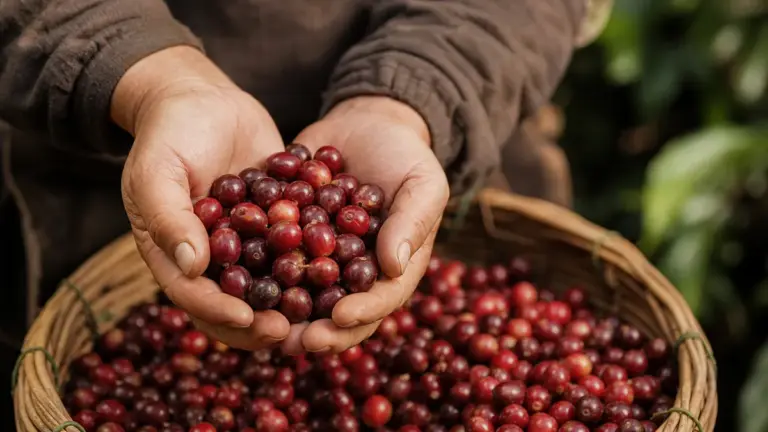
Green coffee trading is the buying, selling and movement of unroasted coffee beans between producing countries and roasters. Exporters prepare coffee for overseas sale, while importers connect those shipments with buyers, coordinating quality checks, logistics, storage and finance. The central task is to deliver the agreed coffee in the agreed condition, with clear responsibility at every handover.
In short
- A typical route is producer, processor, exporter, importer, warehouse and roaster, although businesses can combine these roles.
- Contracts need an identifiable lot, agreed quality, quantity, shipment window, payment terms and a procedure for disputes.
- Under both FOB and CIF, transport risk normally transfers when coffee is aboard the vessel at origin, not when it reaches Britain.
- Pre-shipment and landed samples provide checkpoints before and after the voyage.
- Sack weights and container loads vary. Confirm net kilograms and packaging rather than relying on the word “bag”.
Who does what in green coffee trading?
An exporter operates at the producing-country end of the transaction. It may buy from farms, cooperatives or processors, assemble saleable lots and arrange export preparation and documentation. A cooperative can itself be an exporter; a separate trading company is not essential in every chain.
Preparation can include dry milling, which removes the dried fruit or parchment surrounding the beans, followed by grading, sorting and packing. These operations may belong to the exporter or be handled by specialist processors.
An importer buys coffee for a destination market and supplies roasters or other traders. Its work can include sourcing, customs arrangements, quality control, warehousing and dividing larger purchases into smaller sales.
These are functions, not necessarily separate companies. Some trading groups operate at both ends, while a roaster importing its own coffee takes on responsibilities that an importer would otherwise handle.
For the wider structure beyond the movement of beans, start with the coffee industry overview.
The journey from an export lot to a roaster
A simplified shipment follows this sequence:
- Prepare the lot. Coffee is processed, sorted and identified for sale.
- Agree the contract. Buyer and seller establish what will be delivered and on what terms.
- Approve and dispatch. Required samples and documents are checked before shipment.
- Receive and release. Coffee passes through import procedures, arrival checks and warehousing before delivery to the roaster.
The physical journey and the commercial transaction are related but not identical. A shipment contract can be agreed before dispatch, while a spot purchase concerns coffee already available in a destination warehouse.
For a buyer, that distinction changes the questions to ask. Is the coffee physically available, awaiting shipment or still subject to approval? A promising sample is not, by itself, confirmation of stock availability or a delivery date.
What a green coffee contract needs to establish
A useful contract identifies the actual lot rather than merely describing “good Colombian coffee”. It should specify:
- Buyer, seller, origin, lot identification and any certification.
- Quality description, agreed sample basis and acceptance requirements.
- Quantity in net kilograms, packaging and the basis for determining weight.
- Shipment or delivery period, named places and applicable trade terms.
- Payment arrangements, insurance responsibilities and dispute procedures.
Coffee-specific standard conditions provide rules behind those transaction details. The European Coffee Federation’s European Standard Contract for Coffee, for example, addresses shipment, spot and delivery business, including weighing, sampling and claims.
However, a standard form is not a substitute for reading the agreement. Confirm the edition incorporated, any amendments and the arbitration arrangements. A shipment window also needs distinguishing from an arrival commitment.
The benchmark-market side belongs in the C-market and futures. Here, the essential point is that the agreement for physical coffee must describe the goods and the obligations attached to them.
Trade terms: FOB, CIF, EXW and FCA
Incoterms are International Chamber of Commerce rules allocating specified delivery, transport, customs and risk responsibilities. A contract should state the rule, its named place or port and the edition, such as Incoterms 2020.
The comparison below concerns the normal delivery and risk-transfer points under those rules.
| Term | Seller’s principal handover obligation | Main transport arrangement | Normal risk-transfer point |
|---|---|---|---|
| EXW, Ex Works | Make goods available at the named place, normally without loading or export clearance | Buyer | When goods are placed at the buyer’s disposal |
| FCA, Free Carrier | Deliver to the buyer’s nominated carrier at the named place; clear for export | Buyer | Delivery to the carrier under the named-place provisions |
| FOB, Free On Board | Deliver aboard the nominated vessel at the shipment port; clear for export | Buyer | Once aboard at origin |
| CIF, Cost, Insurance and Freight | Deliver aboard; arrange carriage and minimum cargo insurance to the destination port | Seller | Once aboard at origin |
CIF does not mean the seller carries transit risk until arrival. Its destination-port wording describes the carriage and insurance the seller must arrange, not a later risk-transfer point. The minimum insurance required under CIF may also be narrower than the buyer expects.
There is another useful distinction between familiar trade language and suitable contract drafting. ICC recommends considering FCA rather than FOB when containers are handed to a carrier at a terminal before vessel loading. EXW can also be awkward internationally because export clearance falls to the buyer.
Ask where the actual handover happens. Then ensure the contract and insurance reflect it.
Quality control: samples before and after shipment
Samples connect the description on the contract with the coffee being delivered. Cupping, the controlled preparation and tasting of coffee samples, assesses sensory qualities; physical inspection checks the beans themselves.
The useful distinctions are:
- Offer sample: supplied to help a buyer assess a proposed purchase.
- Pre-shipment sample, or PSS: assessed before dispatch against the agreed requirements.
- Landed or arrival sample: taken after arrival to assess delivered condition and conformity.
An offer sample and an arrival sample may coincide when coffee is already in a warehouse. They should not automatically be treated as equivalent when the offered coffee has yet to ship.
Sampling also needs continuity. Keep lot references, dates, assessments and retained samples connected to the contract. Café Imports, for example, describes checking pre-shipment samples, arrival samples and stock during warehouse storage. That is a published company practice, not a universal contractual rule.
Physical checks can include moisture, visible defects and foreign matter. Sensory assessment cannot replace those checks, and neither proves compliance with every food-safety requirement.
If a discrepancy appears, preserve evidence and notify the counterparty promptly. Contractual claims procedures can require independently drawn and sealed samples, not simply a handful taken from an opened sack.
Shipping: sacks, hermetic liners and bulk containers
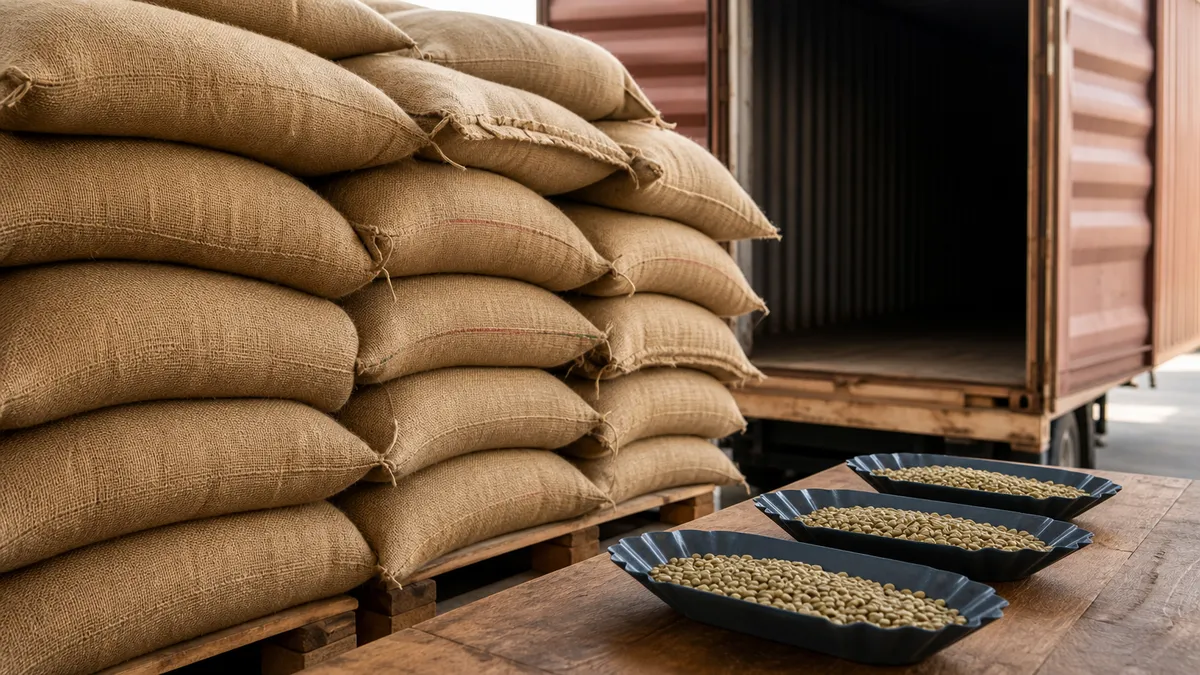
Traditional export packaging includes woven jute or sisal sacks. A common net weight is 60 kg; UK importer DRWakefield lists 69 kg sacks for Central America and Peru, and 70 kg sacks for Colombia. These are useful conventions, not guarantees for every shipment.
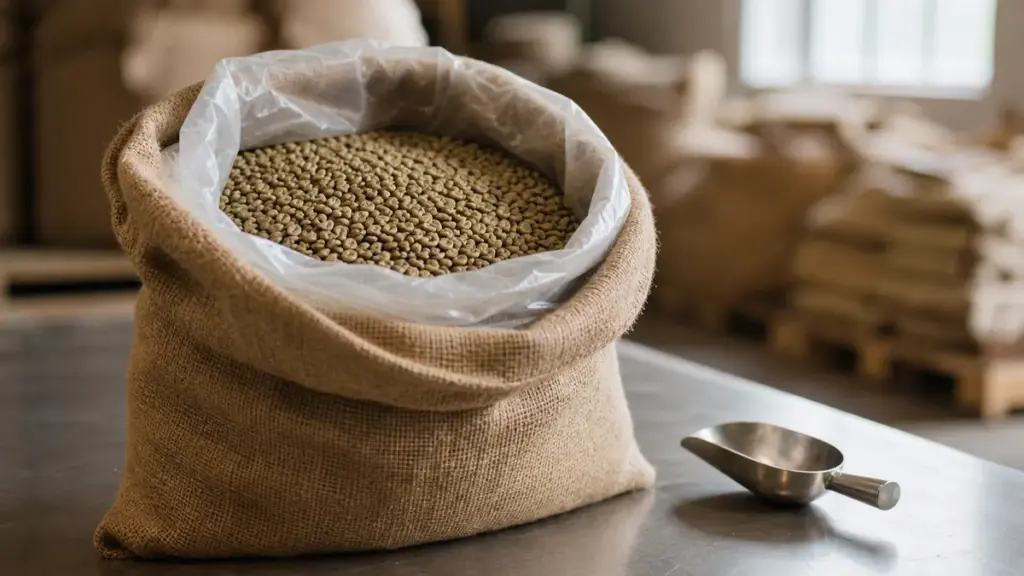
Some coffees have an inner hermetic liner, meaning a sealed barrier intended to limit exchange with the surrounding atmosphere. GrainPro and Ecotact are examples whose manufacturers describe gas or oxygen and moisture barriers. An outer sack provides handling protection; the liner serves a different purpose.
Bulk shipping removes the individual sacks. Beans travel inside a food-contact liner fitted within the container. CBI lists 21.6-tonne polyethylene liners among coffee packaging options, but that is not a universal container payload. The agreed loading plan and transport limits still govern the shipment.
The voyage presents a particular quality risk: temperature differences can cause condensation and local rewetting. Coffee that entered the container dry can therefore develop damp patches.
The International Coffee Organization’s handling guidance stresses inspecting containers for moisture, residues and damage, and protecting loading operations from rain. Packaging cannot compensate for a leaking container or unsuitable loading conditions.
Financing: who supports coffee while it moves?
Coffee requires working capital before the final buyer receives it. Production, preparation, transport and storage happen at different stages, while payment follows the agreed commercial timetable.
Export finance may come from a bank, specialist lender or buyer providing pre-finance. Availability depends on the transaction and relationship, not simply on whether the coffee is described as specialty.
Importers can also finance coffee held for roasters. Café Imports explicitly describes financing and warehousing contracted stock. That service allows the physical purchase and the roaster’s collection schedule to be separated, but the commitments need agreeing in advance.
Payment security is another matter. Under a letter of credit, a bank undertakes payment subject to specified conditions and compliant documents. It is not the same thing as a bank tasting or inspecting the shipment.
For a real purchase, request itemised written quotations covering the beans, packaging, inland movement, ocean freight, insurance, customs handling, storage, finance and final delivery. Establish which elements are already included, then compare offers on the same delivery basis.
Do not confuse the exporter’s transaction with the producer’s return. That separate question is covered in farmgate payments and farmer income.
The UK import route
A sea shipment can enter through a British container port and travel onwards to specialist coffee warehousing or a roastery. Potential gateways include Felixstowe, London Gateway and Liverpool. These are routing options, not a ranking of coffee import volumes.
For imports into Great Britain, meaning England, Scotland and Wales, the practical sequence is:
- Establish the importer and customs arrangements. A GB EORI, an Economic Operators Registration and Identification number, is required for importing goods into Great Britain.
- Classify the goods. Confirm the correct commodity classification and any origin-related requirements.
- Check the specific import controls. Review food requirements and use the official plant-health service for the product and country concerned.
- Prepare the declaration and supporting records. Decide who will undertake customs work and transport.
- Arrange receipt. Coordinate warehouse delivery, sampling, condition reporting and release to the buyer.
Imported food must meet applicable GB standards. Do not assume that requirements for plants intended for growing are identical to those for processed green beans intended for roasting, or that every shipment needs the same certificates.
Northern Ireland has different arrangements. GOV.UK notes that an XI EORI may be needed for movements involving Northern Ireland; the GB checklist should not be applied unchanged.
For someone starting a coffee shop or roastery, the useful first decision is whether to buy available importer stock or accept the additional obligations of importing. In either case, good green coffee trading makes the lot, handovers, quality evidence and delivery commitments clear.
FAQ
Must a roaster buy a whole container?
No, buying green coffee does not necessarily mean buying a whole container. Importers can supply smaller quantities from warehouse stock, and logistics providers also handle smaller consignments. Minimum orders depend on the supplier and offering, so confirm the available pack size, collection arrangements and whether the sample represents stock ready for release.
Does direct trade eliminate exporters and importers?
Not necessarily: a direct producer relationship does not remove the work of export preparation, transport, customs and quality control. Those functions may still be performed by specialist businesses. Ask who undertakes each task rather than assuming that a shorter relationship description means fewer organisations are involved in moving the coffee.
Does a letter of credit guarantee that the coffee will taste as expected?
No, a letter of credit concerns payment against its stipulated conditions and documents, not an independent assessment of flavour. Quality specifications, representative samples and contractual remedies still matter. Treat documentary payment security and coffee acceptance as connected but separate parts of the transaction, with responsibilities agreed before shipment.
Where to go next
Read Coffee Prices: The C-Market and Futures for benchmark-market mechanics, then Farmgate Prices and Farmer Income to distinguish trading transactions from producer earnings. Direct Trade and Coffee Auctions examines alternative buying relationships, while Starting a Coffee Shop or Roastery puts sourcing decisions into a practical business context.
Sources
- International Trade Centre, The Coffee Guide, fourth edition, 2021. Retrieved publication.
- CBI, Netherlands Ministry of Foreign Affairs, Entering the European market for Arabica coffee, updated 31 August 2026. Market-entry guidance.
- CBI, 10 tips on how to organise your coffee exports to Europe, updated 17 July 2024. Export guidance.
- European Coffee Federation, European Standard Contract for Coffee, 2018 edition, retrieved from DRWakefield. Contract document.
- International Chamber of Commerce, Incoterms 2020 Checklist and Flowcharts, 2024 update, and Incoterms 2020, sea and inland waterway rules. Checklist; rules.
- Café Imports Europe, Frequently Asked Questions, undated, current page retrieved November 2026. Sampling, storage and contracting.
- DRWakefield, Frequently Asked Questions, undated, current page retrieved November 2026. Sack weights and ordering.
- CBI, Entering the Italian market for coffee, updated 23 April 2024, packaging section. Packaging guidance.
- GrainPro, Hermetic Bag Premium product description, undated, retrieved November 2026. Manufacturer information.
- Ecotact, manufacturer product and FAQ information, undated, search-retrieved November 2026. Manufacturer information.
- International Coffee Organization, Guidelines for the Prevention of Mould Formation in Coffee, ED 1988/06, 2006. Handling guidance.
- HSBC UK, Documentary credits: A risk management and working capital solution, undated, retrieved November 2026. Documentary credit factsheet.
- GOV.UK, Import goods into the UK: step by step, current guidance retrieved November 2026. Import process.
- Defra, Check plant health information and import rules, current guidance retrieved November 2026. Official checking service.
- Food Standards Scotland, Imports and exports, current guidance retrieved November 2026. Food import requirements.
- Commodity Centre, Green Coffee Warehousing & Storage Solutions, undated, retrieved November 2026. Published logistics services.
- Peel Ports, Port of Liverpool, undated, retrieved November 2026. Published port facilities.
Researched using live-retrieved trade guidance, contractual documents, official British import guidance and published operational information; company statements are used as evidence of their own practices or product claims, not independent performance testing.
Last checked: November 2026