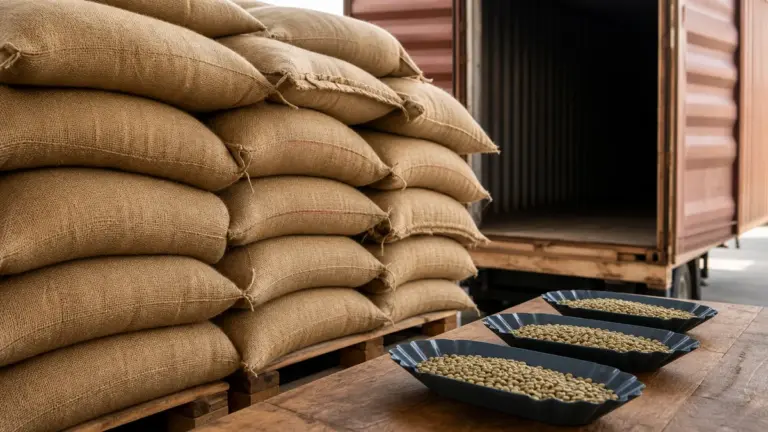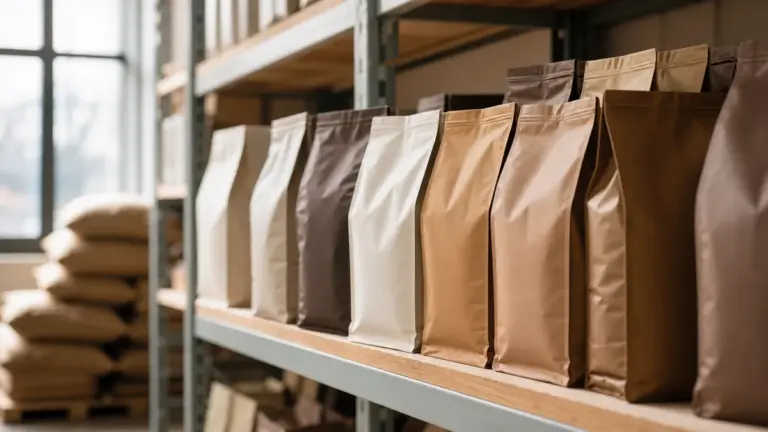
Direct trade is coffee sourcing built around a buyer’s relationship with an identifiable producer, rather than a single agreed certification scheme. Coffee auctions sell individual lots through competitive bidding, often after quality assessment; both approaches can give producers recognition and access to buyers, but neither automatically proves fair treatment or a dependable income.
In short
- “Direct trade” has no single industry-wide definition, minimum payment requirement or universal independent audit.
- Relationship coffee emphasises repeated buying and collaboration, but a relationship is not necessarily a binding purchasing commitment.
- Cup of Excellence began in 1999. Its competitions identify coffees for auctions managed by the Alliance for Coffee Excellence.
- A published auction result or export payment is not the same as the amount an individual farmer receives.
- Look for named producers, clear contract terms, repeat purchasing and independently checked disclosures, not just a sourcing slogan.
What does direct trade mean?
Direct trade usually describes a roaster developing a sourcing relationship with a farmer, cooperative or other producer organisation. The intended distinction is that the buyer knows who produced the coffee and participates in discussions about quality, purchasing terms and future supply.
However, the words alone tell you surprisingly little. There is no single industry-wide direct trade standard defining who must communicate, how much coffee must be bought or what independent checks must take place. Treat an unsupported direct trade label as a marketing claim, not a certificate.
Individual businesses set their own criteria. Stumptown, for example, describes its approach through quality-linked payments, transparency between trading partners and relationships maintained over many years. Those are the company’s stated principles, not requirements that every seller using the term must follow.
Nor does stronger documentation turn direct trade into a universal certification. Audited payment and contract disclosures can substantiate particular claims, but readers still need to know what was checked and against which rules.
Within the wider coffee industry, this is best understood as an approach to sourcing, rather than a completely separate trading system.
Direct does not mean nobody else is involved
An exporter or importer can still have a legitimate role. Coffee must be prepared for export, transported, documented and delivered, even when a roaster and producer negotiate directly.
Cup of Excellence provides a useful example: its auctions connect buyers with named producers, yet designated exporters prepare and ship the winning lots. The important question is not simply how many organisations appear in the chain, but what each does and whether its role is clear.
Our guide to importers and exporters explains those responsibilities without assuming that every intermediary is either essential or exploitative.
Relationship coffee: what continuity should mean
Relationship coffee puts the emphasis on an ongoing commercial partnership rather than a single purchase. It can involve repeated buying, feedback on samples, discussion of processing choices and support intended to improve quality.
The useful mechanism is communication. A producer who understands a buyer’s preferences can make better-informed decisions; a buyer who understands harvest conditions can discuss realistic expectations. Stumptown’s published approach, for instance, includes regular visits and frequent feedback.
But familiarity and contractual security are different things. A visit does not guarantee another order, and a long relationship does not tell you what happens after a disappointing harvest.
For a meaningful account of relationship sourcing, ask:
- How long have the partners traded, and has purchasing continued each harvest?
- What volumes are agreed, rather than merely hoped for?
- When is payment due?
- What happens if quality or available volume changes?
- Can the producer explain the relationship in their own words?
These are editorial checks, not a proposed certification. They help distinguish a continuing commitment from an attractive photograph and a farm name.
How online coffee auctions work
A coffee auction offers identifiable lots, meaning separately defined batches of coffee, to competing buyers. In the specialty auctions discussed here, buyers can assess samples before deciding which lots to pursue.
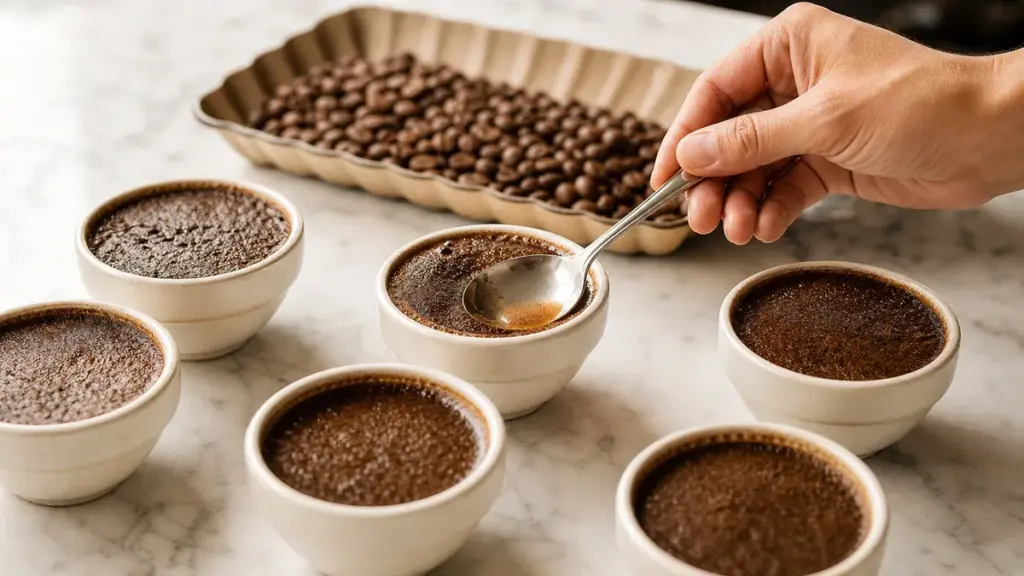
Cup of Excellence combines a competition with an auction. Coffees pass through coded, blind cuppings, the trade’s structured tasting process, involving national and international juries. Blind assessment means the tasters judge the coded coffee without its producer’s identity guiding their decision.
After selection, prospective buyers evaluate samples and approved bidders participate online. The eventual sale still requires payment, export arrangements and delivery.
The following comparison uses three criteria: how the coffee is selected, how the buyer obtains it and what the description alone establishes.
| Route | Selection and purchase | Who it suits | Main limitation |
|---|---|---|---|
| Negotiated direct trade | Buyer and producer agree a purchase under the buyer’s sourcing approach | Buyers seeking producer involvement | The term has no universal requirements |
| Relationship coffee | Continuing collaboration, usually involving repeat purchases | Partners seeking continuity | History does not prove future commitment |
| Cup of Excellence auction | Competition selection followed by competitive bidding | Buyers seeking assessed, traceable lots | Winning a lot does not ensure repeat trade |
| Private collection auction | A selected farm or group offers a curated collection | Buyers exploring a particular producer or origin | Selection rules differ between events |
These routes can overlap. An auction purchase might introduce partners who later negotiate directly.
Read the auction rules before bidding
Auction mechanics are not identical everywhere. ACE’s current platform guidance describes both simultaneous-lot auctions and live auctions where lots are offered in sequence. Buyers should therefore read the agreement for the particular event, rather than rely on an old account of how an auction worked.
ACE also states that confirmed bids are binding. Sampling, approval to bid and understanding the shipping responsibilities belong before bidding, not afterwards.
For anyone starting a roastery, the practical challenge is not merely securing an interesting coffee. It is arranging a purchase that can be received, stored, roasted and sold appropriately.
Cup of Excellence, private auctions and record lots
Cup of Excellence
Cup of Excellence began in 1999. The organisational distinction matters: Cup of Excellence manages the competitions in partnership with the Alliance for Coffee Excellence, while ACE manages sampling and auctions.
Its published results can identify the producer, lot, processing method, score and winning buyer. That makes them useful records of particular transactions, rather than just promotional descriptions.
At the Ethiopia auction on 27 August 2024, Basha Bekele Butusha’s natural-process lot 1A, from Sidama, scored 90.50 points and was bought by Angelino’s Coffee. ACE reported that the winning bid established a Cup of Excellence record at the time.
That is a historical claim about that auction, not a claim that the result remains the latest record.
Private collection auctions
Private auctions may focus on one farm, an estate’s selected lots or a group of producers. They should not be confused with a national Cup of Excellence competition.
ACE’s Private Collection Auction guidelines require suitable quality, representative samples and infrastructure to protect and ship the coffee. For organisations representing multiple small farmers, the guidelines also require willingness to disclose the auction payment to each farmer.
“Private” therefore does not necessarily mean secret. Nevertheless, check who chose the coffees, who assessed them and which results or producer payments will be disclosed.
Best of Panama
Best of Panama is organised by the Specialty Coffee Association of Panama, usually shortened to SCAP. It is separate from Cup of Excellence.
In the auction held on 6 to 7 August 2025, a 20 kg washed Geisha lot from Hacienda La Esmeralda, scored at 98 points, was bought by Julith Coffee. SCAP reported the sale as a world auction record at the time.
The distinction between the two examples is important: the Ethiopia result was a record within Cup of Excellence, while SCAP described the Panama result in broader world-record terms. Neither description should be expanded into a claim about every coffee transaction, including unpublished private sales.
Price transparency: follow the payment to the recipient
Transparency is useful only when the disclosure says what the reported payment represents.
Farmgate refers to the payment to the producer. Free on board, or FOB, describes an export-stage basis that includes activities needed to prepare and place the coffee aboard the vessel. Ex-warehouse describes a later stage, after importing and associated handling.
Those stages must not be treated as interchangeable. Importer Primavera’s explanation, for example, distinguishes producer payment from milling, packaging, transport, financing and its own margin.
Ask a supplier for a documented breakdown covering:
- Recipient: an individual farmer, cooperative, mill, exporter or another business.
- Product: fresh cherries, parchment coffee or export-ready green beans. Parchment is dried coffee still enclosed in its protective husk.
- Basis: weight unit, delivery stage, harvest and payment date.
- Deductions: processing, transport, finance and other services.
- Verification: supporting records and the scope of any independent audit.
For a commercial purchase, obtain itemised written quotations and written delivery responsibilities.
A public auction result establishes a winning bid for a specific lot. Without the settlement and distribution records, it does not establish what each contributing farmer retained. The distinction is explored further in farmgate payments and income.
Criticisms and limits
A flexible label can conceal weak practice
Peer-reviewed research on roasters’ sourcing decisions identifies inconsistent definitions and concern about businesses benefiting from the direct trade label without equivalent commitments. This is evidence about sourcing practices and perceptions, not proof that every direct trade arrangement fails.
The practical response is to assess documented behaviour rather than award credibility to the label itself.
Quality recognition is not a complete welfare assessment
A competition score assesses coffee under that competition’s procedures. It should not be read as an audit of household income, workers’ treatment or environmental performance.
Similarly, KIT Royal Tropical Institute’s review of coffee suppliers found that direct trade has no common social or environmental requirements. A buyer needs separate evidence for those claims.
Auctions require more than a good harvest
ACE’s private-auction requirements include holding lots separately, providing representative samples, maintaining quality and coordinating shipment. Those requirements illustrate why access depends on organisation and infrastructure as well as cup quality.
An auction can create an opportunity for participating producers without being an accessible solution for every farm.
A record lot is not the whole business
The Ethiopia record concerned an identified sub-lot; the Panama example concerned 20 kg. Neither transaction, by itself, describes a producer’s whole harvest or long-term livelihood.
Our assessment is that the strongest evidence of responsible sourcing combines traceability, clear payment records and sustained purchasing. Direct trade and coffee auctions are useful routes to examine, but the evidence behind each transaction matters more than the headline.
FAQ
Is direct trade the same as Fairtrade?
No. Fairtrade is a defined standards and certification system, while direct trade has no single industry-wide equivalent. Fairtrade uses independent certification bodies to check compliance with its economic, social and environmental requirements. A direct trade relationship may involve certified coffee, but the direct trade description itself does not establish certification.
Can smaller roasters share an auction lot?
Yes, ACE describes buying groups in which participants share a lot and nominate a lead bidder. That arrangement needs clear written responsibilities: the lead bidder remains responsible if another participant withdraws or fails to pay. Confirm the allocation, shipping arrangements and current auction agreement before joining a group.
Does an auction-winning farm name prove that a bag contains the winning coffee?
No. Award recognition attaches to the identified competition lot, not automatically to every coffee from that farm. Ask the seller for the harvest, competition year and lot reference, then compare them with the organiser’s results. A producer may sell other coffees alongside the awarded lot.
Where to go next
Read Coffee Industry for the wider trading system, then Green Coffee Trading, Importers and Exporters to understand who handles coffee between producer and roaster. Farmgate Prices and Farmer Income explains why a disclosed transaction does not, on its own, establish a farming household’s income.
Sources
-
KIT Royal Tropical Institute, Andrea Vos, Who supplies KIT coffee? In search of a coffee brand that matches the sustainability ideals of KIT Royal Tropical Institute, 31 August 2020.
https://www.kit.nl/wp-content/uploads/2023/10/KIT-Coffee-Study-final.pdf
Used for direct trade definitions and the absence of common social, environmental and verification requirements. -
Stumptown Coffee Roasters, What is Direct Trade VS Fair Trade? Are all Stumptown Coffees Direct Trade?, 26 February 2025.
https://wholesalesupport.stumptowncoffee.com/hc/en-us/articles/34571902010125-What-is-Direct-Trade-VS-Fair-Trade-Are-all-Stumptown-Coffees-Direct-Trade
A company’s own explanation of its sourcing principles, not independent evidence of outcomes. -
Sustainability, Coffee Roasters’ Sustainable Sourcing Decisions and Use of the Direct Trade Label, volume 11, issue 19, article 5437, 2019.
https://www.mdpi.com/2071-1050/11/19/5437
Peer-reviewed research used for definition and accountability criticisms. -
Alliance for Coffee Excellence, About Us, undated.
https://allianceforcoffeeexcellence.org/about-us/
Used for the programme’s beginnings and the distinction between competition and auction organisations. -
Alliance for Coffee Excellence, Frequently Asked Questions, undated.
https://allianceforcoffeeexcellence.org/faq-2/
Used for blind selection, sampling, designated exporters and buying groups. -
Alliance for Coffee Excellence, Auction Platform Frequently Asked Questions, undated.
https://auction.allianceforcoffeeexcellence.org/en/faq
Used for auction formats, bidder agreements and binding bids. -
Alliance for Coffee Excellence, PCA Guidelines, undated.
https://allianceforcoffeeexcellence.org/pca-guidelines/
Used for private-auction eligibility, disclosure and infrastructure requirements. -
Alliance for Coffee Excellence, Ethiopia 2024, 2024, and Ethiopia COE 2024 Auction Results, official announcement, 2024.
https://allianceforcoffeeexcellence.org/ethiopia-2024/
https://www.linkedin.com/posts/alliance-for-coffee-excellence-inc.-ace-_ethiopia-coe-2024-auction-results-this-year-activity-7241901396688556032-hXua
Used together for the lot identity, auction date, buyer, score and historical record status. -
Specialty Coffee Association of Panama, Café Geisha de Panamá sacude al mundo con impresionantes récords mundiales, 7 August 2025.
https://scap-panama.com/cafe-geisha-de-panama-sacude-al-mundo-con-impresionantes-records-mundiales/
Used for the auction dates, producer, buyer, lot size, score and organiser’s historical record claim. -
Primavera Green Coffee, Transparency, undated.
https://www.primavera.coffee/transparency
Used for farmgate, FOB and ex-warehouse distinctions. -
Fairtrade International, How Fairtrade certification works, undated.
https://www.fairtrade.net/en/why-fairtrade/how-we-do-it/how-does-the-label-work/how-fairtrade-certification-works.html
Used for independent certification and audit requirements.
This article was researched using organiser results and rules, published sourcing explanations, certification guidance and research, with promotional claims distinguished from independently established outcomes.
Last checked: November 2026