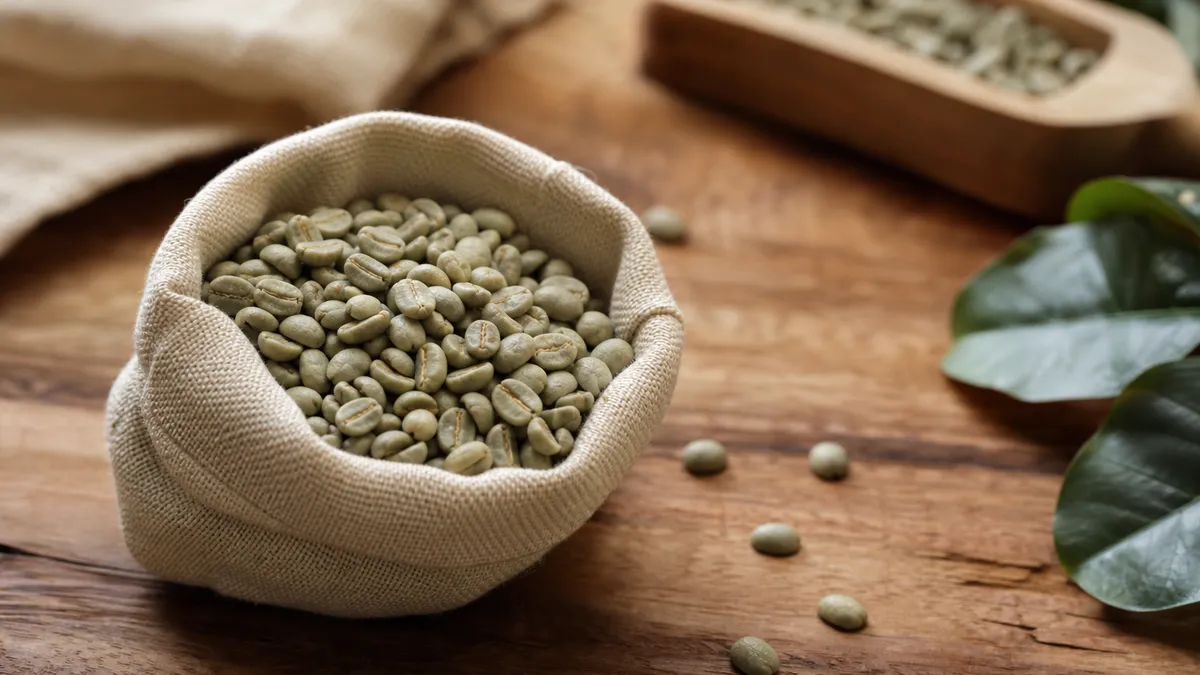
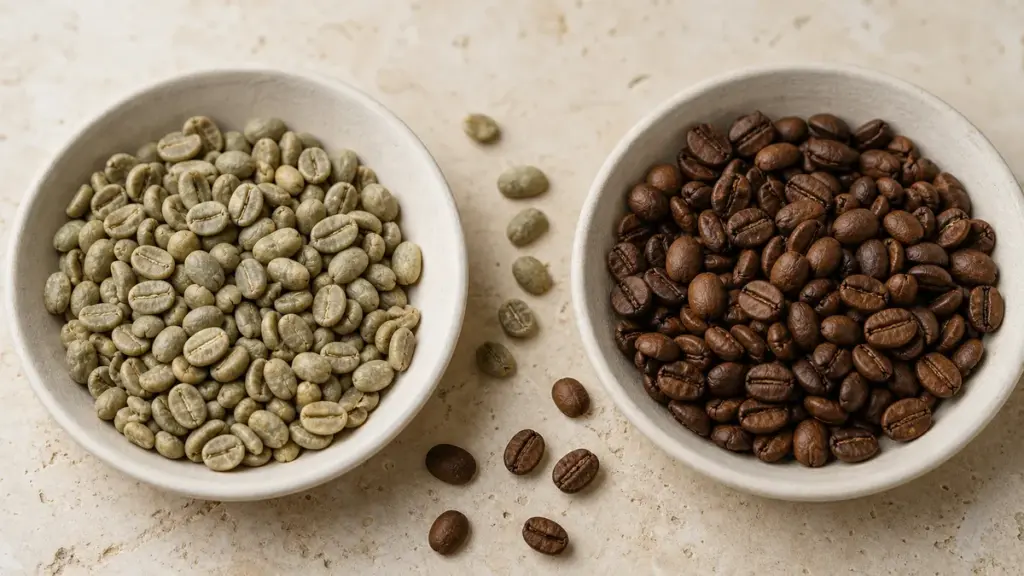
Green coffee beans are the dried, unroasted seeds of the coffee plant, prepared for roasting after the surrounding fruit and protective parchment have been removed. They are the raw material behind familiar brown coffee beans, not a separate coffee species or a naturally caffeine-free alternative.
In short
- “Green” means unroasted, not unripe: green coffee comes from processed coffee fruit.
- Colour varies from bluish-green to yellowish or brownish; the greenest beans are not automatically the best.
- The International Coffee Organization’s voluntary export quality programme specifies moisture between 8% and 12.5%, with exceptions for certain speciality coffees. That is not a universal ideal storage range.
- For home roasting, ask for harvest details, processing information, storage history and roasting guidance.
- Green coffee extract has been studied for weight loss, but the evidence does not justify promises of reliable, lasting results.
What are green coffee beans?
A coffee bean is a seed rather than a botanical bean. It develops inside the coffee plant’s fruit, commonly called a cherry, which usually contains two seeds.
Before coffee reaches a roaster, producers process and dry it, then remove the remaining outer material. The exact sequence depends on the processing method. In natural processing, the fruit dries around the seeds before hulling; in washed processing, the skin and much of the fruit material are removed earlier.
Green coffee is therefore not untouched fruit straight from the tree. It has already undergone substantial preparation, but it has not yet been roasted.
The word describes a processing stage, not an origin, variety or quality grade. Arabica, Coffea arabica, and robusta, Coffea canephora, can both be traded as green coffee. For the wider terminology, start with coffee beans and blends.
What roasting changes
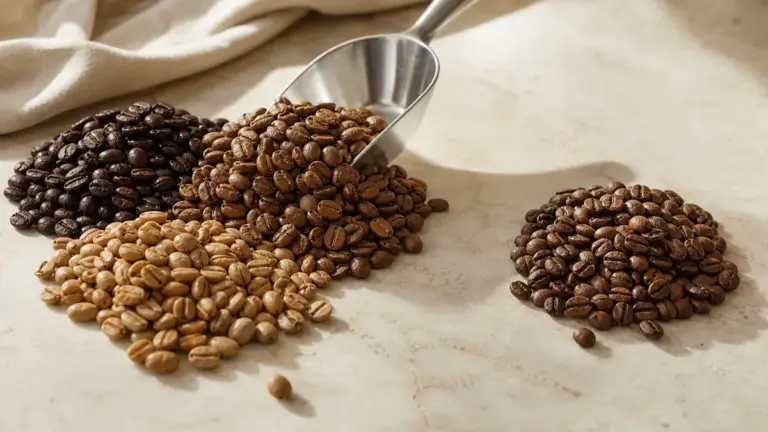
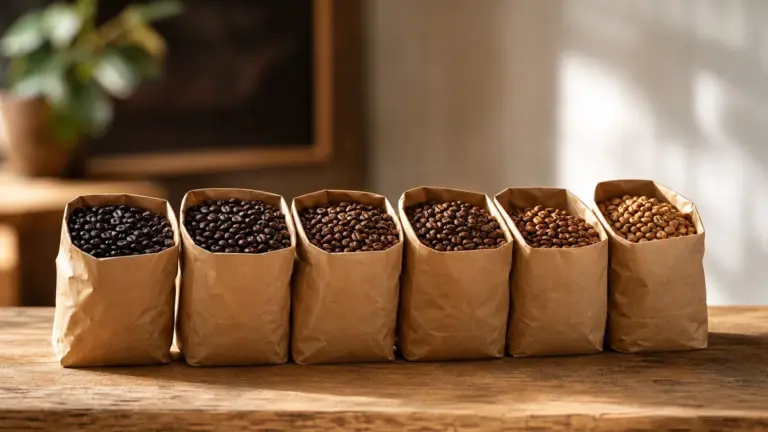
Roasting creates much of the flavour and aroma people recognise as coffee. Heat drives off moisture and triggers chemical reactions, including Maillard reactions, in which sugars react with amino compounds to produce browning and aromatic substances.
That is why a handful of green coffee does not smell like freshly ground roasted beans. The raw seed is a starting material, not a finished version of the same drink with its colour missing. Roasting changes its chemistry as well as its appearance.
What colour and density tell you
Green coffee is not always green
Unroasted coffee can look blue-green, pale green, yellowish or brown-green. Processing and remaining silverskin, the thin covering on the seed, help explain some of these differences. Decaffeinated green coffee can also look noticeably browner.
Colour can provide clues, but it cannot establish quality by itself. A pale appearance may reflect processing or storage history rather than a single identifiable fault. Conversely, a strong green colour does not prove that coffee has been dried properly or will taste good.
Look at the lot as a whole. Ask whether its appearance matches the supplier’s description, rather than judging it against a photograph of a different coffee.
Density is not the same as size
Density describes mass relative to volume. A large bean is not necessarily denser than a small one, and a heavy handful tells you little unless you know the volume it occupies.
There is also a distinction between bean density, concerning the beans themselves, and bulk density, which includes the gaps between beans in a container. ISO 6669 describes a standardised free-flow method for measuring whole-bean bulk density. Figures obtained by different methods should not be treated as interchangeable.
Growing conditions can affect density. A field study in Mozambique found higher apparent density in beans from the highest elevation studied, but that result is not a universal conversion rule between altitude and density. Avoid assuming that every high-grown coffee must behave identically in a roaster.
For a home roaster, density is useful background information, not a quality score or a complete roasting instruction.
| Feature | What it can help describe | What it cannot prove |
|---|---|---|
| Colour | Appearance, processing differences and possible storage changes | Flavour quality or safety |
| Bean size | The size distribution within a lot | Density or sweetness |
| Bulk density | Mass occupying a measured container volume | Individual bean density |
| Moisture content | How much water the coffee contains | Complete storage stability |
| Roasted sample tasting | Flavour under the stated roasting and brewing conditions | How every roast will taste |
Moisture: dried does not mean water-free
Green coffee still contains water. Its moisture content matters because drying and storage must preserve the coffee without allowing conditions that favour mould.
The International Coffee Organization’s Resolution 420 sets a moisture range of 8% to 12.5% for coffee meeting its voluntary export quality programme, with specified exceptions, including traditionally higher-moisture speciality coffees. These are trade programme limits, not a promise that every coffee within them has equal quality or storage life.
Codex guidance on preventing ochratoxin A contamination in coffee also identifies drying to a maximum moisture content of 12.5% as a preventive measure. Ochratoxin A is a toxin produced by certain moulds under suitable conditions.
Moisture content and water activity are different
Moisture content measures the amount of water present. Water activity describes how available that water is for processes such as microbial growth; it is not another way of writing the moisture percentage.
This distinction matters when interpreting a supplier’s specification. A moisture reading alone is not a complete assessment of storage stability, and neither measurement replaces sound handling and inspection.
For home use, ask whether the supplier measures moisture and water activity, when the readings were taken and how the coffee has been stored since. Do not try to estimate either figure from colour, hardness or the sound beans make in a scoop.
How to store green coffee at home
The main aim is to protect the coffee from unwanted moisture changes and contamination. Coffee can exchange moisture with its surroundings, so a damp utility room, leaking outbuilding or cupboard against a wet wall is a poor choice.
Controlled storage research also shows that temperature affects ageing. In one study, green coffee stored at 20°C aged faster than coffee held under the cooler conditions tested. That does not establish a single ideal temperature for every household, but it supports avoiding unnecessarily warm storage.
For ordinary home use, a cool, dry, stable indoor cupboard is a sensible starting point. Choose somewhere you can inspect the coffee regularly, rather than somewhere merely convenient for a large sack.
A practical routine is:
- Keep the supplier’s lot information. Record the coffee’s identity, harvest details where available and the date received.
- Inspect the packaging on arrival. Check for wet patches, damage and evidence of contamination before putting it away.
- Use clean, food-suitable packaging. Retain a suitable protective liner or transfer the coffee into a clean, dry container that closes securely.
- Keep different lots separate. This preserves traceability and makes changes easier to investigate.
- Check before roasting. If beans are wet, visibly mouldy or strongly musty, set them aside and contact the supplier rather than attempting a rescue roast.
These are handling checks, not a home laboratory test. Normal appearance and smell cannot certify that a lot is free from contamination.
How long will it keep?
There is no single dependable shelf life for all green coffee. Processing, packaging, temperature and previous storage conditions all matter, and deterioration in flavour is a different question from whether coffee is safe to use.
Ask the supplier for a realistic use window for that particular lot. Buy an amount you expect to roast within it, rather than assuming unroasted coffee keeps indefinitely. Keep brief tasting notes as you work through the supply so that gradual changes do not pass unnoticed.
Buying green coffee for home roasting
Choose green coffee sold specifically for roasting, with enough information to understand what you are buying. A country name and an attractive picture are not much help when you are trying to repeat a successful roast.
Useful questions include:
- What is the lot? Ask for the country, region and producer or co-operative where known.
- When was it harvested? Distinguish the harvest from the date the seller packed your order.
- How was it processed? Ask for an explanation of unfamiliar processing terms.
- How has it been stored? Find out about protective packaging and any available moisture measurements.
- What roasting guidance is supplied? Seek advice relevant to your equipment, including a suitable starting batch size.
- What do the tasting notes describe? Ask about the roasted sample and the roast level used to assess it.
As an editorial recommendation, start with a clearly described lot and enough coffee for several repeat batches. Changing the green coffee after every roast makes it harder to separate differences in the raw material from differences in your technique.
An origin name is not a roasting programme, and a blend is not inherently inferior raw material. The separate single-origin versus blends guide explains those buying categories without confusing them with roast level.
Keep early experiments straightforward. If you later want to combine coffees, coffee blending covers that subject; mixing several unfamiliar lots immediately makes troubleshooting less clear.
Before the first batch, read the roaster’s instructions, including its ventilation, loading, cooling and cleaning requirements. Roasting requires supervision: manufacturer guidance warns that coffee can ignite, and automatic programmes are not permission to leave the appliance unattended.
Green coffee extract: what does the evidence show?
Green coffee extract is a preparation made from unroasted coffee, often marketed as a supplement. It is not equivalent to a bag of green beans intended for roasting.
Green beans contain chlorogenic acids, a group of plant compounds generally present at higher levels before roasting. They also naturally contain caffeine. Neither fact, by itself, demonstrates that taking an extract produces a useful health benefit.
Weight-loss findings need context
A 2023 umbrella review, a review of existing meta-analyses, pooled findings from intervention studies and reported small reductions in body weight and related measurements. Its authors interpreted the results favourably.
The US National Institutes of Health’s Office of Dietary Supplements takes a more cautious view. Its evidence summary describes possible modest weight effects, highlights poor methodological quality in the trials it assessed and notes that one prominently promoted trial was subsequently retracted.
The reasonable conclusion is not that every study found no effect. It is that the evidence does not establish green coffee extract as a reliable route to lasting weight loss. Results from particular extracts and trial conditions also cannot simply be transferred to homemade green coffee drinks.
Safety is not established by the word “natural”
The NIH notes that green coffee extract’s safety has not been rigorously studied. Its caffeine can cause unwanted stimulant effects, depending on the dose and other products taken alongside it.
Check the complete ingredients and declared caffeine content rather than relying on the product name. During pregnancy, NHS guidance is no more than 200 mg of caffeine a day from all sources; that limit is not an endorsement of weight-loss supplements. Speak to a GP, pharmacist or midwife about supplements, especially during pregnancy or breastfeeding, when taking medicines, or if caffeine causes symptoms.
For the coffee enthusiast, green coffee beans are most usefully understood as a roasting ingredient, not a shortcut to better health.
FAQ
Can green coffee beans go in a bean-to-cup machine?
No, use the roasted coffee specified by the machine manufacturer. Green beans are not sufficiently brittle for ordinary coffee grinding: Breville’s grinder guidance explicitly warns against grinding unroasted green coffee. Keep green and roasted supplies clearly separate, and check your own machine’s instructions before putting anything unfamiliar into its hopper.
Should I freeze green coffee beans?
Freezing is not necessary for a beginner’s routine supply. Controlled research found benefits from cooler storage, including frozen conditions, but that does not establish a universal household freezing method. Packaging and moisture control still matter. For longer storage, ask the supplier for lot-specific advice rather than repeatedly moving coffee between different conditions.
Does green coffee naturally contain caffeine?
Yes, green coffee naturally contains caffeine before roasting. “Green” does not mean decaffeinated, and a green coffee supplement may contribute to your total intake alongside coffee, tea and other products. Check the specific product information rather than assuming its caffeine content from its colour, serving size or health-focused marketing.
Where to go next
Read Coffee Beans and Blends for the broader vocabulary surrounding green coffee beans and their roasted counterparts. Single-Origin vs Blends explains how those purchasing categories differ, while Coffee Blending is the next step when you want to understand how coffees are combined.
Sources
- FAO/WHO Codex Alimentarius, Code of Practice for the Prevention and Reduction of Ochratoxin A Contamination in Coffee, CAC/RCP 69-2009, 2009.
https://www.fao.org/input/download/standards/11250/CXP_069e.pdf - International Coffee Organization, Resolution Number 420: Coffee Quality-Improvement Programme, Modifications, 21 May 2004.
https://ico.org/documents/iccres420e.pdf - Specialty Coffee Association, Coffee Decoded: Flavor from the Fires, Why Roast Color Matters, undated year on the retrieved page.
https://sca.coffee/sca-news/coffee-decoded-4-roast-color - Sweet Maria’s, Thompson Owen, Green Coffee FAQ, 2023. Used for the supplier’s direct explanation of green coffee colour and processing differences.
https://library.sweetmarias.com/green-coffee-faq/ - International Organization for Standardization, ISO 6669:1995: Green and Roasted Coffee, Determination of Free-Flow Bulk Density of Whole Beans (Routine Method), edition 1, 1995. Public abstract consulted, not the full standard.
https://www.iso.org/standard/13098.html - Cassamo and colleagues, Shade and Altitude Implications on the Physical and Chemical Attributes of Green Coffee Beans from Gorongosa Mountain, Mozambique, Agronomy, 2022.
https://research.unl.pt/ws/portalfiles/portal/56516487/Shade_and_Altitude_Implications_on_the_Physical_and.pdf - Polish research team, Scientific Reports, Effect of Green and Roasted Coffee Storage Conditions on Selected Characteristic Quality Parameters, 2023.
https://pmc.ncbi.nlm.nih.gov/articles/PMC10119118/ - Behmor, Behmor Roaster Quick Start Guide, undated. Manufacturer’s operating and safety guidance, not an independent performance assessment.
https://behmor.com/knowledge-base/behmor-roaster-quick-start-guide/ - Breville, The Oracle Touch: Instruction Book, BES990, G23 document version, 2023. Manufacturer’s grinder-use guidance.
https://assets.breville.com/BES990/BES990_KOR-EN_IB_G23_LR.pdf - US National Institutes of Health, Office of Dietary Supplements, Dietary Supplements for Weight Loss: Health Professional Fact Sheet, updated 18 May 2022.
https://ods.od.nih.gov/factsheets/WeightLoss-HealthProfessional/ - Yang and colleagues, The Effect of Green Coffee Extract Supplementation on Obesity Indices: Critical Umbrella Review of Interventional Meta-Analyses, published online 2023.
https://pubmed.ncbi.nlm.nih.gov/37341701/ - NHS, Foods to Avoid in Pregnancy, current web guidance retrieved November 2026.
https://www.nhs.uk/pregnancy/keeping-well/foods-to-avoid/
Researched using international coffee and food-safety guidance, published research, a specialist supplier’s processing explanation and manufacturers’ operating instructions; no first-hand testing was undertaken.
Last checked: November 2026