Italian espresso culture is the everyday ritual of meeting, pausing and drinking a small coffee, often standing at the counter of a neighbourhood bar. The essential distinction is between customs and rules: ordering un caffè normally means espresso, cappuccino belongs chiefly to breakfast, and payment arrangements depend on the establishment.
In short
- Al banco means at the counter; al tavolo means at a table, where a different tariff may apply.
- Some bars require payment at the cassa, or till, before you take your scontrino, the receipt, to the barista.
- Espresso accompanies breaks throughout the day and commonly follows meals.
- The familiar “no cappuccino after 11 am” advice describes a breakfast tradition, not a universal service deadline.
- Regional vocabulary matters: an espresso in Trieste can be a nero, while Naples is associated with the generous caffè sospeso tradition.
The bar at the centre of Italian espresso culture
An Italian bar is closer to a café than the word suggests to many British visitors. It can provide breakfast coffee and pastries, lunchtime snacks and an evening aperitivo, the drink taken before dinner. Coffee is part of its daily rhythm rather than its only purpose.
The pausa caffè, or coffee break, is also an opportunity to talk. Friends and colleagues exchange news at the counter, and the conversation need not last longer than the drink. A short visit is not necessarily an impersonal one.
That is the useful starting point for understanding the ritual. The cup matters, but so does the familiar place in which it is served. Our coffee culture guide places this relationship between drink, setting and custom in its wider context.
For a visitor, there is no need to reproduce every local habit. Learn how the particular bar works, order clearly and leave yourself enough attention to enjoy the coffee rather than treating the visit as an etiquette examination.
Standing at the banco and understanding pricing culture
Drinking al banco, standing at the counter, is a widespread Italian habit. You order, receive the coffee and drink it there, rather than automatically looking for a seat. This is especially useful to understand if your normal café routine involves settling at a table.
Al tavolo describes the seated alternative. Counter service and table service can have separate tariffs, particularly in city cafés. The distinction concerns the way you are served, not simply whether the espresso itself is different.
Before sitting down, check the displayed menu and establish whether it applies to the counter or the tables. Do not assume that taking a drink from the counter to a seat leaves the service arrangement unchanged. Asking first is clearer than trying to infer the answer from the furniture.
Equally, avoid treating a familiar espresso figure quoted in a travel guide as a nationwide promise. For the practical purpose of ordering, the establishment’s current list matters. This guide gives no monetary benchmarks: understand the service distinction and check locally.
Standing is an option, not a test of authenticity. Choose the counter for a brief pause or a table when you want a seated visit, after confirming the arrangements.
How to order and pay without confusion
The cassa and the coffee counter may be separate stations. In many bars, particularly busy transport venues and larger city establishments, customers pay at the till first, then take the receipt to the person preparing the drinks. Elsewhere, payment follows service.
Use this straightforward sequence:
- Look before joining a queue. Check for a separate till and any instruction about payment.
- Ask if necessary. Si paga prima? means “Do we pay first?”
- Name the drink clearly. Un caffè, per favore means “A coffee, please” and normally requests an espresso.
- Follow the receipt system. Where payment comes first, keep the scontrino and show or hand it to the barista, repeating your order.
- Drink where you have arranged to be served. If you want a table, establish that before ordering.
- Finish with a thank you. Grazie is enough; elaborate coffee vocabulary is not required.
Think of this as a way to avoid uncertainty, not a compulsory national choreography. A receipt-first system separates taking payment from making drinks. Following it helps the staff understand that your order has already been paid for.
If you are unsure, a short question is preferable to confidently joining the wrong queue. There is no benefit in memorising a procedure so rigidly that you overlook what the bar in front of you is doing.
Drinks and their place in the day
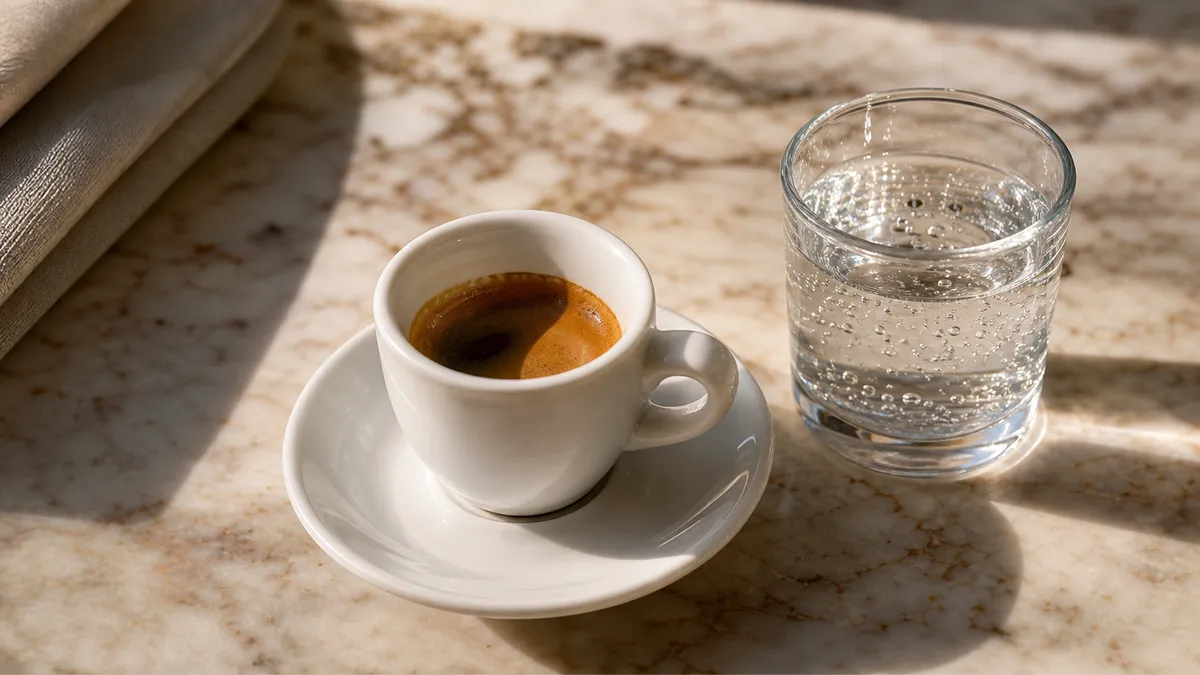
The key word is caffè. In an ordinary Italian bar order, it generally means espresso rather than a large mug of filter coffee. Naming a different preparation tells the barista how you want that basic coffee changed.
| Order | What it means | Useful distinction |
|---|---|---|
| Caffè | Espresso | The usual starting point for a coffee order |
| Caffè macchiato | Espresso with a small addition of milk | Still chiefly a small coffee, not a large milk drink |
| Ristretto | A shorter espresso extraction | Less beverage is extracted through the coffee |
| Lungo | A longer espresso extraction | Not the same preparation as adding water afterwards |
| Cappuccino | Espresso with steamed milk and milk foam | Strongly associated with breakfast |
| Caffè latte | Coffee with a larger milk component | Say the complete name; latte means milk |
| Caffè corretto | Espresso with an added spirit | Contains alcohol; specify the spirit if you have a preference |
Breakfast commonly brings cappuccino or another milk-rich coffee alongside something to eat. Espresso also appears at breakfast, during a mid-morning pause and after meals. A macchiato provides a small milk addition without turning the drink into a full breakfast-style milk coffee.
The ristretto and lungo distinction concerns extraction, meaning the process of dissolving substances from ground coffee into water. A lungo runs more water through the grounds; an americano adds hot water to espresso afterwards. They should not be treated as interchangeable names for a larger coffee.
For ordering, start with the experience you want: a small black coffee, a small coffee softened with milk, or a milk-rich drink. That choice is more useful than trying to rank the names by how “Italian” they sound.
Why cappuccino belongs to breakfast
Cappuccino timing makes more sense when understood through meals rather than the clock. Milk-rich coffees are established breakfast drinks, often paired with a pastry. After lunch or dinner, the conventional coffee is espresso rather than another substantial milk drink.
Travel advice often compresses this into “never order cappuccino after 11 am”. Eataly and Lavazza both describe that familiar convention strongly. It is useful guidance about traditional expectations, but it should not be turned into a claim that every bar stops making cappuccino at the same moment.
The cultural distinction is between breakfast and the coffee that follows a meal. If you want to follow the customary pattern, order cappuccino with breakfast and espresso after lunch. If you want cappuccino later, ask whether it is available rather than assuming either refusal or disapproval.
Some explanations invoke the belief that milk is too heavy after food. That is a description of a cultural belief, not medical evidence that cappuccino becomes unsuitable at a particular hour. There is no need to attach a health claim to a breakfast preference.
Breakfast itself is not uniform. Italia.it describes Genoese focaccia with cappuccino or caffè latte, showing why the standard image of coffee beside a sweet pastry is only part of the story.
Regional differences worth knowing
Regional variation is more useful than a rigid checklist of supposed national rules. It can change the words you order with, what accompanies the coffee and even the form of the drink.
Trieste: learn the local vocabulary
In Trieste, a nero is an espresso. A capo is the local term for a small milk-marked coffee, and capo in b means that drink served in a glass, with the “b” standing for bicchiere.
These names are a good reason to ask what a local order means before copying it. A word that resembles a familiar drink name may refer to a different preparation.
Naples: the caffè sospeso
A caffè sospeso, literally a suspended coffee, is an act of generosity rather than a recipe. A customer pays for an additional coffee to be made available later to someone who needs it.
Gran Caffè Gambrinus describes this Neapolitan custom as offering coffee to a stranger. Ask whether a bar participates and how it handles the arrangement. Do not assume every establishment operates the same system.
Lecce: espresso over ice
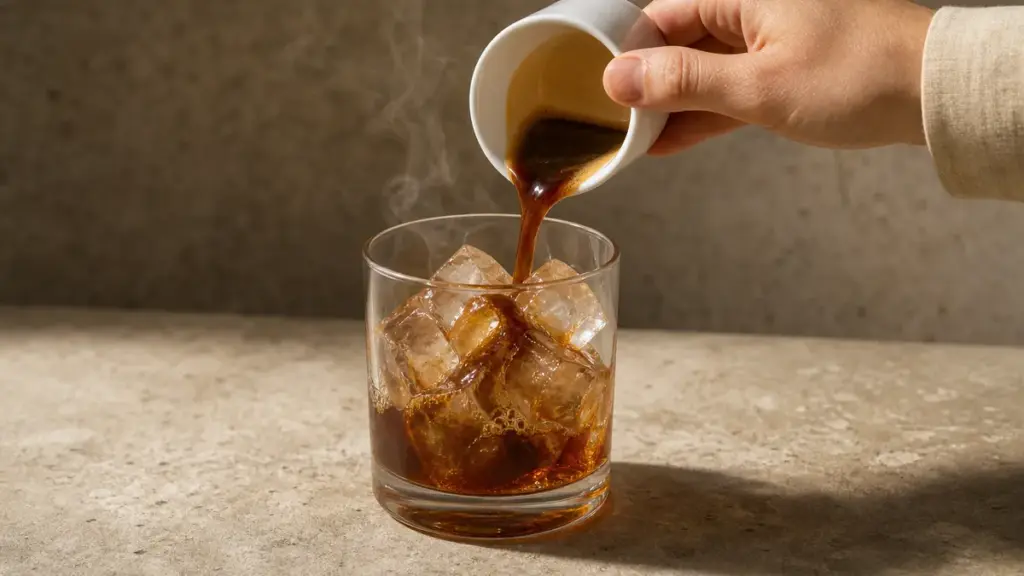
In the Lecce area of Salento, caffè in ghiaccio is hot espresso poured over ice in a glass. The regional traditional-food register also describes the optional addition of latte di mandorla, almond milk, according to local tradition.
This is a useful reminder that Italian coffee culture includes cold preparations as well as hot espresso.
Turin: coffee, chocolate and cream
Turin’s bicerin combines coffee, chocolate and milk cream in a glass. The local tourism board advises enjoying it without stirring, allowing the layers to meet as you drink.
It is a distinct local speciality, not simply another name for espresso. Regional drinks reward curiosity more than assumptions.
Etiquette: attention matters more than performance
A practical approach is to separate service instructions from cultural preferences. Where to order, when to pay and whether a table has separate service are matters to establish with staff. Breakfast pairings and favourite preparations are traditions to understand, not rules you must imitate.
Keep your order concise when the counter is busy. Decide on the drink before your turn, make any request for milk clear and avoid occupying the serving space while debating the menu. These are sensible courtesies rather than uniquely Italian obligations.
Nor should the speed of a counter visit make you rush a drink that is uncomfortably hot. The aim is to participate comfortably, not to perform a timed version of local life.
Italian espresso culture becomes easier to understand when you watch the particular place rather than search for a single script. Learn the service system, notice the regional choices and let the coffee break remain a pleasure.
FAQ
What happens if I order just “latte”?
Latte means milk, so use caffè latte if you want coffee with milk. A familiar shortened British café order does not necessarily carry the same meaning in Italy. If you want a small espresso with only a little milk, ask for a caffè macchiato instead.
Is caffè sospeso a special kind of espresso?
No, caffè sospeso describes an arrangement for giving coffee to someone else, not a different brewing method. You pay for an additional coffee that remains available for a later recipient. Ask whether the bar takes part and follow its procedure rather than leaving an unexplained payment.
Should I stir a bicerin?
The Turin tourism board recommends drinking bicerin without stirring it. Its coffee, chocolate and milk-cream components are intended to meet as you sip, with contrasting textures and temperatures. That advice belongs to this particular layered speciality, so it should not be generalised into a rule for every Italian coffee.
Where to go next
Read Swedish Fika and Nordic Coffee Culture for another way of organising a coffee break, or Turkish Coffee Rituals to explore a different relationship between preparation and hospitality. Ethiopian Coffee Ceremony is the next read for a closer look at coffee served through a more extended ceremonial sequence.
Sources
Publication years are stated where supplied by the retrieved page; otherwise the source is identified as undated.
-
The Open University, Beginners’ Italian: food and drink, undated course, retrieved 2026. Sections on al bar, ordering and payment.
https://www.open.edu/openlearn/mod/oucontent/view.php?id=20337&printable=1
Supports bar functions, conversation, receipt-first service and counter/table distinctions. -
Italian Ministry of Education, University and Research, Study in Italy: Mangiare all’italiana, undated.
https://miur.mur.gov.it/studiare-in-italia/about/eating.html
Supports breakfast customs, standing at the counter and coffee after meals. -
Lavazza, Italian Coffee Culture: Drinks, History & Etiquette, undated.
https://www.lavazzausa.com/en/coffee-secrets/italian-style-coffee-history-types-culture
Supports ordering terminology, drink distinctions and conventional cappuccino timing. Used as a producer’s account of coffee customs, not independent medical evidence. -
Eataly, A Guide to Italian Coffee Culture, undated.
https://www.eataly.com/us_en/magazine/culture-and-tradition/italian-coffee-culture
Supports milk-drink vocabulary and the commonly stated breakfast convention. -
Italia.it, The traditional Italian breakfast in 6 cities, undated.
https://www.italia.it/en/italy/things-to-do/traditional-italian-breakfast-in-6-italian-cities
Supports regional breakfast variation, including Genoese focaccia with milk coffee. -
PromoTurismoFVG, A journey through coffee to discover the treasure of Trieste, 20 June 2018.
https://www.turismofvg.it/en/2018/06/20/a-journey-through-coffee-to-discover-the-treasure-of-trieste/?LangSetCMS=en
Supports Triestine ordering vocabulary. -
Gran Caffè Gambrinus, Caffè sospeso, from the ancient Neapolitan habit to national phenomenon, 9 October 2017.
https://grancaffegambrinus.com/en/caffe-sospeso-from-the-ancient-neapolitan-habit-to-national-phenomenon/
Supports the meaning and charitable purpose of suspended coffee. -
PAT Puglia, Atlante dei PAT: Caffè in ghiaccio, undated entry, retrieved 2026.
https://www.patpuglia.it/it/12/Caff%C3%A8_in_ghiaccio/1_413_C
Supports the Lecce-area drink, espresso-over-ice preparation and optional almond-milk addition. -
Turismo Torino e Provincia, Bicerin, undated.
https://turismotorino.org/en/visit/things-to-do-and-things-to-see/food-and-wine/chocolate/bicerin/
Supports the ingredients, glass presentation and advice not to stir.
This piece was researched through live retrieval of university teaching material, Italian government and tourism resources, and first-party coffee and venue accounts, distinguishing documented customs from editorial advice.
Last checked: November 2026