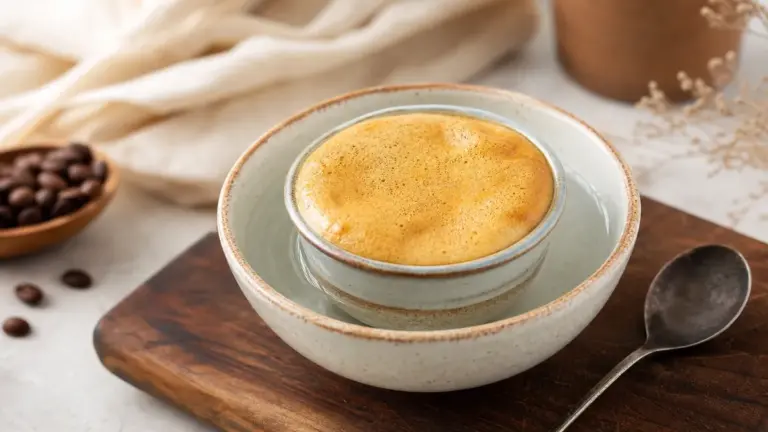
An iced latte combines espresso, cold milk and ice; an iced Americano uses cold water instead of milk; shaken espresso is shaken with ice to make a chilled, frothy drink. Start with a normal espresso rather than a large hot coffee, measure the milk or water, and allow for the extra dilution from melting ice.
In short
- Use cold milk or chilled drinking water, not hot ingredients that the ice must then cool.
- Weigh ice for repeatable results: cube counts vary considerably between trays.
- The recipes below use 60 ml of espresso per serving, with different amounts of milk or water.
- For shaken espresso, use a cocktail shaker with ice, never a sealed container of hot coffee alone.
- Sweeten gradually with syrup, starting with 5 ml to 10 ml rather than an unmeasured pour.
Choose your iced espresso drink
Choose by texture first. An iced latte is milk-led, an iced Americano keeps the coffee flavour unobscured by milk, and shaken espresso adds an airy head of foam.
| Drink | What goes with the espresso | Texture | Choose it when |
|---|---|---|---|
| Iced latte | Cold milk and ice | Milky, with optional layering | You want a longer milk drink |
| Iced Americano | Cold water and ice | Light-bodied, without milk | You want to taste the coffee more directly |
| Shaken espresso | Ice, optional syrup and a little optional milk | Frothy and coffee-led | You want texture without a full glass of milk |
These are hot-brewed drinks chilled during preparation, not cold brew. You can find other styles in coffee recipes, but the useful starting point here is the same: make espresso that tastes balanced before adding anything else.
The quantities below are suggested starting recipes, not official drink standards. Keep the espresso constant while adjusting the milk, water or syrup, so you know which change helped.
Ice and dilution: treat melting water as an ingredient
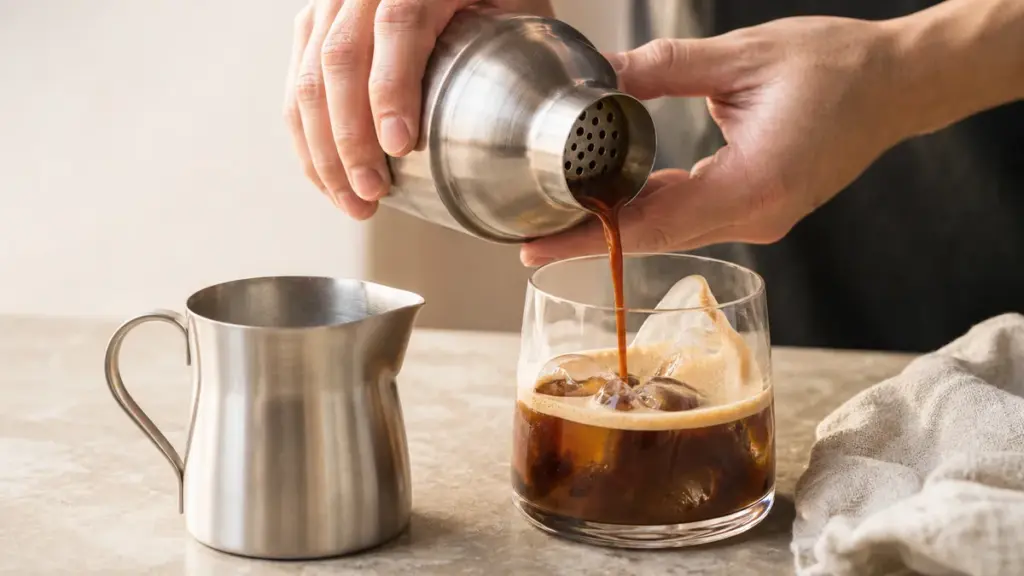
Ice does two jobs: it chills the drink and, as it melts, adds water. Some melting is therefore part of making iced coffee, not evidence that something has gone wrong.
The problem is uncontrolled dilution. A large volume of hot liquid gives the ice more heat to absorb, while a drink left standing continues to gain heat from its surroundings. Starting with chilled milk or water reduces the cooling work left for the ice.
For repeatable drinks:
- Use fresh drinking water for ice and clean trays.
- Weigh the ice rather than counting cubes.
- Keep the cube size reasonably consistent between attempts.
- Measure the milk or water before adding it.
- Stir, taste and adjust before topping up the glass.
Do not fill every available gap with milk or water. A larger glass does not necessarily need a larger drink.
For example, suppose an iced Americano contains 60 ml espresso and 120 ml water. If 30 g of ice subsequently melts, it adds approximately 30 ml of water, bringing the liquid volume to roughly 210 ml. That is an illustration, not a prediction of how much your ice will melt.
Iced latte recipe
An iced latte needs cold milk, not steamed milk left to cool. Pouring espresso over the milk produces attractive swirls, but stir before drinking if you want consistent flavour from the first sip to the last.
Serves: 1
Time: about 5 minutes once the machine is ready
Equipment: espresso machine, heatproof espresso cup, kitchen scales, measuring jug, spoon and approximately 400 ml glass
Ingredients
- 60 ml freshly brewed espresso
- 160 ml cold pasteurised milk or a suitable chilled plant-based alternative
- 120 g ice cubes
- Optional: 5 ml to 10 ml coffee syrup
Approximate caffeine: 80 mg using EFSA’s reference estimate for 60 ml espresso. This is not a measurement or an upper limit for your coffee. See the pregnancy and sensitivity note below.
Method
- Put 120 g ice into the serving glass.
- Add 160 ml cold milk.
- Brew 60 ml espresso into the heatproof cup, using your machine’s normal espresso preparation.
- If using syrup, stir it into the espresso.
- Pour the espresso slowly over the milk and ice.
- Stir, taste and serve immediately.
For a more coffee-forward version, try 120 ml milk next time, keeping the other quantities unchanged. If you prefer a gentler drink, increase the milk modestly rather than automatically adding more syrup.
Cold milk does not need frothing for this recipe. Foam is an optional texture choice, not a requirement for an iced latte.
Iced Americano recipe
An iced Americano combines espresso with cold water and ice. Make the espresso normally, then add the separate water: do not run the entire drink volume through the coffee grounds.
Serves: 1
Time: about 5 minutes once the machine is ready
Equipment: espresso machine, heatproof espresso cup, kitchen scales, measuring jug, spoon and approximately 350 ml glass
Ingredients
- 60 ml freshly brewed espresso
- 120 ml chilled drinking water
- 120 g ice cubes
- Optional: 5 ml coffee syrup
Approximate caffeine: 80 mg using EFSA’s reference estimate for 60 ml espresso. Actual content varies with the coffee and preparation. See the pregnancy and sensitivity note below.
Method
- Put 120 g ice into the glass.
- Add 120 ml chilled water.
- Brew 60 ml espresso into the heatproof cup.
- Stir in the optional syrup.
- Pour the espresso over the cold water and ice.
- Stir gently and taste before adding anything else.
If it is too concentrated, add cold water in 20 ml increments. If it is thin, reduce the initial water next time rather than making a longer espresso extraction.
This is the simplest of the three drinks for comparing coffees. Keep the water and ice quantities fixed, then change the coffee. Otherwise, a difference in dilution can easily be mistaken for a difference between beans.
Shaken espresso recipe
Shaking espresso with ice chills and aerates it, producing a frothy surface. This version uses a small optional milk addition, rather than the larger milk quantity in the iced latte.
Serves: 1
Time: about 5 minutes once the machine is ready
Equipment: espresso machine, heatproof espresso cup, approximately 500 ml cocktail shaker with strainer, scales, measuring jug, spoon and approximately 350 ml glass
Ingredients
- 60 ml freshly brewed espresso
- 150 g ice for shaking
- 80 g fresh ice for serving
- Optional: 10 ml cooled simple syrup
- Optional: 40 ml cold milk or plant-based alternative
Approximate caffeine: 80 mg using EFSA’s reference estimate for 60 ml espresso. Milk and syrup do not make that estimate more reliable. See the pregnancy and sensitivity note below.
Method
- Brew 60 ml espresso into the heatproof cup and stir in the optional syrup.
- Put 150 g ice into the open cocktail shaker.
- Pour the espresso over the ice. Stir briefly with the shaker open until the liquid is cold.
- Close the shaker securely according to its instructions.
- Shake vigorously for about 20 seconds, keeping hold of both sections.
- Put 80 g fresh ice into the serving glass.
- Strain the coffee over the fresh ice, then add the optional 40 ml cold milk.
Do not shake hot espresso alone in a sealed jar or shaker. Use equipment intended for shaking drinks, add ice first and chill the liquid before closing.
For a shorter, black alternative, omit the milk and strain into a chilled small stemmed glass without serving ice. This follows the style of a caffè shakerato, espresso shaken with ice and usually sweetened.
Syrups: dissolve first, then adjust
Syrup makes sweetness easier to distribute through a cold drink. Alternatively, dissolve a measured amount of sugar in the hot espresso before chilling it, rather than leaving granules at the bottom of the glass.
For a small batch of simple syrup, gently warm 20 g white sugar with 20 ml water, stirring until dissolved, then cool before use. This is a suggested small-batch formulation. Make it in clean equipment, refrigerate any remainder in a clean covered container and avoid assigning it a long shelf life without a validated recipe.
Try vanilla in the iced latte or plain sugar syrup in shaken espresso. Brown sugar is another option, but begin with a small quantity: the aim is to adjust the drink, not obscure the coffee.
Measure commercial syrups too, because sweetness differs between products. Check ingredient and allergen information, particularly when making drinks for colleagues. For a contrasting cold combination, espresso tonic is a useful next recipe.
Glassware, milk and serving safely
Use a glass large enough for the ingredients, displaced ice and stirring space. The suggested capacities above allow some headroom; the exact fit depends on the shape of the glass and cubes.
Brew espresso into a heatproof cup first. Do not assume that an ordinary drinking glass is suitable for receiving hot espresso directly, especially when it is already very cold. Follow the glassmaker’s instructions.
Keep dairy milk refrigerated and follow the storage instructions on plant-based alternatives, including after opening. FSA guidance recommends a fridge temperature between 0 and 5°C and keeping chilled ingredients out for the shortest time practical during preparation.
At an office tea point, return the milk promptly rather than leaving a shared carton beside the machine. Wash the shaker and utensils after use, and serve these recipes immediately for their intended ice balance and foam.
Fine-tuning strength and texture
Separate extraction, dissolving material from the coffee during brewing, from dilution, adding liquid afterwards. If the espresso already tastes unpleasant, changing the ice or syrup may conceal the problem without resolving it.
Shaking also changes texture by incorporating air. A foam cap does not mean the drink contains milk, nor does it mean the espresso is more concentrated. Unlike nitro cold brew, this method does not introduce nitrogen from a dispensing system.
| Symptom | Likely cause | Fix |
|---|---|---|
| Latte tastes mostly of milk | Too much milk for your preferred balance | Reduce milk while keeping espresso fixed |
| Americano becomes thin | Too much added water or prolonged melting | Start with less water and serve promptly |
| Drink is insufficiently cold | Warm milk or water, or insufficient ice | Chill the additions and weigh the ice |
| Sweetness collects at the bottom | Sugar was not dissolved or syrup was not mixed | Dissolve first, then stir the finished drink |
| Shaken espresso lacks foam | Gentle shaking or delayed serving | Shake vigorously and serve straight away |
FAQ
Can I make these without an espresso machine?
Yes, but concentrated coffee from another brewer will be a substitute rather than espresso. Start with a small, strong brew and adjust the milk or water around it, rather than treating a full mug of filter coffee as interchangeable. For a deliberately different instant-coffee method, try whipped coffee.
Do milk, water and ice reduce the caffeine?
They reduce its concentration, not the total caffeine in the espresso you added. Each recipe’s approximate 80 mg figure uses EFSA’s 60 ml espresso reference, not a measurement. A laboratory survey reported 54 to 276 mg across sampled retail espressos, illustrating variability rather than predicting these recipes. Use product-specific information where available.
Are these suitable during pregnancy or if I am caffeine-sensitive?
They can be made with decaffeinated coffee, but do not assume the recipe estimate is a guaranteed caffeine allowance. The NHS advises no more than 200 mg daily from all sources during pregnancy. Sensitivity varies, and EFSA’s population guidance is not a personal target. Ask a GP, pharmacist or midwife if you need individual advice.
Where to go next
Return to recipe ideas in Coffee Recipes to choose another preparation, or read Espresso Tonic for a sparkling alternative. Dalgona Coffee explains a different route to a frothy cold drink, while Nitro Cold Brew explores another approach to texture once you have tried iced latte, iced Americano and shaken espresso.
Sources
- Nespresso, Iced Latte, undated manufacturer recipe. Method reference for cold milk and ice followed by espresso. Recipe PDF.
- Nespresso, Iced Americano, undated manufacturer recipe. Method reference for espresso, cold water and ice. Recipe.
- Starbucks At Home, Shaken Espresso with Milk Recipe, undated. Method reference for shaking with ice, approximately 20 seconds of shaking and straining over fresh ice. Recipe.
- Faith Willinger, Shakerato, 2018. First-person recipe reporting supporting the black, strained variation and sugar-syrup method. Recipe.
- European Food Safety Authority, Caffeine, current topic page summarising its 2015 scientific opinion. Espresso caffeine reference and population safety guidance. Topic page.
- NHS, Foods to avoid in pregnancy, current guidance. Pregnancy caffeine limit. Guidance.
- Food Standards Agency, How to chill, freeze and defrost food safely, 2017, current GOV.UK version. Refrigeration and chilled-food handling guidance. Guidance.
- Ludwig and colleagues, Variations in caffeine and chlorogenic acid contents of coffees: what are we drinking?, Food & Function, 2014, volume 5, pages 1718 to 1726. Laboratory analysis of espresso caffeine variability, particularly Table 8. Paper.
- Georgia State University, HyperPhysics, Cooling with Ice, undated. Physical explanation of cooling through melting. Teaching reference.
Researched using retrieved manufacturer recipes, first-person recipe reporting, food-safety guidance, EFSA and NHS guidance, a peer-reviewed analytical study and a university physics reference; quantities are suggested adaptations, not first-hand test results.
Last checked: November 2026