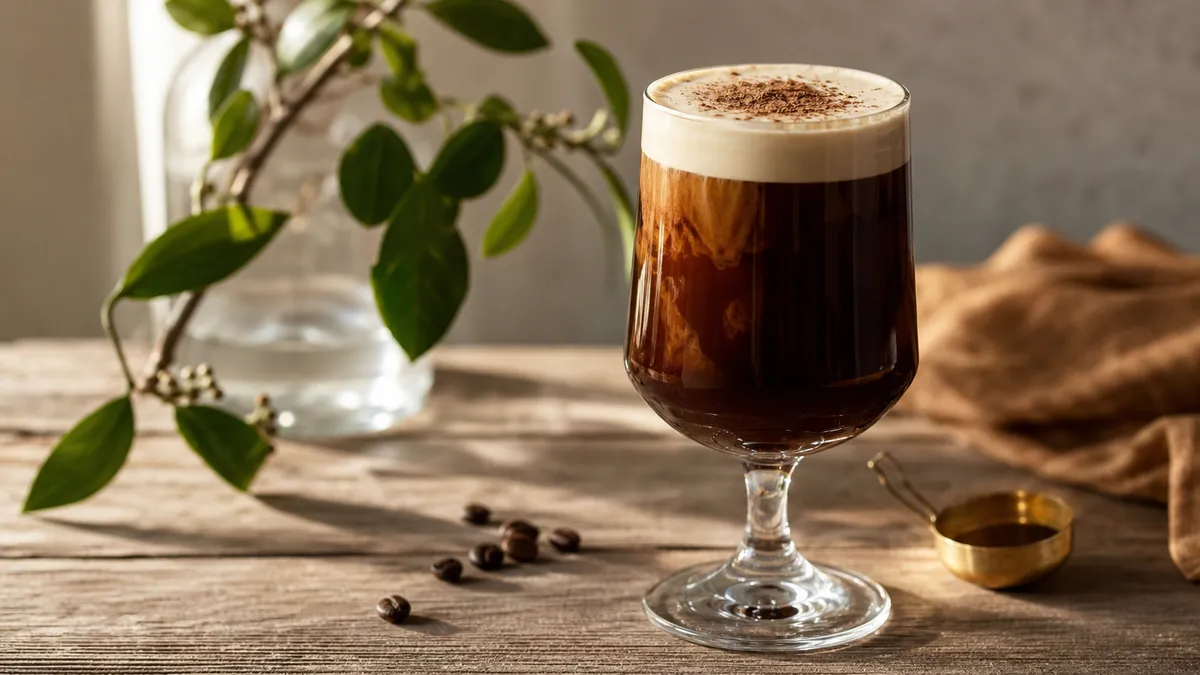
Irish coffee combines hot coffee, Irish whiskey and dissolved sugar beneath a floating layer of lightly thickened cream. To make one, mix 120 ml coffee with 50 ml whiskey and sugar in a warmed, heatproof glass, then gently pour chilled cream over the back of a spoon.
In short
- Use fresh whipping or double cream, lightly whisked but still pourable, not stiff peaks or aerosol cream.
- Dissolve the sugar completely before adding the cream.
- Choose glassware made for hot drinks, with room for the cream and some headspace.
- Leave the finished drink unstirred and sip the coffee through its cool cream layer.
- This is an alcoholic cocktail: coffee does not counteract alcohol’s effects.
Classic Irish Coffee
The classic has four ingredients: coffee, Irish whiskey, sugar and fresh cream. There is no steamed milk, and cream liqueur is not a substitute in the traditional recipe.
The International Bartenders Association specifies 50 ml Irish whiskey, 120 ml hot coffee, 50 ml chilled cream and a teaspoon of sugar. The recipe below follows those liquid measures, with a suggested sugar weight for repeatability rather than an exact conversion from a teaspoon.
For other drinks to make at home, explore our coffee recipes.
A brief history
According to the Foynes Flying Boat & Maritime Museum’s current account, chef Joe Sheridan created Irish coffee at the Foynes flying boat terminal in County Limerick during winter 1943, for passengers whose New York-bound flight returned because of bad weather.
Foynes and Rineanna are not the same place. The museum records that Sheridan and the catering staff moved to Rineanna, now Shannon Airport, after Foynes closed in October 1945.
The short timeline is:
- Winter 1943: Sheridan serves whiskey-laced coffee to returning passengers at Foynes, according to the museum.
- 1951: Travel writer Stanton Delaplane encounters Irish coffee at Rineanna.
- 10 November 1952: Buena Vista owner Jack Koeppler and Delaplane begin recreating the drink in San Francisco, according to the café’s own history.
Recipe card
Serves: 1 adult
Time: approximately 5 minutes with freshly brewed coffee ready
Equipment: heatproof Irish coffee glass, measuring jug or measure, scales, small bowl, whisk and spoon
Suggested glass capacity: approximately 250 to 300 ml, allowing space above the ingredients
Ingredients
- 120 ml freshly brewed hot filter coffee
- 50 ml Irish whiskey
- 5 g demerara or soft brown sugar, a suggested starting amount
- 50 ml chilled whipping cream or double cream, measured before whisking
Approximate caffeine: about 54 mg, calculated as 120 ÷ 200 × 90 mg, using EFSA’s illustrative figure of 90 mg in 200 ml filter coffee. This is an estimate, not a measurement of your brew; beans and preparation can change it substantially. Individual sensitivity varies. During pregnancy, avoid the alcoholic recipe and keep total caffeine from all sources within the NHS limit of 200 mg a day.
Method
- Warm the glass. Use glassware specifically intended for hot drinks. Warm it with hot water according to its maker’s instructions, then empty it. Do not use an ordinary wine glass.
- Prepare the cream. Lightly whisk the chilled cream until it thickens slightly but still pours in a continuous ribbon. Stop before it forms a firm mound.
- Dissolve the sugar. Add the sugar and hot coffee to the warmed glass. Stir until no crystals remain.
- Add the whiskey. Measure it into the coffee and stir gently.
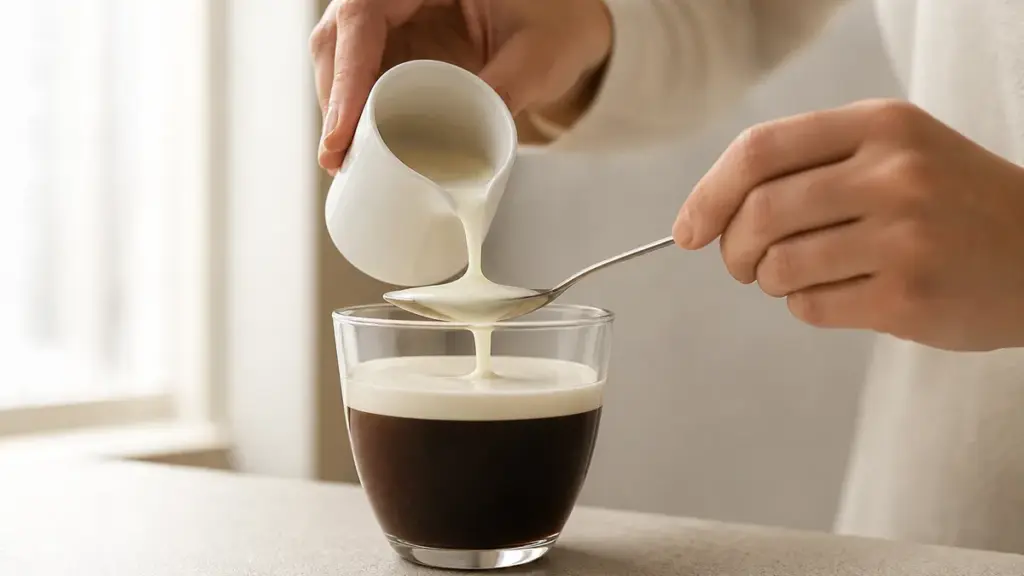
- Float the cream. Hold the back of a spoon just above the coffee’s surface. Slowly pour the cream onto it, moving the spoon if necessary to distribute the layer.
- Serve immediately. Leave the layers intact and sip through the cream. Take care: the coffee underneath remains hot.
Making the cream float
Aim for a smooth white cap, not a pile of whipped topping. Light whisking incorporates air while keeping the cream fluid enough to spread over the surface. Pouring close to the coffee over a spoon reduces disturbance.
Dissolved sugar increases the density of the liquid beneath the cream, which helps the float. That is a practical application of solution-density principles, not a guarantee: cream consistency and a gentle pour still matter.
For UK ingredients, choose whipping or double cream. Ordinary British single cream does not whip, so “lightly whipped single cream” is not a reliable instruction. Use fresh cream rather than an aerosol topping for this recipe, and do not assume a warm spoon alone will solve sinking cream.
Keep cream refrigerated, ideally at 5°C or below, and follow its use-by date and storage instructions.
| Symptom | Likely cause | Fix |
|---|---|---|
| Cream disappears into the coffee | Cream too thin or poured forcefully | Thicken it slightly and pour slowly over a spoon close to the surface |
| Cream sits in lumps | Whisked too far | Start again, stopping while it still flows |
| Sugar remains at the bottom | Incomplete dissolving | Stir thoroughly before adding cream |
| Drink is already lukewarm | Unwarmed glass or delayed assembly | Warm suitable glassware and assemble just before serving |
Irish Coffee Variations
These are suggested adaptations, not claims about the original recipe. Change one component at a time so you can judge the result.
Cream liqueur version
Replace the whiskey with a measured serving of Irish cream liqueur, following the producer’s recipe, and reassess the sugar before adding more. Keep a fresh cream float if you want the layered presentation. This remains alcoholic and is a variation, not the four-ingredient classic.
Iced version
For a suggested cold adaptation, dissolve the sugar in the hot coffee first, then cool it before combining with the whiskey over ice. Add the lightly thickened cream last. For a different cold coffee without whiskey, try Vietnamese iced coffee.
Decaf or whiskey-free version
Use decaffeinated coffee if you prefer, but remember that changing the coffee does not remove the alcohol. For a whiskey-free adaptation, omit the spirit and adjust the coffee and sweetness to taste; call it sweetened coffee with cream rather than the classic cocktail.
If you want a different alcoholic coffee drink, see coffee cocktails.
Responsible drinking
Using whiskey labelled 40% alcohol by volume, this recipe contains 2 UK alcohol units: 50 ml × 40 ÷ 1,000. Use the strength on your own bottle when calculating yours.
NHS guidance advises adults who drink regularly not to exceed 14 units a week, spread over three or more days if drinking that amount. This is lower-risk guidance, not a target or a guarantee of safety.
Caffeine does not reduce alcohol’s effects on your body. Do not treat Irish coffee as a way to sober up, and choose an alcohol-free drink if driving. During pregnancy, the NHS advises avoiding alcohol; ask a GP, pharmacist or midwife about personal concerns, including medicines and caffeine sensitivity.
FAQ
Can I use instant coffee?
Yes, you can use instant coffee as a practical adaptation. Make 120 ml according to its producer’s instructions, then follow the assembly method. The caffeine estimate in the recipe card applies to filter coffee, not instant: use information supplied for your particular coffee where available rather than assuming the same caffeine content.
Does Irish coffee need a garnish?
No, the International Bartenders Association recipe does not require one. The plain cream layer is enough. For your first attempt, leave off cocoa, cinnamon and nutmeg so you can judge the balance of coffee, whiskey and sweetness without another flavour covering it. Add a garnish later only if you prefer it.
Can I prepare Irish coffee in advance?
Prepare the equipment and measure the ingredients ahead, but assemble the drink just before serving. The method depends on hot coffee beneath chilled, pourable cream, so a fully assembled glass is not a useful make-ahead drink. Keep the cream refrigerated until needed and follow its storage instructions.
Where to go next
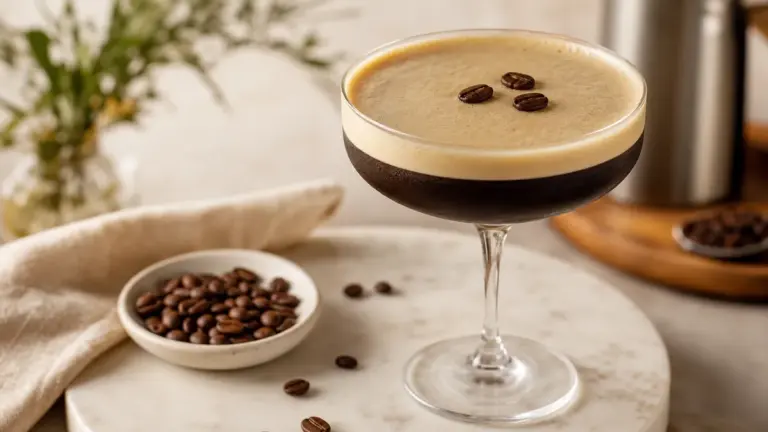
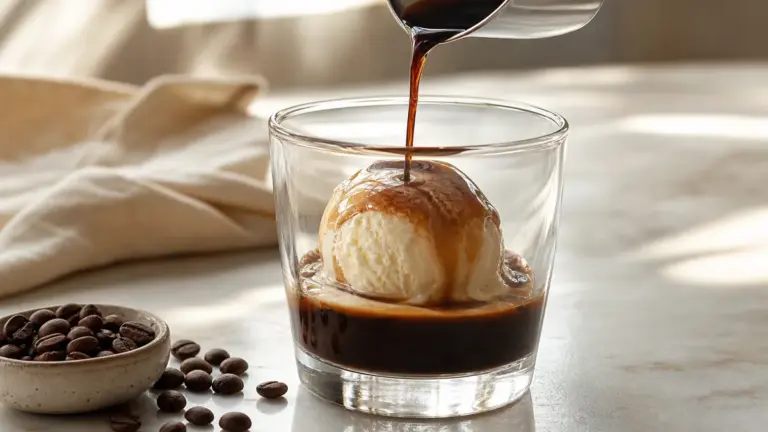
Read Coffee Recipes for more drinks to make at home, or Espresso Martini and Coffee Cocktails for another direction after Irish coffee. For a non-alcoholic coffee dessert rather than another cocktail, try Affogato.
Sources
- International Bartenders Association, Irish Coffee, undated, current online recipe. Recipe.
- Foynes Flying Boat & Maritime Museum, The Origin of Irish Coffee, undated, current online account. History.
- Foynes Flying Boat & Maritime Museum, Meet Chef Joe Sheridan, Inventor of Irish Coffee, undated. Biography.
- The Buena Vista, The Irish Coffee Story, undated. Café history.
- Jameson Irish Whiskey, Jameson Irish Coffee Recipe, undated. Used for the producer’s lightly whipped cream method, not as an endorsement. Recipe.
- BBC, Get Baking: Classic Recipes and Top Tips, undated booklet. Booklet.
- California State University, Bakersfield, Department of Chemistry, Sugar Water Density Columns, undated teaching resource. Resource.
- EFSA, Caffeine, current topic page accompanying its 2015 safety assessment. Caffeine guidance.
- Food Standards Agency, Storing Chilled Foods at Incorrect Temperatures, undated retrieved report. Report.
- NHS, Alcohol Units, current online guidance. Units and drinking guidance.
- NHS, Foods to Avoid in Pregnancy, current online guidance. Pregnancy guidance.
- US Centers for Disease Control and Prevention, Effects of Mixing Alcohol and Caffeine, current online guidance. Alcohol and caffeine.
This piece was researched using the IBA recipe, institutional and venue histories, published preparation guidance and official food-safety and health advice; suggested adaptations are not presented as tested recipes.
Last checked: November 2026