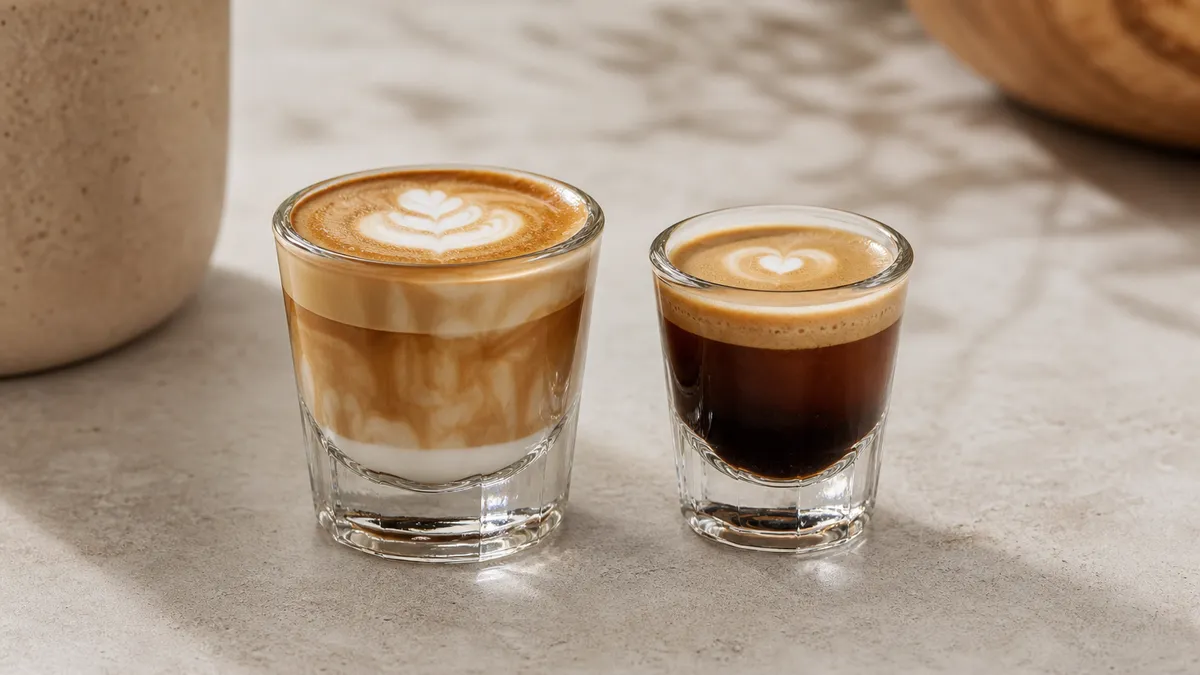
Cortado and piccolo are small espresso drinks with warm milk, but their balance is different: a cortado commonly uses roughly equal parts espresso and milk, while a piccolo has a single short shot with proportionally more milk. Choose a cortado for a more coffee-forward drink, or a piccolo for a small, silky milk coffee.
In short
- A cortado is Spanish in origin. Its name comes from cortar, meaning “to cut”, referring to coffee softened with milk.
- Equal parts espresso and milk, a 1:1 ratio, is a useful cortado starting point, not a rule followed everywhere.
- A piccolo commonly combines a single ristretto or espresso with silky milk in a glass of about 90 to 100 ml.
- Piccolo recipes vary: a short coffee base with roughly three to four parts milk is one approach; some Australian cafés use nearer two parts milk.
- Both need restrained foam. A flat white normally gives you a larger serving with more milk than a cortado.
Cortado and piccolo: the differences
The useful comparison is the amount of coffee, the amount of milk and the texture, rather than the name alone.
| Feature | Cortado | Piccolo |
|---|---|---|
| Origin and association | Spanish origin | Associated with Australian café culture |
| Coffee base | Often a double espresso in contemporary café recipes | Usually a single ristretto or espresso |
| Coffee-to-milk balance | Commonly about 1:1 | Often about 1:2 to 1:4, depending on the shot and recipe |
| Milk texture | Warm, lightly textured, minimal foam | Silky microfoam with a thin surface layer |
| Suitable vessel | Small heat-safe glass or espresso cup | Small heat-safe glass, commonly about 90 to 100 ml |
A ristretto is an espresso prepared with a shorter beverage yield relative to its dry coffee dose. Microfoam means milk containing very fine bubbles, giving it a smooth, glossy texture rather than a stiff cap of froth.
Cortado: Spanish roots, variable proportions
The cortado’s defining idea is coffee “cut” with milk. Equal parts is a helpful modern recipe, but it should not be presented as the only authentic Spanish formula: Nespresso’s professional recipe, for example, uses 40 ml coffee with 15 ml hot milk.
For an equal-parts version, about 35 to 40 ml espresso plus the same volume of milk makes a compact drink. A heat-safe rocks-style glass of about 90 to 130 ml leaves room above it, but a glass is not compulsory.
Do not assume that a double espresso always measures 35 to 40 ml. Crema, the foam on espresso, changes its apparent volume; weighing the output gives a more repeatable recipe.
Piccolo: a short shot with silky milk
A piccolo commonly uses a single ristretto or espresso, topped with textured milk in a small glass. The drink is associated with Australia, although the sources reviewed do not establish a single inventor or a securely documented invention date.
A short base of about 15 to 25 ml with approximately 60 to 75 ml textured milk is a useful recipe family, not a fixed specification. For example, 20 ml coffee with 60 ml milk is 1:3; with 75 ml milk it is nearly 1:4. A longer single espresso produces a lower milk ratio in the same glass.
Published practice differs. Breville uses a single espresso for its piccolo, while Australian café Flinders Lane describes a single ristretto and a 1:2 coffee-to-milk ratio. Ask about the house recipe if the distinction matters to you.
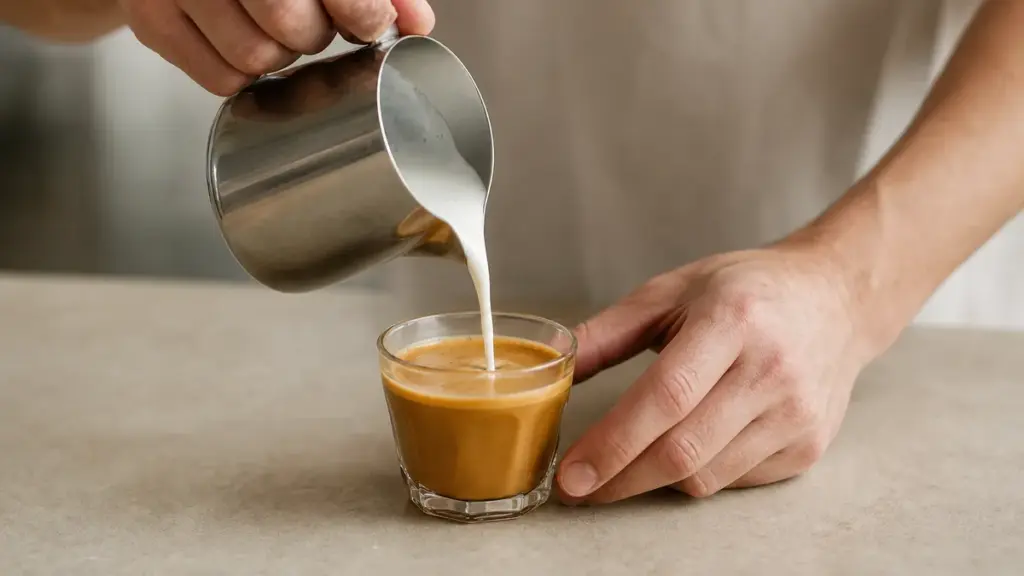
Recipe card: make either drink at home
These are repeatable house recipes, not claims of universal authenticity. They use weight for the finished coffee-to-milk balance, keeping that separate from the customary volume descriptions above.
Serves: one
Time: allow about 5 minutes once the machine is ready
Equipment: espresso machine with steam wand, grinder, suitable double basket, scales, milk jug, thermometer and heat-safe cup or glass
Ingredients
For a cortado
- 18 g coffee beans, ground for espresso
- 150 ml cold pasteurised milk for steaming, or the minimum your jug and machine require
- Use 36 g brewed espresso and pour in 36 g steamed milk, a 1:1 ratio by weight
For a piccolo
- 18 g coffee beans, ground for espresso, to prepare a double shot
- 150 ml cold pasteurised milk for steaming, or the minimum your equipment requires
- Use half the double shot, 18 g espresso, and pour in 60 g textured milk, approximately 1:3.3 by weight
- Reserve the other half for a second drink
The starting milk quantity is a steaming allowance, not the amount that goes into the glass. Breville likewise specifies more cold milk in the jug than its small piccolo glass can hold.
Method
- Prepare the espresso. Grind 18 g coffee into a basket suitable for that dose, distribute evenly and tamp level. Start with 36 g espresso out, a 1:2 dose-to-yield ratio, in about 25 to 35 seconds. These are starting settings, not a guarantee of good flavour.
- Choose the coffee portion. Keep the full shot for the cortado. For the piccolo, divide the espresso equally between two cups; Breville also demonstrates making piccolos by splitting a double shot.
- Steam the milk. Start with cold milk and purge the wand. Introduce only a little air, then keep the milk circulating until glossy. Aim for 60 to 65°C for these dairy-milk recipes.
- Adjust the texture. For the cortado, keep aeration especially restrained. For the piccolo, retain a thin, silky microfoam layer, not a spoonable mound.
- Clean and pour. Wipe and purge the wand after steaming. Swirl the jug, place the coffee on the scales and add the specified milk weight. Serve promptly.
Approximate caffeine: allow around 150 to 175 mg for the full-double cortado, or 75 to 90 mg for the half-double piccolo. These are evidence-informed estimates based on laboratory measurements of arabica double espressos made with approximately 18 to 20 g coffee, not measurements of these recipes. Different beans and extraction settings can fall outside those estimates.
Pregnancy and sensitivity note: the NHS advises no more than 200 mg caffeine daily from all sources during pregnancy. Individual sensitivity varies; ask a GP, pharmacist or midwife about personal circumstances.
For more drink methods, use the coffee recipes hub.
Milk texture, glassware and troubleshooting
Both drinks should pour easily and feel integrated. The piccolo needs fine microfoam throughout the milk; the cortado needs even less aeration, so the coffee is softened without acquiring a thick foam topping.
Use glassware intended for hot drinks, or a small ceramic cup. Choose the recipe first and the vessel second: filling a larger glass to the rim changes the milk balance.
| Symptom | Likely cause | Fix |
|---|---|---|
| A stiff white cap sits above the drink | Too much air introduced | Shorten the aeration stage and keep the milk circulating |
| Large bubbles remain | Poorly integrated milk | Swirl before pouring; improve circulation during steaming |
| Coffee flavour seems lost | Too much milk for the shot | Weigh the milk rather than filling the glass |
| Espresso runs unusually fast and tastes thin | Grind may be too coarse | Adjust finer while keeping dose and target yield unchanged |
Keep milk refrigerated until needed. FSA guidance recommends a fridge temperature of 0 to 5°C; the steaming temperature above is a preparation target for pasteurised milk, not a method for making raw milk safe.
How they differ from a flat white
A flat white also uses espresso and finely textured milk, but normally provides a larger serving. Compared with an equal-parts cortado, its greater milk addition generally makes the coffee taste less concentrated.
The piccolo overlaps more closely with a flat white in texture. Its distinction is the small serving and usually single-shot base, not a completely different kind of foam. Read flat white for that drink’s recipe rather than treating every small milk coffee as interchangeable.
An espresso macchiato usually adds only a small amount of milk or foam. See macchiato if you want less milk still.
For precise comparison, separate flavour intensity from caffeine amount. Adding milk dilutes the coffee’s concentration but does not remove its caffeine; changing the coffee dose or the portion of espresso changes how much caffeine reaches the glass.
FAQ
Can I use a single espresso instead of ristretto for a piccolo?
Yes, a single espresso is an established piccolo approach, including in Breville’s recipe. It leaves less room for milk than a shorter ristretto in the same glass, so the balance changes. Keep the serving small and the milk silky, and adjust the milk quantity to the actual coffee portion rather than relying on the shot’s name.
Can I use plant-based milk?
Yes, but follow the product’s heating guidance rather than automatically using the dairy-milk temperature above. Breville advises gentler heating for non-dairy alternatives because some can separate. Start with a small amount of aeration and judge the result by its pourable texture; a thick foam cap is unsuitable for either recipe.
Can I make both drinks from one double espresso?
Yes, if you make a single-shot cortado and a single-shot piccolo. Split the espresso equally, then add approximately equal-weight milk to one portion and a larger milk addition to the other. This makes a useful side-by-side comparison with the same coffee base, although it differs from the full-double cortado recipe above.
Where to go next
Read Flat White to compare a larger silky milk drink, and Macchiato for a smaller milk addition. Specialty Coffee Recipes offers other directions once you have settled your preferred cortado and piccolo balance.
Sources
- Flinders Lane Cafe, Cortado vs Piccolo: Master the 2 Best Ratios, undated live page, checked 2026. A café’s published practice, not a universal standard.
https://flinderslanecafe.com.au/blogs/news/cortado-vs-piccolo - Nespresso Professional, Momento Milk Recipe Book, undated PDF, checked 2026. Supports the Spanish description, meaning of cortado and an alternative milk proportion.
https://www.nespresso.com/ecom/medias/sys_master/public/14182635175966/Nespresso-Professional-Momento-Milk-Recipe-Book.pdf - Breville, Piccolo, undated live recipe, checked 2026. Supports split-double preparation, steaming technique and milk temperature.
https://www.breville.com/nz/en/coffee-journey/recipes/piccolo.html - Breville Philippines, Tips & Advice, undated live guide, checked 2026. Supports the single-espresso piccolo, 90 ml glass and starting milk allowance.
https://breville.com.ph/tips-advice/ - La Marzocco Home, Using Espresso Brew Ratios, 2022. Supports weighed espresso recipes, dose, yield and timing.
https://home.lamarzoccousa.com/using-espresso-brew-ratios/ - Ludwig and colleagues, Variations in caffeine and chlorogenic acid contents of coffees: what are we drinking?, Food & Function, 2014, accepted manuscript. Laboratory analysis supports the caffeine estimate and its uncertainty.
https://pubs.rsc.org/en/content/getauthorversionpdf/c4fo00290c - NHS, Foods to avoid in pregnancy, current live guidance, checked 2026.
https://www.nhs.uk/pregnancy/keeping-well/foods-to-avoid/ - Food Standards Agency, How to chill, freeze and defrost food safely, 2017, current GOV.UK publication.
https://www.gov.uk/government/publications/how-to-chill-freeze-and-defrost-food-safely/how-to-chill-freeze-and-defrost-food-safely
This article compares published manufacturer and café recipes, uses laboratory research for cautious caffeine estimates, and checks food-safety advice against official guidance; it does not report first-hand testing.
Last checked: November 2026