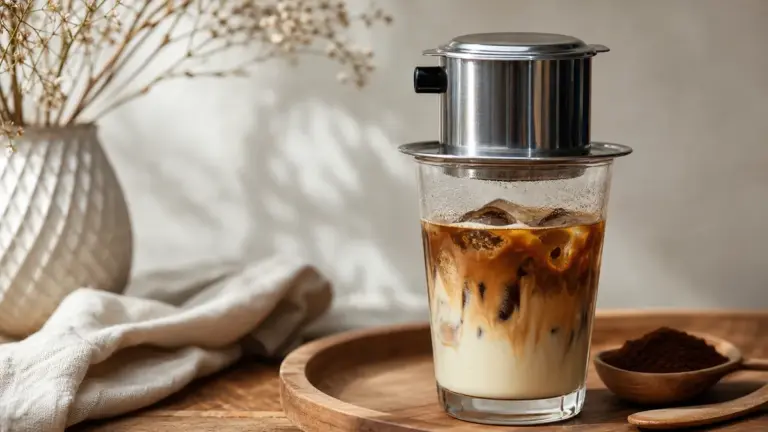
A latte is espresso mixed with steamed milk and a light layer of fine foam. To make one, start with 18 g of coffee brewed into 36 g of espresso, then add milk steamed from 180 ml cold milk; stir in vanilla or caramel syrup before pouring the milk if you want a flavoured version.
In short
- Measure espresso by weight: 18 g in and 36 g out is a 1:2 dose-to-yield ratio.
- Use 180 ml cold milk for the recipe below, adjusting the milk quantity to taste rather than treating it as a fixed latte standard.
- Aim for glossy, pourable microfoam, not a stiff cap of bubbles.
- For dairy milk, a practical steaming target is 60 to 65°C. Follow the carton’s guidance for plant milks.
- Start flavoured versions with 10 ml syrup, taste, then adjust your next drink.
What makes a latte?
A latte combines a concentrated coffee base with enough steamed milk to make a smooth, milk-led drink. The foam should blend into the milk rather than sit above it as a separate, spoonable mound.
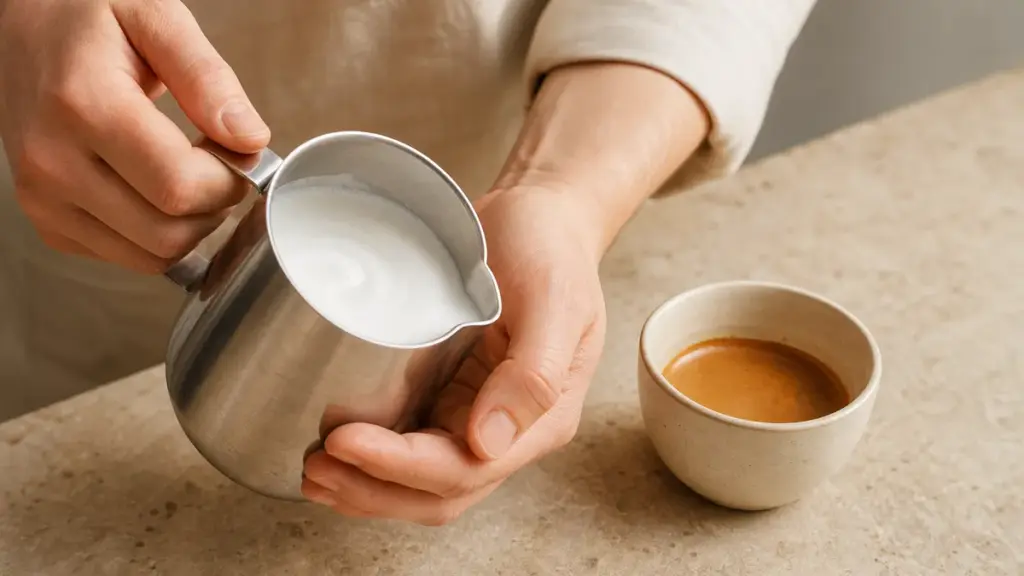
Microfoam means milk containing very fine air bubbles. Well-textured milk looks glossy and pours as a continuous liquid, giving the latte a soft, velvety texture.
There is no need to master decorative pouring before making a good latte. Concentrate on an espresso you enjoy, a repeatable quantity of milk and a texture that stays integrated as you drink.
For the wider family of drinks, see espresso-based drinks. This recipe belongs to our coffee recipes collection.
Latte ratios: keep coffee strength and milk quantity separate
Two different measurements matter here, and confusing them makes recipes difficult to repeat.
The espresso ratio describes dry coffee dose to brewed espresso yield, both by weight. In this recipe, 18 g of grounds produces 36 g of espresso: a 1:2 ratio, consistent with the common practice reported in an SCA barista survey.
The milk quantity describes how much milk you add to that espresso. Here, the starting measure is 180 ml cold milk before steaming. That is a recipe choice, not an official definition of a latte.
Do not describe the whole drink as simply “1:2”. That would leave the reader wondering whether the second number meant espresso, milk or water.
For a more coffee-forward result, keep the espresso recipe unchanged and use less milk. For a gentler drink, add more milk, provided the vessel has room. Change one variable at a time so you can tell what improved the balance.
Milk quantity and texture also help distinguish neighbouring drinks. Our cappuccino recipe and flat white guide cover those differences without needing to turn this latte recipe into a catalogue of drinks.
Latte recipe card
Serves: 1
Preparation and making time: about 5 minutes, excluding machine warm-up
Method: espresso with steamed milk
Recipe basis: an editorial starting recipe informed by the manufacturer and SCA guidance listed below, not a claim of first-hand testing.
Ingredients
- 18 g roasted coffee beans, ground for espresso, using a basket suitable for that dose
- 180 ml cold pasteurised milk, or a barista-style plant milk
- Fresh drinking water for the machine, following its water requirements
- Optional: 10 ml vanilla or caramel coffee syrup
Equipment
- Espresso machine with a steam wand
- Espresso-capable grinder, unless integrated into the machine
- Scales and a timer
- Milk jug suitable for the milk quantity and steam wand
- Milk thermometer
- A cup or heat-resistant glass of approximately 300 ml capacity
- Clean damp cloth and a spoon
Approximate caffeine
Allow around 160 mg per serving as a rough planning estimate, assuming an arabica double espresso. The basis is a laboratory study that measured 152 to 174 mg in espressos prepared from 18.1 to 20.4 g of arabica coffee. Those extractions were not identical to this recipe, so the estimate is not a measured value or a guaranteed range.
Milk and ordinary vanilla or caramel syrup do not remove the caffeine in the espresso. Use product-specific caffeine information where available, especially if monitoring intake closely.
Pregnancy and sensitivity note: NHS advice is no more than 200 mg caffeine daily from all sources during pregnancy. Individual sensitivity varies; ask a GP, pharmacist or midwife about personal concerns.
Method
-
Prepare the machine and vessel. Follow the machine’s warm-up instructions. Warm the cup or suitable glass, then empty it. Put any optional syrup into the serving vessel.
-
Prepare the coffee. Weigh 18 g into an appropriate double basket, distribute the grounds evenly and tamp level. If your basket requires a different dose, follow its instructions rather than forcing in this amount.
-
Brew the espresso. Place the vessel on the scales, tare and extract 36 g of espresso. Around 25 to 30 seconds is a useful initial reference, but follow the coffee supplier’s recipe where provided and adjust by taste. Stir to combine with any syrup.
-
Measure the milk. Pour 180 ml cold milk into the jug. Check that this meets the equipment’s minimum fill requirement and leaves space for expansion.
-
Purge and position the wand. Following the machine’s instructions, briefly purge the steam wand over the drip tray. Position the tip near the milk’s surface, slightly off-centre, to establish a rolling circulation.
-
Introduce a little air. Keep the tip close enough to the surface to draw in air gently. Once the milk has expanded slightly, raise the jug so the tip sits deeper, maintaining the circulation without continuing to add lots of air.
-
Finish heating. For dairy milk, aim for 60 to 65°C, using the thermometer. For plant milk, follow its manufacturer’s recommended temperature. Stop the steam before removing the wand.
-
Clean and pour. Wipe and purge the wand as instructed by its manufacturer. Gently tap the jug if there are large surface bubbles, swirl until glossy, then pour the milk into the espresso. Stop before the vessel overfills and serve promptly.
How to get smooth microfoam
Think of steaming as two linked jobs: introducing air and distributing it through the milk. The first creates foam; the rolling circulation helps integrate that foam into a pourable texture.
For a latte, introduce air gently rather than aiming for a large increase in volume. If the wand repeatedly breaks through the surface and gulps air, reposition it slightly deeper.
Watch the milk as well as the thermometer. You are looking for a shiny surface and milk that moves together when you swirl the jug. If a thick raft of foam remains stationary above thin liquid, the texture is not yet integrated.
Swirl immediately before pouring and work promptly. Manufacturer guidance recommends tapping to collapse larger bubbles and swirling to reintegrate the texture before the milk separates.
Do not chase a fixed steaming time. Steam power, jug shape, starting milk quantity and milk type differ. Temperature and texture are more useful finishing cues.
Glass or cup?
Either is suitable. A glass is a presentation choice, not a requirement for making the drink correctly.
For this recipe, choose a vessel of about 300 ml so there is room for the espresso, expanded milk and optional syrup. Do not assume that a glass which holds the cold ingredients will also hold them comfortably after steaming.
Use glassware explicitly suitable for hot drinks and follow its care instructions. A handled cup may be easier to hold comfortably; a clear glass lets you see the milk and foam, although sharp layers are not the goal of this espresso-first recipe.
Vanilla Latte
Make the base recipe with 10 ml vanilla coffee syrup, stirred into the espresso before adding the milk. This is a restrained starting point rather than a universal sweetness standard.
Nespresso’s published vanilla-flavoured latte recipe also uses 10 ml vanilla syrup, although its coffee quantity, milk quantity and preparation differ from this one. Syrup strength varies, so treat the measure as a starting point.
For a sweeter next drink, try 15 ml, keeping the espresso and milk unchanged. Measuring in millilitres makes the result easier to repeat than counting unspecified pump presses.
Vanilla extract is not a direct substitute for vanilla syrup. Use a product intended for flavouring drinks, following its directions, rather than replacing the syrup with the same volume of extract.
Caramel Latte
For the caramel version, stir 10 ml caramel coffee syrup into the espresso, then complete the milk method. Taste before deciding whether the next drink needs more.
If you prefer a sweeter result, try 15 ml next time. These are this recipe’s suggested adjustments, not prescribed latte proportions.
Caramel syrup and thick caramel sauce should not automatically be substituted in equal quantities. Follow the sauce maker’s serving directions, check its ingredients and stir thoroughly into the hot espresso before adding milk.
A decorative drizzle is optional. If using one, assess sweetness after including it rather than adding a full syrup measure and then treating the topping as flavour-free decoration.
Making a latte with plant milks
Choose a barista-style plant milk intended for hot coffee, then follow its carton instructions. Manufacturers formulate these products for coffee preparation, but performance still differs between products.
Start with the same 180 ml measure so you have a consistent comparison with the dairy recipe. Reassess the texture and flavour before changing the coffee dose or adding syrup.
Do not assume every plant milk needs the dairy steaming temperature. For example, Alpro recommends 60°C for its Barista Almond and 65°C for its Barista Soya, Oat and Coconut. These are manufacturer-specific recommendations, not universal targets for every almond, soya or oat drink.
Use a thermometer while learning a new product. If it pours poorly, adjust one factor at a time: the amount of air introduced, the finishing temperature or the milk product itself.
For a fully plant-based vanilla or caramel latte, check the syrup or sauce ingredients too. Follow the storage instructions after opening, and clean shared milk equipment carefully when preparing drinks for someone with an allergy.
Troubleshooting your latte
| Symptom | Likely cause | Fix |
|---|---|---|
| Stiff foam above thin milk | Too much air, or texture left to separate | Introduce less air; swirl and pour promptly |
| Large surface bubbles | Air introduced too aggressively | Keep the tip more consistently near the surface; tap and swirl before pouring |
| Coffee tastes lost in the drink | Milk quantity is too high for your preference | Keep the espresso fixed and reduce the milk next time |
| Vanilla or caramel dominates | Too much flavouring for that product | Reduce the measured syrup quantity |
| Results change between drinks | Dose, yield, milk or syrup is not measured consistently | Record all four and change only one at a time |
Keep milk refrigerated according to its label; FSA domestic guidance recommends a fridge temperature of 0 to 5°C. Return the carton promptly, observe use-by dates and prepare only the milk you need.
FAQ
Can I make a latte without a steam wand?
Yes, an espresso machine paired with a separate milk frother can make a practical latte. Follow the frother’s fill limits and hot-milk instructions rather than applying the steam-wand method. Choose a low-foam or latte setting if available, then swirl the milk before pouring. The texture will depend on the appliance and milk.
Can I use decaffeinated coffee?
Yes, use decaffeinated coffee in the same basic recipe, then adjust the espresso to the coffee supplier’s instructions. Do not apply the recipe card’s regular-coffee caffeine estimate to the decaffeinated version. If you need a dependable caffeine figure for medical or pregnancy planning, seek product-specific information and advice from your healthcare professional.
Can I use instant coffee instead of espresso?
Yes, but describe it as an instant-coffee approximation rather than an espresso latte. Prepare a small, concentrated amount following the coffee manufacturer’s directions, then add warmed, lightly frothed milk. Judge the balance by taste. The espresso dose, yield and caffeine estimate in this recipe no longer apply.
Where to go next
Read Coffee Recipes for more drinks, or Espresso-Based Drinks to understand how the coffee-and-milk family fits together. Try Cappuccino next to practise a different foam balance, or Flat White to compare another approach with your latte.
Sources
-
Specialty Coffee Association, “Defining the Ever-Changing Espresso”, 25 Magazine, issue 3, reporting the 2017 Barista Guild of America survey. Used for common espresso dose-to-yield and timing references, not as a mandatory latte standard.
URL: https://sca.coffee/sca-news/25-magazine/issue-3/defining-ever-changing-espresso-25-magazine-issue-3-zyx36 -
Sage, the Bambino BES450/SES450 Quick Guide, UK file revision G21, publication year not stated in the retrieved text. Used for manual steaming, the 60 to 65°C dairy target and wand care.
URL: https://assets.sageappliances.com/BES450/SES450_UK_UG1_G21_FA_WEB.pdf -
Breville, the Oracle BES980 Instruction Book, publication year not stated in the retrieved text. Used for swirling, tapping, prompt pouring and equipment-specific milk preparation.
URL: https://assets.breville.com/BES980/BES980_USCM_IB_W24_LR.pdf -
Nespresso, “Totally Sweet Latte”, undated recipe sheet. Used as a manufacturer reference for a 10 ml vanilla-syrup serving, not copied as the base recipe.
URL: https://www.nespresso.com/ncp/res/generated/recipes/30825LAT_en_INT.pdf -
Ludwig and colleagues, “Variations in caffeine and chlorogenic acid contents of coffees: what are we drinking?”, Food & Function, volume 5, 2014. Used for laboratory caffeine measurements and their limitations.
URL: https://pubs.rsc.org/en/content/articlepdf/2014/fo/c4fo00290c -
European Food Safety Authority, “Caffeine”, topic page incorporating the Scientific Opinion on the Safety of Caffeine, 2015. Used for caffeine variability and the scope of population guidance.
URL: https://www.efsa.europa.eu/en/topics/topic/caffeine -
NHS, “Foods to avoid in pregnancy”, current web version retrieved November 2026. Used for the pregnancy caffeine limit.
URL: https://www.nhs.uk/pregnancy/keeping-well/foods-to-avoid/ -
Food Standards Agency, “How to chill, freeze and defrost food safely”, 2017, current retrieved version. Used for domestic refrigeration, storage instructions and use-by guidance.
URL: https://www.gov.uk/government/publications/how-to-chill-freeze-and-defrost-food-safely/how-to-chill-freeze-and-defrost-food-safely -
Alpro, “Barista”, undated manufacturer guidance, current version retrieved November 2026. Used for product-specific plant-milk steaming temperatures.
URL: https://www.alpro.com/egen/collection/barista
This piece was researched using live-retrieved SCA material, manufacturer instructions, peer-reviewed laboratory research and official food-safety and health guidance; recipe choices are identified separately from standards and measured findings.
Last checked: November 2026