Coffee pests and diseases attack leaves, fruit, roots and the tissues that carry water through the plant. The main threats include coffee leaf rust, coffee berry borer, coffee berry disease, plant-parasitic nematodes and coffee wilt disease; farmers respond by combining monitoring, farm hygiene, suitable varieties and carefully targeted controls rather than relying on a single treatment.
In short
- Leaf rust damages foliage, while coffee berry borer attacks the seeds that become coffee beans.
- Coffee berry disease is a fungal infection, not another name for berry borer damage.
- Root damage and wilt can resemble drought or nutrient deficiency, so diagnosis matters before treatment.
- Integrated pest management combines prevention, monitoring, biological controls and, where justified, approved pesticides.
- Resistance is specific to a threat. A rust-resistant variety is not automatically resistant to nematodes or wilt.
Understanding the main coffee pests and diseases
A pest is an organism that damages the crop, such as a beetle or a plant-parasitic nematode. An infectious disease is caused by a pathogen, an organism such as a fungus that infects the plant. Both can reduce production, but they require different responses.
The first useful question is therefore not simply, “What looks unhealthy?” It is, “Which part of the plant is affected, and what is causing the damage?” Yellow leaves alone are not a reliable diagnosis.
Our coffee farming overview explains how crop protection fits alongside planting, nutrition, pruning and harvesting.
| Threat | Main target | Typical warning signs | Main management priorities |
|---|---|---|---|
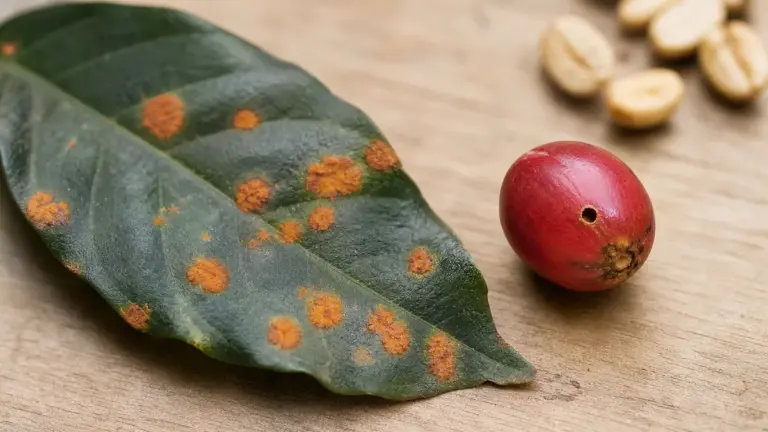
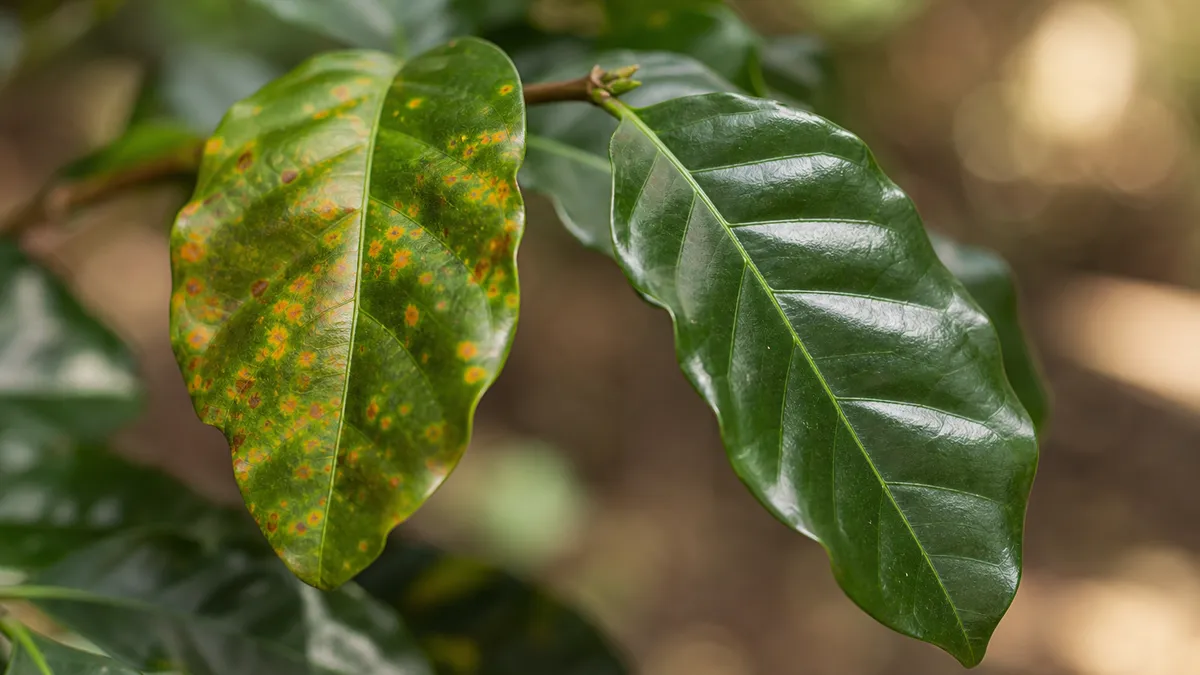
| Coffee leaf rust | Leaves | Orange powder beneath leaves; premature leaf fall | Suitable varieties, crop management and locally recommended fungicide programmes |
| Coffee berry borer | Fruit and seeds | Small entrance holes; feeding damage inside beans | Monitoring, thorough harvesting and removal of residual berries |
| Coffee berry disease | Developing fruit | Dark, sunken lesions; fruit rotting or dropping | Resistant varieties and locally advised disease protection |
| Plant-parasitic nematodes | Roots | Poor growth, decline and sometimes root swellings | Clean planting material, diagnosis and suitable resistant or tolerant plants |
| Coffee wilt disease | Water-conducting tissues | Wilting, dieback and discoloured wood | Biosecurity, removal of infected trees and suitable resistant planting material |
These signs guide inspection, not treatment decisions on their own. Several problems can occur together, and local agricultural advisers or diagnostic laboratories may be needed to separate them.
Coffee leaf rust: losing the plant’s working leaves
Coffee leaf rust is caused by the fungus Hemileia vastatrix. Its characteristic orange powder develops mainly on the underside of leaves. Severe infection causes premature leaf fall, reducing the foliage available to support growth and fruit production.
The powder contains fungal spores, the reproductive particles that spread infection. Wind and rain move them between leaves and plants. Rust spores need liquid water to germinate, so leaf wetness matters, not simply humid air.
Management combines suitable varieties with nutrition, pruning and other locally appropriate practices. Fungicides may also form part of a regional protection programme. The timing and choice of treatment require local advice, rather than a universal spray calendar.
Coffee berry borer: damage inside the bean
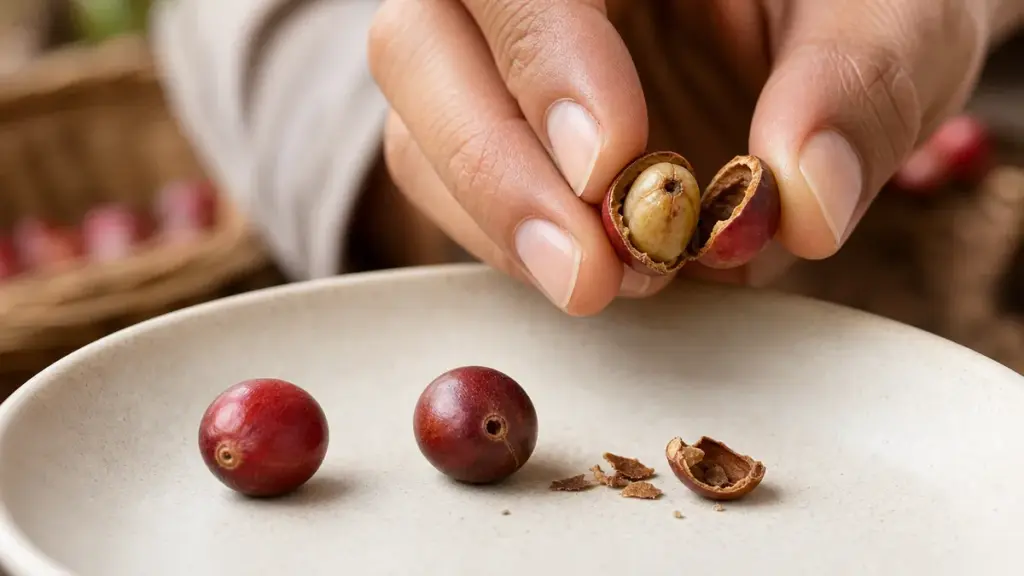
Coffee berry borer, Hypothenemus hampei, is a small beetle. The female bores into a coffee cherry and reproduces inside it; feeding damages the seeds, which are the future coffee beans.
Its sheltered position makes control difficult once it is deep inside the seed. Farmers therefore monitor both infestation and the beetle’s position within berries when deciding whether an intervention is likely to work.
Thorough harvesting is central to management. Berries left on trees or the ground can shelter borers between crops, allowing the next infestation to begin from a resident population.
For a closer comparison of these two widespread threats, read leaf rust and berry borer.
Coffee berry disease: a fungal attack on fruit
Coffee berry disease is caused by Colletotrichum kahawae. Unlike berry borer, it is not an insect problem: the fungus can infect developing green fruit.
Typical active lesions are dark and sunken. Affected berries may rot, shrivel or fall before harvest, and pinkish spore masses can develop on lesions under suitable conditions.
Farm responses include resistant varieties and locally recommended crop protection. Diagnosis remains essential because other infections can also produce dark marks or rotting fruit. Treating every blemished cherry as coffee berry disease risks choosing the wrong response.
Nematodes: a problem below ground
Plant-parasitic nematodes are microscopic roundworms that attack roots. Important groups affecting coffee include Meloidogyne, the root-knot nematodes, and Pratylenchus, the root-lesion nematodes.
Root damage restricts the uptake of water and nutrients. Above ground, the result may look like inadequate watering or feeding: weak growth, declining vigour and, in severe cases, plant death. Adding fertiliser does not remove the underlying infestation.
Prevention begins in the nursery. Clean planting material and avoiding the movement of contaminated soil help prevent new introductions. Where suitable, growers can graft a productive coffee variety onto a nematode-tolerant rootstock, the root system of another plant.
The choice must match the local nematode problem. “Nematode-resistant” should never be read as protection against every species or population.
Coffee wilt disease: disruption to water transport
Coffee wilt disease is associated with the fungus Fusarium xylarioides. It attacks the plant’s water-conducting tissues, called xylem, causing wilting, leaf loss, branch dieback and eventually death.
Blue-black staining beneath the bark is an important warning sign. However, wilting itself can also result from drought or other root and vascular problems.
Management emphasises preventing spread: obtaining healthy planting material, avoiding unnecessary wounds, cleaning tools and removing infected trees under local guidance. Moving diseased wood can carry the problem elsewhere. Where available and locally suitable, wilt-resistant planting material provides another layer of protection.
How climate and shade change the risks
Climate influences both the damaging organism and the coffee plant. For berry borer, controlled laboratory experiments show that development depends strongly on temperature. Climate-based models indicate that warming can make some formerly cooler growing areas more suitable for the beetle.
That does not mean every temperature rise increases pest pressure everywhere. Development and survival have limits, and field outcomes also depend on fruit availability and farm conditions. A model identifies potential risk, not a guaranteed infestation on a particular farm.
For fungal diseases, rainfall and the duration of wet conditions can be as important as warmth. Rust illustrates why “hotter weather means more disease” is too simple: spores need suitable moisture as well as suitable temperatures.
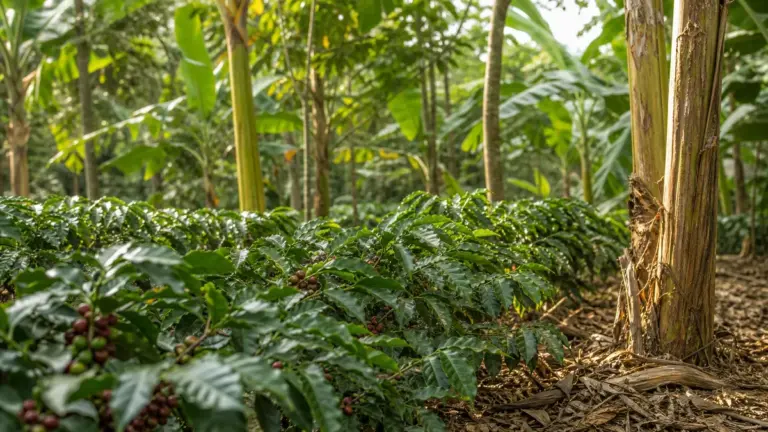
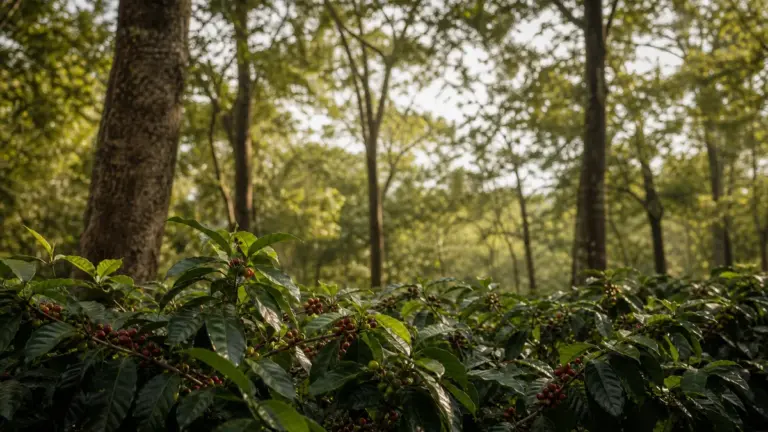
Shade also has competing effects. It changes temperature, leaf wetness, crop load and habitat around the coffee plants. Consequently, neither removing all shade nor increasing it indiscriminately is a dependable disease-control rule.
The practical aim is to manage the farm’s particular conditions and monitor the result. Broader soil and habitat approaches belong within this assessment, as explained in regenerative agriculture, rather than being treated as stand-alone cures.
How integrated pest management works
Integrated pest management, or IPM, is a decision-making approach that combines compatible methods while minimising unnecessary pesticide use and associated risks. It is not a promise to eradicate every pest, nor does it mean spraying routinely and adding a few other measures afterwards.
A practical sequence is:
- Identify the problem. Inspect the affected plant parts and seek diagnostic help when symptoms overlap.
- Monitor consistently. Record where damage occurs, how widespread it is and whether it is increasing. For berry borer, inspect berries as well as using any locally recommended monitoring traps.
- Prevent avoidable carry-over. Use healthy planting material, manage contaminated tools and soil, and remove residual berries where borer management requires it.
- Choose a proportionate response. Combine crop management, suitable varieties and biological controls. Use local action thresholds, the point at which intervention is justified, rather than assuming any pest sighting requires spraying.
- Check the outcome. Repeat observations after intervention and keep records to guide the next decision.
Biological control uses living organisms against a pest. One example is Beauveria bassiana, a fungus used in approved products against coffee berry borer. Its performance depends on conditions and contact with susceptible beetles; it does not replace harvesting hygiene.
Where pesticides are justified, growers need products authorised for coffee in their country, suitable application equipment, label compliance and worker protection. A recommendation published for one producing country is not permission to use that product elsewhere.
IPM can inform different farming systems, but any treatment on a certified organic farm must also satisfy its certification requirements. See organic farming for that separate distinction.
Resistant varieties: protection with limits
A variety is a recognisable genetic type within a coffee species. Choosing one with relevant resistance can reduce vulnerability before a tree is planted, but the useful question is always, “Resistant to what?”
World Coffee Research describes the Kenyan arabica hybrid Ruiru 11 as tolerant to leaf rust and resistant to coffee berry disease. Its robusta catalogue describes NARO-Kituza Robusta 6, also called KR6, as resistant to coffee wilt disease. These are different traits addressing different threats, not interchangeable endorsements.
Catalogue terminology also needs care. Resistance generally limits infection or pest development, while tolerance describes an ability to withstand damage. The definitions and assessment methods behind a particular rating still matter.
Resistance is not permanent immunity. Pathogens evolve, and World Coffee Research explicitly warns that a variety resistant today may not remain resistant tomorrow. Farmers must also consider local adaptation, planting-material quality and the management the variety requires.
That makes access to reliable nurseries and technical support part of crop protection, not an optional extra. Read smallholder farms and co-operatives for the wider organisation of farm support. Managing coffee pests and diseases is ultimately a continuing process of observation, prevention and adjustment.
FAQ
Is robusta immune to coffee pests and diseases?
No, robusta is not immune. Coffee berry borer can attack both arabica and robusta, and coffee wilt disease has affected robusta production in Africa. Resistance varies between varieties and between threats. A description such as “wilt-resistant” should therefore be read as a specific characteristic, not a guarantee of general plant health.
Can a farm have more than one problem at once?
Yes, pests, diseases and environmental stress can occur together. A plant with damaged roots may also show symptoms that resemble poor nutrition or drought, while leaf and fruit problems require separate inspection. Diagnosis should consider the whole plant and its growing conditions rather than assigning every symptom to the first pest found.
Should farmers spray as soon as they find a pest?
Not automatically. IPM uses identification, monitoring and locally appropriate action thresholds to decide when intervention is justified. Some situations require prompt action, but a pest sighting alone does not identify the right treatment. Preventive crop management, harvesting hygiene or biological control may be more appropriate than an immediate pesticide application.
Where to go next
Start with Coffee Farming for the wider production cycle, then read Coffee Leaf Rust and Coffee Berry Borer for a closer examination of those contrasting threats. Regenerative Agriculture explores broader farm management, while Smallholder Farms and Co-operatives explains the context in which many growers obtain advice and organise their work.
Sources
-
American Phytopathological Society, Coffee rust, Plant Health Instructor, 2000, online lesson.
https://www.apsnet.org/edcenter/pdlessons/Pages/CoffeeRust.aspx -
University of Hawai‘i at Mānoa, CTAHR, Recommendations for Coffee Berry Borer Integrated Pest Management in Hawai‘i 2020, IP-47, July 2020.
https://www.ctahr.hawaii.edu/oc/freepubs/pdf/IP-47.pdf -
CABI, Pests and Diseases of Coffee in Eastern Africa: A Technical and Advisory Manual, 2006, hosted by GOV.UK.
https://assets.publishing.service.gov.uk/media/57a08c1b40f0b64974000fcc/U3071CoffeeManual.pdf -
Uganda Ministry of Agriculture, Animal Industry and Fisheries, Coffee Manual, undated document, section 5.3.
https://agriculture.go.ug/wp-content/uploads/2026/01/coffee_manual.pdf -
USDA Agricultural Research Service, Roxana Myers, Management of Plant-parasitic Nematodes, 21 May 2020, summary hosted by University of Hawai‘i CTAHR.
https://gms.ctahr.hawaii.edu/gs/handler/getmedia.ashx?dt=3&g=12&moid=67570 -
World Coffee Research, Coffee Varieties Catalog: Ruiru 11, undated, live catalogue entry.
https://varieties.worldcoffeeresearch.org/varieties/ruiru-11 -
World Coffee Research, Coffee Varieties Catalog: NARO-Kituza Robusta 6 KR6, undated, live catalogue entry.
https://varieties.worldcoffeeresearch.org/varieties/kr-6 -
World Coffee Research, Replanting Arabica Coffee Farms: Practical Tools for Your Supply Chain, undated, live resource.
https://worldcoffeeresearch.org/programs/replanting-guide-tools -
Food and Agriculture Organization of the United Nations, Integrated Pest Management, undated, live guidance.
https://www.fao.org/pest-and-pesticide-management/ipm/integrated-pest-management/en -
US Environmental Protection Agency, Integrated Pest Management (IPM) Principles, undated, live guidance.
https://www.epa.gov/safepestcontrol/integrated-pest-management-ipm-principles -
Jaramillo and colleagues, Thermal Tolerance of the Coffee Berry Borer Hypothenemus hampei: Predictions of Climate Change Impact on a Tropical Insect Pest, PLOS ONE, volume 4, issue 8, e6487, 2009.
https://www.ars.usda.gov/ARSUserFiles/5818/Jaramilloetal-Thermaltoleranceofthecoffeeberryborer-PLoSOne2009.pdf
This article was researched using retrieved plant pathology guidance, agricultural extension manuals, variety catalogue entries and a primary experimental study, with historical biology separated from locally applicable treatment advice.
Last checked: November 2026