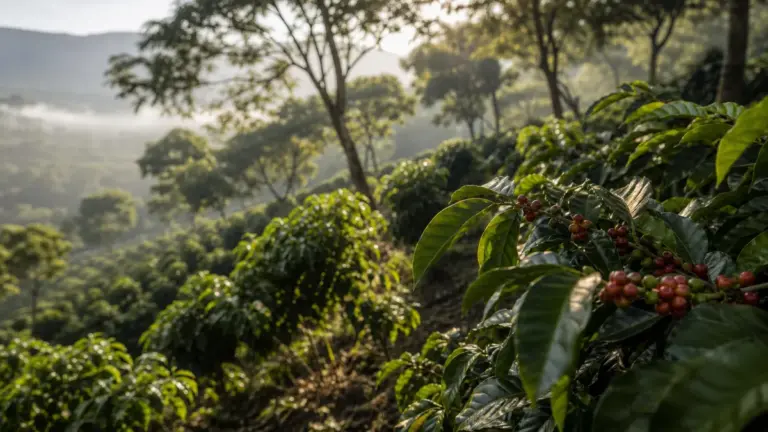
Sustainable coffee farming means producing coffee while protecting soil, water and wildlife, respecting workers and supporting a viable livelihood for farmers. It involves practical decisions, from keeping soil covered to treating processing wastewater, rather than one universal growing method or a label that proves everything.
In short
- Assess environmental, social and economic results together, not tree cover alone.
- Protect existing natural habitats as well as improving cultivated land.
- Reduce unnecessary fertiliser and pesticide use through testing, monitoring and locally suitable planting material.
- Ask what happens to coffee pulp and wastewater, including at mills outside the farm.
- Look for traceable evidence of progress, with a baseline, measurement method and reporting period.
What sustainable coffee farming involves
A useful assessment asks three questions: is the farm protecting its natural resources, are people treated fairly, and can the farming household continue earning a decent living? Improving one area does not automatically resolve the others. A farm can have impressive shade trees while its workers face unsafe conditions.
Sustainability is therefore better understood as a set of outcomes supported by suitable practices. Planting trees, composting pulp and training workers are actions; healthier habitats, cleaner discharges and reduced exposure to hazardous substances are results to investigate.
Our coffee farming hub puts these decisions alongside the wider work of establishing, managing and harvesting a coffee crop. Here, the focus is how to judge whether that work protects both the farm and the people depending on it.
Soil and water care start at ground level
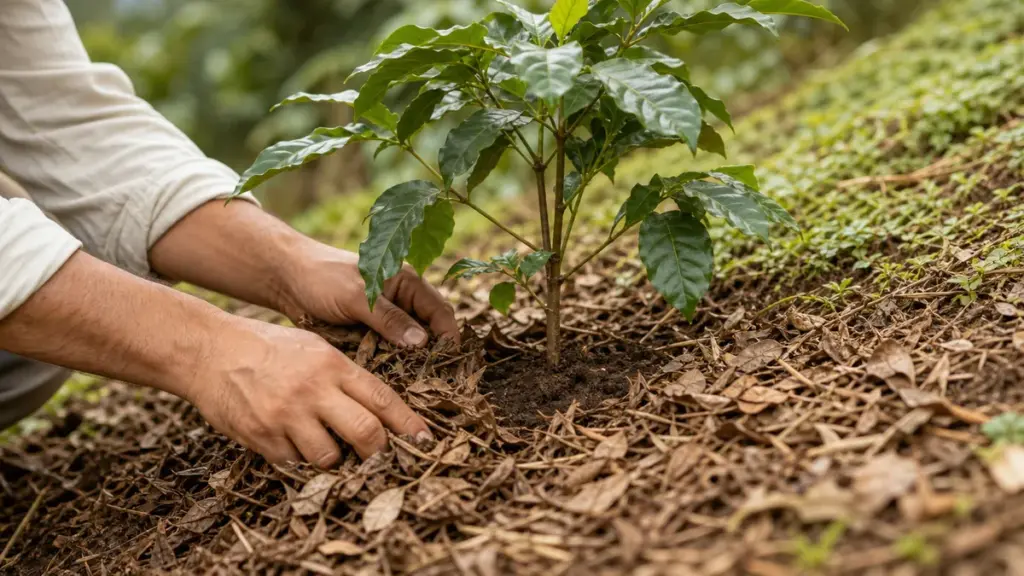
Bare soil is vulnerable to erosion, particularly on sloping land during heavy rain. Mulch, managed ground cover and planting along contours, following the slope’s level lines rather than running straight downhill, help keep soil in place. India’s Coffee Board recommends contour measures, soil-binding grasses and mulching young plants as soil and moisture conservation practices.
Mulch is a protective layer of material such as dry leaves or suitable crop residues. It can help conserve moisture, but it needs sensible placement and management. FAO guidance for young coffee plants advises keeping mulch away from the stem to reduce disease risk.
Soil testing helps growers decide whether lime or fertiliser is needed instead of applying the same treatment everywhere. Soil acidity matters because it affects how effectively coffee plants can use supplied nutrients. Compost contributes organic material and nutrients, but its presence is not proof that a crop’s nutritional needs are being met.
Water care also means looking beyond irrigation equipment. Ask where water comes from, whether extraction is monitored and how the farm protects nearby streams. A claim about reduced water use should specify whether it concerns growing the crop, processing cherries or both.
Agroforestry: trees with a purpose
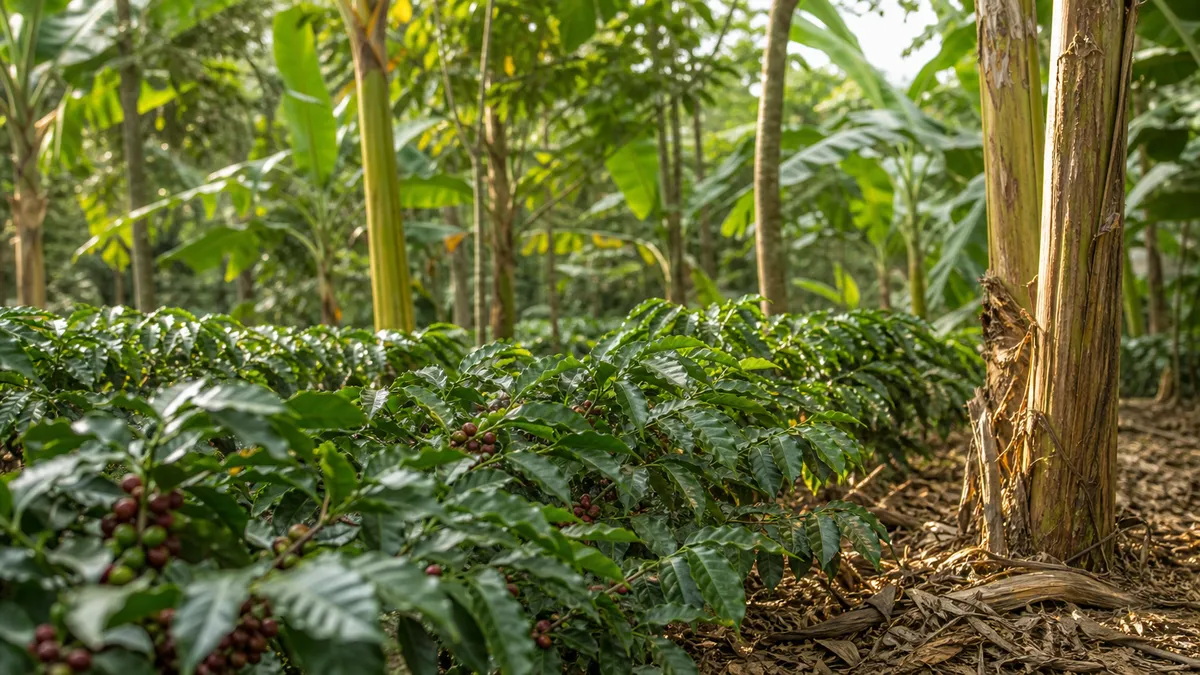
Agroforestry means deliberately growing trees alongside crops. On coffee farms, the arrangement may combine coffee shrubs with shade trees and other useful plants, rather than maintaining coffee alone.
The ecological evidence is encouraging but not uniform. A peer-reviewed meta-analysis published in 2024 found higher species diversity overall in more heavily shaded coffee systems than in sun-grown systems, while also finding differences between regions and groups of organisms. This is a synthesis of multiple studies, not proof that every shaded farm delivers the same benefit.
Shade also creates production trade-offs. A separate meta-analysis published in 2022 found that yield responses depended on shade management and local conditions. Moderate shade could support yields comparable with full-sun systems in some circumstances, while denser shade could reduce production.
The practical question is not simply “Are there trees?” It is which trees, how they are managed and whether the arrangement suits the site. FAO guidance notes that some shade-tree species can compete with coffee for water and nutrients.
Existing natural habitats need protection too. The biodiversity review recommends preventing further encroachment and maintaining habitat connections, not merely adding shade within cultivated plots. See shade-grown coffee for the fuller discussion of canopy design and wildlife.
Reduced chemical inputs, not neglected plants
Responsible input management starts by identifying a problem before treating it. Integrated pest management, usually shortened to IPM, combines prevention, observation and appropriate control methods rather than relying on routine pesticide application.
Rainforest Alliance describes its approach as using biological alternatives where possible, reducing pesticide use and reserving pesticides for situations where they are necessary. Its certification is not the same as organic certification, and permitted pesticide use does not disappear entirely.
Planting material is another part of prevention. World Coffee Research’s variety catalogue helps growers compare characteristics including disease resistance, nutritional requirements and suitability for local conditions. A resistant variety can reduce disease losses, but expected performance still depends on the environment and management.
Reducing inputs should not mean leaving plants undernourished or workers unprotected. Pesticide records should identify the product, purpose and application, while training and suitable protective equipment remain necessary when chemicals are used. “Fewer sprays” is incomplete evidence without knowing what was sprayed and what happened to crop health.
The relationship between growing conditions and plant performance is explained in coffee plant biology.
Waste and wastewater are part of farming sustainability
Sustainability does not stop when cherries leave the branches. Processing creates materials that need management, sometimes at a shared mill rather than on the farm itself.
Coffee pulp can be composted and returned as a soil amendment. Colombian technical guidance describes covered pulp management, worm composting and wastewater treatment among measures for reducing processing impacts. These are managed processes, not a reason to tip fresh residues beside a stream.
Wet processing also produces wastewater containing organic material from the fruit. Research hosted by the University of Hawai‘i measured high biological oxygen demand in processing water. This means that microbial breakdown of the material can consume substantial oxygen, creating a pollution risk if it reaches receiving waters untreated.
Using less water and treating wastewater address different problems. A low-water pulper does not, by itself, demonstrate that the remaining liquid is suitable for discharge. Cenicafé’s guidance describes treatment and recirculation approaches, with monitoring needed for water reuse.
Ask who operates the mill, how solids are separated, where wastewater goes and what checks confirm the system is working. Claims about farm sustainability should not quietly exclude a polluting processing stage.
Farmer income and decent work are essential
A farm cannot be judged on environmental practices alone. The International Trade Centre’s The Coffee Guide treats economic viability, social conditions and environmental protection as connected requirements.
Living income means the net income a household needs for a basic but decent standard of living in its particular location. It is not the same as coffee sales revenue. The International Coffee Organization recommends using an appropriate local benchmark when assessing the gap between actual household income and that standard.
For buyers, useful questions include whether growers have dependable trading relationships, access to agronomic support and a voice in decisions. Ask who carries the risk when a requested change affects production or requires additional work. Do not assume farmers can absorb every transition simply because the intended environmental outcome is desirable.
Workers need separate attention. The Coffee Guide identifies risks including pesticide exposure, sharp tools, heavy lifting and heat. A responsible assessment should examine working conditions, pay arrangements, protection from exploitation and ways to raise concerns, rather than assuming that support for farm owners automatically reaches seasonal labourers.
Fairtrade explicitly states that certification alone does not guarantee a living income. That admission is useful: credible sustainability work should explain what remains unresolved, not just describe its ambitions.
Certifications versus practices: what each can tell you
Certification offers a defined framework against which requirements can be checked. It is useful evidence, but the meaning depends on the particular scheme and its scope. For example, Rainforest Alliance states that its certified farms do not have to be organic.
Separate three kinds of evidence when assessing a claim:
- Requirements: what a standard says participants must do.
- Implementation: records or checks showing what happened on the farm.
- Outcomes: measurements showing whether conditions improved.
These answer different questions. An audit showing that a required management plan exists is not the same evidence as monitoring that demonstrates cleaner water.
Equally, an uncertified farm should not be assessed solely by the absence of a logo. Ask for evidence of its practices and results, while recognising that unsupported assurances are weaker than transparent, independently checked information.
The following checklist is an editorial tool for comparing evidence, not a certification standard.
| Area | Ask the supplier | Useful supporting evidence |
|---|---|---|
| Soil and water | How are erosion, nutrients and water use managed? | Soil results, management records and clearly defined water measurements |
| Trees and habitats | What is protected, planted and maintained? | Farm boundaries, habitat records and tree monitoring |
| Inputs and safety | Why are treatments used, and how are workers protected? | Application records, monitoring and training records |
| Processing | Where do pulp and wastewater go? | Treatment descriptions, maintenance records and relevant test results |
| Livelihoods and work | How are household income and working conditions assessed? | Benchmark methods, trading commitments and worker feedback |
For approaches centred on rebuilding soil and ecological functions, read regenerative agriculture, while keeping the same distinction between a proposed practice and a demonstrated result.
Measuring progress and recognising trade-offs
Good measurement starts with a baseline: the condition before a change. It also needs a consistent boundary, such as an individual plot, a whole farm or a processing mill.
Use more than one measure. Water use per kilogram of processed coffee answers an efficiency question; total water extraction answers a different question. Reporting only one can obscure what happened to the other.
Likewise, report yield alongside environmental indicators. The agroforestry research shows why a single prescription is unreliable: shade, crop management and site conditions interact. A sensible plan should track production, ecological effects and implications for the household together.
Be cautious about cause and effect. A before-and-after improvement is useful evidence, but rainfall, crop age or other management changes may also have influenced the result. Controlled comparisons provide stronger evidence about a particular intervention; reviews help establish whether findings hold across different settings.
UK green claims: specific evidence beats broad promises
The UK CMA Green Claims Code applies to environmental marketing directed at UK consumers, including coffee claims. Its principles require claims to be accurate, clear, complete enough not to mislead, fairly compared, considered across the relevant life cycle and supported by evidence.
For sustainable farming practices, distinguish a documented improvement, such as a verified reduction in processing water use within a stated boundary, from a broad assertion that coffee is “environmentally friendly”. The narrower finding does not establish that every environmental impact has improved.
When assessing a claim, ask: what changed, compared with what, where, over which period, and who checked it? If the evidence concerns farming alone, the wording should not imply that roasting, packaging and preparation have also been assessed.
FAQ
Can a farm use fertiliser and still practise sustainable farming?
Yes, fertiliser use alone does not settle the question. Soil testing and an appropriate nutrient plan matter more than a simple claim that inputs are either used or avoided. India’s Coffee Board recommends soil testing to guide lime and fertiliser applications. Ask whether applications address identified needs and whether soil and crop conditions are monitored.
Does sustainably farmed coffee necessarily taste better?
No, sustainability evidence is not a sensory guarantee. World Coffee Research identifies variety, environment, nutrition, weather and management among the influences on coffee performance and quality. Assess farming claims on their environmental and social evidence, then assess flavour separately. A compelling farm story should not substitute for information about the coffee itself.
What should a small UK workplace ask its coffee supplier?
Start with traceability and a specific claim the supplier can substantiate. Ask which producer or group supplied the coffee, what the claimed improvement covers and what evidence supports it. Then ask about wastewater and livelihoods, not just packaging. This is a practical purchasing checklist, not a requirement to commission your own farm audit.
Where to go next
Read Coffee Farming: The Complete Guide for the wider production cycle, then Shade-Grown Coffee for a closer look at trees and habitat. Regenerative Agriculture examines restoration-focused approaches and the evidence needed to assess their results.
Sources
-
International Trade Centre, The Coffee Guide, fourth edition, 2021, particularly the sustainability and livelihoods discussion.
https://www.intracen.org/media/5718 -
Coffee Board of India, Planter: Agronomic Practices, undated live guidance, soil and water conservation and nutrition sections.
https://coffeeboard.gov.in/planter.aspx -
FAO, Arabica Coffee Manual for Lao PDR, “Field management & planting trees”, undated chapter page.
https://www.fao.org/4/ae939e/ae939e05.htm -
Agriculture, Ecosystems & Environment, Biophysical drivers of yield gaps and ecosystem services across different coffee-based agroforestry management types: A global meta-analysis, volume 337, 2022. Publisher abstract retrieved.
https://www.sciencedirect.com/science/article/pii/S0167880922001736 -
Science of the Total Environment, Effect of shade on biodiversity within coffee farms: A meta-analysis, volume 914, 2024. Publisher abstract retrieved.
https://www.sciencedirect.com/science/article/pii/S0048969724000160 -
World Coffee Research, About the Catalog, undated living resource.
https://varieties.worldcoffeeresearch.org/about-the-catalog -
Rainforest Alliance, Does Rainforest Alliance Certification Require a Farm to Be Organic?, updated 18 March 2026. Used for the organisation’s stated certification and IPM requirements, not as independent proof of impact.
https://www.rainforest-alliance.org/business/certification/is-rainforest-alliance-certified-organic/ -
Cenicafé, Federación Nacional de Cafeteros de Colombia, AGROSAVIA, Quantis and partners, Environmental Footprint of Coffee in Colombia: Guidance Document, version 1.0, publication year not stated in the retrieved front matter.
https://biblioteca.cenicafe.org/bitstream/10778/4243/2/ENVIRONMENTAL%20COFFEE%20IN%20COLOMBIA.pdf -
University of Hawai‘i, Hue, Bittenbender and Ortiz-Escobar, Managing Coffee Processing Water in Hawaii, undated hosted research manuscript.
https://www.ctahr.hawaii.edu/huen/coffeewaste_water.pdf -
International Coffee Organization, Living and Prosperous Income Process Guide: Determine the Living Income Benchmark, undated live guidance.
https://ico.org/global-knowledge-hub/guide/determine-the-living-income-benchmark/ -
Fairtrade International, Fairtrade’s Approach to Living Incomes for Farmers, undated live guidance. Used for Fairtrade’s stated approach and limitations.
https://www.fairtrade.net/en/why-fairtrade/why-we-do-it/decent-livelihoods/living-income.html -
Competition and Markets Authority, Making Environmental Claims on Goods and Services, 2021, live guidance checked for its principles and UK scope.
https://www.gov.uk/government/publications/green-claims-code-making-environmental-claims/environmental-claims-on-goods-and-services
Research combined national coffee-board and FAO agronomy guidance, peer-reviewed research, institutional livelihood guidance and the CMA’s environmental-claims principles; certification organisations were used to establish their own stated requirements and limitations.
Last checked: November 2026