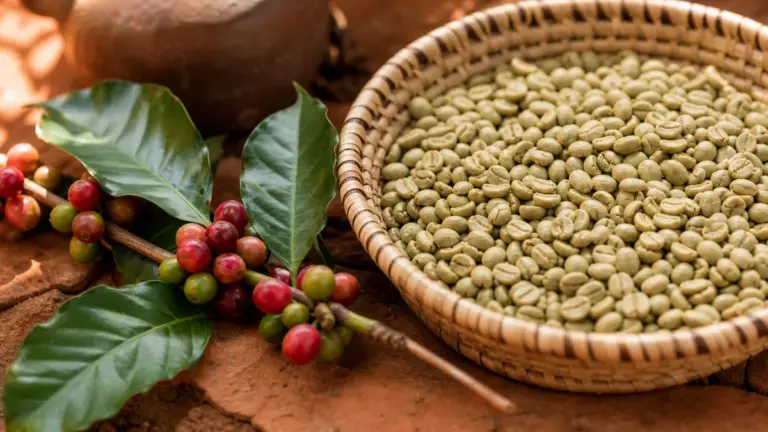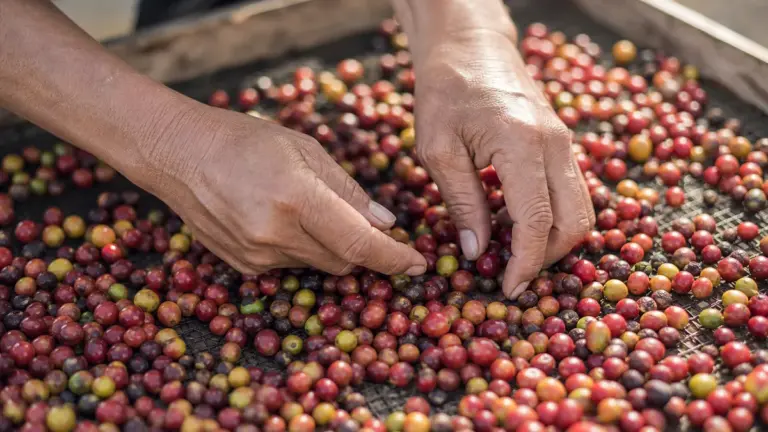
Ethiopian coffee is known for floral aromas, lively fruit flavours and remarkable variety, from delicate, citrus-led washed coffees to berry-rich naturals. Ethiopia is arabica’s birthplace and its main centre of genetic diversity, but the most useful buying rule is to choose by region, processing method and the individual lot, not the country name alone.
In short
- For floral clarity: start with a washed Yirgacheffe, Sidama or Guji.
- For fuller fruit: look for a natural-process coffee, particularly if the tasting notes mention berries or wine.
- Sidamo and Sidama: both appear on coffee labels, but historical trading names do not map neatly onto present administrative boundaries.
- Harrar: the eastern origin is particularly associated with natural processing, substantial body and fruity, mocha-like flavours.
- Traceability has changed: direct-export and vertical-integration routes now coexist with the Ethiopia Commodity Exchange.
Ethiopian coffee at a glance
The following panel describes a broad origin, not a specification that every Ethiopian coffee must meet. Altitude and harvest dates vary between districts and individual farms.
| Feature | Origin guide |
|---|---|
| Species | Arabica, Coffea arabica |
| Growing altitude | Sucafina gives a broad commercial range of 1,100 to 2,300 metres above sea level |
| Varieties | Locally adapted landraces and research selections, including JARC 74110, 74112 and 74165 |
| Main processing methods | Washed and natural |
| Main harvest | Broadly October to January; some regional harvests extend later |
| Typical cup possibilities | Floral, citrus, berry, stone fruit, spice, wine-like fruit and chocolate, depending on origin and processing |
These figures draw on Sucafina’s origin handbook and the Oromia Coffee Farmers Cooperative Union’s regional register. Neither altitude nor a prestigious regional name guarantees flavour.
For the wider geographical context, start with our guide to east african coffee. Ethiopia deserves particular attention because its coffees offer such different expressions of the same species.
Why Ethiopia’s genetic diversity matters
A species is not a variety. Coffea arabica is the species; within it, Ethiopian farmers cultivate locally adapted populations and selected varieties with different characteristics.
A landrace is a cultivated population shaped over time by local conditions and farmers’ selection. A cultivar is a cultivated variety selected or bred for particular characteristics. Ethiopia contains both, alongside forest coffee populations whose relationship with cultivation is more complicated than the word “wild” suggests.
Research using genetic markers has demonstrated substantial diversity among Ethiopian commercial varieties. This matters beyond the cup: distinct genetic material gives breeders potential options when selecting for adaptation, productivity and disease resistance.
On a bag, “Ethiopian heirloom” is a broad description, not a precise variety identification. It may be the most honest label available for mixed or incompletely identified planting material, but it should not be mistaken for one uniform botanical variety.
Numbered selections such as 74110 and 74112 provide more specific information. Even then, variety is only part of the explanation: the growing site, harvesting and processing still matter.
Sidamo
Sidamo is a long-established coffee trading name; Sidama is also widely used. Older coffee literature applies the name across a broader southern producing area than a reader might infer from a current administrative map.
That distinction explains some apparently contradictory labels. Historical classifications grouped coffees differently from today’s more specific origin descriptions. Ask for the district, producer or washing station rather than trying to resolve every bag through the word “Sidamo”.
What Sidamo coffee tastes like
The Ethiopian Coffee and Tea Authority describes washed Sidamo through sweetness, balanced flavour, fine acidity and good body. The cooperative union’s regional register also highlights citrus and spice.
Here, acidity means the bright, refreshing sensation that can resemble fruit, rather than a claim about how the coffee will affect someone’s stomach.
Sidama is not one fixed cup profile. Washed lots can retain clear fruit character, while naturals may emphasise more intense fruit. Treat those as starting expectations, then read the particular lot’s tasting notes.
For a first purchase, a washed Sidama is a useful choice if you want to explore fruit and sweetness without making processing intensity the main attraction. Compare a natural afterwards, ideally from a similar locality, rather than assuming every difference comes from the regional name.
Harrar
Harrar, also written Harar, comes from Ethiopia’s eastern highlands. It is especially associated with coffee dried inside the whole cherry, the natural process.
The classic profile is fruity and substantial, with creamy body. Blueberry is a celebrated possibility, while the national coffee authority also describes full body and a distinctive mocha character.
Those descriptions are possibilities, not promises. A bag labelled Harrar should not be expected to taste identically to another Harrar, and “mocha” here is a coffee flavour description, not an instruction to add chocolate.
How to choose a Harrar
Look for a named source and a description of the actual lot, rather than buying solely on the region’s reputation. If blueberry is what interests you, choose a coffee whose current tasting notes explicitly identify it.
My suggested comparison is a Harrar natural beside a washed Sidama. Pay attention to body, the separation of individual flavours and the character of the fruit, rather than simply deciding which tastes stronger.
That comparison is an introduction to Ethiopia’s range, not a controlled experiment: origin and processing are changing together.
Yirgacheffe, Guji and the other origins
Yirgacheffe and Guji deserve to be read as origins in their own right, not treated as interchangeable alternatives to Sidamo.
| Origin or trading name | Useful flavour starting point | What to check on the bag |
|---|---|---|
| Yirgacheffe | Floral, citrus-led, sometimes jasmine-like | Washed or natural, plus the specific locality |
| Guji | Floral, stone-fruit or tea-like possibilities | Producer or station and processing details |
| Limu | Balanced, spicy and wine-like possibilities | Processing method and the lot’s own notes |
| Jimma | Broad-ranging coffees, often associated with natural processing | Named source rather than the regional name alone |
| Kaffa and western origins such as Wollega or Nekemte | Diverse profiles, including spice, cocoa or fruit | Farm, cooperative, process and harvest information |
Yirgacheffe’s reputation is strongly associated with washed coffee, but it also produces naturals. Guji likewise supplies both washed and natural coffees, so neither name tells you the processing method.
Other names worth recognising include Illubabor, Tepi and Bebeka. The practical lesson is not to memorise a league table of regions: it is to recognise how much information a country-only label leaves out.
For neighbouring country guides, explore kenyan coffee and tanzanian coffee separately rather than treating East Africa as a single flavour category.
Garden, semi-forest and forest coffee
Ethiopian coffee grows under different levels of management.
- Garden coffee grows alongside food crops, root crops or fruit trees, often close to households.
- Semi-forest coffee grows beneath a canopy of indigenous trees, with management of the coffee and surrounding vegetation.
- Forest coffee is harvested from forest understorey with relatively little management.
Plantations also exist. These categories are useful, but their boundaries are not absolute: researchers describe a gradient of management intensity rather than a collection of perfectly separate systems.
“Forest coffee” therefore does not necessarily mean coffee untouched by people. Long histories of harvesting, selective clearing and movement of planting material complicate that picture.
For buyers, a production-system description supplies context, not a flavour score. Ask what the term means for that producer, rather than assuming forest coffee must taste better than garden coffee.
Washed and natural: the difference in the cup
Processing is how the harvested fruit becomes dried coffee ready for milling.
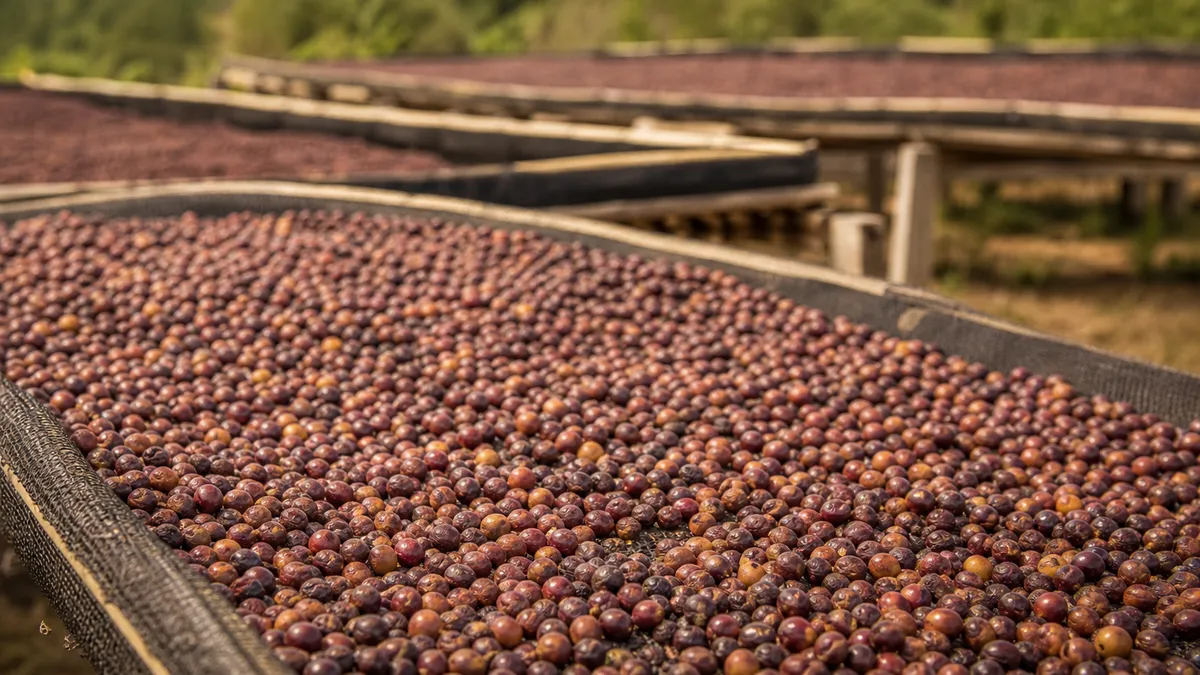
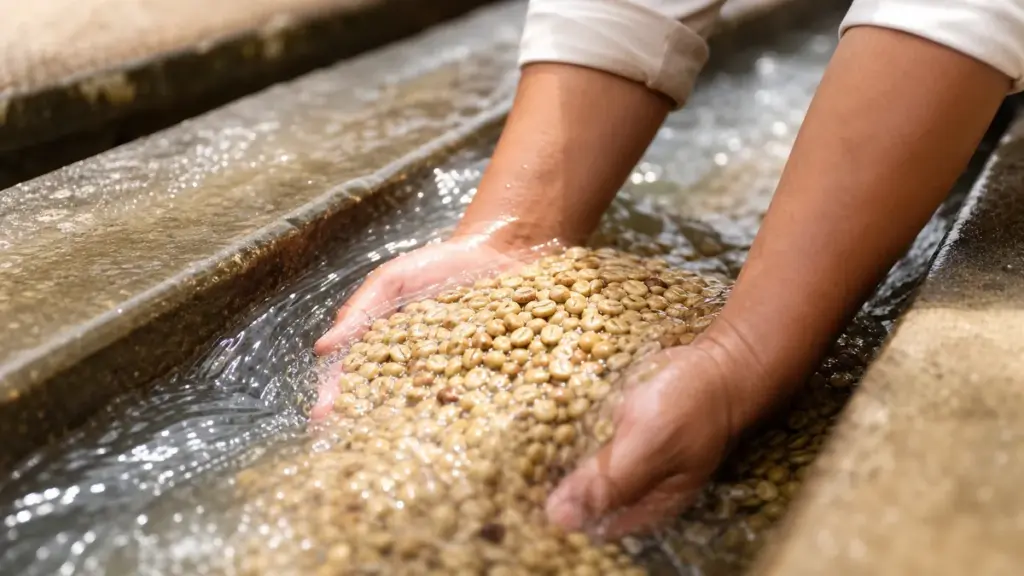
In natural processing, the whole cherry dries before its outer layers are removed. In washed processing, the skin and pulp are removed first, followed by removal of the sticky mucilage surrounding the seed, then drying.
The distinction changes the conditions around the seed during processing. It helps explain why two coffees from the same area can offer quite different sensory experiences.
Ethiopian naturals are often described through fruit, berry notes and a creamy mouthfeel. Washed coffees are commonly associated with clearer flavour definition and more apparent acidity. These are tendencies, not a rule that naturals are always heavy or washed coffees always delicate.
Careful handling matters in both methods. Sorting, appropriate fermentation where used, clean equipment and controlled drying help preserve quality; the processing label alone cannot tell you how well those jobs were done.
A useful tasting exercise is to compare a washed and a natural from the same producer or station, if available. Keep your brewing method unchanged and note aroma, sweetness, body and finish before reading the tasting notes again.
How Ethiopian coffee trading has changed
The historical ECX route
The Ethiopia Commodity Exchange, or ECX, was established in 2008 and began coffee trading that year. Its standardised grading and geographical designations helped organise trade, but the traditional route often gave overseas buyers less precise origin information than a named farm or station.
It was never the only possible export channel: cooperative unions and licensed private estates already had alternatives.
Reforms and direct sourcing
The 2017 Coffee Marketing and Quality Control Proclamation established a framework explicitly concerned with traceable marketing. Further policy changes reported in 2019 allowed direct exports by qualifying smallholders with at least 2 hectares, alongside commercial farms.
USDA’s May 2026 report confirms that eligible producers, cooperatives and exporters can source through direct relationships outside the ECX auction floor. This is often called vertical integration: closer links between supply, processing and export.
ECX remains part of the system, but it is no longer accurate to describe every Ethiopian export as an anonymous exchange purchase. Equally, direct sourcing does not automatically prove that a retail bag is traceable to one farm.
Digital traceability
The Ethiopian Coffee Traceability Management System, ECTMS, provides batch records linked to registered farms and exporters, including geographical data intended to support EU Deforestation Regulation compliance.
That is distinct from flavour traceability. A washing-station name helps identify a coffee commercially; regulatory traceability requires supporting records about the land and supply chain.
For a UK buyer, ask a simple question: what does this lot trace back to, and what documentation supports that description?
Buying Ethiopian coffee in the UK
Choose by the experience you want, then check the detail.
- Choose a processing direction. Start washed for flavour clarity, or natural if berry-rich fruit is the attraction.
- Read beyond the country. Look for region, locality, producer or station, process and variety information.
- Use tasting notes as a shortlist. They describe the seller’s assessment of that lot, not ingredients or a guaranteed result.
- Ask about intended brewing use. Follow the roaster’s guidance rather than assuming every Ethiopian coffee needs the same treatment.
- Compare deliberately. Change one purchasing criterion at a time where possible, and keep brief tasting notes.
The best next Ethiopian coffee is not necessarily from a more famous region. It is the one with enough specific information to help you understand why you enjoyed it.
FAQ
Is Ethiopian coffee a blend?
Ethiopian coffee is an origin description, not automatically a blend. A named station or cooperative lot may combine cherries supplied by several farmers while remaining a single-origin coffee. That differs from a product deliberately combining coffees from different countries. Ask what the seller means by “single origin” and how narrowly the lot is identified.
Does “natural” mean the coffee is certified organic?
No, natural describes processing, not organic certification. It means the coffee was dried inside the whole cherry before hulling. Garden, forest and semi-forest likewise describe production systems rather than certification status. If organic certification matters to you, look for a specific, verifiable certification statement instead of inferring it from these terms.
Does Grade 1 mean I will prefer it?
No, a grade is not a guarantee of personal preference. Grading provides information about assessed coffee quality, but does not choose your preferred processing style or flavour profile. Use it alongside the producer information and tasting notes. A useful buying decision starts with what you enjoy, not the highest-looking number on the label.
Where to go next
Read East Africa to place Ethiopian coffee within the wider growing region. Continue with Kenya and Tanzania to explore neighbouring origins on their own terms and build a more useful comparison than a single “East African” flavour description.
Sources
- World Coffee Research, Arabica, online varieties catalogue, undated, retrieved November 2026. Catalogue introduction. Botanical origin and genetic-diversity context.
- Sucafina, Origin Handbook 2023, Ethiopia entry and African altitude overview, 2023. Origin handbook. Commercial altitude range, varieties, harvest and producing areas.
- Oromia Coffee Farmers Cooperative Union, The Origin Atlas, undated, retrieved November 2026. Regional register. Regional harvest windows and the union’s descriptive cup profiles.
- Ethiopian Coffee and Tea Authority, Ethiopia: Taste of Origins, undated booklet, hosted in 2022. Authority booklet. Processing and traditional regional flavour descriptions.
- Benti and colleagues, Genetic diversity among commercial arabica coffee (Coffea arabica L.) varieties in Ethiopia using simple sequence repeat markers, Journal of Crop Improvement, 2021. Research record and abstract. Primary genetic-marker research.
- Hylander and colleagues, Lessons from Ethiopian coffee landscapes for global conservation in a post-wild world, Communications Biology 7, article 714, 2024. Research perspective. Production systems and the difficulty of separating wild and managed coffee populations.
- USAID Agribusiness and Trade Expansion Program, Fintrac, Willem J. Boot, Ethiopian Coffee Buying Manual, March 2011. Buying manual. Historical terminology, Harrar, Sidama and early ECX arrangements, not current trading rules.
- TechnoServe, Coffee Wet Mill Processing Guide, hosted March 2022. Processing guide. Processing stages and quality-preserving practices.
- Ethiopian Ministry of Justice, Coffee Marketing and Quality Control Proclamation No. 1051/2017, 2017. Official proclamation record. Traceable-marketing framework.
- USDA Foreign Agricultural Service, Coffee Annual: Ethiopia, report ET2021-0013, 14 May 2021. Annual report. Historical account of the 2019 export-policy changes.
- USDA Foreign Agricultural Service, Coffee Annual: Ethiopia, report ET2026-0005, 20 May 2026. Annual report. Current direct-sourcing routes, eligibility and regulatory context.
- Ethiopian Coffee and Tea Authority, Ethiopian Coffee Traceability Management System portal, undated, retrieved November 2026. ECTMS portal. Published functions and intended compliance support, not independent verification of nationwide coverage.
Research combined botanical and genetic literature, producer and national-authority descriptions, processing guidance and dated trade reports, keeping historical arrangements separate from current routes.
Last checked: November 2026