Ethiopian heirloom coffees are not one variety: “heirloom” is a loose trade label that can conceal locally adapted arabica populations, named farmer selections and officially released varieties. “Landrace” is more precise when it describes a traditional, locally adapted population, but it still does not identify exactly which trees supplied a particular bag.
In short
- Read “heirloom” as incomplete variety information, not a guarantee of age, wild origin or quality.
- A landrace develops through local adaptation and human cultivation; it is not necessarily an untouched forest population.
- JARC selections such as 74110, 74112 and 74158 belong to Ethiopia’s disease-resistance breeding history, not a category of laboratory-created hybrids.
- Yirgacheffe, Sidama and Harar describe origins or recognised coffee types, not individual botanical varieties.
- The most useful label combines a credible variety description with the producer or washing station, location, processing method and harvest information.
What “heirloom” hides on an Ethiopian coffee bag
On an Ethiopian coffee bag, “heirloom” usually occupies the space where another origin might name a particular variety. Yet it does not establish a single pedigree, a defined population or a documented planting history. It is an umbrella description, not the equivalent of a precise cultivar name.
The difficulty is that Ethiopian coffee includes several overlapping categories: forest populations, traditional landraces maintained by farmers, selections developed from local material, and varieties released through formal research. Reducing these to one nostalgic word hides both biological diversity and Ethiopian agricultural expertise.
A bag labelled “heirloom” therefore leaves useful questions unanswered. Does it contain mixed local landraces? Are research selections also planted on the supplying farms? Is the description based on farmer knowledge, planting records or simply the information available to the exporter?
For the wider framework, start with coffee varieties. Here, the essential distinction is between a broad description of ancestry and a supported identification of the plants behind a lot.
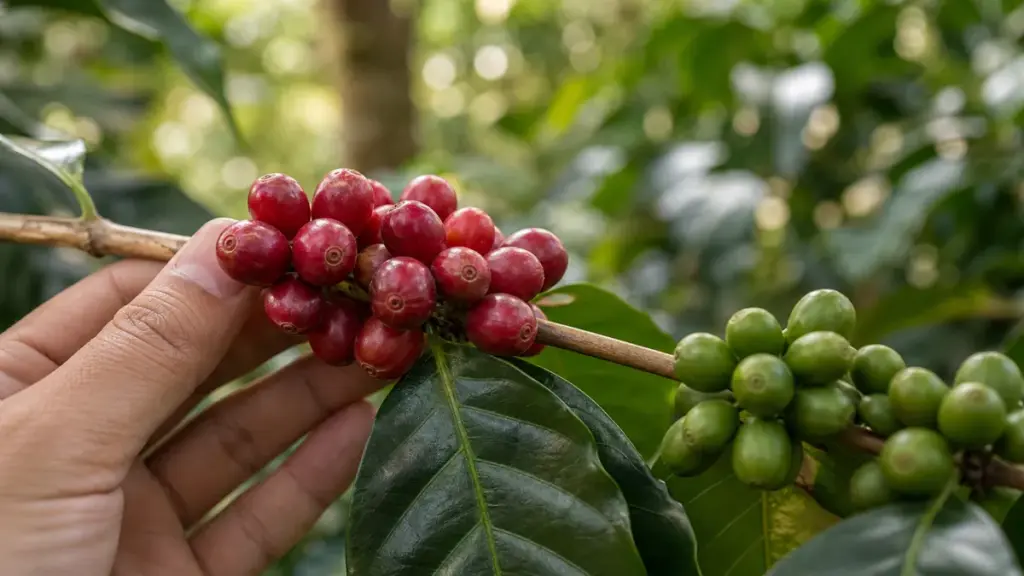
Why Ethiopia’s genetic diversity matters
Ethiopia contains the principal centre of genetic diversity for Coffea arabica. Much of the arabica cultivated elsewhere descends from a comparatively narrow set of plants associated with the Typica and Bourbon groups. Ethiopian coffee cannot sensibly be treated as another single branch of the same size.
That diversity is useful beyond flavour. Different genetic material provides options for breeding and adaptation, including responses to disease and different growing environments. A named selection represents particular material drawn from that wider resource, not a replacement for the resource itself.
There is also no simple boundary between “wild” and cultivated coffee. Forest management, seed movement and planting have brought different populations into contact. Genetic research in south-western Ethiopia has found differentiation between managed and unmanaged populations, alongside evidence of mixing with improved cultivars.
This is why claims that every heirloom coffee comes from untouched ancient forest trees are misleading. Equally, counting every local name or collected sample as a separate, scientifically established variety produces false precision.
Landraces, local names and farmer selections
A landrace is a traditional, locally adapted population shaped over time by its environment and cultivation. Farmers are part of that history: choosing seed, retaining useful trees and moving planting material all influence what survives.
Ethiopian farmers recognise coffee types through features including tree form, leaf colour, fruit and bean characteristics, and perceived quality. Names such as Dega, Wolisho and Kurume, also encountered in related spellings such as Kurumei, carry local knowledge that “heirloom” fails to communicate.
However, a local name should not automatically be treated as proof of one uniform genetic identity everywhere it appears. A name recorded in a village, a nursery’s planting material and a genetically characterised research accession are different kinds of evidence.
A local selection is material chosen from a broader population for useful characteristics. That selection may remain part of farmer practice or enter a formal testing programme. “Landrace” and “selection” therefore describe related ideas, but they are not interchangeable.
When buying, ask what a local name means for the actual lot. “Reported by the supplying farmers” is useful information, provided it is not presented as laboratory confirmation.
What JARC numbers mean
The Jimma Agricultural Research Center, usually abbreviated to JARC, is central to Ethiopia’s formal coffee improvement work. Coffee berry disease, commonly shortened to CBD, was a major driver of the early selection programme.
The familiar numbered varieties 74110, 74112 and 74158 are selections, not F1 hybrids created by crossing two chosen parents. They came from Ethiopian coffee material selected and evaluated for useful characteristics, especially CBD resistance.
Selection is not the same as crossing
In pure-line selection, breeders identify promising plants within existing variation and develop their descendants into a more consistent line. The starting material already contains the characteristics being sought. Deliberately crossing distinct parents to produce an F1 hybrid is a different breeding route.
Ethiopia has used both approaches. Calling every JARC variety a hybrid is therefore wrong, but so is assuming that all research releases are traditional landraces.
The distinction also matters when comparing Ethiopian selections with the breeding histories covered in disease-resistant variety groups and F1 hybrids.
The collection year is not the release year
The “74” series is associated with the 1974 collection, rather than a 1974 release to farmers. Published Ethiopian research records that collection as the genetic base of early CBD-resistant pure-line selections.
A separate study lists 74110, 74112 and 74158 with a 1978/79 release year. This distinction prevents a common muddle: collection, selection, testing and release are different stages, not alternative dates for the same event.
The reviewer’s description of these varieties as selections rather than artificial laboratory hybrids is sound. The mother-tree story needs more care: Ethiopian breeding material came from coffee forests and farmers’ fields, so “selected from Ethiopian material” is safer than claiming that every research variety originated from a completely unmanaged wild tree.
Ethiopian origin fact panel
These are broad origin reference points, not specifications for every coffee carrying an Ethiopian heirloom or landrace label.
| Feature | Reference point | How to interpret it |
|---|---|---|
| Altitude | Kew’s national overview places coffee mainly at 1,200 to 2,100 metres above sea level | A broad growing range, not an upper limit for individual farms |
| Varieties and populations | Traditional local landraces, including names such as Dega and Wolisho, alongside released selections such as 74110, 74112 and 74158 | These are examples, not a national planting-share ranking |
| Main processing methods | Washed and natural, also called dry processing | Washed coffee has fruit removed before drying; natural coffee dries within the cherry |
| Harvest months | Broadly October to January or February, corresponding to the main dry season | Timing varies with location and growing conditions |
| Typical cup character | Floral and bright-fruited examples from Yirgacheffe; sweet, fruity examples from Sidama; fruity, fuller-bodied examples from Harar | Regional descriptions, not guaranteed flavours or variety identities |
Panel sources: Kew and ECFF, 2017; ECFF, 2015; Tirfe, Kufa and Mohammed, 2015. The flavour descriptions are sensory conventions rather than genetic diagnostic tests.
Regional character is not a variety name
Yirgacheffe, Sidama, Guji and Harar help locate a coffee, but location alone does not identify its plants. Reading “Yirgacheffe heirloom” as though both words formed a precise variety name gives the label more certainty than it contains.
Regional descriptions remain useful starting points. Yirgacheffe is associated with floral character, bright acidity and fruit; Sidama includes sweet, fruity coffees; Harar is recognised for fruity character and fuller body. These expectations should guide exploration, not overrule the description of an individual lot.
Growing conditions and processing also matter. In an experimental comparison of early Ethiopian releases grown at Jimma, Gera and Metu, location and wet or dry processing influenced assessed cup quality. A variety code is therefore not a complete flavour recipe.
For a useful tasting comparison, choose coffees with clear producer and process information. If the aim is to explore variety, try to keep other differences modest. Comparing an unusually processed natural with a conventional washed coffee may reveal more about processing than genetics.
How Ethiopian coffee labelling is changing
More specific descriptions are already possible. Counter Culture Coffee records publishing A Reference Guide to Ethiopian Coffee Varieties, by Getu Bekele and Tim Hill, in 2018, helping make detailed Ethiopian variety information more accessible to the trade.
Competition records show the practical result of more explicit identification. The official 2024 Ethiopian Cup of Excellence results name varieties including 74158, 74110 and 74112 rather than placing everything under “heirloom”.
That does not mean every variety declaration has been DNA-verified. Competition and supplier records establish what was declared for a lot; they are not automatically genetic certificates.
The better direction is towards specificity with an honest basis. “Mixed local landraces” can be more accurate than an unsupported single-variety claim. “74110 and 74112, according to planting records” is more informative still, where those records exist.
For Ethiopian heirloom and landrace coffees, the goal is not simply a longer variety field. It is a label that preserves what is known and makes the remaining uncertainty visible.
Reading a label before you buy
Use this short sequence when comparing UK roasters’ descriptions:
- Find the producer or washing station. Ask whether the lot comes from one farm or combines several suppliers.
- Separate place from plant. Treat the region, variety and process as different fields.
- Check the basis of identification. Look for planting records, producer knowledge or genetic testing, without assuming they are equivalent.
- Read the processing description. Do not attribute every distinctive flavour to the landrace or selection.
- Accept a clear limitation. “Mixed varieties, exact composition unknown” is preferable to an invented pedigree.
A number is useful when it is traceable. An honest broad description is useful when greater precision is unavailable. Neither should be treated as a quality score on its own.
FAQ
Is an Ethiopian heirloom coffee always a blend?
No, the word “heirloom” does not establish whether a coffee is a blend. It leaves variety composition insufficiently specified. The lot might combine coffee from different plants or farms, but the label alone cannot tell you how many populations are involved. Ask separately about producer traceability and variety composition.
Can I identify the landrace from the shape of the beans?
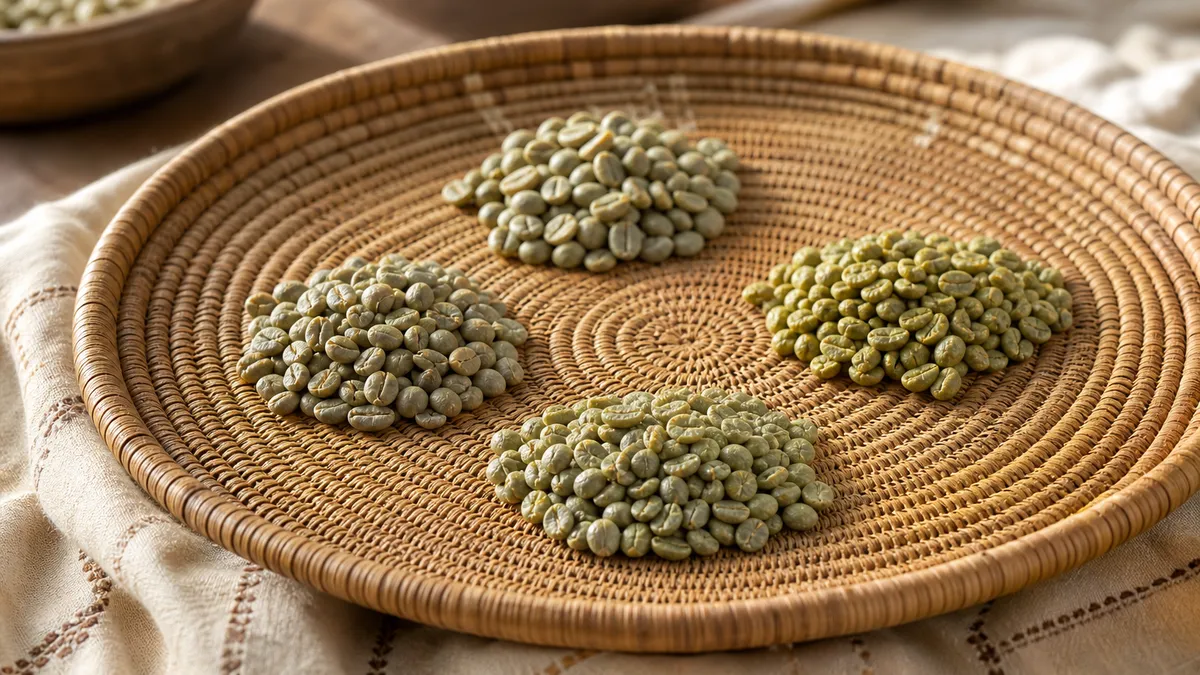
Not reliably from appearance alone. Farmers use physical characteristics as part of local identification, but a finished green or roasted bean is not equivalent to observing the tree and its fruit. Treat small, elongated or uneven beans as observations, not proof that a coffee belongs to a particular named landrace.
Does a numbered JARC selection mean lower cup quality?
No, a research number does not mean lower cup quality. Official Ethiopian competition results include explicitly numbered selections among highly placed coffees. That demonstrates their quality potential, not a guarantee for every harvest or lot. Producer practice, growing conditions, processing and preparation still need to be considered.
Where to go next
Use Coffee Varieties to place Ethiopian landraces within the wider terminology. Read Pink Bourbon and Sudan Rume for another discussion of names and ancestry, then Ruiru 11, Batian and F1 Hybrids to understand why selection and crossing need separate explanations.
Sources
-
World Coffee Research, History of Arabica, Varieties Catalog, undated live reference.
https://varieties.worldcoffeeresearch.org/arabica-2/history-of-arabica -
Royal Botanic Gardens, Kew and Environment & Coffee Forest Forum, Coffee Farming and Climate Change in Ethiopia: Impacts, Forecasts, Resilience and Opportunities, summary report, 2017.
https://www.kew.org/sites/default/files/2019-01/Coffee%20Farming%20and%20Climate%20Change%20in%20Ethiopia.pdf -
Environment and Coffee Forest Forum, Tadesse Woldemariam Gole, Coffee: Ethiopia’s Gift to the World, 2015.
https://cdn.naturskyddsforeningen.se/uploads/2021/05/11102756/coffee_-_ethiopias_gift_to_the_world_ecff_2015_0.pdf -
Benti and colleagues, Genetic diversity among commercial arabica coffee (Coffea arabica L.) varieties in Ethiopia using simple sequence repeat markers, Journal of Crop Improvement, volume 35, issue 2, 2021, published online 2020.
https://horizon.documentation.ird.fr/exl-doc/pleins_textes/2021-06/010079733.pdf -
Tirfe, Kufa and Mohammed, Liquor Quality Performance of Some Early Released Coffee Varieties at Three Locations in South-West Ethiopia, World Journal of Dairy & Food Sciences, volume 10, issue 2, 2015.
https://library.sweetmarias.com/wp-content/uploads/2020/08/Quality-Performance-of-Some-Early-Released-Coffee-Varieties-at-Three-Locations-in-South-West-Ethiopia.pdf -
Aerts and colleagues, Genetic variation and risks of introgression in the wild Coffea arabica gene pool in south-western Ethiopian montane rainforests, Evolutionary Applications, 2013.
https://pmc.ncbi.nlm.nih.gov/articles/PMC3689350/ -
Counter Culture Coffee, History, entry for 2018, undated live page.
https://counterculturecoffee.com/pages/history -
Alliance for Coffee Excellence, Ethiopia 2024, official competition results, 2024.
https://allianceforcoffeeexcellence.org/ethiopia-2024/
The piece was researched using live-retrieved botanical references, Ethiopian research publications, an origin report, genetic research, publisher records and official competition results; no first-hand testing is claimed.
Last checked: November 2026