Ugandan coffee ranges from substantial, chocolatey robusta to bright, fruit-toned arabica from Mount Elgon and the Rwenzori Mountains. The most useful buying rule is to check the species, region and processing method together: washed Bugisu, natural Drugar and Ugandan robusta are distinctly different starting points, not variations on one national flavour.
In short
- Robusta dominates, but Uganda also has established highland arabica production and indigenous wild coffee species.
- Bugisu usually means washed arabica from the western slopes of Mount Elgon; AA and A are physical export grades, not varieties.
- Drugar means Dry Ugandan Arabica. It is strongly associated with western Uganda, including Rwenzori, but the name alone does not guarantee that origin.
- Wild robusta survives in forests including Kibale and Zoka. Uganda is part of the species’ indigenous African range.
- Excelsa is a different species, Coffea dewevrei, indigenous to Uganda and recognised separately from liberica in recent genomic research.
Uganda coffee fact panel
These are broad growing and harvesting guides, not specifications for every farm. Altitude summaries differ between official publications: the export leaflet gives a narrower arabica range than the cultivation handbook, which includes growing areas from 1,200 to 2,500 metres.
| Feature | Ugandan robusta | Ugandan arabica |
|---|---|---|
| Species | Coffea canephora | Coffea arabica |
| Broad commercial altitude | 900 to 1,500 metres | 1,300 to 2,300 metres in UCDA’s export summary |
| Main planting material | Local robusta populations and improved coffee-wilt-resistant clones | Includes SL14, SL28 and Nyasaland |
| Main processing | Predominantly natural; some washed and partially washed | Washed and natural, including Bugisu, Wugar and Drugar |
| Harvest guide | Central, eastern and northern main crop generally November to February; Masaka and western main crop generally April to July | Broad main crop October to January; smaller crop April to July, with regional variation |
| Cup-profile guide | Chocolate, nuts, caramel and spice; body and bitterness vary | Floral, citrus, berry, chocolate and dried-fruit notes, depending on region and process |
Panel sources: UCDA’s growing handbooks and export leaflet, World Coffee Research’s variety catalogue, Kew’s harvest summary and UCDA’s regional sensory profiles. The flavour descriptions are tendencies, not promises about an individual bag.
Why robusta matters so much in Uganda
Robusta is not a minor supporting crop here. Uganda’s official September 2026 report recorded exports of 622,081 bags of robusta and 113,354 bags of arabica, each weighing 60 kg. That is a monthly trade snapshot rather than a production census, but it makes robusta’s commercial importance unmistakable.
Much of the crop grows around the Lake Victoria basin and across central and western Uganda. Commercial robusta cultivation commonly reaches elevations that surprise readers accustomed to thinking of robusta simply as lowland coffee. Uganda’s cultivation handbook gives a growing range of 900 to 1,500 metres.
The cup deserves more than the shorthand “strong and bitter”. UCDA’s regional profiling records chocolate, caramel, roasted nuts, tropical fruit and spice, with some profiles showing low bitterness and others a heavier body. Those findings do not make every Ugandan robusta exceptional; they show why species alone is an inadequate tasting note.
For a first purchase, ask the roaster what distinguishes the lot: its growing area, harvesting standards and processing, rather than accepting “Ugandan robusta” as a complete description. If you want the wider geographical context before choosing, start with east african origins.
Wild robusta and Uganda’s forest coffee heritage
Uganda is one of robusta’s native homes, not merely a country where the crop was introduced commercially. Wild Coffea canephora persists in forests including Kibale and Zoka, as well as other parts of its Ugandan range. These forest populations must be distinguished from planted coffee growing under shade on farms.
That distinction matters because wild populations preserve genetic diversity that is not necessarily represented in commercial planting material. Research reviewed by Davis and colleagues identifies differences among Uganda’s wild and cultivated robusta populations and discusses their relevance to breeding and conservation. A productive plantation is therefore not a substitute for protecting native forest coffee.
Nor should a bag described as “wild” automatically be treated as a conservation success. Ask where it was harvested, who authorised collection and how the supplier supports habitat protection. Kew’s assessment documents forest fragmentation and disturbance affecting Uganda’s indigenous coffee resources, making traceability more useful than romantic wording.
Arabica from Mount Elgon and Rwenzori
Mount Elgon and washed Bugisu
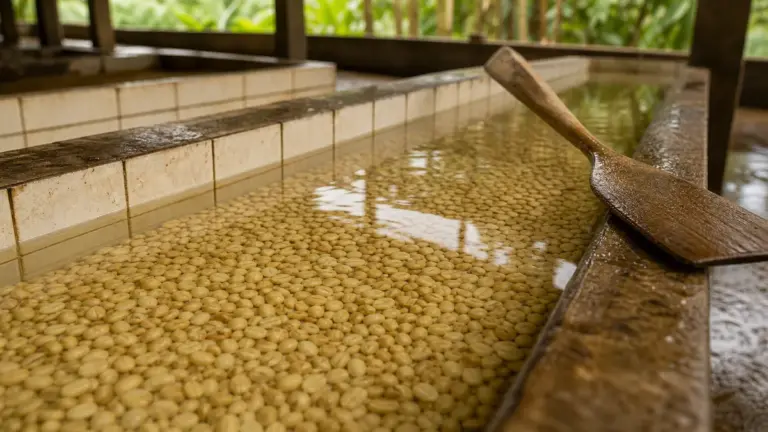
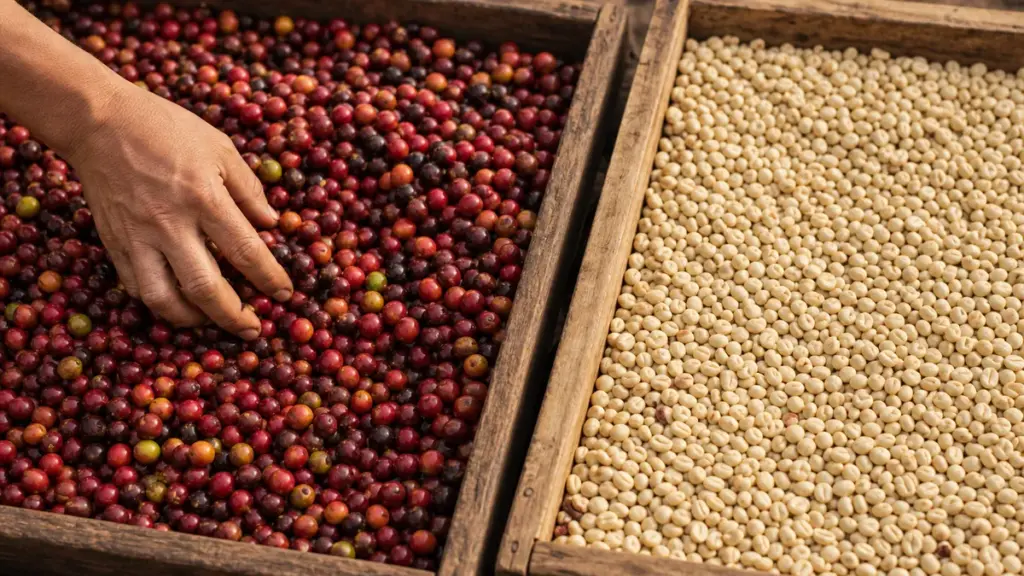
Mount Elgon stands on Uganda’s eastern border with Kenya. Bugisu coffee comes from its western slopes, where washed arabica is an established commercial identity. “Washed” means that the fruit flesh and sticky mucilage surrounding the seeds are removed before the coffee finishes drying in its parchment covering.
The Uganda Coffee Federation describes Bugisu as winey and fruit-toned. That is a useful starting expectation, but choose a particular lot by its own tasting notes rather than assuming that every Mount Elgon coffee has identical acidity, sweetness or body.
Bugisu AA and Bugisu A are export grades involving bean size and permitted defects. AA generally selects larger beans than A, but neither label names a botanical variety or guarantees which coffee you will prefer. A carefully described A-grade lot can be a more sensible choice than an anonymous AA whose only selling point is its lettering.
Rwenzori and natural Drugar
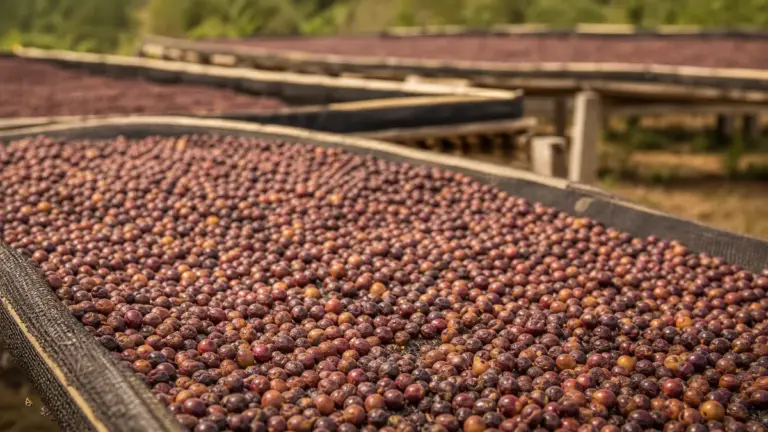
The Rwenzori Mountains form another major arabica area in western Uganda, beside the Democratic Republic of the Congo. Natural arabica from this area is commonly sold as Drugar, an abbreviation for Dry Ugandan Arabica. Here, the coffee dries inside the whole fruit before hulling removes the dried outer layers.
A traceable Rwenzori natural can be distinctly fruity. As one documented example, importer Covoya described its Bujuku Valley natural from the 2021/22 harvest with fruit-sweet, cranberry and milk-chocolate notes. That is a historical lot description, not a universal Rwenzori profile or a statement of current availability.
Do not turn the familiar contrast into a rigid rule. Rwenzori also produces washed coffee, while Drugar can be sourced from elsewhere in Uganda. Sucafina explicitly describes its Drugar offering as coming from smallholders across the country. Ask for the actual region whenever the label stops at the trade name.
For your next origin comparison, explore tanzanian coffee, keeping species and process consistent where possible.
How processing changes the buying decision
Uganda’s robusta is predominantly naturally processed, while arabica is sold in both washed and natural forms. Processing names tell you how the fruit was handled, not whether the finished coffee is good: either route still requires sound harvesting, drying and storage.
In washed processing, pulping removes the outer flesh. Fermentation or mechanical treatment removes the mucilage, after which the parchment coffee is dried. In natural processing, whole cherries are dried first and hulled afterwards. These are materially different routes to the green bean, even before roasting begins.
Drying deserves particular attention. Uganda’s official processing guidance calls for prompt drying, regular stirring and protection against rewetting to prevent undesirable taints and mould. “Natural” should describe the method, not excuse careless handling.
For buying purposes, separate three questions:
- What is it? Establish the species and, where known, variety.
- Where was it grown? Look beyond the country to the mountain area, producer group or named lot.
- How was it handled? Confirm the process and read the roaster’s description of the actual coffee.
Treat “Bugisu”, “Drugar” and “robusta” as different kinds of information, not interchangeable quality grades. Their meanings concern origin, processing and species respectively.
Varieties, excelsa and Uganda’s deeper diversity
Arabica labels may name SL14, SL28 or Nyasaland. World Coffee Research describes SL14 as a tall variety with drought and cold tolerance, found mainly in Kenya and Uganda. Nyasaland, also called Bugisu local or Nyasa, has good cup-quality potential but susceptibility to major diseases. These are varieties within arabica, unlike robusta and excelsa, which are separate species.
Nyasaland also illustrates why names need care. World Coffee Research places it in the Typica-related genetic group and records its historical movement through southern Africa before its arrival in Uganda. A local name such as “Bugisu local” does not mean that the plant is a separate species native to Mount Elgon.
Excelsa adds a different chapter. Coffea dewevrei is indigenous to Uganda, with wild populations documented in Zoka Central Forest Reserve and Semuliki National Park. It is not a large-beaned robusta variety.
Older literature often calls it Coffea liberica var. dewevrei. Davis and colleagues’ genomic, morphological and geographical study, published in Nature Plants in August 2025, supports recognising excelsa separately as Coffea dewevrei. This article follows that treatment; the older classification explains the different name readers may encounter in earlier research.
Kew’s Ugandan evaluations have recorded chocolate, grape and other fruit notes in excelsa. These observations show sensory promise, not a settled national style or proof that it can replace arabica or robusta everywhere. Read a named lot’s description and keep commercial development separate from the equally important task of conserving its wild populations.
Choosing Ugandan coffee in the UK
My suggested starting point is washed Bugisu if you want to explore Uganda through its established arabica trade identity. Choose a traceable Rwenzori natural if a particular lot’s fruit-led description appeals, or a separately identified Ugandan robusta if you want to investigate that species on its own terms.
Ask for a roast date, intended brewing use and specific origin information. If the bag is a blend, ask which species it contains rather than inferring the composition from the country name. For a useful tasting exercise, compare coffees with similar roast styles before changing several variables at once.
The strongest reason to explore Uganda is its breadth. Build your choice around the coffee actually in the bag, then use rwandan coffee as another next read rather than expecting one East African origin to stand in for another.
FAQ
Is Bugisu a coffee variety?
No, Bugisu is an origin and commercial coffee name, not a botanical variety. It is associated with arabica from the western slopes of Mount Elgon. Nyasaland can also appear under the name “Bugisu local”, which creates understandable confusion, but the two uses should not be treated as equivalent.
What does Wugar mean?
Wugar means Washed Ugandan Arabica. It distinguishes washed coffee from natural Drugar, but does not by itself provide complete farm-level traceability. The Uganda Coffee Federation associates Wugar with western mountain-growing areas. Ask the roaster for the region and producer information rather than treating the abbreviation as a complete origin description.
Does Uganda grow arabica naturally in its forests?
Uganda’s commercial arabica is an introduced crop, unlike its indigenous robusta and excelsa. The presence of native wild coffee therefore does not mean that every species grown commercially in Uganda originated there. Keeping native species, cultivated varieties and modern production regions separate makes both conservation claims and coffee labels easier to interpret.
Where to go next
Read East Africa to place Uganda within the wider regional guide, then Tanzania for another country-level origin study. Continue with Burundi and Rwanda to build your comparisons without reducing neighbouring origins to one shared flavour.
Sources
-
Uganda Coffee Development Authority, Robusta Coffee Handbook, 2019. Growing zones, altitude, planting material, wild robusta and harvesting guidance.
https://ugandacoffee.go.ug/sites/default/files/2022-03/Robusta%20Coffee%20Handbook.pdf -
Uganda Coffee Development Authority, Arabica Coffee Handbook, 2019. Growing areas, varieties and export-grading tables.
https://ugandacoffee.go.ug/file-download/download/public/43 -
Uganda Coffee Development Authority, export information leaflet, undated. Commercial altitude ranges, processing and export-grade names. Its historical production figures were not used.
https://ugandacoffee.go.ug/index.php/file-download/download/public/289 -
Ministry of Agriculture, Animal Industry and Fisheries, Coffee Department, Monthly Coffee Report: September 2026, 2026. Species-specific monthly export quantities.
https://ugandacoffee.go.ug/sites/default/files/2026-10/12%20September%202026%20Report%20dpptx%20%281%29.pptx_Finalptx.pdf -
Uganda Coffee Federation, Uganda Coffee Industry, undated. Bugisu geography and commercial terminology.
https://ugandacoffeefederation.org/resource-center/uganda-coffee-industry/ -
MAAIF Coffee Department, Primary Processing, undated. Washed and natural processing sequences and drying precautions.
https://ugandacoffee.go.ug/index.php/primary-processing -
Uganda Coffee Development Authority, Uganda Coffee Profiles, undated. Regional sensory descriptions.
https://ugandacoffee.go.ug/file-download/download/public/399 -
Royal Botanic Gardens, Kew, Davis and colleagues, The Wild Coffee Resources of Uganda: A Precious Heritage, 2023. Harvest calendars, indigenous species, forest populations, conservation and excelsa sensory observations.
https://www.kew.org/sites/default/files/2024-01/The%20Wild%20Coffee%20Resources%20of%20Uganda.pdf -
Davis and colleagues, A Review of the Indigenous Coffee Resources of Uganda and Their Potential for Coffee Sector Sustainability and Development, Frontiers in Plant Science, 2023. Native coffee diversity and genetic-resource context.
https://pmc.ncbi.nlm.nih.gov/articles/PMC9982753/ -
World Coffee Research, Arabica Coffee Varieties: SL14 and Nyasaland, live catalogue, undated. Variety identities, characteristics and history.
https://varieties.worldcoffeeresearch.org/varieties/sl14
https://varieties.worldcoffeeresearch.org/varieties/nyasaland -
Davis and colleagues, Genomic Data Define Species Delimitation in Liberica Coffee with Implications for Crop Development and Conservation, Nature Plants, 2025. Published 8 August 2025.
https://www.nature.com/articles/s41477-025-02073-y.pdf -
Sucafina, Uganda Drugar, undated; Covoya, Uganda Bujuku Valley Natural, 2021/22 harvest listing. First-party sourcing descriptions and a clearly identified historical lot example.
https://www.sucafina.com/na/offerings/uganda-drugar
https://uk.covoyacoffee.com/uganda-bujuku-valley-natural.html
This article was researched from retrieved Ugandan official publications, botanical research, World Coffee Research and first-party trade descriptions; no first-hand tasting is claimed.
Last checked: November 2026