Malawian coffee can offer a sweet, rounded cup with bright fruit acidity, a silky or creamy texture, and flavours ranging from peach and pear to berries and caramel. This small coffee origin is particularly interesting for its varieties: locally documented plantings include Geisha, Catimor 129 and Nyika, but a Malawian Geisha label should not be read as a promise of Panama-style Gesha.
In short
- Northern smallholder coffee is associated with Misuku, Phoka, Viphya and other highland areas served by the Mzuzu Coffee Planters Cooperative Union.
- Southern production includes estates around Thyolo and Mulanje, so Malawi is not exclusively a northern smallholder origin.
- Mzuzu lists a May to October harvest; individual areas and lots can have narrower picking windows.
- Fully washed coffee is well documented, while Satemwa also produces natural and pulped-natural coffees.
- Buy by the named producer, processing method and lot description, rather than treating either “Malawi” or “Geisha” as a fixed flavour specification.
Malawi coffee at a glance
The panel below gives documented examples rather than pretending that one altitude band or harvest calendar describes every farm.
| Feature | Documented picture |
|---|---|
| Altitude | Satemwa reports coffee at 900 to 1,000 metres; Mzuzu describes its coffee broadly at 1,000 to 2,000 metres. These are producer ranges, not national limits. |
| Main documented varieties | Mzuzu currently lists Nyika, Geisha and Catimor 129. The national production handbook also documents Agaro and other varieties. |
| Processing | Fully washed at Mzuzu; washed, natural and pulped natural at Satemwa. |
| Harvest | May to October for Mzuzu overall; an importer’s Viphya North fact sheet gives June to September for that coffee. |
| Cup profile | Producer and supplier descriptions include creamy or silky body, fruit acidity, peach, pear, berries and caramel. These are examples, not guaranteed national characteristics. |
Malawi belongs in a wider exploration of east African coffee, but its own producer names and variety history deserve attention. Start with the information on the bag, then use the country profile to understand it.
What does Malawian coffee taste like?
A useful starting expectation is sweetness, fruit and a rounded texture, rather than one dominant national flavour. Mzuzu describes its washed coffee as having a softer, creamier body. InterAmerican Coffee’s Viphya North Geisha fact sheet describes a silky, balanced body, peach and pear, with malic acidity: the fresh, apple-like impression meant by that tasting term.
A different example, the Malawian Coffee Company’s washed Geisha and Catimor mixture from a northern smallholding, carries blackberry, blueberry and caramel notes. Those descriptions show why “Malawian coffee tastes like peach” would be too narrow. Even within the northern growing areas, the published tasting descriptions differ.
These are producer and supplier assessments, not results from a tasting conducted for this article. Read them as indications of what a particular coffee may offer.
Our buying view: Malawi is worth investigating if you enjoy fruit alongside sweetness and body, rather than choosing coffee solely for an intensely floral aroma. For a first purchase, choose the description that sounds appetising to you, whether that is pear and peach or berries and caramel. Do not buy a variety name in place of a flavour description.
Where coffee grows in Malawi
Northern hills and central highlands
Malawi’s agricultural production guide identifies Misuku Hills, Phoka Hills, Viphya North, Nkhata Bay Highlands and South East Mzimba as established northern smallholder areas. It also records cultivation extending into central areas, including Ntchisi and Dedza.
The Mzuzu Coffee Planters Cooperative Union brings several of these growing areas together. Its published regional descriptions put Misuku coffee at 1,700 to 2,000 metres and Viphya at 1,200 to 1,500 metres. These figures describe different producing areas, not interchangeable specifications for anything sold under the Mzuzu name.
That distinction matters when shopping. “Mzuzu” can identify the cooperative organisation supplying a coffee without telling you which hillside, farmer group or combination of varieties contributed to the bag. Ask for the cooperative or subregion where it is available.
Phoka is another locally documented producing area, but its regional elevation figures should not automatically be treated as measured coffee-field altitudes. For a particular purchase, a lot-specific growing range is more useful than the highest point associated with a region.
Southern estates
The agricultural guide also records estate coffee in Thyolo, Mulanje and Chiradzulu. Satemwa, in Thyolo, provides a clear producer example: it reports coffee grown at 900 to 1,000 metres and produces several processing styles.
This southern estate production is an important corrective to the idea that all Malawi coffee comes from high northern smallholdings. It also means that a washed northern cooperative coffee and a southern estate natural should be approached as separate products, not simply two versions of an identical national style.
Smallholders and the Mzuzu cooperative union
Mzuzu describes itself as a farmer-owned cooperative union working with smallholders across northern and central Malawi. Its current website lists six primary societies and names Nyika, Geisha and Catimor 129 among the varieties grown.
The organisation connects growers with shared processing and quality assessment. Mzuzu reports central washing stations and a central cupping laboratory, where coffee is tasted systematically. DRWakefield’s account describes further sampling and assessment at the central hulling plant, including moisture checks, green-coffee inspection and tasting.
For the buyer, this structure provides useful questions rather than an automatic quality guarantee. Is the coffee from one cooperative or several? Is it a separately identified lot? Does the seller know the processing method and variety mixture?
Ask those questions before drawing conclusions from a cooperative name alone. The same habit is useful when exploring Rwandan coffee: keep the country, producer organisation and individual lot distinct in your notes.
Nor should smallholder production itself be treated as proof of an environmental or certification claim. If a certification matters to your purchase, request documentation covering the coffee actually being supplied.
Geisha, Agaro, Catimor 129 and Nyika
Malawi’s variety story is about agricultural survival and selection as well as flavour. The names are related to different histories and should not be collapsed into a single category of “speciality varieties”.
Geisha and Agaro
The Coffee Association of Malawi’s production handbook documents both Geisha and Agaro as Ethiopian-origin material. It describes the local Geisha selection as coming from Geisha 56 and Agaro as the selection S Agaro 60. Both were selected in response to Fusarium disease problems affecting coffee production.
Agaro therefore belongs in Malawi’s documented variety history, even though Mzuzu’s current headline variety list names Geisha, Nyika and Catimor 129 rather than Agaro. Historical documentation does not establish how much Agaro is planted today, or whether it is present in a particular shipment.
The important distinction is between a locally documented plant selection and a broad name on a retail bag. Neither tells you the precise composition of an unidentified lot.
Why Malawian Geisha is not automatically Panama Gesha
World Coffee Research warns that several genetically distinct plant types have been called Geisha. Its catalogue identifies the Panama-associated T2722 lineage as distinct and genetically uniform.
That does not establish that every Malawian coffee called Geisha belongs to that lineage. Nor does a shared name establish the same fragrance or cup character.
For buying purposes, keep three questions separate: what the producer calls the variety, what is known about its planting material, and what the coffee actually tastes like. A Malawian Geisha can be interesting on its own terms without being presented as an alternative version of a famous Panamanian coffee.
Catimor 129 and the local Nyika selection
Nyika is a selection from Catimor 129, not an unrelated variety. Malawi’s production handbook records its selection for resistance to coffee leaf rust and coffee berry disease.
Research at Lunyangwa gives the mechanism behind that choice. Although the Catimor populations evaluated were resistant to the local rust races, most were susceptible to coffee berry disease. Some Catimor 129 seedlings showed resistance to that second disease, and further selection produced Nyika.
This is why the detail after “Catimor” matters. Resistance observed in a particular selection should not be assigned to every Catimor population.
The research also reported good cup quality for Catimor 129 in its comparison. That supports judging a coffee on its own evidence, rather than dismissing it because it carries the Catimor name. It does not guarantee that every commercial lot will taste alike.
Processing and harvest
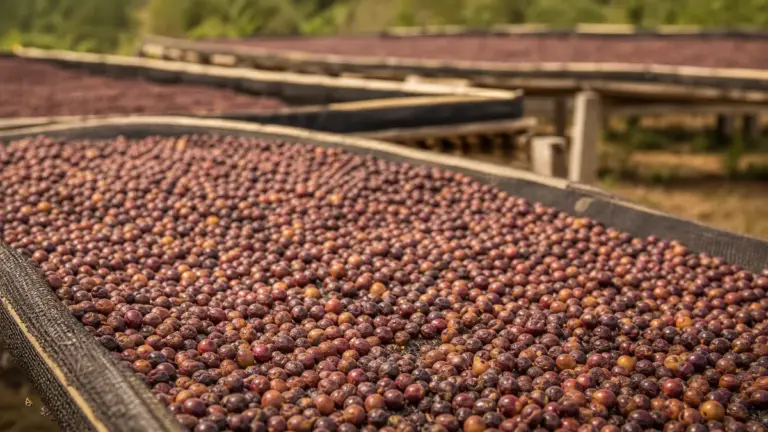
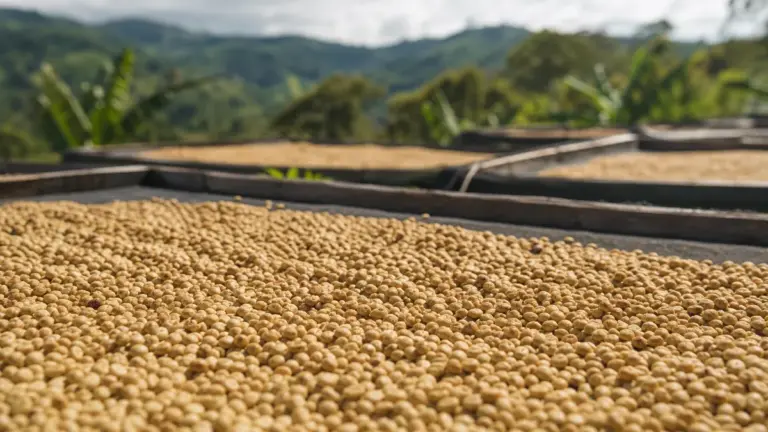
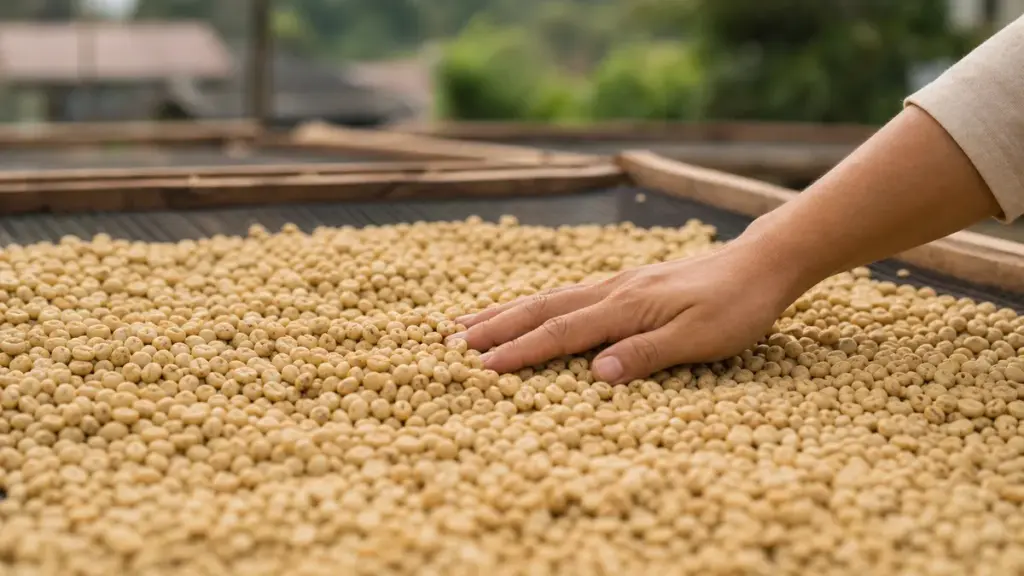
Fully washed coffee is prominent in the documented Mzuzu supply. In this process, the fruit is removed before the beans are dried. DRWakefield describes pulping, fermentation, washing and drying on raised beds, followed by assessment and hulling at Mzuzu.
The beans dry inside parchment, a protective layer removed during dry milling. “Washed” therefore describes the post-harvest process, not something the buyer needs to do before brewing.
Satemwa demonstrates the wider processing picture by listing washed, natural and pulped-natural coffees. Check the actual lot description rather than assuming all Malawi coffee is washed.
Harvest dates also need their geographical context. Mzuzu gives May to October overall, while InterAmerican’s Viphya North sheet gives June to September. These windows need not conflict: one covers the union’s broader supply and the other a more specific coffee.
Finding and choosing Malawi coffee in the UK
Malawi coffee is available through specialist sellers, although a live product listing is not a guarantee of continuing stock. In November 2026, the Malawian Coffee Company listed a washed northern Geisha and Catimor mixture, providing one directly checked example of availability.
Use this buying sequence:
- Find the producer identity. Prefer a named estate, cooperative, farmer or clearly described union lot.
- Check the variety wording. “Geisha and Catimor mix” is not a separately identified Geisha lot.
- Read the processing information. Keep washed and natural coffees separate when comparing descriptions.
- Ask about the harvest and roast. Record both where supplied, rather than confusing the growing season with the roasting date.
- Choose the intended use. Ask the roaster which offering they recommend for your filter brewer, espresso machine or workplace machine.
For a comparative tasting, put Malawi beside another traceable origin such as Ugandan coffee, and record the processing and roast alongside your impressions. Choose Malawi coffee for the named lot and the cup you want, not for an assumed national flavour or the reputation of a variety grown elsewhere.
FAQ
Is Malawi coffee always Geisha?
No. Mzuzu currently documents Nyika, Geisha and Catimor 129, while the national production handbook records a wider selection, including Agaro. A retail coffee may contain more than one variety. Look for explicit wording such as “Geisha and Catimor mix”, and ask the seller before assuming that a bag contains a separately harvested Geisha lot.
Does Malawi coffee contain added fruit flavouring?
Fruit tasting notes do not, by themselves, mean that flavouring has been added. The examples discussed here are described by their suppliers using peach, pear, berry and caramel notes. If added ingredients are something you wish to avoid, check the product’s ingredient information rather than using its tasting description as the ingredient list.
When should I look for a new Malawi harvest?
Use Mzuzu’s May to October picking season as an enquiry prompt, not a promised UK release date. A specific Viphya North coffee is documented with a June to September harvest. Ask the importer or roaster which crop they hold and when it arrived; neither harvest window establishes when a particular seller will offer it.
Where to go next
Read East Africa to place Malawi within the site’s regional guide. Continue with Uganda and Rwanda to compare other origins while keeping producer identity, varieties and processing separate from country-wide expectations.
Sources
-
Mzuzu Coffee Planters Cooperative Union, Home, undated, current website checked November 2026.
http://www.mzuzucoffee.org/ -
Mzuzu Coffee Planters Cooperative Union, About Us, undated, current website checked November 2026.
http://www.mzuzucoffee.org/about-us-2/ -
Malawi agricultural production guide, Guide to Agricultural Production, chapter 5.1, “Smallholder Coffee Production”, undated retrieved edition.
https://docs.dcafs-tipdep-donors-mw.org/dt_docs/DOC20230307082517.pdf -
Coffee Association of Malawi and Imani Development, Handbook for Sustainable Coffee Production in Malawi, 2015, sections 4.2 and 4.3.
https://imanidevelopment.com/wp-content/uploads/2015/06/Handbook-For-Sustainable-Coffee-Production-In-Malawi.pdf -
Natural Resources Institute and collaborating Malawian researchers, R8204 Final Technical Report Appendices, including “Crop protection implications for coffee smallholders in Malawi of the introduction of Catimor cultivars”, 2005.
https://assets.publishing.service.gov.uk/media/57a08c80ed915d3cfd001422/R8204_FTR_anx.pdf -
World Coffee Research, Arabica Varieties Catalogue: Geisha, Panama, undated online entry, checked November 2026.
https://varieties.worldcoffeeresearch.org/varieties/geisha-panama -
Satemwa Tea Estate, Coffee, undated producer page, checked November 2026.
https://www.satemwa.com/coffee-break -
InterAmerican Coffee, Malawi: Mzuzu Coffee Planters Cooperative Union Limited, undated Viphya North fact sheet.
-
DRWakefield, Malawi Mzuzu AA, undated fact sheet, hosted in a December 2019 directory.
https://drwakefield.com/wp-content/uploads/2019/12/Malawi-Mzuzu-AA.pdf -
Malawian Coffee Company, Blackberry + Caramel: Geisha Catimor AA/AB, undated product listing, checked November 2026.
https://www.malawiancoffee.com/products/blackberry-caramel-geisha-catimor-aa-ab-1kg
Research combined producer documentation, Malawi’s production handbook, primary agronomic research and directly retrieved supplier descriptions; tasting notes are attributed, with no first-hand testing claimed.
Last checked: November 2026