Rwandan coffee is often sweet and bright, with citrus, currant, floral and tea-like notes, sometimes balanced by chocolate. Its rise in speciality coffee owes much to washing stations, where smallholders’ cherries are sorted and processed together under more controlled conditions.
In short
- Start with a washed lot if you want to explore Rwanda’s citrus, floral and tea-like character.
- Bourbon-type arabica dominates, but Rwanda does not grow only one variety.
- Typical cultivation spans 1,300 to 2,150 metres above sea level, according to the International Coffee Organization’s value-chain study.
- Read the washing-station name and processing method, not just the country on the bag.
- Potato taste defect is an occasional quality problem, associated with insect damage, not Rwanda’s normal flavour.
What does Rwandan coffee taste like?
A useful starting picture is citrus brightness, berry-like fruit and sweetness, with a finish that can suggest tea or chocolate. These are reference points rather than a national recipe: individual lots should have their own tasting descriptions.
For a concrete example, exporter Sucafina describes its washed Kayumbu Bourbon lot with currant, citrus and floral notes and a black-tea-like body. Gasharu Coffee describes its Muhororo natural as chocolatey and fruity, with a fuller body and integrated acidity. These are suppliers’ descriptions of particular coffees, not independent tasting results or promises about every Rwandan bean.
When choosing your first bag, use those descriptions to decide what interests you. Look for citrus and floral notes if you want a brighter cup, or chocolate and fuller-body descriptions if you prefer something rounder. Treat the processing method as another clue, then check the roaster’s account of the actual lot.
Rwanda belongs within a much wider regional story. Our East African coffee guide provides the surrounding context without treating neighbouring origins as interchangeable.
Rwanda coffee fact panel
| Feature | Reference information | Source |
|---|---|---|
| Growing altitude | Typically 1,300 to 2,150 metres above sea level, not an absolute national limit | ICO and COSA, Rwanda’s Coffee Value Chain |
| Main species and varieties | Almost entirely Coffea arabica, predominantly traditional Bourbon and Typica material; Bourbon-type coffee dominates | World Coffee Research; NAEB |
| Processing | Washed processing predominates; semi-washed, honey and natural coffees also occur | TechnoServe, processing guidelines |
| Harvest months | One annual crop, starting in late February near Lake Kivu and early March elsewhere; some northern areas continue into August | NAEB, About Rwanda coffee |
| Typical cup references | Washed examples include citrus, currant, florals and tea-like texture; individual naturals may be fruitier and fuller-bodied | Sucafina, Kayumbu; Gasharu, Muhororo |
Altitude should describe the farms supplying a lot, rather than automatically being the height of its washing station. Those are different places, and a station may receive cherries grown across a substantial elevation range.
History and recovery: how quality became the focus
Coffee’s role in Rwanda predates the modern speciality industry. NAEB dates its introduction by Germans to the early twentieth century. For much of its subsequent history, the sector offered growers limited incentives to distinguish exceptional coffee from ordinary production.
The World Bank describes an industry constrained by compulsory production, export controls and economic instability, followed by further deterioration during the 1994 genocide against the Tutsi. Recovery involved more than replanting trees: the route from farm to buyer also needed rebuilding.
Reforms in the late 1990s and early 2000s encouraged investment and a shift towards fully washed coffee. Farmers, cooperatives, private businesses, government institutions and development programmes contributed to that change. Washing stations provided a practical means of turning carefully picked fruit into more consistently prepared export lots.
A short timeline captures the main stages:
- Early twentieth century: coffee was introduced to Rwanda, according to NAEB.
- 1994: genocide and economic devastation deepened the coffee sector’s difficulties.
- 2002: the government issued a national coffee strategy focused on opportunities in speciality coffee. USAID’s historical station directory records Maraba’s start-up as March that year.
- 2008: Rwanda became the first African country to host the Cup of Excellence competition.
Maraba is an important part of this history, but describing it simply as Rwanda’s first washing station is misleading. The same USAID directory records an older facility at Nkora, originally constructed in 1980. The decisive development was the expansion of quality-focused processing, not the invention of washing coffee in Rwanda.
Why washing stations matter
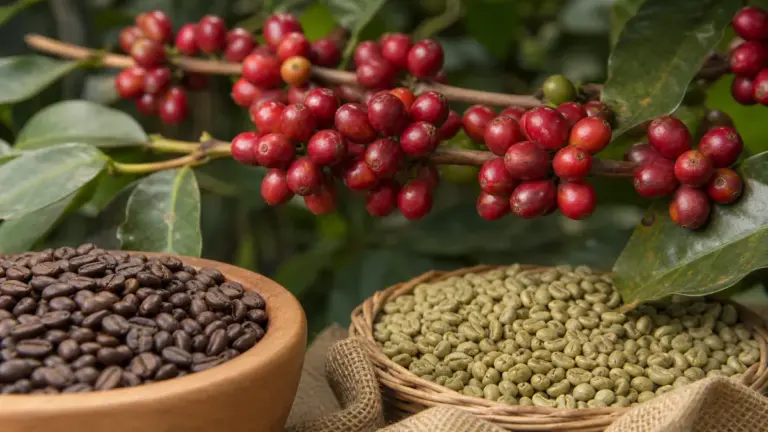
A washing station is a shared processing facility, also called a wet mill. Farmers deliver coffee cherries, the fruit containing the seeds we roast as beans, rather than completing every processing step themselves.
This suits Rwanda’s fragmented production. The ICO and COSA study describes small, scattered coffee plots, with farmers often cultivating more than one parcel. A central facility brings cherries together and provides equipment and organised handling beyond the scale of an individual smallholding.
From ripe cherry to dried coffee
Details vary between stations, but the main stages of washed processing are:
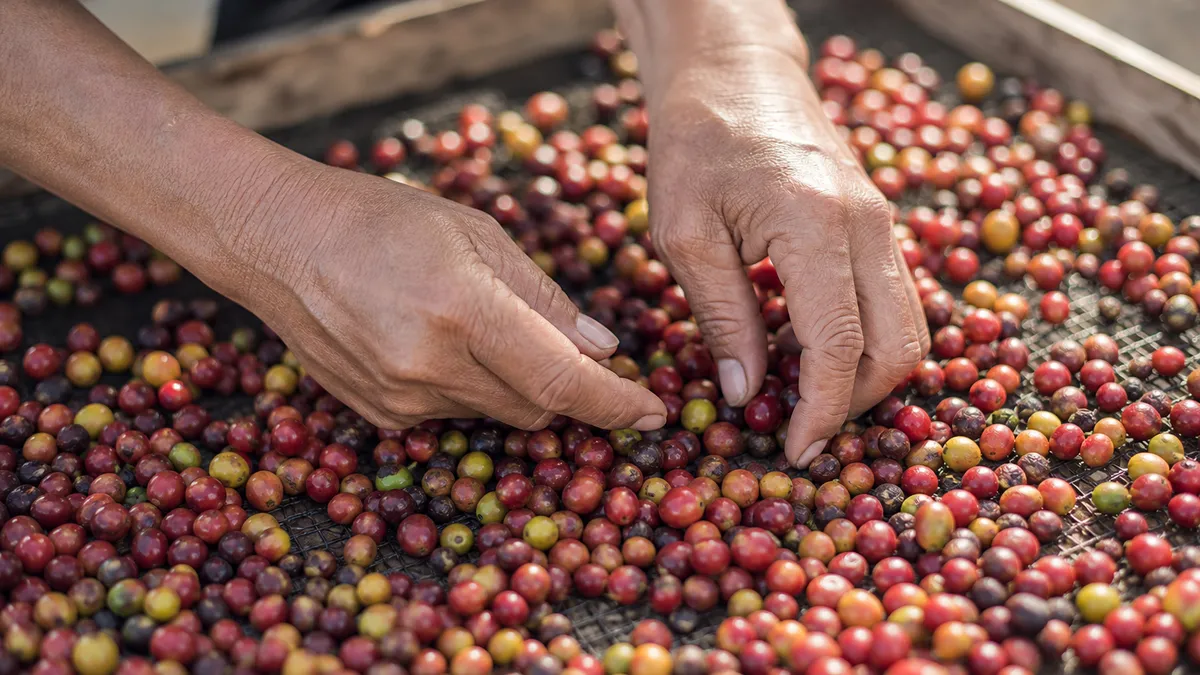
- Receive and sort the cherries. Workers inspect the fruit and separate unsuitable material. Flotation in water provides another sorting stage.
- Remove the outer fruit. A pulper separates the skin and some of the sticky fruit layer, called mucilage, from the seeds.
- Remove the remaining mucilage. Fermentation, mechanical equipment or a combination of methods prepares the coffee for washing.
- Wash and grade. Clean water and grading channels help separate and clean the coffee.
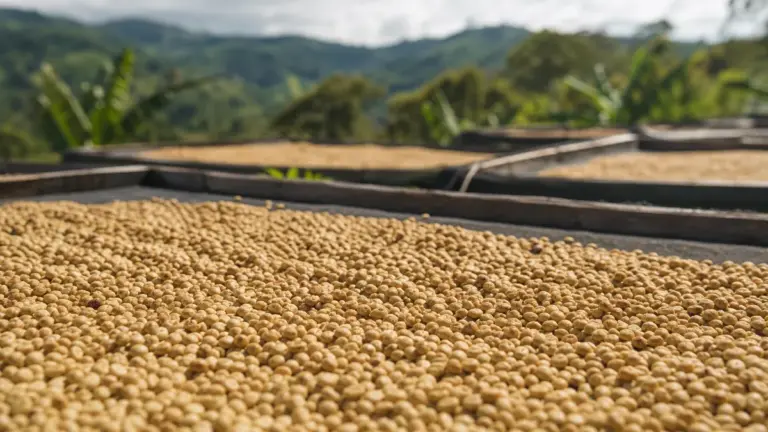
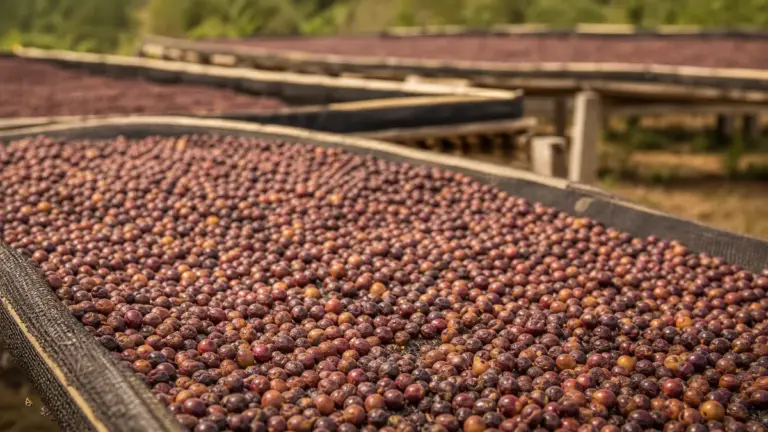
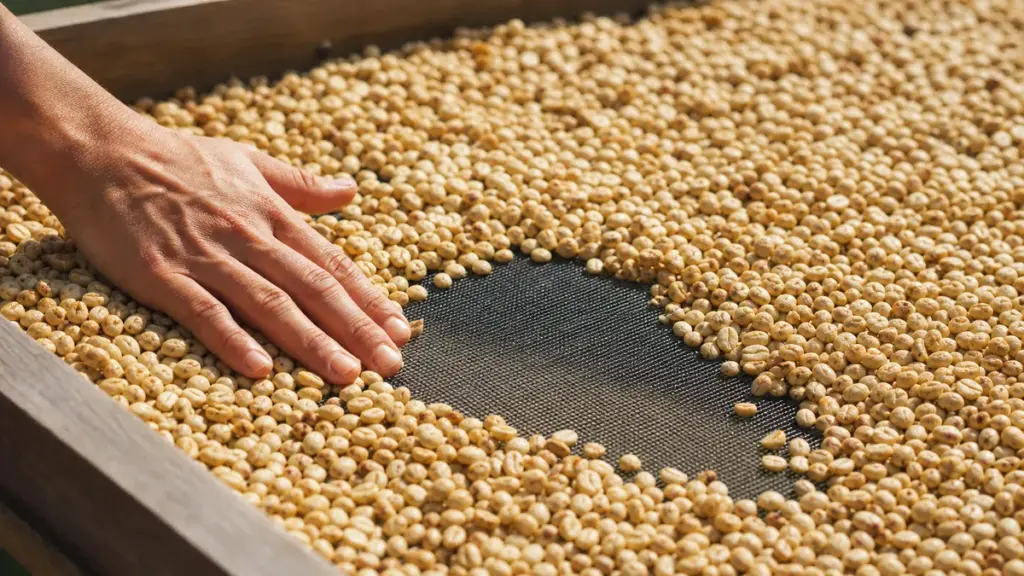
- Dry and sort again. Coffee is spread on raised beds and managed for even drying, with further removal of defective material.
The point is not that washing automatically makes coffee excellent. Each stage creates an opportunity to preserve quality or introduce problems. TechnoServe’s Rwanda guidelines emphasise uniformity and risk management, including maintaining pulpers so they separate fruit without cracking beans.
Nor is there one national fermentation schedule. A station’s equipment, coffee and operating conditions matter. A detailed account of the actual process is more useful than an impressive-sounding duration without context.
A station name is not necessarily a farm name
The name on a bag may identify the facility that processed cherries from many growers. It does not necessarily identify a single estate.
That distinction makes washing-station information valuable, but incomplete. For a more traceable purchase, ask whether the lot represents a particular collection period, producer group or separately processed batch. A station name is a starting point for questions, not the whole answer.
For a neighbouring origin to investigate next, read Burundi alongside the details on your Rwandan bag.
Bourbon, altitude and the limits of origin labels
Bourbon is a variety of Coffea arabica, not a separate coffee species, roast style or processing method. World Coffee Research identifies it as an important traditional variety with very good quality potential at high altitude.
Its reputation should not obscure its agricultural disadvantages. WCR lists Bourbon as susceptible to coffee leaf rust and coffee berry disease. Quality potential and ease of cultivation are different things, and a familiar variety name is not a guarantee of an exceptional harvest.
Rwanda’s coffee is predominantly Bourbon-type, but “all Rwandan coffee is Red Bourbon” goes too far. WCR’s country profile also identifies Typica and discusses improved planting material. Use the variety information supplied for the particular lot rather than assuming a country-wide identity.
Altitude needs similar care. The ICO’s typical cultivation range is useful context, but it is not a grading system. Sucafina, for example, distinguishes Kayumbu station’s elevation of 1,756 metres from its supplying farms at 1,600 to 2,100 metres.
When comparing bags, therefore, do not simply choose the highest number. Read altitude alongside variety, processing, traceability and the description of the finished coffee. If you want to broaden that label-reading exercise, explore the separate origin guides to Uganda and Malawi.
Choosing Rwandan coffee in the UK
My suggested starting point is a clearly identified washed Bourbon lot with a named washing station. That gives you a specific coffee to learn from, rather than asking one anonymous bag to represent an entire country.
Look for:
- The station or producer group: who processed or supplied the coffee?
- The processing method: fully washed, natural, honey or a more specifically described treatment.
- The harvest information: which crop does the coffee belong to?
- The farm altitude: is it distinguished from the station’s elevation?
- The roaster’s tasting description: does it describe flavours you actually enjoy?
Do not dismiss a natural simply because Rwanda is associated with washed coffee. Gasharu’s Muhororo example is sorted and dried as whole cherries on raised beds, demonstrating that a facility called a washing station can also produce natural coffee.
For a useful comparison, choose clearly described lots rather than relying on country stereotypes. Keep your usual brewing method unchanged initially and write down what you notice. This is a tasting exercise, not a requirement to find every fruit named on the packet.
Potato taste defect: what it is and what remains uncertain
Potato taste defect, often shortened to PTD, produces an unmistakable aroma resembling freshly peeled raw potato. It may become apparent when coffee is ground or brewed and can overwhelm otherwise attractive flavours. It is not the characteristic taste of Rwandan coffee.
World Coffee Research’s review associates PTD with damage from Antestia bugs, insects in the genus Antestiopsis. Farm management and repeated sorting aim to reduce the risk, but they should not be presented as guarantees of complete elimination. WCR describes PTD as a quality defect with no known health risk attributable to the defect itself.
What the research actually shows
A laboratory study by Jackels and colleagues, published in 2014, found the odour compound IPMP inside affected green beans. Its chemical results supported a link between insect feeding damage and the defect. That is analytical evidence supporting an association, not proof of every step in the biological process.
The precise mechanism remains unsettled. Proposed explanations include microbial activity following damage and a stress response within the plant. A 2022 study by Hale and colleagues investigated fungal communities associated with affected beans, but association alone does not establish that a particular fungus causes PTD.
The practical response is straightforward: if a dose smells strongly of raw potato, set it aside and contact the roaster with the lot details. Do not try to correct that aroma by repeatedly changing your brewing recipe, and do not assume that encountering it means every coffee from Rwanda will taste the same.
FAQ
Does Bourbon coffee contain alcohol?
No. Bourbon identifies a coffee variety, not an alcoholic ingredient. It tells you something about the plant material, while terms such as washed or natural describe processing. If a coffee has undergone an unusual treatment, look for a separate explanation from the producer or roaster rather than inferring it from “Bourbon”.
Does a washing-station name guarantee fair treatment of farmers?
No. A station name identifies part of the supply chain, but does not by itself demonstrate how farmers are treated. Ask for specific information about ownership, purchasing arrangements and any independently verified certification. Traceability makes further questions possible; it is not a substitute for evidence about working conditions or farmer outcomes.
Should I avoid Rwanda because of potato taste defect?
No, the existence of PTD is not a reason to assume every Rwandan coffee is defective. A sensible approach is to choose a clearly identified lot from a roaster willing to discuss quality problems. If you encounter a strong raw-potato aroma, report that particular coffee rather than treating the whole origin as suspect.
Where to go next
Read East Africa for the regional overview, then Burundi as a neighbouring origin to explore alongside Rwanda. Continue with Uganda and Malawi to build a broader understanding of the region and practise comparing specific coffees rather than national stereotypes.
Sources
-
National Agricultural Export Development Board: About Rwanda coffee, undated live page. Coffee introduction, Bourbon-type production and regional harvest calendar.
URL: https://www.naeb.gov.rw/rwanda-coffee/about-rwanda-coffee -
International Coffee Organization and Committee on Sustainability Assessment: Rwanda’s Coffee Value Chain: Insights into coffee production costs, household actual income, and supply chain efficiency, 2024, especially the cultivation discussion on printed pages 15 to 16.
URL: https://icocoffee.org/documents/GKH/Rwanda_.pdf -
World Coffee Research: Rwanda, live country profile, consulted November 2026. Species, traditional varieties and planting-material development.
URL: https://worldcoffeeresearch.org/countries/rwanda -
World Coffee Research: Arabica Coffee Varieties: Bourbon, online catalogue entry, consulted November 2026. Variety identity, quality potential and disease susceptibility.
URL: https://varieties.worldcoffeeresearch.org/varieties/bourbon -
World Bank: Africa Development Indicators 2011, “Transformation of Rwanda’s coffee sector: an African success story”, 2011. Historical sector constraints and reforms.
URL: https://databankfiles.worldbank.org/public/ddpext_download/site-content/adi_2011-web.pdf -
USAID-hosted historical directory: An Overview of Coffee in Rwanda, undated, containing station records through 2004. Maraba and Nkora histories and processing infrastructure.
URL: -
Alliance for Coffee Excellence: After Hiatus, Rwanda Cup of Excellence Returns with 340+ Coffee Submissions, 23 August 2018. Verification of the inaugural 2008 competition.
URL: https://allianceforcoffeeexcellence.org/blog/2018/08/23/after-hiatus-rwanda-cup-of-excellence-returns-with-340-coffee-submissions/ -
TechnoServe: Rwanda INC Minimum Quality and Sustainability Guidelines, undated document hosted in August 2024, section 4, “Processing Methods”.
URL: https://www.technoserve.org/wp-content/uploads/2024/08/EN_Rwanda-INC_Minimum-Quality-and-Sustainbility-Guidelines.pdf -
Sucafina: Kayumbu Bourbon FW Beyond Flagship, undated live lot description, consulted November 2026. Supplier-reported flavour, elevations and processing.
URL: https://sucafina.com/emea/offerings/kayumbu-bourbon-fw-beyond-flagship -
Gasharu Coffee: Muhororo Natural Grade 1, undated live producer description, consulted November 2026. Producer-reported cup character and natural processing.
URL: https://gasharucoffee.com/products/muhororo-natural-grade-1 -
World Coffee Research: Potato taste defect: Review of the impacts of the Antestia bug and ongoing mitigation efforts, 2023. Research review and mitigation guidance.
URL: https://worldcoffeeresearch.org/download/a2a841cb-658e-4020-b70d-c38d3bc3f0c3 -
Jackels, S. C., and colleagues: GCMS investigation of volatile compounds in green coffee affected by potato taste defect and the Antestia bug, Journal of Agricultural and Food Chemistry, 2014, volume 62, issue 42.
URL: https://pubmed.ncbi.nlm.nih.gov/25284290/ -
Hale and colleagues: Fungi associated with the potato taste defect in coffee beans from Rwanda, Botanical Studies, 2022, volume 63, article 17.
URL: https://www.rolshausen-lab.com/_files/ugd/6f7ec4_a55dbe73c2bc43f7a6da9533652d2858.pdf
This article was researched using Rwanda’s national coffee board, intergovernmental reports, variety references, processing guidance and peer-reviewed studies; commercial sensory descriptions are attributed and no first-hand tasting is claimed.
Last checked: November 2026