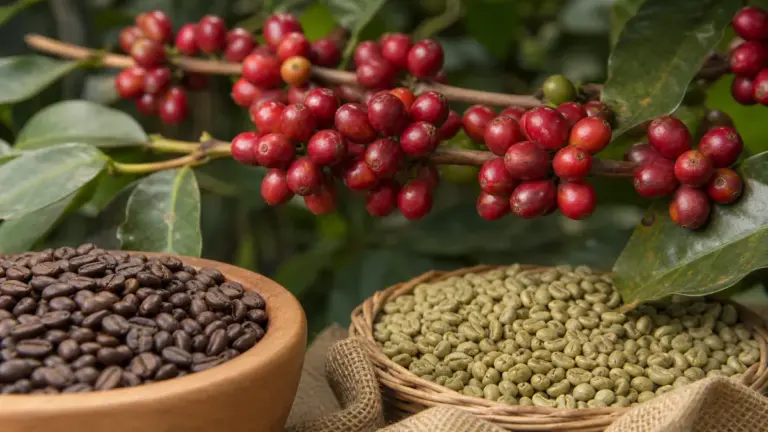
Tanzanian coffee can be bright, juicy and fruit-led, with washed arabicas showing citrus, stone fruit, black tea, caramel and cocoa notes. Kilimanjaro and small, rounded peaberry beans are its best-known calling cards, but the country also grows arabica in the southern highlands and robusta around Lake Victoria, so the name alone cannot predict the cup.
In short
- Look beyond Kilimanjaro: Songwe, Mbeya and Ruvuma are also important arabica origins.
- Peaberry describes bean shape, not a species, variety or guaranteed level of quality.
- Washed arabica is the established style, although natural and experimental lots are available.
- Check the full variety name: traditional N39 and newer numbered N39 selections should not be treated as interchangeable.
- Buy the identifiable lot: ask for region, producer or cooperative, processing method and the roaster’s tasting notes rather than relying on “Tanzania peaberry” alone.
Tanzania coffee at a glance
These are origin-level reference points, not specifications that every Tanzanian coffee must meet. Harvest calendars in particular differ between regions, seasons and the supply chains reporting them.
| Feature | Origin reference |
|---|---|
| Growing altitude | TANTRADE gives 1,000 to 2,500 metres for arabica and approximately 800 to 900 metres for the Kagera robusta belt. These are broad published ranges, not the limits of every farm. |
| Main varieties and selections | Bourbon and Kent backgrounds, traditional N39 and KP423, plus improved numbered selections and compact TaCRI cultivars. Named robusta selections include Maruku1, Maruku2, Bukoba1 and Muleba1. |
| Processing | Predominantly washed arabica; natural processing is also used, including for robusta. Specialty offerings include anaerobic naturals. |
| Harvest months | TANTRADE lists July to December for northern and southern regions and May to October for western regions. These broad windows differ from importer calendars and individual seasons, as explained below. |
| Typical cup profile | For specialty washed arabica: fruit-led acidity, stone fruit or citrus, black tea, caramel and cocoa are useful expectations, not guarantees. These descriptors should not be applied automatically to robusta. |
For the wider geographical context, start with our guide to east African coffee.
Where Tanzanian coffee grows
Kilimanjaro and Arusha
The northern arabica belt includes the slopes of Mount Kilimanjaro and Mount Meru. The Tanzania Coffee Board describes coffee grown beneath banana plants here, making intercropping, growing different crops together, part of the region’s farming picture.
Kilimanjaro is therefore a meaningful origin name, but it is not a complete description. When choosing a bag, look for the estate, cooperative or processing site as well. “Kilimanjaro” tells you an area; it does not tell you the variety, processing decisions or how the roaster intends the coffee to taste.
Nor should the mountain’s fame become a shortcut for judging everything else from Tanzania. A useful tasting comparison would put a traceable northern coffee beside a southern one with a similar roast and processing method, rather than assuming the better-known name must win.
The southern highlands
Songwe, Mbeya and Ruvuma form another important arabica-growing belt. The Coffee Board records both coffee intercropped with bananas and coffee grown in stands without that companion crop.
This is not merely an alternative source of anonymous blending coffee. Nordic Approach’s southern sourcing programme reports washed lots with dark cherry, citrus, stone fruit and floral characteristics, alongside more fermentation-led natural coffees. Those are observations from its own supply chains, not a flavour guarantee for the whole south.
For buyers, the useful lesson is simple: do not exclude an unfamiliar southern cooperative because the bag lacks the Kilimanjaro name. Ask what distinguishes the actual coffee.
Kagera and other growing areas
Kagera, west of Lake Victoria, is Tanzania’s principal robusta-growing region. Coffee is also grown outside these main belts, including in Tanga, Iringa, Morogoro, Kigoma, Manyara and Mara.
That distribution explains why a single national tasting description is inadequate. A washed highland arabica and a naturally processed Kagera robusta are different products, not interchangeable examples of one national style. Our Uganda guide provides another useful country-level perspective on an origin producing both arabica and robusta.
Arabica, robusta and the varieties behind them
Arabica, Coffea arabica, and robusta, traded from Coffea canephora, are different species. Bourbon, Kent and named breeding selections sit below that species-level distinction; “peaberry” does not belong in the same category.
Among Tanzania’s established arabicas, N39 is Bourbon-type, while KP423 is a selection of Kent. World Coffee Research describes KP423 as having a likely Bourbon-like genetic background, a useful reminder that variety family trees are not always as tidy as retail labels suggest.
Modern planting material makes the picture more detailed. Tanzania’s national training manual distinguishes traditional N39 and KP423 from improved numbered selections and compact TaCRI cultivars. “Compact” refers to plant growth habit, not a small bean or a peaberry.
For precision, retain the suffix when it is supplied. N39-8, for example, has its own official seed-register entry, registered to TaCRI in 2012. Reducing that name to “N39” loses information about the planting material.
The breeding objectives also deserve attention. TaCRI researchers report selecting arabicas for disease resistance, yield and beverage quality together, rather than treating flavour as irrelevant to agricultural improvement. Their results are breeding-programme evidence, however, not proof that every commercial lot carrying an improved variety name will taste exceptional.
For a drinker, variety is best used as one clue among several. Ask for it where available, but do not reject a well-described, traceable coffee simply because the producer’s variety information is incomplete.
Why Tanzania is famous for peaberries
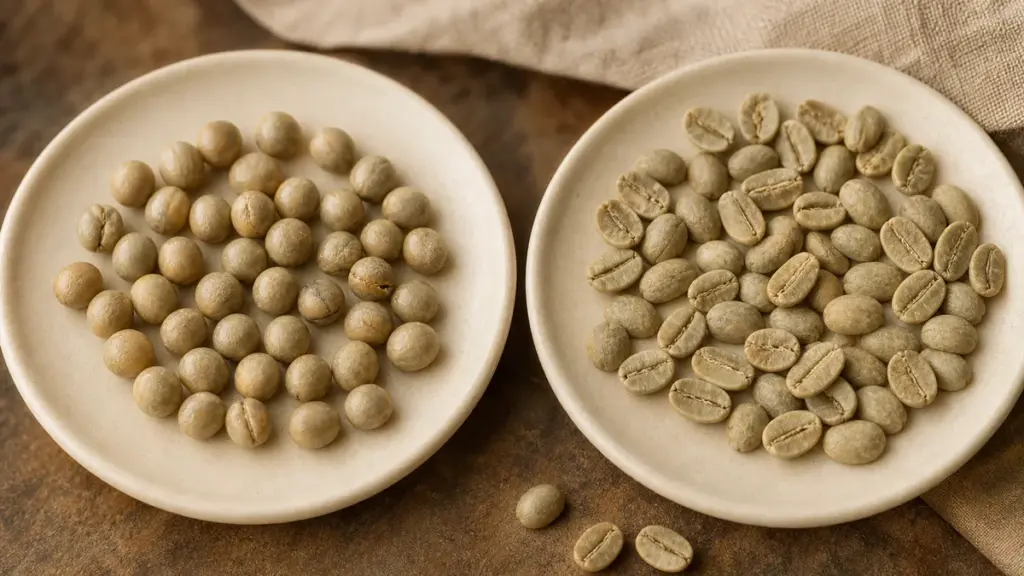
A normal coffee cherry usually develops two seeds with flat faces against each other. A peaberry develops as a single, rounder seed instead. Tanzania’s grading system recognises these beans as PB, and milling equipment separates them from other shapes and sizes.
Peaberries are not unique to Tanzania. What distinguishes the country is their prominence in its export reputation: Cafe Imports describes separated peaberry lots as the Tanzanian coffees most familiar to many Western buyers. That is a market identity, not a separate botanical identity.
Does the shape make them better?
Not reliably enough to use as a buying rule. Cafe Imports records differing opinions about whether peaberries offer greater flavour intensity, with some tasters finding a difference and others not. That disagreement does not establish universal superiority.
A sensible comparison would use peaberry and flat-bean portions from the same underlying coffee, roasted appropriately and tasted without seeing the labels. Comparing unrelated bags cannot isolate the effect of shape, because the coffees may differ in several other ways.
Treat PB as a physical grade, not a tasting score. The same caution applies to larger-bean labels such as AA: Tanzania grades green coffee by physical characteristics, while tasting is a separate assessment. A bag marked AA and one marked PB still need their own cup descriptions.
Processing and what reaches the cup
Washed coffee
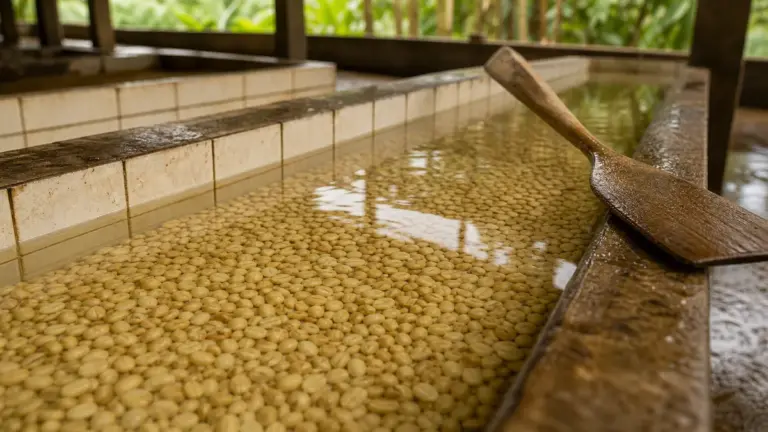
Washed processing is the established Tanzanian arabica style. In a conventional washed sequence, the fruit skin and pulp are removed, fermentation helps break down the sticky mucilage around the seed, and washing precedes drying. The dried parchment covering is removed later.
This gives “washed” a practical meaning, but it is not a complete production recipe. Nordic Approach reports different fermentation arrangements between the Tanzanian sites it sources from, reflecting differences in facilities and working conditions. Two washed coffees need not have undergone identical handling.
Natural and experimental coffee
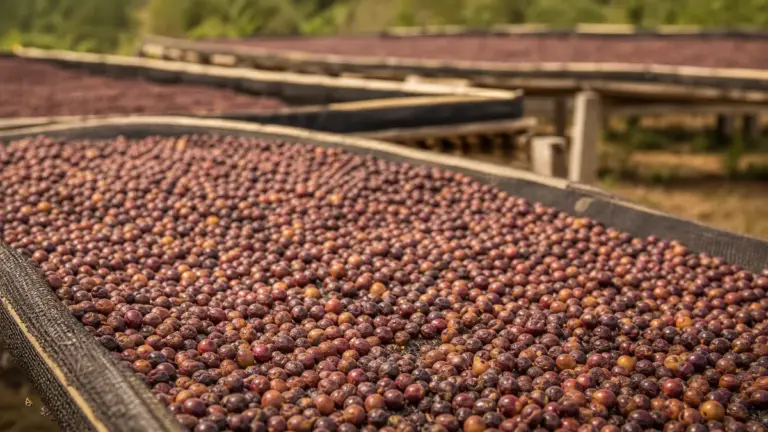
Natural processing dries the cherry with its fruit layers still around the seeds, before hulling removes the dried coverings. It is distinct from washed processing, not a synonym for organic production or minimal intervention.
Tanzanian specialty offerings also include anaerobic naturals, involving fermentation under restricted oxygen. Nordic Approach describes its examples as more process-led, with ripe yellow-fruit and mildly boozy characteristics. Read that as the importer’s description of particular coffees, not the expected taste of all Tanzanian naturals.
If you want to explore the origin without starting with an overt fermentation character, our suggested first purchase is a traceable washed arabica. If you actively enjoy fermentative fruit notes, an explicitly described natural offers a different comparison.
How to read Tanzanian tasting notes
For washed specialty arabica, think in families rather than demanding one named fruit: citrus or stone fruit, tea-like notes, caramel sweetness and cocoa are a useful starting vocabulary. Cafe Imports also identifies complex acidity and juicy texture as qualities it seeks in Tanzanian lots.
These are sensory comparisons, not a list of added ingredients. World Coffee Research’s sensory lexicon provides reference language for coffee’s aromas, flavours and textures; it does not assign a fixed flavour to a country.
Avoid buying Tanzania merely as “a softer Kenya”. Use our Kenya guide for that origin’s detail, then compare named coffees on their own terms. The useful question is not which national stereotype a bag resembles, but whether its described balance sounds enjoyable to you.
Buying Tanzanian coffee in the UK
Before choosing, use this order:
- Identify the coffee: look for a named producer, estate, cooperative or processing site.
- Check species and process: do not assume every Tanzanian bag is washed arabica.
- Read the tasting description: decide whether you want fruit and tea-like notes or a more fermentation-led style.
- Check the intended brewing use: ask the roaster whether it recommends the coffee for your filter brewer, espresso machine or bean-to-cup machine.
- Treat PB and AA as supporting information: neither should replace a description of the cup.
Harvest information needs similar care. Cafe Imports gives May to September for southern Tanzania and July to November for the north, differing from TANTRADE’s broader calendar. Sucafina’s 27 October 2026 field report describes that season’s arabica picking as June to late October, and robusta as late April through August. These accounts cover different scopes and seasons, so ask for the actual lot’s harvest rather than forcing every coffee into one national window.
Our buying recommendation is to let traceability and a useful flavour description lead. Tanzania peaberry is worth exploring, but it should be an invitation to taste, not the end of the selection process.
FAQ
Does Tanzanian coffee contain berries or chocolate?
No, those words normally describe flavour similarities, not added ingredients. Coffee tasting vocabulary includes fruit, cocoa and many other sensory references. Unless a product is explicitly sold as flavoured coffee, read those notes as the taster’s description of the beans themselves, while checking the ingredients if you need certainty.
Is Tanzanian coffee suitable for espresso?
Yes, suitable Tanzanian lots can be used for espresso as well as filter brewing. Nordic Approach explicitly lists both uses for its Tanzanian offerings. For your own equipment, ask the roaster for a coffee it has developed and assessed for espresso rather than assuming that the origin name or peaberry grade determines suitability.
Can I identify the variety by looking at a peaberry?
No, its rounded shape does not identify the variety. Peaberry describes how the seed developed inside the cherry, whereas names such as Kent and KP423 identify planting material. Look for separate variety information from the producer or roaster; a label that gives only “peaberry” leaves that botanical detail unanswered.
Where to go next
Read East Africa to place Tanzania within the wider growing region, then Kenya for a focused neighbouring-origin comparison. Ethiopia and Burundi are useful next reads for broadening your tasting exploration beyond Tanzania’s peaberry reputation.
Sources
Publication dates are given where stated; undated live pages are identified as such.
-
Tanzania Coffee Board, Growing Regions, undated live page.
https://www.coffee.go.tz/pages/growing-regions -
Tanzania Trade Development Authority, TANTRADE, Tanzania Coffee Profile, undated document.
https://www.tantrade.go.tz/downloads-prodcut-profile/TANZANIA%20COFEE%20PROFILE -
Joint Coffee Stakeholders of Tanzania, Tanzania National Coffee Sustainability Curriculum: Coffee Extension Materials, Trainer’s Manual and Lesson Plans, second edition, 2023. Hosted by the Tanzania Coffee Board.
https://www.coffee.go.tz/uploads/documents/sw-1720694516-Tanzania%20coffee%20curriculum%20Manual_June%202023%20Final%206.pdf -
World Coffee Research, Arabica Coffee Varieties: KP423, undated live catalogue entry.
https://varieties.worldcoffeeresearch.org/varieties/kp423 -
World Coffee Research, Robusta, undated live catalogue page.
https://varieties.worldcoffeeresearch.org/robusta -
Tanzania Official Seed Certification Institute, N39-8, live register entry recording registration in 2012.
https://www.tosci.go.tz/seed-varieties/n39-8 -
Kilambo and colleagues, Tanzania Coffee Research Institute, A Decade of Contributing to a Profitable and Sustainable Coffee Industry in Tanzania: The Arabica and Robusta Improvement Programmes, American Journal of Research Communication, 2015, volume 3, issue 1, pages 31 to 35.
https://www.usa-journals.com/wp-content/uploads/2014/12/Kilambo_Vol31.pdf -
International Coffee Organization, Coffee Development Report 2022-23: Beyond Coffee, Towards a Circular Coffee Economy, fourth edition, report period 2022 to 2023.
https://ico.org/documents/cy2024-25/coffee-development-report-2022-23.pdf -
World Coffee Research, Sensory Lexicon, version 2.0, October 2017, accompanying resource page.
https://worldcoffeeresearch.org/resources/sensory-lexicon -
Cafe Imports, Tanzania, undated live origin page.
https://www.cafeimports.com/europe/Tanzania -
Nordic Approach, Tanzania, undated live sourcing page.
https://www.nordicapproach.no/origin/tanzania -
Sucafina, Kenya: Tanzania Harvest Update, 27 October 2026.
https://www.sucafina.com/emea/news/kenya-tanzania-harvest-update
This article was researched from official Tanzanian publications, variety records, primary breeding research and importer accounts, with commercial tasting observations attributed to the supply chains reporting them rather than presented as first-hand site testing.
Last checked: November 2026