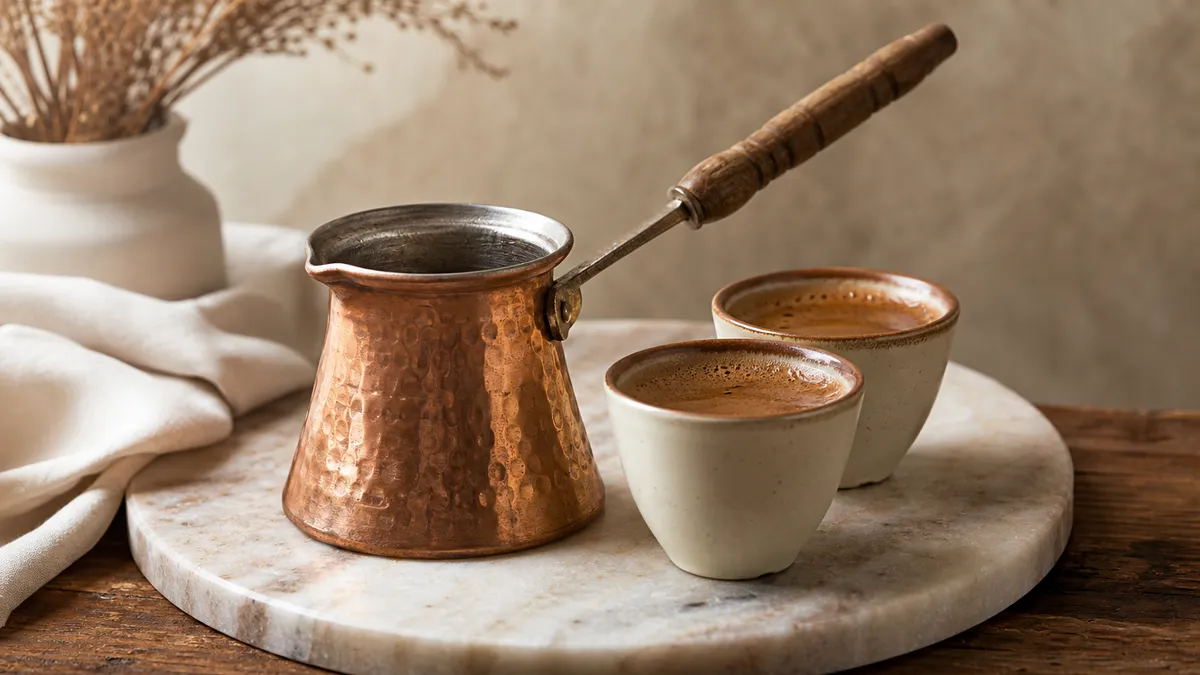
A cezve is a small, long-handled pot used to brew Turkish coffee by gently heating powder-fine ground coffee with water, then pouring it into small cups without filtering. Choose a pot that matches your usual serving size and heat source, with a sound food-contact interior: the lining matters more than decorative hammering.
In short
- Choose by usable brewing capacity, not just the advertised number of cups. Leave room for the foam to rise.
- Copper and brass pots need a suitable food-contact interior. Tin and silver are established lining options for copper cezves.
- Use pulverised Turkish coffee, not ordinary filter grounds or a typical espresso grind.
- Heat gently and watch continuously. Rising foam is the cue to act, not an invitation to keep boiling.
- Allow the grounds to settle in the serving cup, and leave the sediment behind when drinking.
What is a cezve?
A cezve has a long handle, a pouring lip and a body that usually narrows above its wider base. You may also see the name ibrik in English-language coffee listings.
Coffee and water are heated together inside it. The grounds are poured into the cup with the drink, rather than being trapped in a paper filter or separated by a machine.
The result is a small, concentrated coffee with a foamy surface and sediment at the bottom. Turkish coffee is also a social tradition, recognised by UNESCO in 2013, rather than simply another way of producing a strong drink.
Our coffee equipment guide places this hands-on brewer alongside other equipment. Here, the useful distinction is simple: the cezve is the brewing vessel, while you control the heat and decide when to pour.
Why Turkish coffee pots have this shape
The shape helps a thick foam develop, while the narrowing upper body makes its rise easy to observe. The pouring lip helps direct the coffee into a small cup.
That does not mean the neck seals in all the aroma or creates pressure. A cezve is an open pot, and its practical advantages are foam management, controlled pouring and a shape suited to small batches.
Size and shape work together. A small quantity brewed in a much larger pot may struggle to develop the desired foam, while an overfilled pot leaves little room to catch the rise before it spills.
When inspecting a pot, look beyond its silhouette. Check that it stands securely, that the handle attachment is firm and that you can lift and pour it comfortably. Those are more useful buying checks than an elaborate exterior pattern.
Copper, brass or stainless steel?
Compare pots on food-contact materials, hob compatibility, handling and care before considering appearance.
| Material | What to look for | Main limitation | Who it suits |
|---|---|---|---|
| Copper | A clearly specified, intact tin, silver or other suitable food-contact lining | The interior needs gentle cleaning and inspection | Someone who enjoys traditional equipment and attentive care |
| Brass | Explicit confirmation that it is cookware, with a suitable food-contact interior | A gold-coloured exterior says nothing about the inner surface | Someone who prefers its appearance and will check construction carefully |
| Stainless steel | A well-finished interior, secure handle and stated hob compatibility | “Stainless steel” alone does not guarantee induction compatibility | Someone prioritising straightforward everyday care |
Copper and its lining
Copper conducts heat well, making temperature control responsive. Traditional copper cookware commonly uses an inner coating to separate food from the copper itself; cezve manufacturer Soy publishes both tin-lined and silver-lined options.
Do not brew in a copper pot with exposed copper inside. Public-health guidance advises against using uncoated or damaged copper cookware for food preparation. Acidity, temperature and contact time affect how much copper can migrate into food.
A lining that has worn through needs assessment and repair before further use. Do not assume that polishing the exposed patch makes it suitable again.
Brass and stainless steel
For brass, ask the seller to identify both the body material and the surface that actually touches the coffee. A decorative vessel, an antique of unknown construction or a listing that merely says “traditional metal” is not enough information.
Stainless steel avoids the need to maintain a separate tin or silver lining. Nevertheless, follow the individual pot’s instructions: handle materials, bonded bases and surface finishes can affect cleaning and hob suitability.
My practical preference for a beginner is whichever properly specified pot fits their hob and usual batch. There is little value in choosing copper for its appearance if its care requirements will be ignored.
Choosing the right size
Start with the amount you normally brew, not the largest pot available.
The Turkish coffee specification published in the EU Official Journal describes traditional serving cups of 60 to 90 ml. These are small coffee servings, not mugs.
Manufacturers’ capacities also need interpretation. Soy, for example, publishes cezve sizes of 85, 140, 225 and 440 ml. Those are the maker’s stated capacities, not a promise that each vessel can be filled to the rim during brewing.
Before buying, establish:
- Whether the stated capacity is total volume or recommended brewing volume.
- How much water the maker recommends for your usual batch.
- Whether there is sufficient space above the mixture for foam.
- Whether the base sits safely on your hob.
- Whether you can pour the full pot comfortably.
If you mainly make one serving, buy for that task. For occasional guests, separate batches are preferable to routinely brewing a shallow single portion in an oversized vessel.
For broader checks on suitability and specifications, see equipment buying mistakes.
Grind and heat sources
Use a true Turkish grind
Turkish coffee needs a pulverised, powder-like grind, generally finer than espresso. When buying ready-ground coffee, look specifically for Turkish preparation rather than assuming “fine ground” means the same thing.
Be cautious about exact particle-size claims. The specification published in the EU Official Journal in 2025 gives an average particle size of 75 to 125 micrometres, rather than the sometimes-quoted 50 to 100 micrometres. That is a description of an average, not a requirement that every particle falls within those limits.
For a home brewer, the useful question is whether a grinder is explicitly suitable for Turkish coffee. Follow its manufacturer’s settings and limits rather than forcing the adjustment beyond its intended range.
Gas, electric and induction
On gas, use a stable support and a flame no wider than the pot’s base. Flames climbing the sides are unnecessary and may expose the handle to heat.
For electric or ceramic hobs, confirm that the pot is suitable and use a controllable setting. Be ready to lift it completely away from the hot surface when the foam rises.
Induction needs particular care. Copper and brass bodies do not work directly unless the pot incorporates an appropriate magnetic base. Some stainless-steel cookware is suitable, but not all.
Check the hob manual’s minimum pan-base diameter as well as the cezve’s compatibility statement. A pot can have an induction-compatible base yet still be too small for a particular hob to detect.
What does hot sand do?
In sand brewing, the cezve sits in a bed of sand heated by a purpose-built appliance. The hot sand transfers heat to the pot; it is not an ingredient.
Manufacturer Johny describes equipment with an electric heating element, a temperature regulator and specially treated sand. This is a different arrangement from simply putting a pot on a burner.
Sand is not necessary for Turkish coffee: UNESCO’s description explicitly includes slow stovetop preparation. For home use, concentrate first on stable support and controllable heat. Do not improvise a sand heater from an unsuitable container.
How to brew Turkish coffee in a cezve
The following is a practical starting method, not a claim that every household follows an identical recipe.
Equipment: a suitably sized cezve, scales, a small serving cup, a spoon suitable for the lining and, optionally, a thermometer.
- Measure the ingredients. Use 7 g of Turkish-ground coffee and 70 g of drinking water, approximately 70 ml. This is a coffee-to-water ratio of 1:10 by weight. Add any desired sugar before heating.
- Mix before heating. Start with cold or room-temperature water. Stir until the coffee is evenly wetted, taking care not to scratch a lined interior.
- Heat gently. Aim for roughly 2½ to 3 minutes as a starting point. The published Turkish coffee specification describes a finishing temperature of 88 to 92 degrees Celsius, but watch the foam rather than waiting blindly for a number.
- Catch the rise. Remove the pot as the foam rises, before it reaches the brim. Do not let the mixture continue into a rolling boil.
- Pour carefully. For several servings, distribute the foam between the cups before dividing the remaining coffee and grounds.
- Let it settle. Leave the cup undisturbed briefly before sipping. Avoid stirring the sediment back through the drink, and stop before drinking the grounds at the bottom.
The foam is called köpük; the small serving cup is a fincan.
Must it rise more than once?
Published traditional instructions differ. Türkiye’s Ministry of Culture and Tourism describes repeated heating, while the Turkish Coffee Culture and Research Association describes successive foam rises but cautions against boiling. The specification published in the EU Official Journal also says not to boil the coffee.
The distinction is between a controlled rise and prolonged vigorous boiling. For a beginner, a single carefully watched rise is a sensible starting method. Repeated boil-overs are not a quality requirement.
Care and troubleshooting
Let the pot cool, then wash it according to its maker’s instructions. For lined copper, use mild washing-up liquid and a soft cloth or sponge. Avoid abrasive pads and metal utensils that can damage the interior.
Soy specifies hand-washing for its plated cookware. Do not transfer that instruction automatically to every stainless-steel pot, but equally do not assume that every cezve is dishwasher-safe.
Inspect the interior while cleaning. Changes in colour are not necessarily the same as missing lining, but exposed body metal, flaking or uncertain damage warrants stopping and asking the manufacturer or a competent repairer.
| Symptom | Likely cause | Fix |
|---|---|---|
| Coffee overflows suddenly | Excess heat, overfilling or delayed removal | Reduce the heat, leave headroom and watch continuously |
| Little foam | Pot too large for the batch, unsuitable grind or heating technique | Match the vessel to the batch and use Turkish-ground coffee |
| Harsh, burnt flavour | Prolonged heating or boiling | Remove earlier and avoid holding the coffee at a boil |
| Sediment throughout the drink | Grounds disturbed after pouring | Let the cup stand and sip without stirring |
| Induction hob will not activate | Unsuitable base or insufficient base diameter | Check both manuals rather than increasing the power |
The best Turkish coffee pots and cezves are not necessarily the most ornate. Choose a sound interior, an appropriate batch size and a pot you can control safely.
FAQ
Can I use any coffee beans in a cezve?
Yes, Turkish coffee describes a preparation method rather than one compulsory bean origin or roast. The published Turkish coffee specification includes arabica and robusta, separately or together, and different roast levels. The essential equipment-related requirement is a sufficiently fine grind. Start with coffee you enjoy, ground specifically for Turkish preparation.
Do I need paper filters?
No, traditional Turkish coffee is served with its grounds rather than passed through paper. Let the sediment settle in the cup and leave it behind when drinking. If you want a filtered drink instead, choose a preparation designed around filtration rather than expecting a cezve to produce a sediment-free cup.
Does silver lining automatically make a better cezve?
No, silver lining alone does not establish that a pot will brew better coffee. Manufacturers offer different lining materials, but batch size, heat control, handling and condition still matter. Ask what the lining is, how it should be maintained and whether repair is available. Treat superiority claims as marketing unless supported by comparative evidence.
Where to go next
Read Coffee Machines to compare the cezve with other brewing equipment, and Coffee Machine Buying Mistakes for checks that prevent an unsuitable purchase. Pour-Over Brewers: V60, Chemex, Kalita Wave and Melitta Cone is the useful next read if you prefer filtered coffee, while Siphon Coffee Makers explores another hands-on brewer with a very different process.
Sources
- UNESCO, Turkish coffee culture and tradition, inscription record, 2013. Describes powder-fine coffee, slow stovetop preparation and small-cup service. URL: https://ich.unesco.org/en/RL/-00645.
- British Museum, Life in a cup: coffee culture in the Islamic world, large-print exhibition guide, 2021, section “Long handled coffee pots”. Supports terminology and the relationship between pot shape and foam. URL: https://www.britishmuseum.org/sites/default/files/2021-10/Life_in_a_cup_coffee_culture_in_the_Islamic_world_large_print_guide_1021.pdf.
- European Commission, Official Journal of the European Union, Publication of an application for registration of “Türk Kahvesi / Turkish Coffee”, C/2025/5912, 2025, sections 4.1 and 4.2. This is a published application specification, not presented here as a universal brewing standard or proof of completed registration. URL: https://eur-lex.europa.eu/legal-content/en/ALL/?uri=CELEX%3A52025XC05912.
- Türkiye Ministry of Culture and Tourism, Turkish Coffee, undated. Describes pulverised coffee, small-cup service and a repeated-heating preparation. URL: https://www.ktb.gov.tr/EN-98850/turkish-coffee.html.
- Turkish Coffee Culture and Research Association, 7 Steps to Perfect Coffee, undated. Supports matching pot size to batch, mixing before heating, gentle heat and avoiding boiling. URL: https://www.turkkahvesidernegi.org/en/index.php?gastronomi=menuactive&icerik=7-adimda-mukemmel-turk-kahvesi-kilavuzu.
- German Federal Institute for Risk Assessment, BfR, Copper intake: Essential in trace amounts, but risky in larger amounts, 2023. Explains copper migration and the effects of acidity, temperature and contact time. URL: https://www.bfr.bund.de/en/release/copper-intake-essential-in-trace-amounts-but-risky-in-larger-amounts/.
- Health Canada, The safe use of cookware and bakeware, undated retrieved version. Provides copper cookware safety and cleaning guidance. URL: https://www.canada.ca/en/health-canada/services/household-products/safe-use-cookware.html.
- Soy Türkiye, Coffeeware, undated manufacturer specification. Publishes copper construction, tin or silver lining and stated capacities. URL: https://site.soy.com.tr/coffeeware.
- Soy Türkiye, How to Use & Care, undated manufacturer instructions. Supports gentle hand-washing and avoidance of scratching plated interiors. URL: https://soy.com.tr/tr/pages/how-to-use-care.
- Bosch, Getting Started with your Bosch Cooktop: Cooktop FAQs, undated manufacturer guidance; and Zanussi, What Cookware Works on Induction, undated manufacturer guidance. Support gas flame sizing, magnetic-base requirements and model-specific diameter checks. URLs: https://www.bosch-home.ca/en/service/get-support/cooktop-faqs and https://support.zanussi.co.uk/support-articles/article/what-cookware-is-suitable-for-cooking-zones-with-induction-heating.
- Johny, Coffee Machine AK/8-5, undated manufacturer specification. Describes electrically heated, regulated sand-brewing equipment. URL: https://www.johny.gr/en/product/xovoli-ak-8-5/.
This article was researched using cultural institutions, published preparation specifications, public-health guidance and manufacturers’ instructions; no first-hand equipment testing is claimed.
Last checked: November 2026