Coffee percolators repeatedly circulate hot water, then brewed coffee, through a basket of grounds. They can make a satisfying, full-flavoured pot, but prolonged brewing and reheating can produce harsh bitterness, so careful heat control matters more than their reputation suggests.
In short
- Stovetop percolators need a compatible external heat source; electric models use an integral heater and automatic controls.
- The defining feature is recirculation: brewed coffee returns to the reservoir and passes through the grounds again.
- Start with a coarse grind, respect the minimum fill and keep the water below the coffee basket.
- Follow the particular model’s brewing instructions. There is no reliable universal percolating time.
- Choose by usable capacity, heat-source compatibility, cleaning access and replacement parts, not the advertised number of “cups” alone.
How coffee percolators work
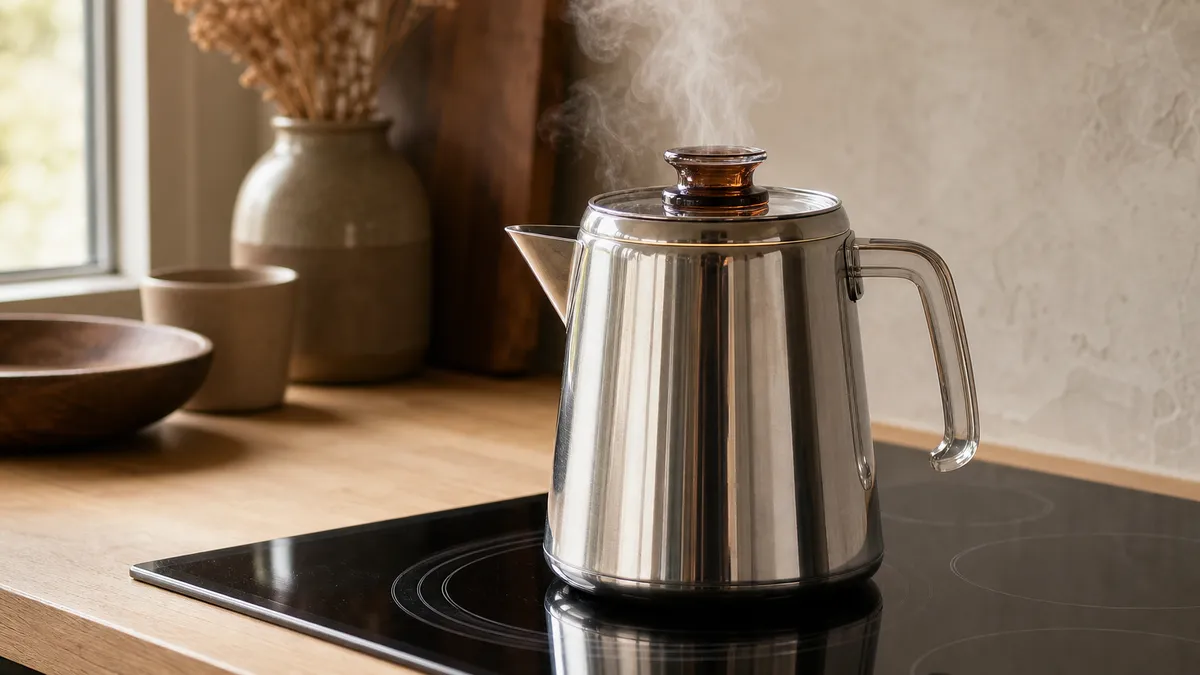
Inside a conventional percolator are a reservoir, a central rising tube and a perforated coffee basket near the top. A spreader or basket lid distributes the liquid over the grounds.
The cycle works like this:
- Heat concentrates beneath the lower end of the tube.
- Local boiling generates steam bubbles that propel small quantities of hot liquid up the tube.
- Liquid emerges above the basket and spreads over the coffee.
- Gravity draws it through the grounds and back into the reservoir.
- The returning coffee mixes with the remaining water and circulates again.
This is a heat-driven pumping action, not an electric pump forcing water through the coffee. Importantly, local boiling can start the pumping before the whole reservoir reaches boiling temperature.
The characteristic bubbling is therefore part of the mechanism, not an instruction to keep the entire pot at a fierce rolling boil.
A percolator is not a moka pot
Retail descriptions sometimes blur the distinction, but the liquid follows different routes.
In a moka pot, pressure in the lower chamber pushes water through the coffee into a separate upper collecting chamber. The finished drink does not normally return to the lower chamber and circulate through the grounds again.
A conventional percolator deliberately returns the drink to its original reservoir. That repeated exposure to the grounds and heat explains much of its brewing behaviour. For the wider equipment categories, start with our coffee machines guide.
Stovetop and electric percolators
The important comparison is who controls the heat and when circulation stops.
| Criterion | Stovetop percolator | Electric percolator |
|---|---|---|
| Heat source | Compatible hob or approved outdoor heat source | Integral electric heater |
| Brewing control | User adjusts heat and ends brewing | Automatic controls manage the brewing phase |
| Serving | Pot removed from heat | Some models have a detachable serving pot |
| Main limitation | Needs close attention to heat and timing | Brewing controls may offer little adjustment |
| Best suited to | Hands-on brewing and suitable camping setups | People wanting an automatic percolating routine |
“Stovetop” does not mean suitable for every hob. Check the manufacturer’s instructions for induction compatibility, burner size and permitted outdoor use. Handles, lid components and finishes can impose restrictions even when the body is metal.
Electric models vary too. C3’s Design percolator, for example, switches to a keep-warm phase after brewing, while its published specification also describes automatic shut-off. Those are different functions: stopping extraction is not necessarily the same as switching the appliance off.
For UK use, check the actual model’s electrical rating, plug and intended market. Presto’s American 02811 manual specifies a 120 V supply, so its instructions should not be mistaken for confirmation that the appliance is suitable for a UK socket.
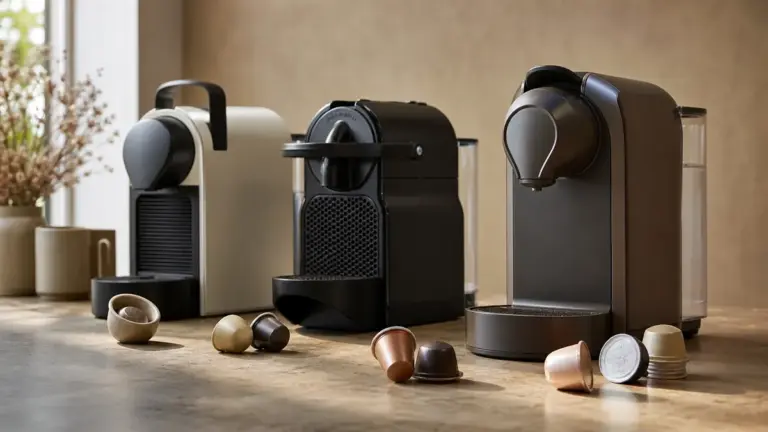
If you are also considering capsule machines, our nespresso comparison provides a separate route through those options.
Why percolators can over-extract coffee
Extraction means dissolving material from the grounds into water. Over-extraction describes taking the process further than produces a balanced drink.
A percolator keeps giving the liquid contact with the grounds while continuing to apply heat. Brewing does not finish simply because the first coffee has drained from the basket, as it would in a single-pass filter arrangement.
Three processes deserve separating.
Continued extraction
Repeated circulation extends contact with the grounds. Experimental research on hot-water extraction shows that different bitter compounds leave coffee at different rates: some extract quickly, while others release more slowly or remain strongly retained.
This supports controlling the brewing endpoint rather than assuming that longer always means better. It does not support the simplistic claim that all desirable flavours emerge first and every bitter substance appears only at the end.
Aroma loss during heating
Coffee’s volatile aroma compounds can move from the liquid into the surrounding air and escaping vapour. Prolonged heating therefore creates opportunities to lose aroma as well as continue extraction.
Research modelling industrial coffee aroma extraction demonstrates these transfer mechanisms. Applying that mechanism to a household percolator is reasonable, but it does not tell us exactly how much aroma a particular pot loses.
Temperature is not one fixed number
Calling percolator brewing “constant boiling water over the grounds” is too crude. The pumping chamber, reservoir, rising liquid and wet coffee bed need not share one temperature.
The defensible concern is repeated hot extraction combined with continued heating, not a claim that every percolator holds every ground at precisely the boiling point throughout brewing. Equally, bitterness alone does not prove over-extraction: roast character also matters.
How to get better results
The following is an editorial starting method, not a manufacturer-approved recipe for every percolator. The appliance manual takes priority, especially for filling limits, heating and automatic controls.
A repeatable brewing method
- Choose a suitable batch. Use a water quantity within the model’s minimum and maximum limits. For this example, use 1,000 g of water, approximately 1,000 ml, only if the machine permits it.
- Weigh the coffee. Try 60 g, giving a coffee-to-water ratio of approximately 1:16.7 by weight. This is a suggested starting point for adjustment, not a universal percolator standard.
- Use a coarse grind. Avoid powdery espresso grounds. C3 and Petromax both recommend relatively coarse coffee to limit particles entering the drink.
- Fill and assemble correctly. Use fresh cold water where the manual specifies it. Seat the tube securely, add the grounds without compressing them and fit the basket cover and main lid.
- Control the heat. On a suitable stovetop model, reduce the heat once percolation starts if its instructions direct this. Aim for controlled circulation rather than violent splashing. Do not try to impose a separate kettle-temperature recipe on a brewer whose pumping depends on local boiling.
- Time the correct phase. Record when circulation starts, not just when you switch on the heat. Follow the model’s stated brewing period or automatic endpoint.
- Serve and assess. Remove a stovetop pot from its heat source when brewing finishes. Let a sample cool enough to taste, then record the dose, water quantity, grind and brewing time.
There is genuine variation in manufacturer guidance. Standard Sales’ instructions give 5 to 15 minutes of percolation, while Petromax’s guide suggests approximately 12 to 13 minutes for its smaller models and longer for its large version. These are model-specific directions, not competing universal rules.
For adjustment, change one variable between batches. If the drink is balanced but too weak, try a little more coffee rather than automatically extending circulation. If it is drying and harsh, investigate heat, duration and grind before adding more grounds.
For a different small-batch routine without repeated circulation through a heated reservoir, explore the aeropress.
Troubleshooting
| Symptom | Likely cause | Fix |
|---|---|---|
| Harsh, drying finish | Excessive brewing, aggressive heating or unsuitable roast | Follow the proper endpoint; reduce heat where permitted; compare another coffee |
| Thin, weak coffee | Insufficient dose or poor circulation | Check dose, tube seating and any movable pump washer |
| Grounds in the cup | Fine grind, grounds dropped into the stem or unsuitable filter | Grind coarser; keep the stem clear; use only an approved filter |
| Overflowing | Excessive fill or brewing disturbance | Switch off the heat and allow cooling before checking fill and assembly |
Never remove the lid to inspect the grounds during active brewing. Hot liquid can spurt from the tube.
Brands
Select a percolator by compatibility, usable capacity, handling and access to replacement components before considering appearance. The examples below describe manufacturers’ published products, checked in November 2026, not independently tested recommendations.
- GSI Outdoors: its Glacier Stainless range includes stovetop and campfire models with a glass viewing dome. Check the exact size and heat-source instructions; the dome is also a component to inspect and protect.
- Petromax: its Perkomax range includes enamelled and stainless-steel designs. Its published guide explains filling, coarse grinding and model-dependent brewing times. Do not assume every version shares identical construction or capacity.
- C3: its Design electric range includes automatic brewing and keep-warm functions. Check the minimum batch, shut-off behaviour and availability of the correct UK-market configuration.
- Presto: its electric percolators provide useful examples of automatic operation, but the American 02811 is specified for 120 V. Treat electrical compatibility as a deciding issue, not a minor accessory question.
Ask whether replacement baskets, stems and lid components are available for the exact model. Manufacturer descriptions establish claimed features, not comparative reliability or superior flavour.
Advantages/Benefits & Disadvantages
Advantages and benefits
A suitable stovetop percolator makes coffee without mains electricity, which gives it a practical role in an approved camping setup. Its reusable basket can also avoid disposable paper filters where the instructions permit brewing without them.
The process has an appealing directness: fill the pot, assemble the internals and manage the heat. Electric versions retain the percolating method while automating more of the routine.
Disadvantages
The same reservoir serves as both brewing supply and finished-coffee container. That makes it harder to separate extraction from heating than in a brewer that collects the finished drink elsewhere.
Minimum batch sizes can be inconvenient, and stems, baskets and pump components need attention during cleaning. A keep-warm function should not be treated as evidence that flavour remains unchanged indefinitely.
Our view: percolators deserve a fair hearing when their serving style and brewing ritual appeal. They would not be our first choice for someone whose priority is precise control over the extraction endpoint.
Cleaning and care
Allow the appliance to cool before dismantling it. Wash the basket, spreader and tube as the manual directs, clearing trapped grounds and checking any movable pump components.
For electric models, distinguish removable washable parts from the electrical body and base. Presto specifically warns against immersing the appliance or wetting its electrical connection.
Do not assume dishwasher suitability or use a generic cleaning chemical on every material. Follow the particular model’s washing and descaling instructions, and never heat it dry.
FAQ
Can I use ready-ground supermarket coffee?
Yes, provided its grind suits the basket and the manufacturer’s instructions. “Ground coffee” covers several particle sizes, so a blend intended for espresso may be unsuitable. If the drink contains sediment, try a coarser grind or a manufacturer-approved paper filter rather than improvising a liner that could obstruct drainage.
Does a glass knob tell me when the coffee is ready?
No, it shows circulation and colour rather than directly measuring extraction. GSI describes its viewing dome as a way to observe brewing progress, but darker liquid alone cannot establish a balanced flavour. Use the proper brewing endpoint, then assess the cooled drink and keep notes for the next batch.
Can I put milk in the reservoir?
Do not do so unless the manufacturer explicitly permits it. The brewing instructions reviewed here use water in the reservoir and coffee in the basket, not milk as the circulating liquid. Brew the coffee as directed and add milk in the cup instead; do not assume a metal pot can safely heat any drink.
Where to go next
Read Coffee Machines to place percolators alongside the wider equipment choices. Aeropress is useful for comparing a different small-batch brewing routine, while Nespresso Original vs Vertuo helps if your next decision concerns capsule systems rather than percolators.
Sources
-
United States Patent Office, Percolator, US913293A, Julian R. Holley, 1909. Primary description of local heating and steam-driven pumping.
https://patents.google.com/patent/US913293A/en -
National Presto Industries, 12-cup Stainless Steel Coffee Maker: Instructions, model 02811, form 49-218V, 2026.
https://www.gopresto.com/uploads/02811_49_218V_Eng_Web_Instructions_CL.pdf -
C3, Step by step guide: Brew good coffee with your percolator, undated, retrieved November 2026.
https://c3.se/en/step-by-step-guide-brew-good-coffee-with-your-percolator/ -
C3, Percolator Design Brushed Stainless Steel 10 cups, undated manufacturer specification, retrieved November 2026.
https://c3.se/en/percolator-design-brushed-stainless-steel-10-cups/ -
GSI Outdoors, Glacier Stainless Coffee Percolator, product description, care instructions and warnings, undated, retrieved November 2026.
https://gsioutdoors.com/products/glacier-stainless-coffee-percolator -
Petromax, Perfect coffee on the go: with the percolator, undated guide, retrieved November 2026.
https://petromax.com/blogs/advisor/perfect-coffee-on-the-go-with-the-percolator -
Standard Sales, Percolator Instructions, undated manufacturer instruction sheet, hosted by The Home Depot.
https://images.thdstatic.com/catalog/pdfImages/be/bec9b845-bb9f-4dad-aa49-d3c6ab768220.pdf -
Bialetti cookware support, How to use the Moka Express?, updated 15 June 2023.
https://bialetti-cookware.zendesk.com/hc/en-us/articles/5416235346322-How-to-use-the-Moka-Express -
Blumberg, Frank and Hofmann, Technical University of Munich, Quantitative studies on the influence of the bean roasting parameters and hot water percolation on the concentrations of bitter compounds in coffee brew, Journal of Agricultural and Food Chemistry, 2010.
https://pubmed.ncbi.nlm.nih.gov/20180507/ -
Beverly and colleagues, University of Birmingham and Jacobs Douwe Egberts, Modeling Mass and Heat Transfer in Multiphase Coffee Aroma Extraction, Industrial & Engineering Chemistry Research, 2020.
https://pmc.ncbi.nlm.nih.gov/articles/PMC7304076/
This guide was researched using manufacturer instructions, a primary patent description and peer-reviewed extraction research; the suggested starting recipe is editorial guidance, not a report of first-hand testing.
Last checked: November 2026