For car dealerships, shortlist commercial bean-to-cup coffee machines that customers can use easily and that staff can keep presentable throughout the day. For retail staff areas, prioritise break-time throughput, straightforward cleaning and dependable support rather than showroom appearance. Size each installation around its busiest period, not simply the number of people employed.
In short
- Assess customer hospitality and staff refreshments separately, even if you initially plan to share one machine.
- Ask suppliers to demonstrate your actual drink sizes and milk recipes, not just quote a daily capacity.
- Choose fresh-milk drinks only when somebody will own refrigeration, replenishment and the specified cleaning routine.
- Include installation, ingredients, maintenance, staff time and waste when calculating your own cost per cup.
- Get itemised written quotations and contract terms covering weekend support, breakdowns, consumables and termination.
Customer-facing coffee in car dealerships
Treat the coffee point as part of the waiting area, rather than an appliance placed wherever a socket happens to be. Our buying recommendation is a commercial bean-to-cup machine with a short, clearly named drinks menu, suitable cups and a nearby member of staff who can help without taking over.
Bean-to-cup means the machine grinds whole beans and prepares each coffee automatically. For dealership hospitality, assess the complete interaction: finding a cup, choosing a drink, positioning it correctly, collecting it and disposing of any waste.
Start with the drinks customers actually request. A manageable menu might include black coffee, a milk coffee and a decaffeinated option where the machine supports one. Do not add unfamiliar drink names merely to make the screen look impressive.
Presentation needs an owner. Assign checks for splashed milk, used cups, empty sugar containers and overflowing trays, with a handover when reception staff change shifts. A polished cabinet is no substitute for a clean dispensing area.
For wider workplace selection principles, start with coffee for every workplace. Here, the key distinction is whether coffee is part of customer hospitality or a facility employees use during breaks.
Staff-only coffee in retail workplaces
In a staff room, begin with the break pattern. Ask how many people arrive together, how much time they have and whether the machine remains accessible before opening and after closing.
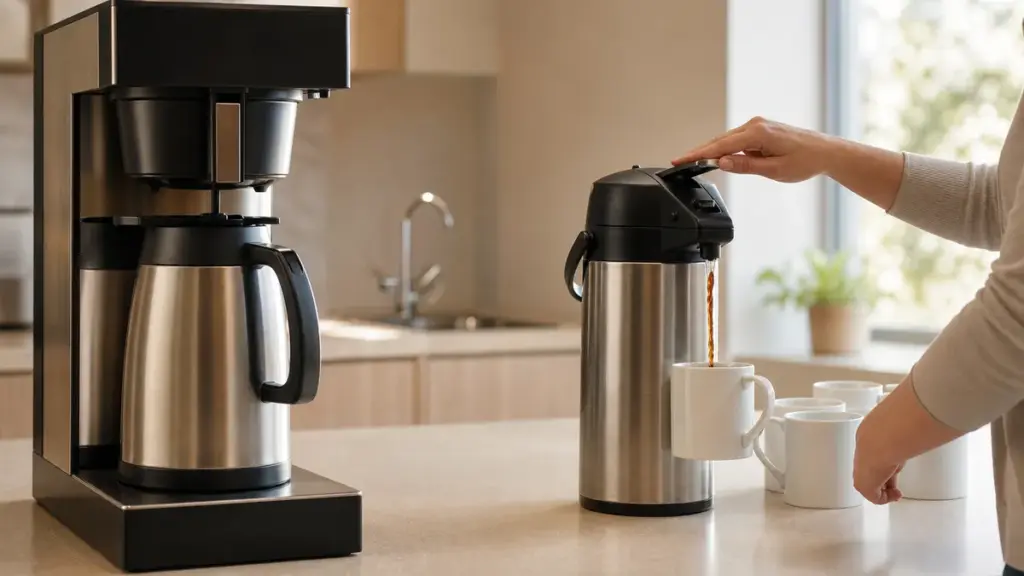
Our recommendation is to favour a compact commercial bean-to-cup machine for individually prepared drinks, or consider batch filter coffee where several staff want black coffee together. Batch brewing prepares coffee in advance into a serving vessel, such as an insulated airpot, rather than making every drink separately.
Keep staff provision independent of customer hospitality where access or queues would otherwise conflict. This does not automatically mean buying two machines: a separate filter setup may be a more suitable second coffee point.
Name a cleaning lead and a deputy for each operating shift. Avoid a system that depends on one enthusiastic employee being present.
For workplaces with several buildings or departments, the access questions in school and university coffee provision are also useful. Where refreshments must remain available across changing shifts, compare the operational priorities in healthcare coffee provision, without assuming healthcare-specific requirements apply to retail.
Which machine format suits each setting?
Use these criteria before comparing brands: customer independence, drink range, peak demand, cleaning responsibilities and installation requirements. The table is an editorial shortlist, not a ranking based on first-hand testing.
| Format | Best suited to | What to assess | Main compromise |
|---|---|---|---|
| Fresh-milk bean-to-cup | Dealership hospitality offering cappuccinos and similar drinks | Customer interface, milk cooling, cleaning steps and completed-drink speed | Requires an organised milk-handling routine |
| Black-coffee bean-to-cup | Staff areas or hospitality focused on black coffee | Coffee quality, cup sizes and provision for milk separately | Does not provide one-touch fresh-milk drinks |
| Batch filter brewer with insulated server | Staff breaks with grouped demand for black coffee | Batch size, preparation routine and easy dispensing | Someone must prepare batches and manage unused coffee |
Ask for the exact configuration in writing. A product family may have different milk systems, cooling units, water connections and cleaning arrangements.
For example, Franke currently publishes an “up to 200 cups” average daily capacity for its new A600 on its UK website. That is a manufacturer claim, checked in November 2026, not an independently verified result or a promise about how quickly your chosen milk drinks will be served. It illustrates why model generation and configuration matter more than a familiar product name.
Capacity: count drinks and peak arrivals
Build demand from the people actually on site. For dealerships, include sales, reception, workshop and parts staff where they use the same machine, then add customer drinks separately. For retail, use the staffing pattern across the trading day rather than the entire payroll.
The following matrix contains illustrative planning assumptions, not measured consumption averages. Each employee present is assumed to take two coffees during the day; customer drinks are additional.
| Example workplace | Staff present across the day | Assumed staff coffees | Assumed customer coffees | Planned daily coffees |
|---|---|---|---|---|
| Small retail staff area | 10 | 20 | 0 | 20 |
| Larger retail staff area | 30 | 60 | 0 | 60 |
| Dealership with shared provision | 25 | 50 | 40 | 90 |
| Busier dealership with shared provision | 50 | 100 | 80 | 180 |
Replace every assumption with your own counts. Record busy and quiet days, including weekends and promotional events.
Then measure the busiest period separately. As an illustration, 12 drinks required within 15 minutes means an average of one completed drink every 75 seconds. That interval must accommodate customer selection, cup handling and any interruptions, not just the machine’s dispensing cycle.
Ask the supplier to demonstrate a realistic sequence of black and milk drinks in your intended cups. Record queues, replenishment and tray-emptying needs. A daily rating alone does not answer that operational question.
Make self-service clear, comfortable and manageable
Test the proposed coffee point with somebody unfamiliar with the machine. Can they identify the drinks, position a cup and collect it without instructions? Can a seated user approach and operate it comfortably, or is an assisted-service arrangement needed?
For dealerships, place cups and accessories in the order people use them. Keep the collection point clear of paperwork and vehicle keys, and provide an obvious place for used crockery. Check operating noise during a demonstration near the waiting-area seating.
For staff rooms, preserve enough worktop space for people to prepare food and put down their mugs. Confirm access for filling water, removing grounds and cleaning the machine without blocking the whole room.
Agree an opening check, checks during service and a closing handover. Follow the exact machine’s cleaning instructions: automated cleaning does not mean there are no manual tasks. Franke’s current cleaning literature, for example, describes automatic processes alongside regular rinsing and manual care.
Installation, milk hygiene and workplace duties
Water, power and servicing access
Before ordering, have the supplier survey the electrical supply, water connection, drainage, ventilation clearances and maintenance access. Include the refrigerator and accessories in the measured footprint.
Obtain the local water supplier’s hardness information and ask the installer to confirm suitable treatment against the machine manufacturer’s requirements. Hardness describes dissolved minerals; reports may express it in milligrams per litre as calcium carbonate. Do not substitute a general assumption about UK water for the actual site supply.
In England and Wales, plumbed-in installations must meet the Water Supply (Water Fittings) Regulations 1999, including adequate backflow prevention. Ask the installer to identify the applicable local requirements rather than treating that legislation as UK-wide.
Machines with steam boilers can fall within the Pressure Systems Safety Regulations 2000 in Great Britain. Ask the supplier to confirm applicability and any examination requirements using HSE guidance.
Milk and allergen information
Require a written routine for milk storage, replenishment, cleaning and action after refrigeration failure. Do not accept “automatic milk cleaning” as the whole explanation.
For customer hospitality, keep accurate allergen information available for milk, powders, syrups and other ingredients. FSA guidance for England, Wales and Northern Ireland states that mandatory allergen information also applies to complimentary food supplied by food businesses.
A plant-based selection is not, by itself, assurance that a drink is safe for somebody with a milk allergy. Shared equipment can transfer allergens. Agree how staff will answer questions and assess cross-contact risks rather than promising an allergen-free drink.
Staff welfare and grounds disposal
HSE’s Great Britain workplace guidance requires access to drinking water and somewhere to rest and eat meals. Keep those essentials separate from decisions about coffee provision.
In England, workplace food-waste separation requirements include coffee grounds. They have applied since 31 March 2025, with a temporary exemption until 31 March 2027 for businesses with fewer than 10 full-time-equivalent employees. That count is business-wide, not per branch; do not assume a small retail outlet qualifies. Check the relevant national guidance outside England.
Work out cost per cup without overlooking the work
Ask every supplier for an itemised written quotation based on the same demand, drink sizes, opening days and contract period.
Include:
- Machine provision, installation and any removal at the end.
- Beans, milk, alternative milks, powders and other ingredients.
- Cleaning products, filters, servicing and breakdown support.
- Cups, washing, electricity, water and waste collection.
- Staff time for replenishment, cleaning and administration.
Use this method:
Cost per cup = all coffee-service expenditure over a defined period ÷ drinks actually served during that period.
For a comparison worksheet, assume the dealership example above serves 90 coffees daily over 250 operating days. That gives 22,500 drinks annually. If every coffee uses an assumed 9 g of beans, planned beverage use is 202.5 kg before wastage.
If 40 drinks daily each use an assumed 120 ml of liquid milk, beverage use is 1,200 litres annually. These are arithmetic examples, not recommended recipes; replace them with demonstrated doses and measured milk use.
Add wastage and all non-ingredient items separately. State whether your calculation includes VAT and how recoverable VAT is treated. HMRC generally zero-rates coffee and milk sold as food, while hot drinks supplied in the course of catering are standard-rated; do not assume every quotation line has the same treatment.
Contracts: specify what happens when service stops
Compare the equipment agreement, maintenance agreement and ingredient obligations together. Do not evaluate one while leaving the others unread.
Request written answers covering:
- Equipment: exact model, generation, configuration and ownership.
- Support: operating hours, weekend cover, response commitments and the distinction between attending and fixing a fault.
- Continuity: replacement equipment, escalation contacts and responsibility during an outage.
- Consumables: approved products, purchase commitments and consequences of using alternatives.
- Responsibilities: cleaning, filters, descaling, training and safety examinations.
- Exit: initial term, renewal, notice, relocation and collection arrangements.
For dealerships, test the support promise against a busy Saturday. For retail staff rooms, check what happens when closing staff find a fault after the support line shuts.
Choose coffee machines for car dealerships and retail staff areas by the service you can sustain: suitable drinks, manageable queues, clear responsibilities and support that matches your opening hours.
FAQ
Can customers and staff share one machine?
Yes, provided access, demand and responsibilities work for both groups. Before committing, test what happens when a staff break overlaps with customer arrivals. If sharing creates queues or sends employees through customer seating, assess a separate staff coffee point rather than assuming one larger machine solves the problem.
Do complimentary customer drinks still need allergen information?
Yes, where supplied by a food business, complimentary drinks are not exempt from mandatory allergen information requirements. The FSA guidance cited here covers England, Wales and Northern Ireland. Keep information current when ingredients change, and make sure staff know where to find it rather than relying on memory.
What should a supplier demonstration include?
It should reproduce your intended service, not just produce one attractive drink. Request your cup sizes, expected drink mix and a sequence representing the busiest period. Include refilling, emptying and cleaning tasks, then ask the supplier to document the exact configuration demonstrated so the quotation matches it.
Where to go next
Read Coffee for Every Workplace to compare these priorities with other workplace settings. Coffee Machines for Schools and Universities is useful for distributed access and multiple user groups, while Coffee Machines for Healthcare Settings explores provision across changing shifts.
Sources
-
Franke Coffee Systems, The Franke A600 coffee machine, current UK product page, undated, retrieved November 2026. Manufacturer specifications, not independent performance evidence.
https://www.franke.com/gb/en/coffee-systems/products/fully-automatic-coffee-machines/a600-coffee-machine.html -
Franke Coffee Systems, New A Line brochure, current manufacturer brochure, undated, retrieved November 2026. Cleaning arrangements and manual care.
https://www.franke.com/content/dam/franke/language-masters/en/coffee-systems/documents/brochures/en/en_new_a_line_franke_cs_brochure.pdf.coredownload.pdf -
BUNN, CWA-APS Airpot System, current commercial product page, undated, retrieved November 2026. Example of a commercial brewer dispensing into an airpot.
https://commercial.bunn.com/23001.0094 -
HM Revenue & Customs, Food products (VAT Notice 701/14), updated 8 June 2026.
https://www.gov.uk/guidance/food-products-and-vat-notice-70114 -
HM Revenue & Customs, Catering, takeaway food (VAT Notice 709/1), updated 8 June 2026.
https://www.gov.uk/guidance/catering-takeaway-food-and-vat-notice-7091 -
Health and Safety Executive, Have the right workplace facilities: What you must provide, current guidance, undated, retrieved November 2026.
https://www.hse.gov.uk/simple-health-safety/workplace-facilities/welfare.htm -
Health and Safety Executive, Pressure Systems Safety Regulations 2000 (PSSR), current guidance, undated, retrieved November 2026.
https://www.hse.gov.uk/pressure-systems/pssr.htm -
UK legislation, The Water Supply (Water Fittings) Regulations 1999, SI 1999/1148, particularly Schedule 2, paragraph 15.
https://www.legislation.gov.uk/uksi/1999/1148/pdfs/uksi_19991148_en.pdf -
Department for Environment, Food & Rural Affairs, Simpler recycling: workplace recycling in England, updated 3 October 2025.
https://www.gov.uk/guidance/simpler-recycling-workplace-recycling-in-england -
Food Standards Agency, Allergen Information for Non-Prepacked Foods Best Practice, published 24 February 2025. Applies to England, Northern Ireland and Wales.
https://www.gov.uk/government/publications/allergen-information-for-non-prepacked-foods-best-practice/allergen-information-for-non-prepacked-foods-best-practice -
Food Standards Agency, Precautionary allergen labelling, current guidance, retrieved November 2026. Cross-contact and risk assessment.
https://www.gov.uk/government/publications/precautionary-allergen-labelling/precautionary-allergen-labelling -
Thames Water, Hard water, current water-supplier guidance, undated, retrieved November 2026. Hardness and reporting units, not a site-specific water assessment.
https://www.thameswater.co.uk/help/water-and-waste-help/water-quality/hard-water
Research combined manufacturer documentation with official UK tax, safety, food and waste guidance; demand figures and ingredient quantities are explicitly labelled planning assumptions, and no first-hand machine testing is claimed.
Last checked: November 2026