Office coffee machines for high-volume use should be chosen around the busiest break, not just the daily drinks total. Commercial bean-to-cup machines suit busy self-service areas, while multi-group traditional espresso machines suit staffed coffee points; either needs adequate utilities, planned cleaning and backup provision to keep service moving.
In short
- Measure drinks required during the busiest 15 minutes, including visitors and meeting breaks.
- Treat manufacturers’ daily capacity figures as selection guidance, not guaranteed queue-clearing performance.
- Specify the exact electrical configuration, plumbed water, drainage and grounds-disposal arrangements before ordering.
- Twin grinders and separate boilers serve different purposes. Neither automatically doubles output.
- Compare one large machine with multiple smaller machines, including what remains available during cleaning or failure.
Size high-volume office coffee machines around peak demand
Begin with actual attendance rather than payroll headcount. Count coffee drinkers, drinks per person, visitors and demand at each location, then record when people arrive together.
For example, 60 drinks requested within 15 minutes represents an arrival rate equivalent to 240 drinks an hour. That is an illustrative calculation, not a machine specification. A machine’s daily recommendation cannot tell you whether it will clear that queue.
Use this matrix as a starting exercise, not a universal sizing rule.
| People present daily | Assumed coffees per person | Calculated daily coffees | Configuration to investigate |
|---|---|---|---|
| 100 | 2 | 200 | One commercial machine against two smaller units |
| 200 | 2 | 400 | Multiple machines or a staffed commercial installation |
| 400 | 2 | 800 | Distributed machines with overlapping backup capacity |
| 600 | 2 | 1,200 | Several service points with coordinated replenishment |
Every row assumes everyone present drinks two coffees, with no visitors or other drinks. Replace those assumptions with workplace observations, and size individual tea points separately.
Our daily cup capacity guide covers the broader capacity bands. Here, the deciding question is what happens when demand arrives together.
Ask suppliers to demonstrate your actual menu, cup sizes and sequence of orders. Include milk drinks, decaf selections, hot-water requests and the time users spend choosing drinks and collecting cups.
Choose the machine class before the features
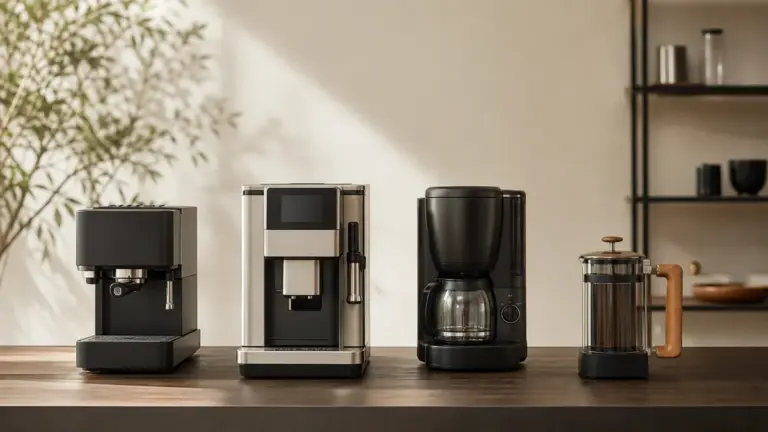
Compare options against peak throughput, staffing, installation requirements, cleaning workload and service continuity. These criteria matter more than the number of drink buttons.
| Configuration | Best suited to | Useful characteristics | Main limitation |
|---|---|---|---|
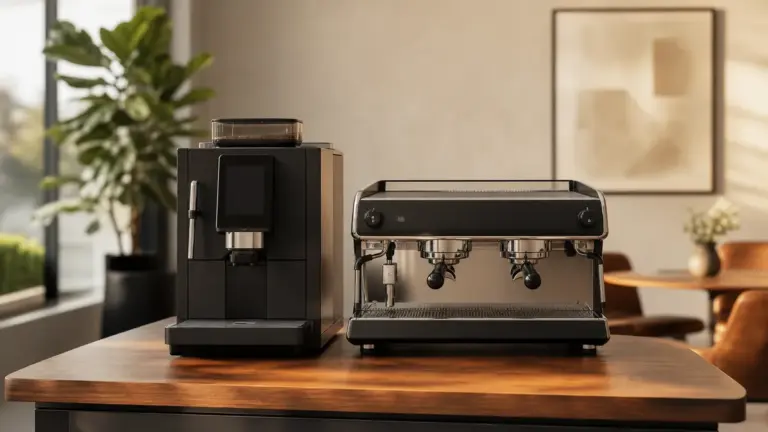
| High-capacity bean-to-cup | Unstaffed office tea points | Automatic grinding, brewing and milk preparation | Whole-machine availability and user interaction can constrain throughput |
| Multi-group traditional espresso | Staffed workplace coffee points | Several brewing positions and separate steam provision | Requires trained operators and an effective workflow |
| Multiple bean-to-cup machines | Distributed or strongly peaked demand | Separate queues and partial backup | More cleaning, replenishment and installation points |
| Espresso service plus batch filter | Large meetings and black-coffee demand | Separates batch serving from individual drink preparation | Does not provide equivalent milk-based drinks |
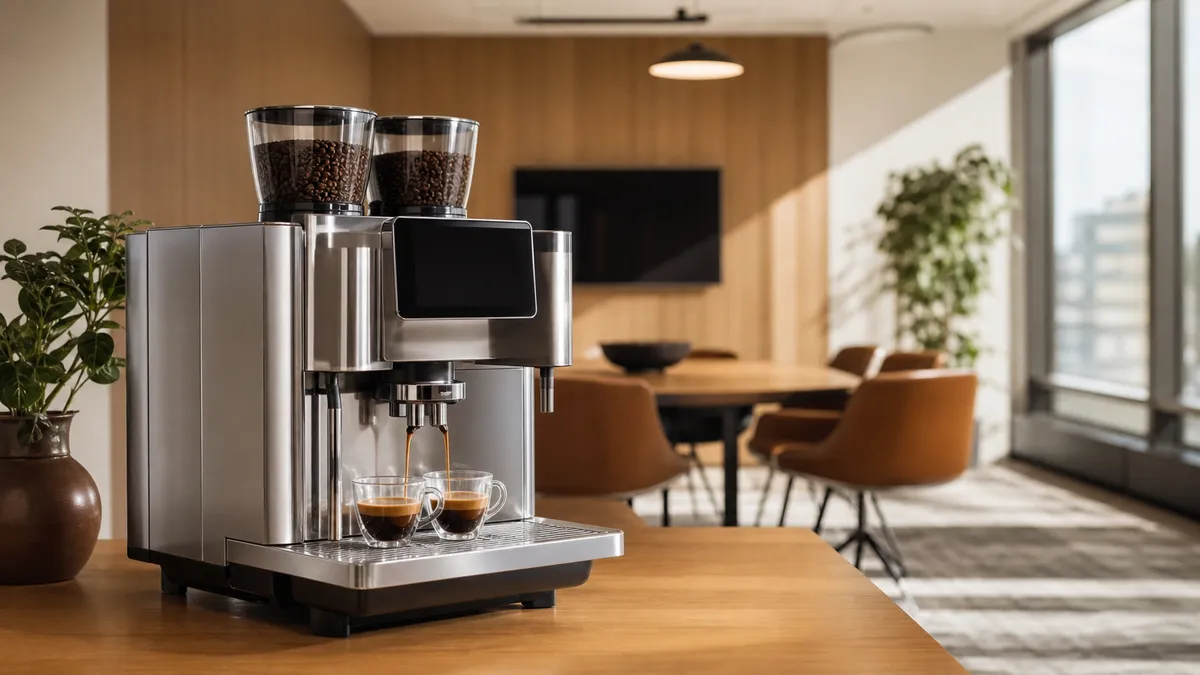
High-capacity bean-to-cup machines
Manufacturer examples show why daily and hourly figures must be read separately. Franke’s A1000 brochure claims capacity of up to 300 cups daily. WMF recommends up to 350 cups daily for its 9000 S+.
WMF also publishes hourly output according to DIN 18873-2: 150 individual cappuccinos or 238 cappuccinos when prepared in pairs. These are manufacturer-published figures under stated test conditions, not independent measurements of an office queue.
Ask which electrical version, recipes and operating conditions support the quoted performance. Do not assume paired production applies to arbitrary combinations of drinks selected by unrelated users.
Traditional espresso machines
A traditional machine has group heads, the brewing positions where portafilters hold the ground coffee. Multiple groups allow brewing at several positions, but the installation also needs grinders, milk preparation, cup handling and trained staff.
La Marzocco’s published Linea PB brochure lists two-, three- and four-group versions with separate coffee and steam boilers. That illustrates the relevant machine class, not a recommendation or a guaranteed drinks-per-hour figure.
Choose this route where somebody owns the service throughout busy periods. For the wider selection process, start with our office coffee machine overview.
Understand twin grinders, boilers and hot-water bypass
Twin grinders provide separate grinding paths, commonly for different coffees such as regular and decaf. They do not necessarily provide two independent brewing systems.
Ask whether both grinders can operate concurrently, whether recipes share one brewing unit, and what happens if one grinder fails. Do not assume the other remains usable.
Separate boilers address a different constraint: supplying heat for coffee, steam and hot water. Franke describes three separate boilers in the A1000, while La Marzocco describes separate brewing and steam boilers in the Linea PB. Look beyond boiler count to recovery performance during your proposed drink sequence.
For Americano-heavy demand, ask about a fast-dispense hot-water bypass, meaning hot water delivered without passing through the coffee grounds. Confirm whether it operates alongside coffee delivery, its usable flow and whether it shares heating capacity with other functions.
WMF lists parallel hot-water and coffee delivery for the 9000 S+. Nevertheless, a separate outlet is not proof of unlimited simultaneous output. Where tea demand is substantial, consider a separate hot-water appliance to keep those users out of the coffee queue.
Plan power, water, drains and waste before ordering
Electrical supply
Do not order first and investigate the socket afterwards. Ask for the installation sheet for the exact UK configuration and have a competent electrician confirm the required circuit, protection, isolation and available building capacity.
Dedicated 16 A or 32 A single-phase supplies, or three-phase supplies, may be relevant across commercial coffee installations, but these are not interchangeable specifications. WMF’s 9000 S+ manual lists a 16 A single-phase configuration and a three-phase configuration protected at 16 A per phase. Bravilor’s B-series manual lists a 230 V B10 configuration with 32 A protection.
Those examples are not permission to select a circuit yourself. Obtain current requirements for the supplied machine, plus separate requirements for refrigeration, grinders and other accessories.
Plumbed water and drainage
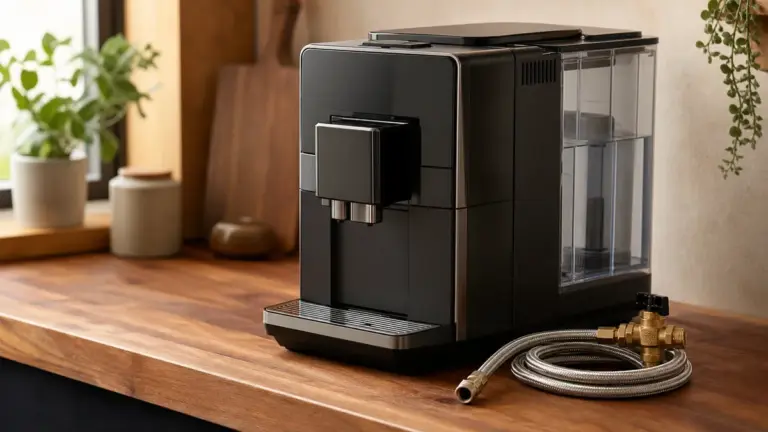
For a busy permanent installation, my preference is plumbed water and a suitable drain wherever practicable: it removes routine tank filling and wastewater carrying from the service workflow.
Have the installer check operating water pressure, flow, isolation access and the drain route. Include the space required for filters and maintenance. Our plumbed-in versus tank-fed comparison explains the wider trade-offs.
In England and Wales, the Water Supply (Water Fittings) Regulations 1999 require appropriate protection against backflow, where water flows back towards the supply. Have the installer establish the applicable protection rather than specifying a valve by guesswork. Confirm the corresponding requirements locally for Scottish and Northern Irish installations.
Obtain your local water supplier’s hardness information, then have the machine supplier assess the actual inlet water against its requirements. Thames Water, for example, provides postcode-based water-quality information. There is no useful single hardness figure for every UK office.
Through-counter grounds disposal
A through-counter grounds chute drops spent coffee into a larger container below the worktop. WMF documents this option for the 9000 S+ and requires daily chute cleaning.
Specify the counter opening, accessible bin space and removal route before fabrication. This is a grounds bin, not the liquid drain: plan both systems separately.
Decide whether multiple machines provide better resilience
Two smaller machines can be preferable to one large machine when independent queues and partial service during outages matter more than a single installation footprint.
However, two machines are not automatically full redundancy. If their combined capacity only just meets normal demand, losing one still leaves a substantial shortfall.
Set a degraded-service requirement: which drinks must remain available, where, and for how long? A smaller backup might maintain black coffee while milk drinks are temporarily unavailable. That can be acceptable if agreed beforehand, but it is not equivalent service.
Check shared vulnerabilities too. Machines connected to the same electrical circuit, water branch or drain may be affected by one building fault.
Stagger cleaning so all machines are not unavailable together. Keep an alternative ready, such as batch filter coffee in suitable servers or access to another adequately sized tea point. Test that alternative before the first breakdown.
Build cleaning and servicing into the operating plan
Automatic cleaning does not remove every manual task. WMF’s manual, for example, specifies daily system and milk-system cleaning alongside manual attention to items including grounds containers and drip trays.
Ask suppliers to distinguish:
- Hands-on cleaning time: preparation, dismantling where required, washing, refilling and reassembly.
- Unavailable time: the period when drinks cannot be served.
- Routine replenishment: beans, milk, cups and grounds-bin emptying.
- Periodic maintenance: filters, descaling where specified and engineer visits.
Assign a trained owner and cover for absences. For continuously occupied sites, agree a cleaning window and alternative provision rather than postponing hygiene work indefinitely.
For service contracts, request written definitions of telephone response, remote diagnosis, engineer attendance and restoration. A response commitment is not the same as a repair commitment.
Confirm coverage hours, your postcode, parts availability, escalation and whether a replacement machine includes delivery, installation and suitable capacity. Ask what happens when a fault occurs immediately before a weekend or major workplace event.
In Great Britain, steam-boiler equipment can fall within the Pressure Systems Safety Regulations 2000. Check applicability with the supplier and HSE guidance, including any required written scheme of examination and examinations. Routine servicing should not be assumed to satisfy those duties.
Assess downtime and compare complete proposals
Treat downtime as lost service capacity and staff disruption, not merely an engineer visit.
For an illustrative incident, assume 100 people each lose four additional minutes obtaining coffee elsewhere. That produces 400 staff-minutes of disruption. It does not establish that every minute becomes lost productive work, but it makes the operational exposure visible.
Record outage duration, affected drinks, queue length, staff diversion and whether meetings lose refreshment service. Compare those observations with the proposed backup arrangements.
For financial comparisons, include equipment, installation, utilities, beans, milk, water treatment, cleaning materials, staff time, servicing, replacement parts and contingency provision. Use a consistent assessment period and divide the relevant total by drinks actually served if calculating your own per-drink figure. Keep VAT treatment explicit and obtain itemised written quotations.
Finally, include waste collection. In England, workplace recycling requirements have applied since 31 March 2025, with micro-firms having until 31 March 2027. Coffee grounds count as food waste; the micro-firm exemption concerns businesses with fewer than 10 full-time-equivalent employees across the business, not each site. Check separate national requirements elsewhere.
Use our office machine comparison guide to turn these requirements into a supplier checklist. For high-volume office coffee machines, the final acceptance test should include peak service, cleaning and an outage scenario, not just a successful first espresso.
FAQ
Should visitors count towards machine capacity?
Yes, include visitors wherever they use the same coffee provision. Ask reception and meeting organisers to identify busy event days rather than relying only on average attendance. Specify whether conference refreshments will use the everyday machines or a separate service, then include that decision in demonstrations and capacity planning.
Do all floors need identical machines?
No, each location should reflect its own demand and operating arrangements. Standardising equipment may simplify training and consumables, but a lightly used floor does not necessarily need the same installation as the main breakout area. Compare local queues, cleaning responsibility and the ability to redirect users during an outage.
Is remote monitoring essential?
No, treat remote monitoring as a support feature rather than a substitute for local ownership or a service agreement. Ask suppliers to demonstrate exactly which faults, drink counts and cleaning events are visible. Specify who receives alerts, who acts on them and what happens when connectivity is unavailable.
Where to go next
Read Office Coffee Machines for the wider selection process, then Office Coffee Machines by Daily Cup Capacity to organise your demand assessment. Plumbed-In vs Tank-Fed Coffee Machines helps with installation choices, while Office Coffee Machine Comparison Guide turns the operational requirements into a consistent shortlist.
Sources
- Franke Coffee Systems, A Line product brochure, August 2024, document 590.0690.832. Manufacturer claims for A1000 capacity, grinders, boilers and cleaning system. Retrieved brochure.
- WMF Professional Coffee Machines, WMF 9000 S+: specifications, undated, retrieved November 2026. Manufacturer-published daily recommendation, DIN 18873-2 hourly outputs and parallel hot-water provision. Retrieved specifications.
- La Marzocco, Linea PB product brochure, undated, hosted in the UK website’s April 2023 directory. Group configurations and separate coffee and steam boilers. Retrieved brochure.
- WMF, WMF 9000 S+ User Manual, English, undated, retrieved November 2026, particularly pages 32, 78 to 84 and 104. Manufacturer-authored manual hosted by Ricmas; grounds chute, cleaning and electrical configurations. Retrieved manual.
- Bravilor Bonamat, Operating instructions: round filter coffee brewer, version 1.0, undated. B10 electrical configuration, technical-data table. Retrieved manual.
- UK legislation, The Water Supply (Water Fittings) Regulations 1999, SI 1999/1148, particularly Schedule 2, paragraph 15. Retrieved legislation.
- Thames Water, Water quality, undated, retrieved November 2026. Local postcode-based water information. Retrieved guidance.
- Health and Safety Executive, Pressure Systems Safety Regulations 2000 (PSSR), undated, retrieved November 2026. Relevant fluids, qualifying equipment and examination duties. Retrieved guidance.
- Department for Environment, Food & Rural Affairs, Simpler recycling: workplace recycling in England, current guidance retrieved November 2026. Implementation dates, employee-count exemption and coffee grounds. Retrieved guidance.
This article was researched using manufacturer specifications and manuals, official legislation, government guidance and water-supplier information; calculations are illustrative, and no first-hand machine testing is claimed.
Last checked: November 2026