Office coffee machines are best chosen by the drinks people want, the busiest period of demand and who will look after the equipment, not by brand alone. Start with actual office attendance and daily cups, then check milk handling, installation requirements and service arrangements before comparing written quotations.
In short
- Count people present on busy days, not just employees on the payroll.
- Ask for both recommended daily output and demonstrated throughput for your chosen drinks.
- Choose the milk system alongside the machine: it determines refrigeration, cleaning and allergen arrangements.
- Have the supplier confirm water, drainage, electrical supply and maintenance access before ordering.
- Compare buying, leasing and renting over the same period, with installation, consumables, servicing and contract terms itemised.
A step-by-step decision path for office coffee machines
Use this order to build a shortlist before approaching suppliers.
- Measure demand. Record attendance, coffee consumption, visitors and meeting-room requirements across a representative working week.
- Agree the drinks menu. Separate essential drinks from occasional requests. Include decaffeinated coffee and plant-based drinks where needed.
- Identify the busiest period. Record how many drinks people need within the same short window, not just across the day.
- Choose the operating model. Decide whether people will serve themselves or a trained operator will make drinks.
- Assign cleaning responsibility. Name a person and a deputy, and check whether their available time matches the proposed system.
- Check the site. Confirm usable space, water, drainage, electrical supply and access for servicing.
- Request comparable proposals. Give every supplier the same demand profile and ask for a demonstration using your intended drinks and cup sizes.
For the wider subject, use our office coffee machines hub. This guide concentrates on the buying decision rather than detailed brewing mechanisms.
The main machine types and who they suit
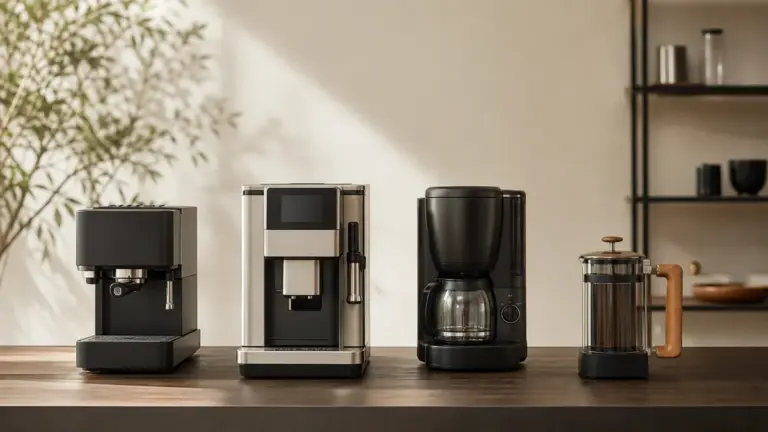
Compare machine types against four criteria: drink choice, user involvement, peak demand and cleaning responsibility. The suitability judgements below are editorial guidance, not manufacturer performance guarantees.
| Machine type | How it works | Best fit | Main limitation |
|---|---|---|---|
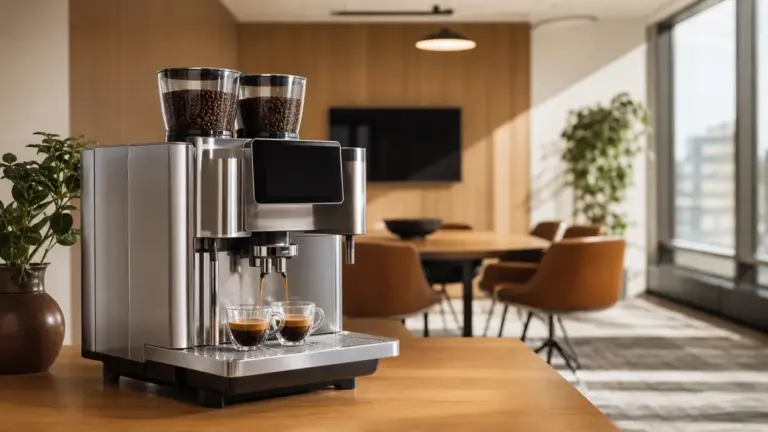
| Bean-to-cup | Grinds whole beans and automatically brews individual drinks | Self-service workplaces wanting freshly ground coffee and an espresso-based menu | Milk systems, grounds containers and cleaning need active management |
| Filter or bulk brewer | Brews ground coffee in batches into a jug, insulated container or dispenser | Meetings and workplaces mainly drinking black coffee, with milk added separately | Does not provide an espresso-based menu |
| Capsule or pod | Brews a pre-portioned serving in a compatible machine | Intermittent demand and users wanting individually selected coffees | Capsule compatibility, replenishment and collection arrangements need checking |
| Traditional espresso | An operator prepares ground coffee in a removable filter handle and steams milk separately | Staffed hospitality areas with trained operators | Preparation and drink quality depend on operator skill |
| Instant or soluble | Mixes soluble coffee and other suitable ingredients with hot water | Self-service settings prioritising straightforward dispensing | Does not brew freshly ground coffee |
Do not assume “automatic” means bean-to-cup. Some automatic machines use soluble coffee; others brew individual servings of filter-style coffee from beans or pre-ground coffee. Ask which ingredients and brewing process the proposed machine actually uses.
Our practical starting recommendation is bean-to-cup for self-service espresso-based drinks, batch filter for shared black-coffee demand, and traditional espresso only where operating it is somebody’s defined job. Capsules deserve consideration where demand is intermittent; soluble systems deserve a demonstration where uncomplicated dispensing matters most.
Read the dedicated guide to office bean-to-cup machines if that route survives the first screening.
Daily cup capacity: size for attendance and queues
Estimate demand using:
Daily coffee drinks = people present × proportion drinking coffee × drinks per coffee drinker + visitor drinks.
The matrix below is an illustrative planning exercise, not a measured UK consumption average. It assumes everyone shown drinks two coffees daily, excludes visitors and makes no allowance for hot water or chocolate.
| People present | Assumed coffees per person | Calculated coffees daily | What to investigate |
|---|---|---|---|
| 10 | 2 | 20 | Whether a compact commercial machine covers peak demand |
| 25 | 2 | 50 | Daily-output recommendation, refill frequency and milk throughput |
| 50 | 2 | 100 | A higher-output machine, multiple points or batch brewing |
| 100 | 2 | 200 | Distributed provision, peak queues and a backup arrangement |
Daily output is not peak throughput
As one scale reference, JURA publishes a recommended maximum daily output of 50 cups for its W8. That is a manufacturer’s recommendation, checked in November 2026, not independent evidence of how quickly it will serve your office’s drink mix.
An illustrative requirement of 30 drinks in 15 minutes means dispensing an average of two drinks per minute during that period. Ask the supplier to demonstrate that sequence, including cup changes, milk preparation, refills and interruptions.
Specify drink sizes in millilitres. A throughput demonstration using small black coffees does not establish performance for your chosen large milk drinks.
Milk systems: choose the work as well as the drink
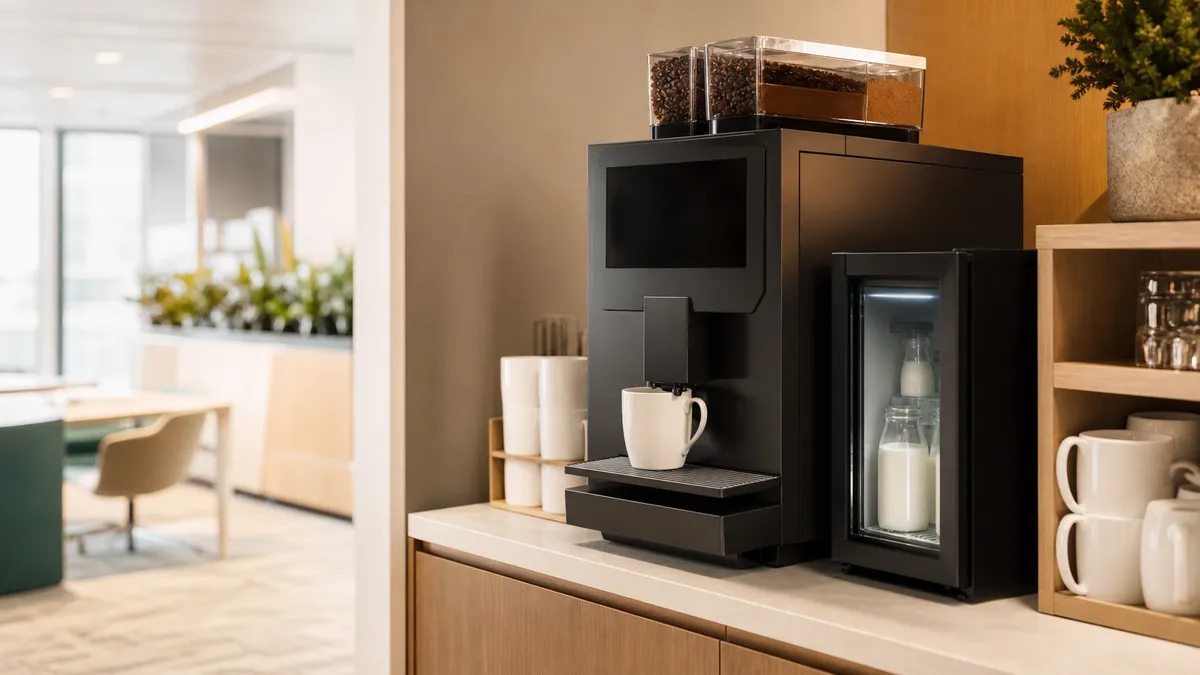
Fresh-milk systems draw milk from a container or refrigerated unit and heat or foam it. They suit workplaces that want automatic milk drinks and can support the required refrigeration and cleaning.
Powdered-milk or topping systems use suitable dry ingredients mixed within the machine. They avoid a fresh-milk supply circuit, but mixers, outlets and ingredient containers still need the manufacturer’s prescribed cleaning. Check the ingredient label rather than assuming every “topping” is simply milk powder.
Separate milk provision is worth considering for predominantly black-coffee service. It keeps milk outside the brewer, although storage, handling and any separate frother remain somebody’s responsibility.
For dairy and plant-based options, ask whether containers, tubes, mixers and outlets are shared. Allergen cross-contact means unintended transfer of an allergen between ingredients or surfaces; selecting a different drink button does not establish separation.
Taste the proposed drinks, but also ask to see the complete end-of-day routine.
Plumbing, power, water and space
Tank-fed or mains-connected?
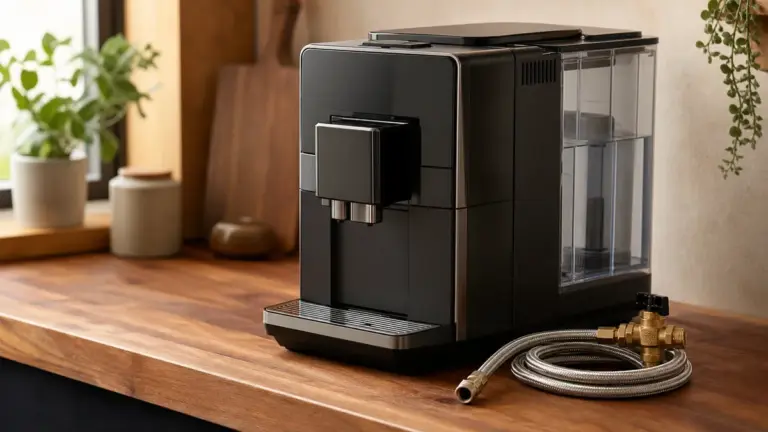
A tank-fed machine needs manual filling. A mains-connected machine needs a suitable water connection, and some installations also need drainage.
Check the whole installation rather than the machine’s footprint: milk fridge, filter, waste container, door opening, hopper filling and service access all need space.
For plumbed equipment in England and Wales, the Water Supply (Water Fittings) Regulations 1999 require appropriate backflow protection. This prevents water flowing backwards from equipment towards the supply. Ask the installer to confirm the requirements for your specific installation; do not treat England and Wales guidance as UK-wide permission.
Confirm the electrical specification
A familiar-looking machine does not establish its electrical requirements. Franke’s A600 technical leaflet, for example, lists configurations with different supply arrangements.
Have the supplier identify the exact configuration and confirm its voltage, power, connection and circuit requirements in writing. Include the milk fridge and other equipment at the tea point in the site assessment.
Use local water information
Water hardness varies with the supply. Obtain your water supplier’s local report and have the installer test and specify treatment against the machine manufacturer’s requirements.
Reports may express hardness as mg/L as calcium carbonate, a common comparison basis, or in Clark or German degrees. Check which unit the machine setting requires rather than entering the same number regardless of unit. Ask who monitors filter capacity and arranges replacement.
Buy, lease or rent: compare the complete arrangement
Treat these as different proposals to examine, not labels that guarantee particular terms.
- Buying: establish ownership, warranty coverage, installation responsibilities and how servicing will be arranged.
- Leasing: check the finance term, ownership position, service arrangements and end-of-term obligations separately.
- Renting: ask exactly what equipment and support are included, whether substitutions are permitted and what happens when the agreement ends.
For every route, request itemised written quotations covering equipment, installation, water treatment, ingredients, cleaning products, servicing, repairs, staff training and removal.
To calculate your own cost per cup, add the applicable expenditure across one comparison period and divide by the number of drinks you realistically expect to dispense during it. Include bean dose or capsules per drink, milk use, discarded ingredients, cleaning labour and electricity. Use the same assumptions for each proposal and keep VAT treatment consistent.
Coffee and milk supplied as food are generally zero-rated for VAT. Hot drinks sold in the course of catering are generally standard-rated, while HMRC separately addresses free employee catering. Ask suppliers to identify the VAT treatment of each quotation item rather than applying one assumption to the entire package.
Service, hygiene and workplace responsibilities
A service visit and a daily cleaning routine solve different problems. Require a written schedule showing what users do, what the service provider does and what happens when either task is missed.
For example, JURA’s W8 instructions require daily milk-system cleaning when milk has been prepared. The manual distinguishes this from rinsing, so an automatic rinse should not be treated as a substitute for the specified cleaning programme.
Allocate responsibility for milk storage, cleaning, grounds disposal, drip trays, ingredient replenishment and maintenance records. Ask for hands-on training for both the main operator and their deputy. Our explanation of how office bean-to-cup machines work helps identify the components involved.
Pressure systems and workplace facilities
Machines incorporating steam boilers can bring pressure-system duties into scope in Great Britain. HSE identifies steam at any pressure as a relevant fluid and requires qualifying equipment to have a written scheme of examination and an examination before use. Check applicability with the supplier and a competent person; routine servicing is not a substitute for statutory examination.
HSE’s workplace guidance requires access to drinking water and somewhere to rest and eat. Keep that provision separate from the coffee-machine project.
Grounds and other waste
In England, workplace Simpler Recycling rules took effect on 31 March 2025. Micro-firms with fewer than 10 full-time-equivalent employees across the business have until 31 March 2027.
Coffee grounds belong within food-waste planning. Confirm the collection arrangements for grounds and packaging separately, and do not assume a capsule is accepted because its description says “compostable”. Check the applicable arrangements outside England independently.
Questions to ask suppliers before signing
Put these questions into the same written brief for every shortlisted supplier:
- What daily output is recommended for this exact configuration?
- Can you demonstrate our busiest drink sequence using our cup sizes?
- How often will beans, water and milk need replenishing, and waste containers emptying?
- What is shared between dairy and plant-based drinks?
- What cleaning is required, who performs it and what training is included?
- What water treatment, plumbing, drainage and electrical work are required?
- What response time is contractual, and does it mean acknowledgement, attendance or restoration?
- Are parts, labour, travel, filters and replacement equipment included or excluded?
- Are there ingredient commitments, minimum volumes or restrictions on consumables?
- What are the renewal, termination, ownership and removal terms?
Choose only after the demonstration and written answers agree. A suitable office coffee machine is an arrangement your workplace can operate consistently, not just a machine that makes an appealing first drink.
FAQ
Can we use a domestic coffee machine in an office?
Check the manufacturer’s intended-use statement and warranty before doing so. Do not assume that a domestic machine’s drink menu makes it suitable for shared workplace demand. Give the supplier your expected daily volume and peak sequence, and obtain written confirmation that the proposed use is supported.
Does automatic cleaning remove the need for staff involvement?
No, automatic programmes do not remove every operator task. The exact duties depend on the machine, but can include providing cleaning agent, positioning containers, dismantling specified parts and emptying waste. Ask the supplier to demonstrate the whole routine rather than showing only the button that starts it.
How should we test coffee quality before choosing?
Use the drinks, ingredients and cup sizes you actually intend to provide. This is our recommended acceptance method: taste black coffee and milk drinks, repeat the busiest sequence, and inspect the cleaning routine afterwards. Record agreed settings so that the installed machine can be checked against the demonstration.
Where to go next
Use office coffee machines, the Office Coffee Machines hub, to explore the wider equipment choices. Read Office Bean-to-Cup Coffee Machines for a closer look at that machine category, then How Office Bean-to-Cup Machines Work to understand the brewing and milk systems behind the specification.
Sources
Manufacturer material below supports descriptions and claimed specifications, not independent reliability or performance ratings.
- JURA, W8 product information, undated, retrieved 2026. Recommended daily output and automatic preparation. Manufacturer leaflet.
- JURA, W8 Instructions for Use, EA/SA/INTA, undated, retrieved 2026. Operation, maintenance and milk-system cleaning. Instructions.
- Franke, A600 product leaflet, undated, retrieved 2026. Configuration-dependent electrical and water requirements. Technical leaflet.
- Bravilor Bonamat, Filter coffee machines, Airpot Furento and Bolero, undated, retrieved 2026. Filter service, insulated dispensing and soluble-ingredient systems. Filter machines, airpot information, Bolero information.
- Nespresso Professional, Nespresso Momento Coffee & Milk, undated, retrieved 2026. Professional capsule equipment and milk-drink provision. Product information.
- La Marzocco Home, The Essential Guide to Mastering Espresso at Home, undated, retrieved 2026. Manual espresso preparation and milk steaming. Preparation guide.
- HMRC, Food products, VAT Notice 701/14, current online version retrieved 2026. Notice 701/14.
- HMRC, Catering, takeaway food, VAT Notice 709/1, current online version retrieved 2026. Hot drinks and employee catering. Notice 709/1.
- HSE, Workplace facilities: What you must provide and Pressure Systems Safety Regulations 2000, current online guidance retrieved 2026. Workplace facilities, pressure systems.
- UK legislation, The Water Supply (Water Fittings) Regulations 1999, SI 1999/1148, Schedule 2. Regulations.
- DEFRA, Simpler recycling: workplace recycling in England, current online guidance retrieved 2026. Workplace recycling guidance.
- Thames Water, Hard water, undated, retrieved 2026. Hardness variation and reporting units. Water hardness information.
- Food Standards Agency, Precautionary allergen labelling, current online guidance retrieved 2026. Shared equipment and allergen cross-contact controls. Allergen guidance.
This guide was researched using manufacturer documentation and official UK guidance; the planning examples and selection method are editorial tools, not first-hand machine testing.
Last checked: November 2026