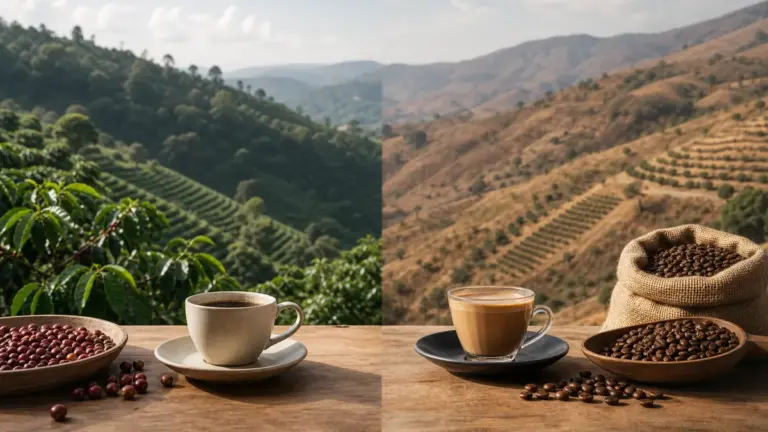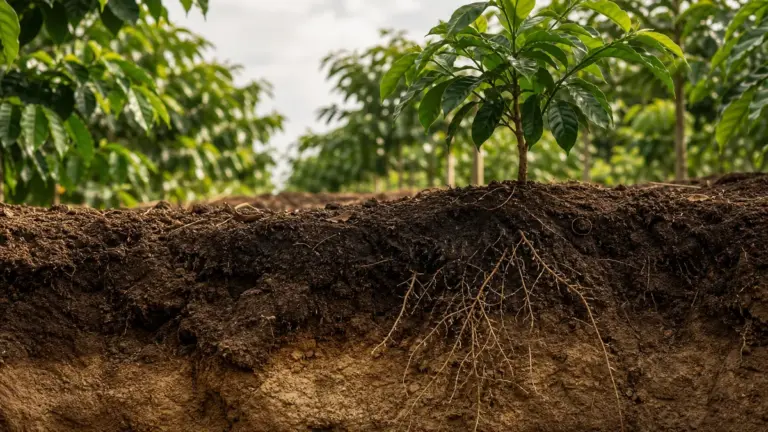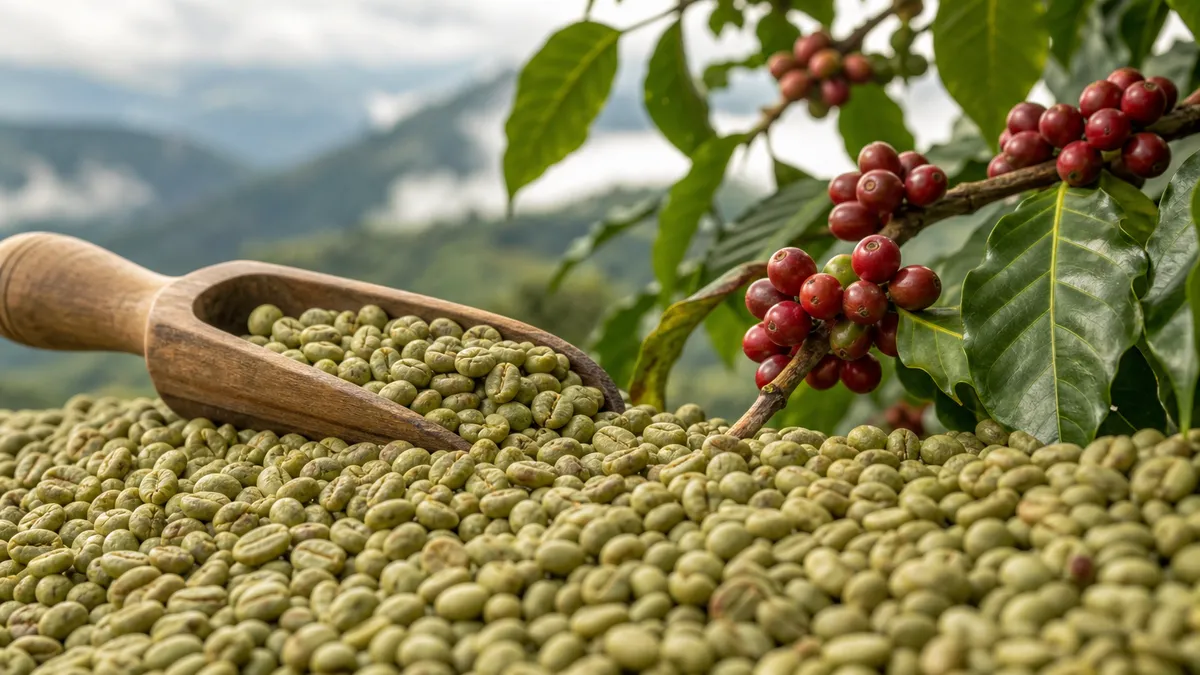
Altitude and temperature affect coffee mainly by changing how quickly its fruit develops: cooler growing conditions can slow ripening and support well-filled beans with desirable cup characteristics. High-grown coffee is prized for that potential, but elevation alone guarantees neither greater density nor brighter acidity nor better flavour.
In short
- Air temperature decreases with height by a global average of about 0.65°C per 100 m, but an individual mountain slope can behave differently.
- Slower maturation can support bean filling, provided the tree has enough water, nutrients and light.
- Latitude changes what “high-grown” means: the same elevation is not an equivalent growing environment everywhere.
- SHB means Strictly Hard Bean. In Guatemala, Anacafé places this altitude-based grade above 1,370 m.
- Climate warming can shift suitable growing conditions uphill, but relocation is not a simple or universally available solution.
Why altitude and temperature belong together
An altitude printed on a coffee bag is a clue about growing conditions, not a quality score. Its usefulness comes largely from the relationship between elevation and temperature, alongside changes in moisture, exposure and other environmental conditions.
Much of the evidence discussed here concerns arabica, Coffea arabica. It should not be treated as an identical set of rules for every coffee species or variety.
Think of altitude as a proxy: an easily recorded measurement standing in for conditions that are harder to describe on a label. Two farms at the same elevation can differ in shade, rainfall, slope exposure and the temperatures their fruit actually experiences. Those differences help explain why their coffees need not taste alike.
Our coffee terroir guide places elevation within the wider growing environment. Here, the useful question is narrower: what does height tell us about temperature and bean development, and where does that explanation stop working?
How much does temperature fall with altitude?
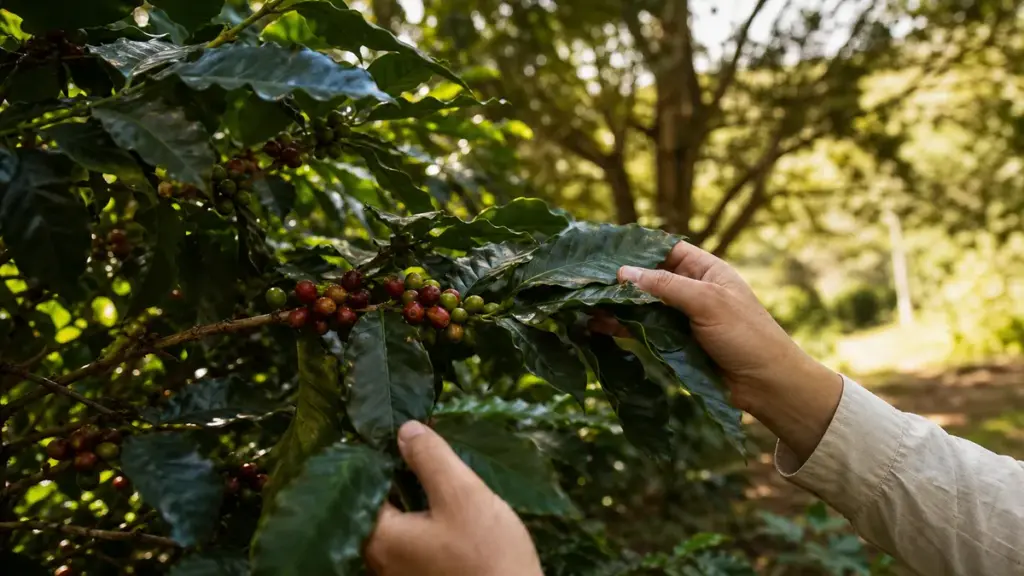
The environmental lapse rate describes how air temperature changes with height. NOAA gives a global average decrease of 6.5°C per kilometre, equivalent to 0.65°C per 100 m. The often-used approximation of about 0.6°C to 0.65°C per 100 m is therefore a useful starting point, not a farm-specific forecast.
For an illustrative calculation, a rise of 500 m would correspond to:
500 m ÷ 100 m × 0.65°C = 3.25°C cooler.
That calculation assumes the average rate applies throughout the height difference. It does not establish the temperature difference between two actual farms.
There is also a distinction between air temperature in the wider atmosphere and the conditions around a coffee cherry. Shade and exposure can alter the plant’s immediate environment. A shaded tree and a sun-exposed tree on the same hillside do not necessarily experience the same fruit temperatures.
This is why a precise elevation should not create false precision about ripening conditions. Local measurements are more informative than simply subtracting a standard temperature allowance for every uphill step.
Slower maturation and bean density
What slower development can offer
Cooler conditions can lengthen the period during which coffee fruit and seeds develop. That can give the plant more time to supply material to the growing beans, supporting fuller development before harvest.
The qualification matters: more time helps only if the tree can use it. Water shortage, inadequate nutrition or an excessive fruit load can constrain the resources available to each bean. Slow development is not automatically good development.
Research combining altitude comparisons with experiments on shade, nitrogen and fruit thinning supports this resource-based explanation. Better cup quality was associated with conditions that allowed both sufficient maturation time and an adequate supply of resources to developing beans.
The helpful mental model is not “mountain air makes better coffee”. It is “a suitable temperature can give a properly supported plant time to develop its seeds well”.
Density is not the same as size
Bean density describes mass relative to volume. A larger bean is therefore not necessarily a denser bean, and neither measurement independently establishes how good the coffee will taste.
A study in south-western Ethiopia found that highland coffees had greater bean density, while lower-elevation coffees had larger bean volumes and heavier individual beans on average. That is a useful correction to the idea that high-grown beans must always be bigger and heavier.
The same research found interactions between growing conditions, production systems and processing. Elevation mattered, but it did not act alone.
Density should consequently be treated as one physical characteristic, not a substitute for tasting. The conditions that produce a dense seed and those that produce a desirable drink overlap, but they are not interchangeable definitions of quality.
Why latitude changes the meaning of high-grown
Latitude is distance north or south of the equator. World Coffee Research explicitly adjusts its altitude guidance by latitude: farms near the equator generally require greater elevation to reach the catalogue’s equivalent altitude categories.
Its arabica catalogue uses the following bands. These are agronomic categories for interpreting variety suitability, not universal quality grades or guaranteed temperature ranges.
| Latitude band | Low altitude | Medium altitude | High altitude |
|---|---|---|---|
| 5°N to 5°S | 1,000 to 1,200 m | 1,200 to 1,600 m | Above 1,600 m |
| 5° to 15° north or south | 700 to 900 m | 900 to 1,300 m | Above 1,300 m |
| Beyond 15° north or south | 400 to 700 m | 700 to 1,000 m | Above 1,000 m |
The practical lesson is that a coffee grown around 1,000 m farther from the equator should not automatically be dismissed as having a warmer growing environment than every equatorial coffee grown higher up.
However, these bands do not prove that two named farms at different latitudes have matching maturation temperatures. That comparison would require local weather records covering the relevant fruit-development period. Latitude helps explain altitude; it does not provide a reliable farm-to-farm conversion formula.
For buyers, this makes comparisons within a region more useful than a worldwide ranking by metres alone. Broader seasonal and regional differences belong in climate variations.
Does higher altitude mean better flavour?
Higher elevation can be associated with improved sensory quality, but “higher means better” is too simple.
Research from different growing environments reports differing changes in coffee chemistry and acidity with elevation. Variety, shade and management help explain those differences. A chemical compound increasing in one study and decreasing in another is not necessarily evidence that one study is wrong: the plants and surrounding conditions may differ.
A useful exception concerns shade. Cooling and reduced exposure may help coffee in a warm environment, yet additional shade at an already cool, high-elevation site may not improve quality. The balance between light, temperature and the resources available to the fruit matters more than maximising any single variable.
There is supporting evidence beyond air temperature, too. An observational study of Ethiopian farms found associations between soil temperature, soil chemistry and bean quality. Because these conditions varied together, it cannot establish that altitude alone caused the differences.
High elevation is therefore a promising part of a growing environment, not protection against every other limitation. Nor should a lower-grown coffee be rejected before its actual characteristics are considered.
For the wider sensory discussion, see impact on flavour profiles. The separate guide to soil composition explains another part of the growing environment without turning it into a competing single-factor answer.
What SHB grading actually tells you
SHB stands for Strictly Hard Bean, an altitude-linked coffee classification used in Guatemala. Anacafé’s published chart places SHB above 1,370 m above sea level.
The name reflects the association between higher, cooler growing conditions and harder, denser beans. However, an SHB label is not the result of a universal test proving that every bean has a particular density or that the lot will achieve a particular tasting score.
Keep the altitude classification separate from the coffee’s other information. It does not, by itself, describe the variety, processing method or complete sensory character.
When comparing bags, use this short sequence:
- Locate the origin. Interpret elevation within its geographical setting.
- Read the grade in context. For Guatemalan SHB, use Anacafé’s classification rather than assuming a worldwide threshold.
- Check the rest of the description. Look for variety, processing and tasting information.
- Choose for the cup you want. Do not let the largest altitude figure make the decision for you.
Climate change and the pressure to move uphill
The same relationship that makes elevation useful also makes it relevant to climate adaptation. As temperatures rise, conditions suitable for coffee can shift towards higher elevations.
Research led by Kew scientists modelled future suitability for Ethiopian coffee farming using climate scenarios, remote sensing and field verification. It identified both threatened areas and opportunities for adaptation, including relocation combined with forest conservation or re-establishment.
These are modelled possibilities, not a prediction that every farm will move uphill. Land that becomes climatically suitable is not automatically available or appropriate for cultivation. Higher sites may be steep, remote, occupied by other crops or environmentally sensitive.
Moving cultivation can also create pressure on forests. A response intended to preserve coffee production should not be presented as environmentally beneficial simply because it involves a cooler location.
Adaptation at existing farms matters as well. Managing shade can modify growing conditions, although its effects depend on the site and the balance between cooling, light and competition for resources. There is no single shade prescription that can replace local agronomic judgement.
The deeper lesson is that altitude is fixed, but the climate associated with it is not. A familiar elevation cannot guarantee familiar growing conditions indefinitely.
FAQ
Can I compare two coffees by tasting a lower-grown and a higher-grown lot?
Yes, but that comparison cannot isolate altitude unless the other important variables are controlled. Different varieties, growing conditions and processing can all affect the result. As a learning exercise, ask a roaster for closely comparable lots from the same region, then treat any difference as an observation rather than proof that elevation caused it.
Does the altitude on a bag tell me the coffee’s caffeine content?
No, altitude alone is not a dependable caffeine guide. Research reports differing relationships between elevation and bean chemistry across growing conditions. An elevation figure is not a caffeine measurement, so it should not be used to choose a supposedly lower-caffeine drink or estimate the caffeine in a serving.
Should I ignore altitude when choosing coffee for an office?
No, but use it as background rather than a selection rule. A useful approach is to shortlist coffees by their stated flavour characteristics and compare them in the workplace’s normal preparation. Altitude and temperature help explain how a coffee developed; they cannot replace deciding whether the finished drink suits the people drinking it.
Where to go next
Read Coffee Terroir Explained for the wider relationship between place and coffee character, then Impact on Flavour Profiles for the sensory side. Climate Variations explains why altitude and temperature need to be understood alongside the broader climate.
Sources
-
NOAA, JetStream: Weather Glossary, Lapse Rate, undated, current online version. Definition and global average lapse rate.
https://www.noaa.gov/jetstream/appendix/weather-glossary-l -
World Coffee Research, Arabica Varieties Catalog: Nayarita, undated, current online version, “Optimal Altitude” explanatory bands.
https://varieties.worldcoffeeresearch.org/varieties/nayarita -
Bote, A. D. and Vos, J., Tree management and environmental conditions affect coffee (Coffea arabica L.) bean quality, NJAS: Wageningen Journal of Life Sciences, volume 83, 2017.
https://www.tandfonline.com/doi/pdf/10.1016/j.njas.2017.09.002 -
Worku, M., Astatkie, T. and Boeckx, P., Effect of growing conditions and postharvest processing on arabica coffee bean physical quality features and defects, Heliyon, volume 8, article e09201, 2022.
https://pmc.ncbi.nlm.nih.gov/articles/PMC8991259/ -
Cassamo, C. T. et al., Shade and Altitude Implications on the Physical and Chemical Attributes of Green Coffee Beans from Gorongosa Mountain, Mozambique, Agronomy, volume 12, article 2540, 2022.
https://horizon.documentation.ird.fr/exl-doc/pleins_textes/2022-12/010086414.pdf -
Getachew, M. et al., The relationship between elevation, soil temperatures, soil chemical characteristics, and green coffee bean quality and biochemistry in southwest Ethiopia, Agronomy for Sustainable Development, volume 42, article 61, 2022.
https://www.plantmicrobeinsect.com/wp-content/uploads/Getachew-et-al_2022_Agronomy-for-sustainable-development-1.pdf -
Anacafé, Guatemalan National Coffee Association, Coffee Types, undated, including its altitude classification graphic.
https://www.guatemalancoffees.com/main/coffee-types/
https://www.guatemalancoffees.com/media/1095/types_altitudes.png -
Moat, J. et al., Royal Botanic Gardens, Kew and collaborating institutions, Resilience potential of the Ethiopian coffee sector under climate change, Nature Plants, 2017, PubMed abstract.
https://pubmed.ncbi.nlm.nih.gov/28628132/
This article was researched using meteorological guidance, the World Coffee Research catalogue, Anacafé’s published grading chart and peer-reviewed agronomic research, distinguishing field associations from experimental findings and climate projections.
Last checked: November 2026