Q Grader certification is a professional credential for people who evaluate and communicate coffee quality. The Specialty Coffee Association (SCA) now awards the licence through a six-day course built around its Coffee Value Assessment (CVA), with nine assessments that candidates must pass. It is intended for experienced tasters, rather than beginners looking for their first coffee qualification.
In short
- The SCA took over operation of the programme from the Coffee Quality Institute (CQI) on 1 October 2025.
- The current course has eight practical assessments and one written examination.
- CVA separates physical characteristics, sensory description, impressions of quality and information such as origin and processing.
- The licence lasts three years, with renewal through continuing professional development.
- Older accounts of 19 or 20 examinations and compulsory CQI calibration courses describe the historical system, not the current qualification.
What does a Q Grader do?
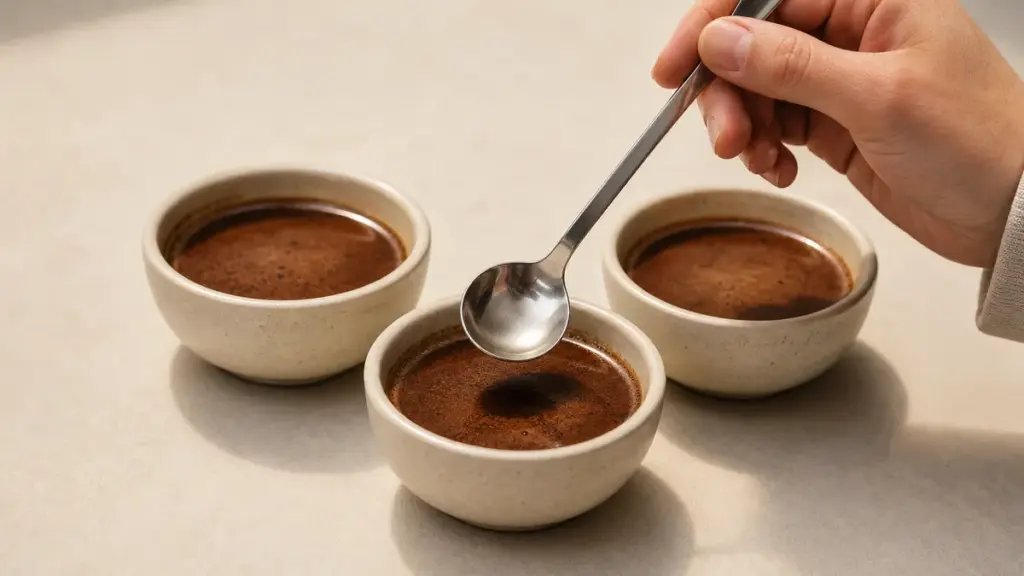
A Q Grader evaluates coffee using standardised procedures and a shared vocabulary. The work combines tasting with disciplined observation and recording: describing aromas, assessing sensory characteristics and examining green coffee, meaning beans before roasting.
These skills support sourcing, roasting and quality-control work. A buyer needs to communicate what distinguishes one sample from another; a quality team needs descriptions that colleagues can understand and use. The useful skill is not simply noticing something unusual, but recording it consistently.
The qualification is therefore more specific than being “good at coffee”. It assesses coffee evaluation, not espresso service, milk steaming or the management of a café. For the wider choice of learning routes, start with coffee education.
Nor does a Q Grader’s judgement replace your own taste. Under CVA, describing what a coffee is like and judging its quality are separate tasks. A strong fruity character can be recorded without assuming that every customer wants it.
What changed in October 2025?
The central change was both organisational and technical. From 1 October 2025, the SCA became responsible for operating the evolved Q Grader programme, replacing CQI as its administrator and aligning the qualification with CVA.
The historical CQI course also ran over six days, commonly divided into training followed by examinations. Its Arabica pathway used the 2004 cupping form and its 100-point scoring approach.
References to both 19 and 20 examinations have a documentary basis. CQI’s 2022 programme guide describes 19 examinations across nine modules; its course description updated in January 2023 describes 20. These are historical versions, not competing descriptions of today’s nine-assessment course.
Legacy testing included sensory and olfactory skills, triangulation, green and roasted coffee grading, and sample-roast identification. Those capabilities remain relevant, but candidates should not use an old examination checklist as their current syllabus.
What happened to existing Q Graders?
The transition did not immediately invalidate existing CQI certificates: they remained valid until their stated expiry dates. Eligible current and lapsed Q Graders could fast-track to the evolved licence by completing the two-day CVA for Cuppers course by 31 December 2025.
That was a transitional deadline, not a standing shortcut for new applicants in November 2026. A holder who missed it should ask the SCA to confirm their individual route rather than rely on an old announcement.
What the Coffee Value Assessment measures
CVA brings together four complementary assessments. Their separation matters because a coffee’s physical condition, flavour and appeal are related, but they are not interchangeable.
- Physical: records characteristics such as defects, moisture, size and colour.
- Descriptive: records the sensory experience, including aroma, flavour, texture and aftertaste.
- Affective: captures an impression of quality, from the evaluator’s perspective or that of a particular market.
- Extrinsic: records information beyond the cup, including traceability, certifications and processing information.
For example, “strong citrus character” is a description. “This citrus character is desirable for our customers” is an evaluative judgement. Keeping those statements separate makes the reasoning easier to examine.
Likewise, traceable origin information belongs in a different part of the assessment from the coffee’s aroma. CVA allows these different attributes to contribute to a fuller account of value without pretending they are all sensory measurements.
What are the current Q Grader examinations?
The current programme runs over six consecutive days and includes eight practical assessments and one written examination. Every assessment must be passed.
The table below is an orientation to the assessment areas, not a substitute for the instructor’s current examination instructions.
| Assessment | What it examines |
|---|---|
| Cupping Skills | Professional conduct during cupping activities |
| Physical Assessment | Performing the CVA green coffee assessment |
| Roasting Problems | Recognising a suitable cupping roast through smell and taste |
| Descriptive Assessment | Accurate sensory description and form use |
| Affective Assessment | Correct form use and consistency of evaluation |
| Olfactory Category Examples | Recognising and describing smells |
| Triangulation | Detecting the different coffee in a group |
| Main Taste Solutions | Identifying tastes and their intensities |
| Written examination | CVA knowledge and cupping procedures |
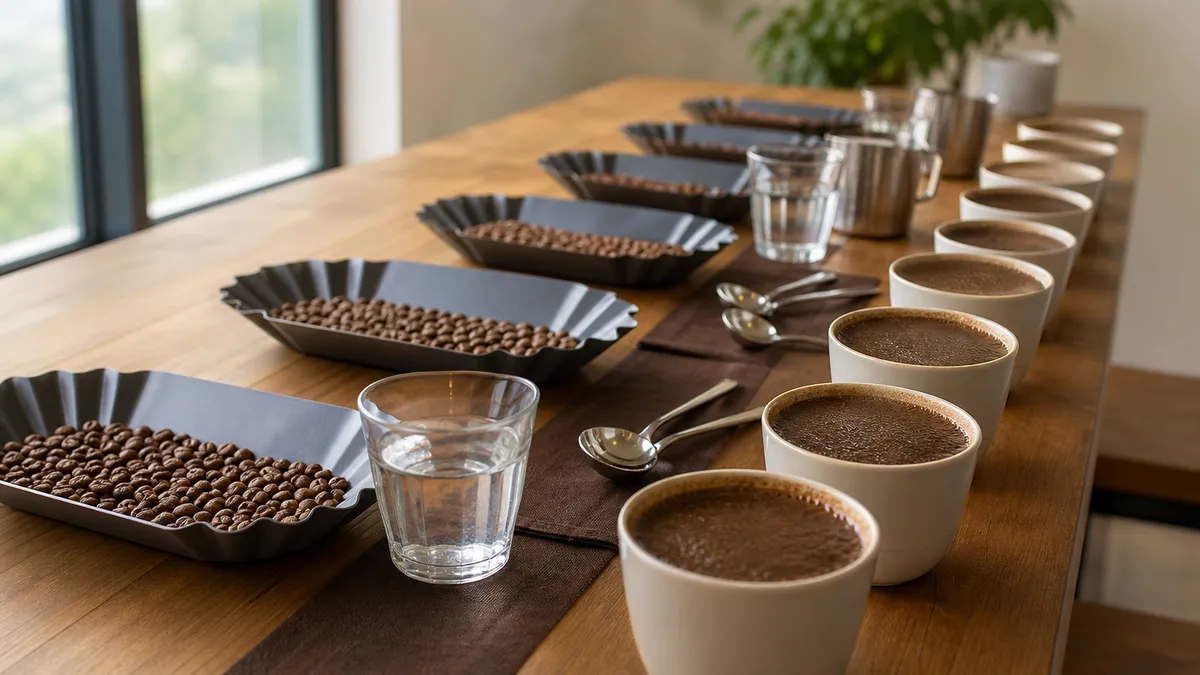
Olfactory means relating to smell. Triangulation is an odd-one-out exercise: three samples are presented, two are the same and one differs.
Green grading remains a distinct practical assessment. The current roasted-coffee assessment is named Roasting Problems, so it should not be presented as the old stand-alone roasted grading examination under a new title. Its preparation guidance includes comparisons with roasts that are too light, too dark, too fast or too slow.
The SCA allows two attempts at each assessment during the course. Its current guidance also provides for a third attempt at individual practical examinations after the course from 2026. Confirm eligibility and arrangements with the instructor before booking.
How to prepare for Q Grader certification
Treat the course as a place to demonstrate and refine existing skills, not as the first opportunity to acquire them. The SCA’s readiness guidance emphasises cupping experience, sensory ability and familiarity with CVA.
A practical preparation sequence is:
- Establish a cupping routine. Practise tasting and recording observations before discussing them with others. Use our cupping and flavour wheel guide for an introduction, then work from the current SCA procedures.
- Practise using the CVA forms. Complete the different assessments rather than concentrating only on a final quality judgement. Aim to understand what belongs in each form.
- Build a shared aroma vocabulary. Use the SCA Olfactory Example Library, which provides vetted examples corresponding to descriptors on the Descriptive Form. Some references use supermarket products, so preparation need not revolve around a proprietary aroma kit.
- Include green coffee and roast comparisons. Ask a suitable training provider or workplace laboratory for guided practice. Do not leave physical assessment until the examination week.
- Arrange blind discrimination practice. Ask a colleague to prepare samples without revealing their identity. Record the decision before receiving feedback.
- Review weaknesses with an instructor. Ask for a readiness assessment and targeted exercises rather than assuming that more unguided tasting will address every gap.
World Coffee Research’s Sensory Lexicon provides reference materials for describing attributes and measuring their intensity. Use references to clarify what a descriptor means, not merely to memorise a list of impressive-sounding words.
The SCA also identifies Sensory Skills and Green Coffee courses as useful preparation, alongside CVA for Cuppers for experienced tasters. A broader SCA diploma pathway is a separate learning choice, not something to confuse with the Q licence itself.
What to include when planning the commitment
Ask each provider for an itemised written quotation. It should distinguish tuition, assessment and registration arrangements, learning materials, practice access and any subsequent retake arrangements. Confirm what is included, what is optional and the VAT treatment of the quotation.
Add your own travel, accommodation where necessary, preparation materials and time away from work. Six consecutive course days are only part of the commitment if you also need guided practice beforehand.
For an employer supporting a candidate, agree what happens afterwards. Useful questions include whether the employee will have access to regular cupping, suitable samples and colleagues with whom to compare results. The practical return should be better evaluation work, rather than a credential that rarely gets used.
Calibration, renewal and recertification
These terms are easily confused because historical and current programme information remain available online.
Calibration as a working practice means aligning understanding and evaluation with shared references and other tasters. It is about making observations interpretable, not forcing everyone to have identical preferences.
Under the legacy CQI system, renewal involved an in-person calibration course every third year. The January 2023 description required candidates to pass at least two of three coffee flights, meaning groups of samples. CQI also had a separate recertification pathway for certain lapsed graders.
Under the current SCA system, the licence lasts three years and renewal requires continuing professional development, or CPD. Retaking the full six-day course is not required. The SCA’s transition FAQ explicitly states that a separate calibration is not required for renewal.
This distinction corrects a misleading shorthand: sensory calibration remains useful professional practice, but the old CQI calibration examination is not the stated renewal mechanism for the evolved licence.
As checked in November 2026, the current public overview confirms CPD-based renewal but does not set out a detailed points or hours schedule. Ask the SCA which activities and records it currently accepts. Keep evidence of relevant learning, but do not assume that an activity automatically qualifies.
If your licence has expired, obtain instructions for your specific status. Historical CQI recertification deadlines should not be applied automatically to an SCA licence.
Is the qualification right for you?
Q Grader certification makes most sense when coffee evaluation is already part of your work, or a clear next step towards it. Before enrolling, ask yourself: can I describe coffees independently, use the current forms and explain the difference between an observation and a preference?
Our recommendation is to prioritise guided sensory practice if those tasks are still unfamiliar. You can be deeply interested in coffee without needing this particular credential. For an experienced evaluator, however, the course offers a structured way to demonstrate competence and identify weaknesses worth working on.
FAQ
Does passing qualify me to teach Q Grader courses?
No, a Q Grader licence does not automatically make you a Q Instructor. The SCA treats teaching as a separate authorisation route with additional requirements. If teaching is your goal, check the current instructor pathway before choosing courses, and do not assume that assessment experience alone grants permission to deliver the programme.
Can someone who qualified through CQI still have a valid certificate?
Yes, an existing CQI certificate can remain valid until its stated expiry date. The transition did not cancel every certificate on 1 October 2025. However, an unexpired legacy certificate and an evolved SCA licence are not identical records, so check the issuing organisation, expiry and any completed transition requirements.
Can I start preparing without an aroma kit?
Yes, useful aroma preparation can begin without a proprietary kit. The SCA’s Olfactory Example Library includes vetted references using readily available products alongside more specialised materials. Follow its preparation instructions and practise recognising categories blind, rather than assuming that familiarity with one set of numbered vials is the qualification’s objective.
Where to go next
Read How to Taste Coffee: Cupping and the Flavour Wheel to build a practical tasting routine, then How to Become a Barista, Roaster or Q Grader to place Q Grader certification within a career plan. SCA Coffee Diploma explains the broader qualification route if you want to develop skills beyond coffee evaluation.
Sources
-
Specialty Coffee Association, “Q Grader”, current programme overview, undated. Course duration, assessment count, licence validity, retakes and renewal.
https://sca.coffee/education/q-grader -
Specialty Coffee Association, “How to Prepare for the Q Grader Course”, undated. Current assessment names, scope and preparation guidance.
https://sca.coffee/education/how-to-prepare -
Specialty Coffee Association, “Coffee Value Assessment”, current overview, undated. The four assessment types and their purposes.
https://sca.coffee/value-assessment -
Specialty Coffee Association and Coffee Quality Institute, partnership announcement, April 2025. Operational transition and the historical fast-track deadline.
https://sca.coffee/sca-news/2025/4/22/the-specialty-coffee-association-and-the-coffee-quality-institute-announce-historic-partnership-to-provide-better-support-and-education-to-the-coffee-industrynbsp-ng7ff -
Specialty Coffee Association Korea Chapter, “Q Grader”, transition FAQ, 2025. Existing certificate validity, the two-day transitional course, separate instructor authorisation and CPD renewal without a separate calibration requirement.
https://korea.sca.coffee/q-grader -
Coffee Quality Institute, Quality Evaluation Program Guidebook, version 5, September 2022. Historical 19-examination structure and recertification pathway.
https://database.coffeeinstitute.org/api/s3proxy/get/coffee/files/18fh3k7z40/QE%20Program%20Guidebook%20v5%2020220901.pdf -
Coffee Quality Institute, “How the Q Combo and calibrations work at CQI”, updated 17 January 2023. Historical 20-examination course and three-year calibration arrangements.
https://www.coffeeinstitute.org/page/q-grader-exams-and-calibrations -
Specialty Coffee Association, Coffee Value Assessment: A System to Assess Coffee Value, June 2024 revision. Background to the 2004 scoring system and the separation of different attributes of value.
-
Specialty Coffee Association, “Olfactory Examples”, undated. Vetted aroma references and preparation instructions.
https://sca.coffee/value-assessment/olfactory-examples -
World Coffee Research, “Sensory Lexicon”, version 2.0, 2017, accompanying resource page. Sensory attributes and intensity references.
https://worldcoffeeresearch.org/resources/sensory-lexicon
This article was researched from retrieved SCA, CQI and World Coffee Research materials, separating current programme requirements from dated historical guidance.
Last checked: November 2026