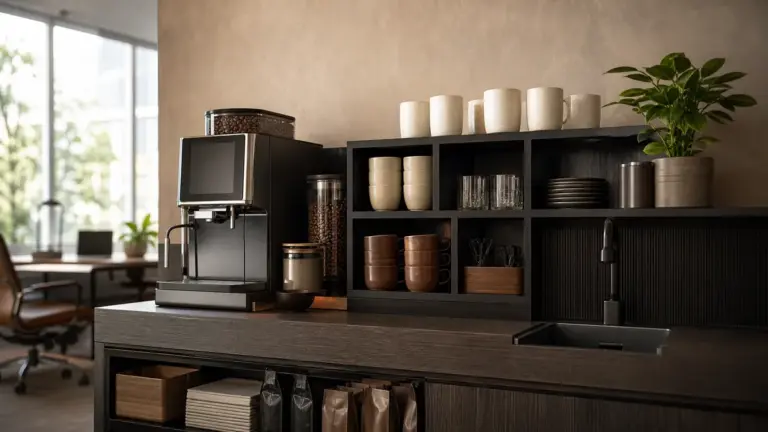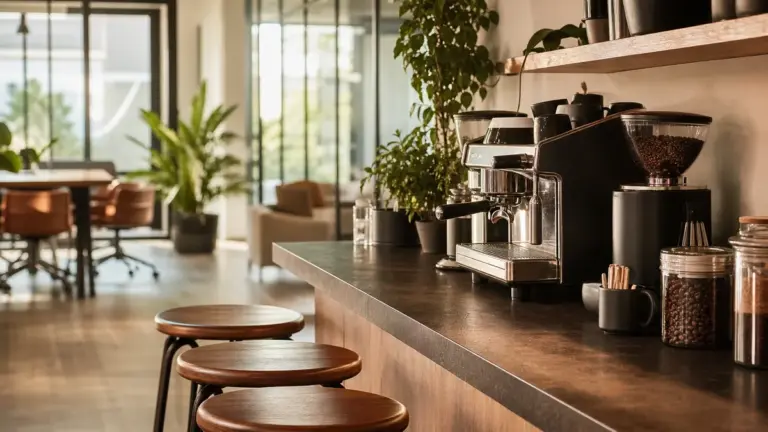
Good office coffee for clients and visitors should be pleasant to drink, straightforward to order and served without disrupting the visit. Offer a small, dependable choice of black and milk-based coffee, a decaffeinated option, tea and water, with clear ingredient information and someone responsible for the service.
In short
- Choose the service around arrivals and meeting breaks, not just the office headcount.
- Keep the menu short enough for reception staff and meeting hosts to manage confidently.
- Ask about milk preferences and allergies before preparing drinks, rather than guessing.
- Where drinks are supplied by a food business, allergen information requirements also cover complimentary drinks.
- Compare the whole service, including preparation, cleaning, ingredients, equipment and waste, using itemised written quotations.
What coffee should a business offer visitors?
Our suggested starting menu is black coffee, a milk-based coffee and decaffeinated coffee, alongside tea and drinking water. Add further drinks only when there is demand and the team can prepare them consistently.
For black coffee, that might mean filter coffee or an americano, espresso diluted with hot water. For the milk-based choice, a straightforward white coffee or cappuccino is sufficient; reception does not need to offer every variation found on a coffee-shop menu.
Choose the coffee through a small internal tasting rather than relying on packaging descriptions. A chocolatey or nutty profile is a useful candidate to try, but this is an editorial preference, not a guarantee that every visitor will like it. Taste the actual drinks you intend to serve, both black and with your chosen milks.
Set a simple acceptance standard: a clean cup, the correct order, a pleasant aroma and no obvious stale, harsh or watery character. Do not assume that an elaborate machine makes the service better if nobody has time to replenish or clean it.
The wider arrangements for staff and shared facilities belong in coffee in the workplace. Here, the priority is making a visitor feel comfortably looked after.
Choose a reception set-up that someone can manage
Decide who will make the drinks before choosing where the machine goes. A receptionist handling arrivals, telephone calls and security checks needs a service that can pause safely, not another queue to supervise.
The following comparison uses staffing, visitor involvement and meeting flow as its criteria. These are suggested arrangements, not equipment performance claims.
| Reception arrangement | Who it suits | Main advantage | What needs managing |
|---|---|---|---|
| Host-prepared drinks from a nearby tea point | Occasional appointments | Personal service without equipment in reception | Cover when the receptionist is busy |
| Assisted self-service bean-to-cup machine | Regular arrivals throughout the day | Visitors can choose their drink with help available | Clear controls, accessibility, replenishment and cleaning |
| Tray service from a hospitality area | Scheduled client meetings | Drinks can be coordinated with the meeting | Orders, preparation sequence and safe transport |
| Filter coffee in a suitable insulated server | Group arrivals or planned breaks | A shared black-coffee service | Batch size, preparation timing and separate milk service |
For self-service, walk through the process as a first-time visitor. Can someone find the cups, understand the choices and reach everything without moving furniture? Provide an assisted alternative rather than making self-service the only route.
Keep used cups and waste away from the clean serving area. Put preparation equipment outside the meeting room where practical, and check its noise during a demonstration.
For the detailed layout, see office coffee station design.
Make meeting room service unobtrusive
Ask for preferences when the meeting is arranged, then confirm them on arrival. A useful question is: “Would you prefer coffee, decaf, tea or water, and is there any milk preference or allergy we should know about?”
Avoid treating every milk request as an allergy declaration. Record the requested drink accurately, then clarify any safety requirement before preparation.
Use this service sequence:
- Confirm the orders. Identify who wants each drink and pass any allergy information directly to the person preparing it.
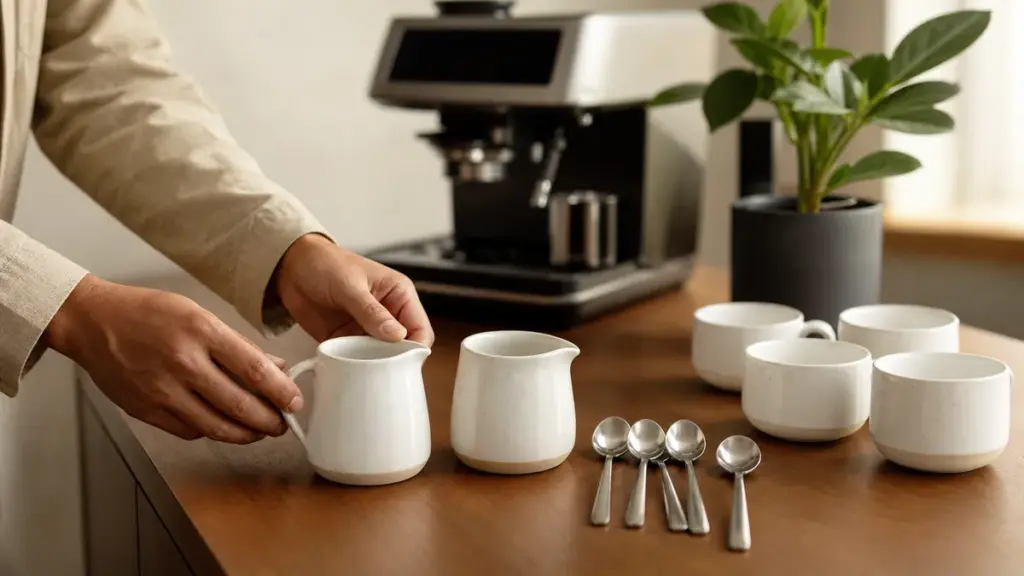
- Prepare the room. Set out clean cups, water, spoons and a stable place for the tray, clear of papers and electrical equipment.
- Prepare drinks close to service. Plan the sequence so the first drink is not left waiting while the rest are made.
- Check the tray. Confirm the drinks, milk choices and any accompanying food against the orders.
- Serve without reaching across guests. Identify each drink as it is handed over, especially when different milks have been requested.
- Agree the next break. Offer a refill at a natural pause rather than repeatedly interrupting the conversation.
For larger meetings, consider serving black coffee with milk separately, provided that this suits the guests and the allergen arrangements. If individually prepared drinks are preferred, arrange enough preparation time or assistance.
Have a backup procedure for equipment failure. It should preserve choice and ingredient checks, rather than sending someone out to improvise while guests wait.
Use cups and presentation to support the service
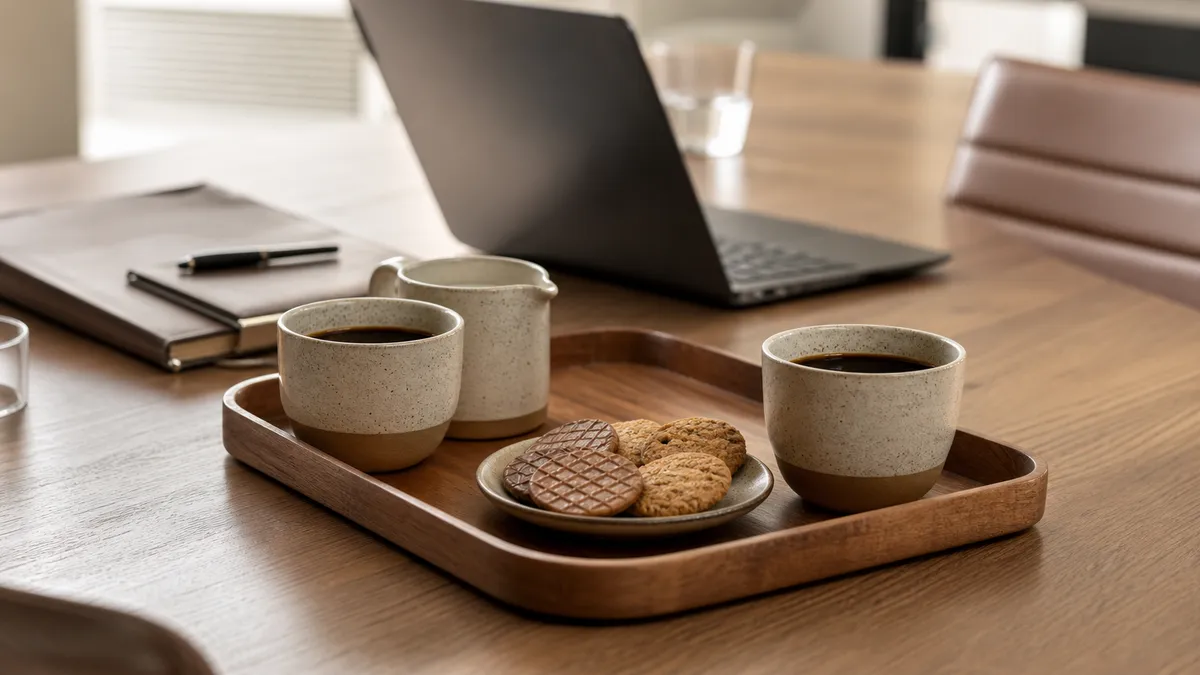
Our recommendation for seated client meetings is plain, matching reusable cups, with saucers where useful. They provide a consistent presentation without turning the table into a display.
Check that the cup fits both the selected drink and the machine outlet. Before committing to crockery, ask the supplier to demonstrate the intended drink in the intended cup, leaving enough room for safe handling and any separately added milk.
Offer an alternative cup where a guest finds a small handle awkward. Presentation should accommodate the person, not oblige them to use something uncomfortable.
Keep trays uncluttered. A clean spoon, the requested milk and an optional biscuit are enough. Present biscuits separately from cup rims and retain their ingredient information, even when they are decanted from a larger packet.
Reusable cups still need washing, storage and collection arrangements. For the broader environmental decisions, including washing and waste routes, use sustainable office coffee rather than assuming that one cup material is always preferable.
Provide dietary choice and reliable allergen information
Offer a dairy milk and a clearly identified plant-based alternative, then adapt the selection to known requirements. Do not describe an unspecified jug simply as “alternative milk”.
Check the exact product labels. Milk, soya, tree nuts such as almonds, and cereals containing gluten such as oats are among the allergens requiring declaration when used as ingredients. Check biscuits, chocolate powders, syrups and toppings too.
When allergen duties apply
Where the business supplies drinks as a food business, mandatory allergen information must be accurate and accessible, including when the drinks are complimentary. Do not assume that providing coffee without charge creates an exemption.
Equally, this does not establish that every office offering an occasional drink must register as a food business. Ask the local authority to confirm how your particular hospitality operation is treated.
For England, Wales and Northern Ireland, FSA best practice for non-prepacked food and drinks is written allergen information supported by a conversation. This recommendation is distinct from the legal requirement to provide the information. In Scotland, consult Food Standards Scotland and the local authority.
Keep preference and safety separate
“Vegan” does not guarantee freedom from milk allergens. Nor should staff promise that changing the milk makes a shared preparation system allergen-free.
Allergens can pass between ingredients through equipment, utensils and surfaces. Assess the actual preparation route, including shared milk equipment, and use effective cleaning or separate equipment as appropriate. If you cannot control cross-contact, explain that before preparing the drink.
Keep current packaging or supplier specifications available. Update the written information whenever a product changes, and make sure a substitute carton is checked before it enters service.
Give hygiene a named owner
Reception hospitality needs a cleaning schedule, not an assumption that somebody will notice a dirty tray. Name a primary owner and a deputy, covering preparation surfaces, touch points, utensils, crockery and waste.
Food-business cleaning guidance calls for a schedule identifying what is cleaned or disinfected, how often and with which products. Apply the machine manufacturer’s instructions to its cleaning processes rather than inventing a universal routine.
For chilled milk, follow the packaging’s storage and use instructions. Set the fridge to 5°C or below, the recommended operating setting in government business guidance, and check its temperature rather than relying on the control dial alone.
Bring out only the milk needed for the service and replenish with a clean jug. As a house rule, do not combine leftover meeting-room milk with fresh stock.
Before each visitor session, check that:
- clean cups and utensils are ready;
- ingredient information matches the products in use;
- milk is stored correctly;
- preparation surfaces and equipment are ready for service;
- used crockery and waste have been removed.
Assign closing checks too, so the next morning’s receptionist does not inherit the previous meeting’s tray.
Plan capacity around the busiest arrival
Headcount is only a starting point. Include staff use if visitors share the same equipment, then examine how many drinks will be requested together.
These are illustrative planning scenarios, not demand forecasts or recommended machine capacities. Each assumes two drinks per staff member per day and one per visitor; the peak requests are separate hypothetical assumptions.
| Staff headcount | Visitors per day | Total drinks per day | Assumed requests within 10 minutes |
|---|---|---|---|
| 10 | 6 | 26 | 6 |
| 40 | 12 | 92 | 12 |
| 100 | 30 | 230 | 20 |
Ask suppliers to demonstrate your expected peak order, including milk drinks, using your cups. Record the time to complete the whole order, not just the time taken to dispense one black coffee.
Also check what happens when water, beans or milk need replenishing, or a cleaning process is due. Treat published capacities as manufacturer claims until the supplier has shown how the proposed arrangement meets your service pattern.
Understand the full cost without overlooking the work
Build the comparison around the same service assumptions for every supplier. Specify staff and visitor drinks separately, the drink mix, operating days, peak demand, coffee dose and milk quantities.
Request itemised written quotations covering equipment, installation, water treatment, servicing, cleaning materials, ingredients, crockery and any contractual commitments. Add your own preparation, washing-up, replenishment and waste-handling work.
To calculate your workplace’s cost per cup:
- Choose a common comparison period.
- Add the equipment commitment and operating expenses for that period.
- Include staff time using your organisation’s own employment figures.
- Include wasted ingredients and cleaning consumption.
- Divide by drinks actually served, excluding rinse water and discarded drinks.
Keep the VAT basis consistent and state it in the comparison. HMRC distinguishes coffee and milk bought as food, generally zero-rated, from drinks supplied in the course of catering, generally standard-rated. Do not infer the tax treatment of complimentary client hospitality from those product rules alone; ask your finance team to check the arrangement.
The final test for office coffee for clients and visitors is a complete rehearsal: take the orders, prepare them, deliver them and clear away. Judge the service as well as the drink.
FAQ
Should important clients receive different coffee from other visitors?
Usually, there is no need for a separate coffee tier. Our recommendation is to make the normal service good enough for any guest, then adjust the hospitality to the occasion. A longer meeting may justify coordinated tray service or a planned break, rather than a different bag of beans.
Is instant coffee acceptable as a backup?
Yes, instant coffee can be a practical backup if it is offered clearly and prepared with the same care as the normal service. Keep the product information available and retain the usual milk and allergy checks. The backup plan should also include an alternative when hot-drink equipment is unavailable.
How can visitors give useful feedback without an awkward survey?
Ask one specific question after the visit, such as whether the coffee was to their taste or the service arrived at a convenient point. Treat individual preferences as preferences, not proof that the whole service needs changing. Look for repeated comments before adjusting the coffee, cup size or meeting routine.
Where to go next
Read Coffee in the Workplace for the wider office arrangements, and How to Design an Office Coffee Station when planning the preparation area. Sustainable Coffee in the Office examines environmental choices, while Workplace Coffee and Employee Satisfaction considers the staff experience alongside visitor hospitality.
Sources
-
Food Standards Agency, Allergen Information for Non-Prepacked Foods Best Practice (2025). Includes complimentary provision and the distinction between requirements and recommended practice.
https://www.gov.uk/government/publications/allergen-information-for-non-prepacked-foods-best-practice/allergen-information-for-non-prepacked-foods-best-practice -
Food Standards Agency, Allergen guidance for food businesses (updated July 2026). Allergenic ingredients, vegan claims and ingredient records.
https://www.gov.uk/government/publications/allergen-guidance-for-food-businesses/allergen-guidance-for-food-businesses -
Food Standards Agency, Food business registration (updated June 2026). Scope of registration and referral to local authorities.
https://www.gov.uk/guidance/food-business-registration -
Food Standards Scotland, CookSafe Food Safety Assurance System, September 2021 compilation, “House Rules: Allergen Management”. Separation, cleaning and allergen cross-contamination controls.
https://www.foodstandards.gov.scot/downloads/CookSafe_Manual_Complete_September_2021.pdf -
GOV.UK, Food hygiene for businesses: Cleaning (undated current guidance). Cleaning schedules, equipment and personal hygiene.
https://www.gov.uk/food-hygiene-businesses/cleaning -
GOV.UK, Food hygiene for businesses: Chilling and freezing (undated current guidance). Recommended fridge setting.
https://www.gov.uk/food-hygiene-businesses/chilling-and-freezing -
HM Revenue & Customs, Food products (VAT Notice 701/14) (updated June 2026). Food ingredient VAT treatment and catering distinction.
https://www.gov.uk/guidance/food-products-and-vat-notice-70114 -
HM Revenue & Customs, Catering, takeaway food (VAT Notice 709/1) (updated June 2026). Supplies made in the course of catering.
https://www.gov.uk/guidance/catering-takeaway-food-and-vat-notice-7091
Research combined live checks of official food-safety and tax guidance with clearly identified editorial service recommendations and hypothetical planning calculations; no machine testing or visitor survey is claimed.
Last checked: November 2026