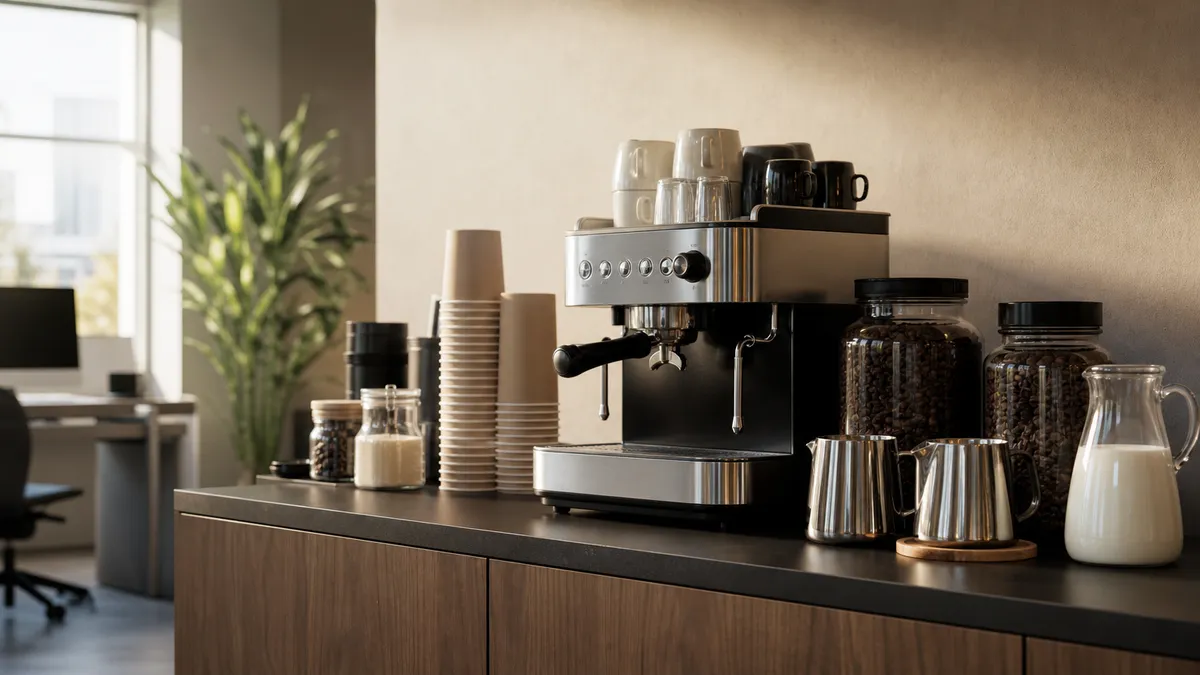
Free coffee can be a worthwhile office perk when employees enjoy it, everyone has a useful choice, and someone takes responsibility for keeping it running. The honest test for coffee stations and office perks is not whether they sound attractive in recruitment material, but whether staff value the provision enough to justify the resources it uses.
In short
- Ask employees what they want before choosing equipment or expanding the drinks menu.
- Offer worthwhile alternatives to caffeinated coffee, with fair access across shifts and locations.
- Generally available workplace refreshments can qualify for HMRC’s subsidised-meals exemption, subject to its conditions.
- Assess ingredients, equipment, maintenance, cleaning time, utilities and waste together.
- Measure satisfaction and reliability, not just how many drinks the machine dispenses.
Is free coffee a worthwhile office perk?
Our editorial view: yes, as a modest everyday benefit, not as compensation for bigger workplace problems. Good coffee deserves a place alongside other thoughtful facilities, but should not be presented as an answer to poor management, excessive workload or inadequate pay.
Consider three possible reactions. A regular coffee drinker might appreciate a pleasant drink without leaving the building. Someone who does not drink coffee might see little benefit unless tea and other alternatives receive equal attention. Another employee might regard basic refreshments as an expected facility rather than a special reward.
These are perspectives to investigate locally, not claims about how all workers think. Avoid assuming that a supplier’s employee-engagement claim describes your own workforce.
Ask what staff currently drink, what they would actually use and what frustrates them about existing provision. Include people who rarely visit the kitchen: their absence may be a choice, or it may reveal an access problem.
For the wider operational picture, start with coffee in the workplace. This article concentrates on whether the benefit is worthwhile, rather than how to build or specify the station.

What makes the benefit feel thoughtful?
Treat the perk as a service rather than an object. The decision is not finished when a machine arrives: agree who replenishes supplies, who cleans equipment and what happens during a breakdown.
Set a clear promise. That might be straightforward coffee and tea throughout working hours, with fresh milk and a dependable decaffeinated option. A short, reliable menu is a sensible starting point before adding drinks that require more ingredients and upkeep.
Keep the language proportionate. “Hot drinks are provided” describes the offer clearly; grand claims about wellbeing or collaboration need evidence beyond the existence of a coffee machine.
Nor should using the station become an obligation. Invite people to share a break, but do not make drinking coffee, joining kitchen conversations or staying on site a test of commitment. The distinction between hospitality and social pressure belongs in office coffee culture.
There is also a legal baseline to distinguish from the perk. In Great Britain, HSE guidance requires access to drinking water and somewhere to rest and eat meals. Those welfare requirements are not a requirement to provide free coffee.
Give everyone a worthwhile choice
Use a short staff survey to establish a core offer. Suggested questions include:
- Which drinks would you use regularly?
- Do you need decaffeinated or non-coffee options?
- Which milk or alternative would you actually use?
- Can you reach and operate the current facilities comfortably?
- Are supplies available during your working hours?
Consider ordinary tea, decaffeinated tea or coffee, herbal infusions and drinking water alongside coffee. Choose alternatives according to expressed demand rather than building an extensive menu that nobody has requested.
Treat allergy management separately from preference. Shared utensils and equipment can transfer allergens between products. Keep ingredient information available, assess preparation routes and use dedicated equipment where appropriate; a separate milk jug alone does not establish that the whole preparation process avoids cross-contact.
Check practical access too: controls, cup storage, carrying routes and the ability to obtain assistance without embarrassment. Include early and late shifts in replenishment arrangements, rather than stocking the station only for daytime office workers.
For hybrid teams, describe the offer honestly as an on-site facility. Ask remote staff about useful benefits for their circumstances instead of assuming an external coffee voucher has the same tax treatment as workplace drinks.
Fairness need not mean identical consumption. A useful aim is that everyone has a reasonable option, not that every employee drinks the same quantity. Wider access and shared-space considerations are covered in creating a coffee-friendly office environment.
Understand the full resource commitment
Start with attendance and likely use, not payroll headcount alone. The following matrix is an illustrative planning exercise, not a consumption benchmark or a machine-capacity recommendation.
| People attending daily | Assumed share using coffee | Assumed coffees per user daily | Calculated coffees daily |
|---|---|---|---|
| 10 | 60% | 2 | 12 |
| 30 | 60% | 2 | 36 |
| 60 | 60% | 2 | 72 |
The calculation is attending staff × participating share × drinks per participant. Replace every assumption with your own observations, record visitors separately and check demand during the busiest break.
Build an itemised assessment covering:
- Ingredients: beans or other coffee formats, tea, decaffeinated drinks, milk, alternatives and optional extras.
- Equipment: acquisition or hire arrangements, installation, water treatment and any refrigeration.
- Upkeep: servicing, replacement parts, cleaning products, filters and breakdown support.
- Workplace resources: electricity, water, washing-up, storage and waste collection.
- Staff time: ordering, deliveries, replenishment, cleaning and supplier administration.
Ask suppliers for itemised written quotations on the same attendance, drink-volume and service assumptions. Specify what is included, what is excluded and whether VAT is included.
To calculate your own cost per drink, total the relevant expenditure over a defined period and divide it by drinks actually served during that period. Spread equipment expenditure over an explicitly chosen period, include consumables and staff time, and use a consistent VAT basis: include VAT that your organisation cannot recover.
Keep the denominator clear. A whole-station calculation should include all drinks served; a coffee-only calculation needs an explained allocation of shared expenditure. Neither should quietly exclude maintenance or wasted ingredients.
Before choosing a machine or rearranging the tea point, use office coffee station design for the separate layout decisions.
Check the UK tax treatment before launch
The following summarises HMRC guidance checked in November 2026. Have payroll or your tax adviser confirm unusual arrangements, particularly external drinks schemes and salary sacrifice.
Workplace tea and coffee: the subsidised-meals exemption
Section 317 of the Income Tax (Earnings and Pensions) Act 2003 provides the relevant workplace-meals exemption. HMRC’s EIM21670 expressly extends it to light refreshments; EIM21671 sets out the conditions.
For an ordinary office coffee station, the key conditions are that provision is on a reasonable scale, is on the employer’s premises or in a qualifying canteen, and is available to all employees or all employees at that particular work location. It must not be provided through salary sacrifice or flexible remuneration arrangements.
Availability is the test, not universal consumption. Employees do not all have to choose coffee.
External coffee gifts: a different exemption
An occasional external coffee gift or qualifying non-cash voucher may instead fall within the trivial-benefits exemption under Section 323A, explained in EIM21864. It is not automatically exempt because it is small or coffee-related.
The statutory limit must be met, the benefit must not be cash or a cash voucher, and it must not be contractual, salary-sacrificed or a reward for services. Additional annual restrictions apply to certain close-company office holders and their families. Ask payroll to check the applicable limits before issuing gifts.
A historical trap deserves attention: EIM21863, which describes a trivial-benefit fallback for workplace tea and coffee, applies to earlier tax years. Current decisions must use the statutory conditions, not that older wording as blanket permission.
VAT: separate staff provision from client hospitality
Employee benefit taxation and VAT recovery are different questions. Under VAT Notice 700, VAT incurred on qualifying staff canteen provision can be input tax; recovery remains subject to the organisation’s VAT position and normal rules.
VIT43600 distinguishes staff entertainment from hospitality provided solely to entertain non-employees. VAT on pure UK client entertainment is generally blocked; mixed use needs appropriate allocation. Overseas-customer rules have additional qualifications.
Coffee and milk purchased as food are generally zero-rated under VAT Notice 701/14, so those purchases may contain no VAT to recover. VAT Notice 709/1 separately confirms that genuinely free employee catering, including free vending-machine supplies, does not require output VAT. Do not apply the rules for selling hot drinks indiscriminately to a free staff station.
Choose alternatives and extras deliberately
Assess additions against three criteria: expressed demand, inclusive access and the work needed to maintain them.
A kettle with well-chosen supplies may suit a team that wants varied tea and occasional coffee. Filter coffee may suit a group that wants shared batches of black coffee. A bean-to-cup arrangement may suit staff who want individual drinks, provided the workplace accepts the associated cleaning and support responsibilities.
These are starting points for discussion, not equipment recommendations based on headcount alone.
Possible extras include drinking chocolate, occasional biscuits, reusable mugs or a tasting session. Introduce one change at a time and ask whether it improves the offer before making it permanent. Do not assume an optional social activity will appeal to everyone.
Agree ownership explicitly. Assign routine tasks within someone’s recognised responsibilities, with cover for absence, rather than relying indefinitely on the most enthusiastic coffee drinker. Keep a simple fallback available so a machine fault does not suspend the entire refreshment offer.
Measure value without inventing a productivity return
Run a time-limited pilot with a review date and measures agreed beforehand. As an editorial starting point, six working weeks gives a defined trial rather than an indefinite commitment; it is not a research-derived minimum.
Record drinks served, stockouts, downtime, discarded ingredients and administration or cleaning time. Ask users about taste, choice, convenience and reliability, and ask non-users why the offer does not suit them.
Use anonymous feedback where practical. Record attendance alongside usage so a busy office week is not mistaken for growing enthusiasm.
Choose the measures that match the purpose. If the aim is better everyday hospitality, staff feedback and dependable availability are relevant. Machine drink counts cannot, by themselves, demonstrate improved productivity, retention or attendance. Even a rise in satisfaction after launch does not establish that coffee caused it.
For deeper treatment of those evidence questions, read workplace coffee and employee satisfaction.
At review, decide whether to retain, simplify, expand or replace the offer. Coffee stations and office perks earn their place through useful choices and dependable delivery, not through an assumed business return.
FAQ
Should employees be given unlimited drinks?
There is no universal best policy. Start with reasonable shared provision and monitor waste, availability and replenishment rather than encouraging consumption targets. If supplies repeatedly run out, investigate attendance, ordering and equipment availability before assuming misuse. Make any usage policy clear and apply it consistently.
Should staff vote on the coffee?
A staff tasting can help choose between suitable options, but it should not decide the entire refreshment offer. Invite feedback on taste and convenience while separately protecting access to alternatives. A majority preference for one coffee does not tell you what non-coffee drinkers need.
Should we remove the perk if uptake is low?
Investigate low uptake before removing it. Ask whether staff dislike the drinks, cannot access the station, find it unreliable or simply prefer something else. Compare usage with attendance and listen to non-users. Simplifying the menu or changing the provision may be more useful than adding more equipment.
Where to go next
Read Coffee in the Workplace for the wider planning framework, and How to Design an Office Coffee Station when you are ready to organise the space. Office Coffee Culture explores shared habits, while Workplace Coffee and Employee Satisfaction examines the benefit claims more closely.
Sources
-
HM Revenue & Customs, Employment Income Manual: EIM21670, Particular benefits: subsidised meals including canteen meals and working lunches, online version retrieved November 2026. Establishes that the meals exemption also covers light refreshments.
https://www.gov.uk/hmrc-internal-manuals/employment-income-manual/eim21670 -
HM Revenue & Customs, Employment Income Manual: EIM21671, Particular benefits: subsidised meals: canteen meals, online version retrieved November 2026. Sets out the Section 317 conditions.
https://www.gov.uk/hmrc-internal-manuals/employment-income-manual/eim21671 -
HM Revenue & Customs, Employment Income Manual: EIM21864, Particular benefits: exemption for trivial benefits, conditions to be satisfied, online version retrieved November 2026. Explains the separate statutory exemption and restrictions.
https://www.gov.uk/hmrc-internal-manuals/employment-income-manual/eim21864 -
HM Revenue & Customs, Employment Income Manual: EIM21863, Particular benefits: trivial benefits, examples (to 5 April 2016), historical guidance retrieved November 2026. Used only to check the historical tea-and-coffee fallback.
https://www.gov.uk/hmrc-internal-manuals/employment-income-manual/eim21863 -
HM Revenue & Customs, VAT guide, VAT Notice 700, section 12, online version retrieved November 2026. Explains input tax on staff canteen provision and staff entertainment.
https://www.gov.uk/guidance/vat-guide-notice-700 -
HM Revenue & Customs, VAT Input Tax: VIT43600, Specific issues: staff entertainment, online version retrieved November 2026. Distinguishes employee provision, mixed entertainment and employees acting as hosts.
https://www.gov.uk/hmrc-internal-manuals/vat-input-tax/vit43600 -
HM Revenue & Customs, Business entertainment, VAT Notice 700/65, updated 2026, sections 2 and 3. Explains blocked client-entertainment input tax, mixed use and overseas-customer qualifications.
https://www.gov.uk/guidance/business-entertainment-and-vat-notice-70065 -
HM Revenue & Customs, Food products, VAT Notice 701/14, updated 2026, section 3.7.2. Lists coffee and milk among generally zero-rated food products, with catering distinctions.
https://www.gov.uk/guidance/food-products-and-vat-notice-70114 -
HM Revenue & Customs, Catering, takeaway food, VAT Notice 709/1, updated 2026, section 5.8. Confirms treatment of free employee catering and free vending-machine supplies.
https://www.gov.uk/guidance/catering-takeaway-food-and-vat-notice-7091 -
Health and Safety Executive, Workplace facilities: What you must provide for a safe and healthy workplace, online version retrieved November 2026. Sets out drinking-water and rest/eating-facility requirements in Great Britain.
https://www.hse.gov.uk/simple-health-safety/workplace-facilities/welfare.htm -
Food Standards Agency, Precautionary allergen labelling, 2023, sections 4 and 5. Describes allergen transfer through shared equipment and appropriate controls.
https://www.gov.uk/government/publications/precautionary-allergen-labelling/precautionary-allergen-labelling
This article was researched using live HMRC, HSE and food-allergen guidance; planning examples and suggested evaluation methods are editorial recommendations, not measured outcomes.
Last checked: November 2026