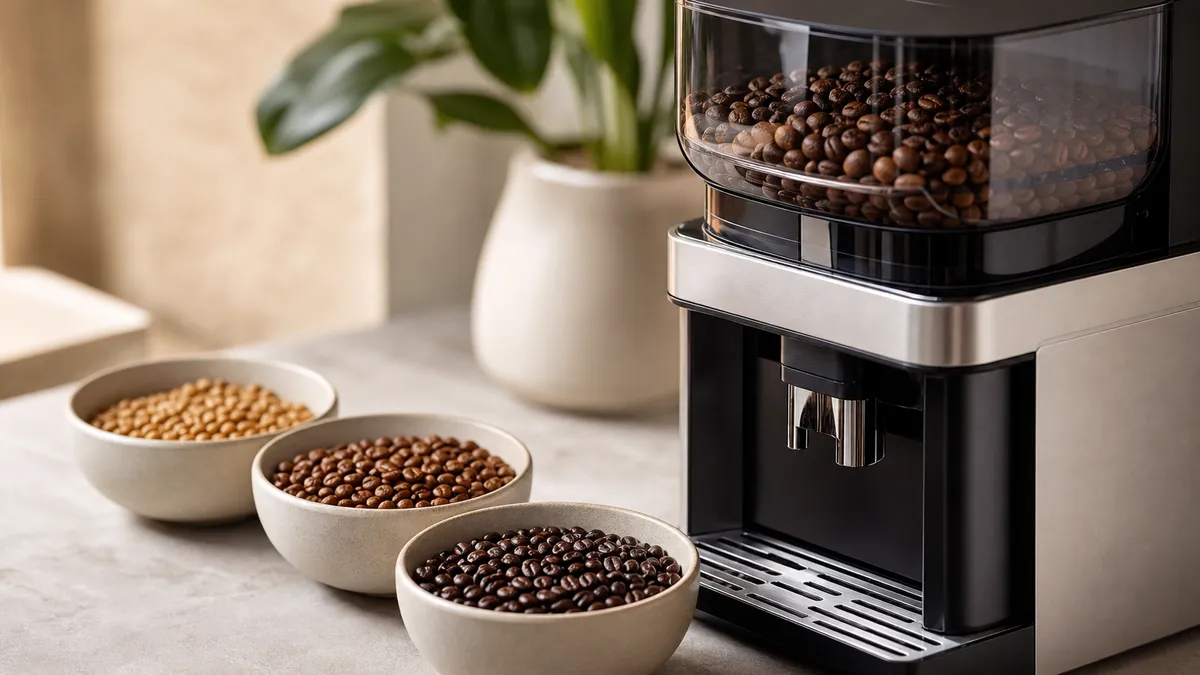
For most workplaces, a medium to medium-dark espresso blend with little visible surface oil is a sensible starting point when choosing coffee beans for office machines. Choose untreated whole beans that meet your machine manufacturer’s instructions, then test them in the drinks colleagues actually order before committing to regular deliveries.
In short
- Check the exact machine manual: ordinary dark-roasted beans are not the same as sugar-coated or flavoured beans.
- Start your shortlist with a low-surface-oil blend, then compare alternatives for taste and reliable feeding.
- Trial beans in both black coffee and your usual milk drinks, using the workplace machine.
- Match bag sizes and delivery frequency to measured consumption, not total employee headcount.
- Compare written quotations per kilogram and per usable drink, allowing for dose, waste and any supply conditions.
Choosing coffee beans for office machines: compatibility first
Before discussing origins or tasting notes, find the instructions for your machine’s bean hopper and grinder. Ask the machine supplier to confirm any restrictions in writing, particularly if a servicing agreement specifies approved consumables.
Roast colour, surface oil and added coatings are separate checks. Dark coffee is not automatically sugar-coated, and a dark roast should not be rejected simply because another machine’s instructions advise against oily beans.
Manufacturer guidance illustrates the distinction. Miele’s troubleshooting advice says oils from dark-roasted beans can hinder movement through the hopper and suggests trying less oily beans. Its CVA 6401 instructions separately prohibit beans treated with caramel, sugar or sugary liquids.
Use the manual for your model as the deciding authority. The wider installation and maintenance guide helps put bean selection alongside the other requirements of running an office machine.
What oily and coated beans can do
Very oily beans can cling to hopper walls instead of falling freely into the grinder. This can produce a “fill beans” warning even when beans remain in the container.
Oil and retained coffee particles can also build up around grinder burrs, the cutting surfaces that break beans into grounds. Urnex documents coffee particles adhering to burrs and coffee-oil residue; this is a reason to follow the approved cleaning routine, not proof that every dark roast will jam every conical or flat-burr grinder.
Bean detection is model-dependent too. KKT KOLBE’s Barista Pure manual specifically warns that oil deposits on its bean-container sensor window can cause malfunctions. Do not assume every office machine has the same sensor arrangement or failure mechanism.
Sugar-coated beans present a different problem. Torrefacto is coffee roasted with added sugar, which caramelises onto the beans. Miele warns that sugar-treated beans can damage its machine and that caramelised ground coffee can block the brew unit.
For a shared office hopper, exclude syrup-flavoured, sugar-coated and other treated beans unless the manufacturer expressly permits them. Add flavour to the finished drink instead, rather than experimenting with the grinder.
Match the roast to the drinks
Our recommended starting point is a medium or medium-dark roast with little surface oil, shortlisted for balanced flavour rather than maximum roast intensity. Ask for samples described as chocolatey, nutty or gently caramel-like if colleagues want a familiar everyday coffee, then check whether those descriptions match the brewed result.
Espresso and filter labels describe the roaster’s intended brewing use. Miele’s selection guide explains that espresso roasts are developed for espresso preparation, while filter roasts commonly retain more pronounced acidity, the bright, fruit-like sharpness in coffee.
That makes an espresso-labelled sample a useful first trial for an espresso-based bean-to-cup machine. It does not establish compatibility by itself: check treatment, surface oil and the machine instructions separately.
Judge coffees against the same criteria: manufacturer approval, feeding behaviour, flavour in the actual drink menu, and consistency after setup.
| Candidate | Who it may suit | What to assess | Main caution |
|---|---|---|---|
| Medium espresso blend, little surface oil | A mixed office wanting one everyday coffee | Balance in black coffee and milk drinks | Still needs testing in the machine |
| Medium-dark espresso blend, little surface oil | Colleagues preferring a more roast-led drink | Whether flavour remains pleasant without milk | Do not confuse darker colour with acceptable oiliness |
| Espresso-roasted single origin | A team interested in a particular provenance | Enjoyment across the drink menu | Agree what happens when that coffee changes |
| Light or filter-labelled roast | A team deliberately seeking brighter flavours | Results within the machine’s permitted settings | Treat as a trial, not the automatic default |
| Very oily or treated beans | Only where expressly permitted | Written manufacturer guidance | Feeding, residue or additive restrictions may rule them out |
A sample described as excellent for hand-brewed filter coffee has not yet demonstrated that it suits your office machine. Buy on the result in your cup.
Blends versus single origin
A blend combines coffees to achieve a chosen flavour profile. A single-origin coffee comes from a stated geographical source, although the supplier should explain whether that means a country, region, estate or more specific lot.
Neither description guarantees a better office drink. Miele’s guide acknowledges that both blends and single origins can work with or without milk.
For one shared hopper, our preference is to start with a blend because the purchasing brief can focus on maintaining an agreed flavour. Ask how the supplier manages changes in its components and whether you will receive notice before a significant change.
A single origin is worth including when colleagues want a particular character or clearer provenance. Ask how long it will be available, what replaces it and whether a replacement will need another machine setup.
Avoid selecting by origin alone. Give suppliers a practical brief: “pleasant black, still distinct in our usual latte, and approved for this machine” is more useful than requesting a country without explaining the intended drinks.
Buy for freshness and actual consumption
Roasted coffee changes during storage. The SCA’s literature review identifies oxygen exposure, temperature and moisture among the factors affecting staling, while its freshness guidance explains that beans continue releasing carbon dioxide after roasting.
Freshness therefore involves packaging, storage and the coffee’s stage after roasting, not just the newest possible roast date. Ask the roaster for a recommended resting period before use and an opened-pack usage recommendation for that particular coffee.
Keep reserve stock sealed, cool and dry. Reseal opened bags promptly, use older stock first and avoid treating the hopper as long-term storage.
Estimate how much to order
Use attendance and machine drink counts rather than payroll headcount. The following matrix is an illustrative stock calculation, not a consumption survey or a machine-capacity recommendation.
Assumptions: everyone shown attends daily, each person orders two coffees, every drink uses one 10 g grinding cycle, and the office operates five days. Waste and visitors are excluded.
| People present daily | Drinks per day | Beans per day | Beans per five-day week |
|---|---|---|---|
| 10 | 20 | 0.20 kg | 1.00 kg |
| 25 | 50 | 0.50 kg | 2.50 kg |
| 50 | 100 | 1.00 kg | 5.00 kg |
| 100 | 200 | 2.00 kg | 10.00 kg |
For the 25-person example: 25 × 2 × 10 g = 500 g daily, or 2.50 kg over five days.
Replace these assumptions with your machine’s actual recipes. A drink using two grinding cycles must count both doses; record setup drinks and discarded beans separately. Then choose pack sizes you can finish without leaving opened stock lingering.
For the wider ordering checklist, see consumables and supplies.
Compare supplier quotations properly
Consider a local roaster, a national coffee wholesaler and your machine-service supplier. Rather than assuming one route is best, send each the same requirements:
- Exact machine model and any manufacturer restrictions.
- Typical attendance, measured drink volumes and the main drink choices.
- Desired flavour, pack size and delivery frequency.
- Roast-date or batch information and storage guidance.
- Sample availability and help with machine setup.
- Minimum orders, delivery arrangements and substitution terms.
- Any requirement to buy coffee through a particular servicing agreement.
Ask for itemised written quotations. Compare the quoted bean amount per kilogram on the same delivery and VAT basis, rather than comparing differently sized bags or bundled agreements.
Work out the consumption component
First calculate theoretical drinks per kilogram:
1,000 g ÷ grams used per drink = drinks per kilogram.
At an assumed 10 g per drink, that is 100 drinks per kilogram before waste. This is arithmetic, not a recommended dose for every machine.
Divide the quoted amount per kilogram by that yield to calculate the bean component per drink. For a more realistic comparison, divide the beans consumed during the trial by the number of accepted drinks served, including setup and discarded drinks in consumption.
For the whole workplace provision, include milk, cleaning products, filters, servicing, equipment provision, delivery and waste handling. Keep the comparison period consistent, state whether VAT is included and separate bundled items so nothing is counted twice.
HMRC VAT Notice 701/14 generally allows coffee supplied as food outside catering to be zero-rated. Do not assume every line in an equipment-and-consumables quotation has the same VAT treatment; request an itemised breakdown.
Run a useful sample trial
A supplier tasting is helpful, but the final trial should happen on the workplace machine. Use this suggested method:
- Shortlist three compatible coffees. Include your likely everyday choice and alternatives with a clear reason for consideration.
- Agree the sample quantity. Allow enough for setup, tasting and a representative period of normal use.
- Prepare the machine correctly. Follow its cleaning and bean-change instructions before introducing each sample.
- Record the recipe. Note the coffee dose in grams, drink volume in millilitres, milk quantity where known, and available temperature and grinder settings. Follow the manual when making adjustments.
- Make a fair comparison. Test the same drinks and serving sizes. Allow each coffee a sensible setup rather than judging one on settings chosen for another.
- Gather simple feedback. Ask colleagues about sweetness, bitterness, sharpness, aftertaste and whether they would happily drink it daily.
- Check operation as well as flavour. Record feeding problems, warnings, discarded drinks and stock used.
- Confirm the supply agreement. Keep the winning recipe, approved coffee description and substitution arrangements on record.
Do not reach into a running grinder or repeatedly retry a machine that sounds abnormal. Follow its troubleshooting instructions and use breakdowns and repairs when the problem needs investigation.
The useful outcome when choosing coffee beans for office machines is a repeatable drink and a workable supply arrangement, not simply a popular sample on tasting day.
FAQ
Can supermarket beans be a suitable office choice?
Yes, they can be worth trialling if they meet the machine’s instructions and colleagues enjoy the results. Apply the same checks as you would to a specialist supplier: untreated whole beans, acceptable surface oil, useful batch information and practical pack sizes. Consider whether you can obtain the same coffee reliably and what you will do if availability changes.
Can we mix leftover beans from different bags?
Avoid mixing them during a comparison because you will no longer know which coffee produced the result. As an everyday purchasing policy, finish compatible stock in an orderly way rather than continually topping up with different products. If considering a deliberate mixture, first confirm that every component meets the machine’s instructions and record exactly what you used.
Should every office location use the same beans?
Not necessarily: make consistency of the finished drink the requirement, rather than imposing one coffee without testing it. Trial the proposed beans on each machine type and gather feedback from each workplace. If standardising supply, keep approved settings and substitution procedures for every location, and nominate someone to investigate complaints before changing the coffee.
Where to go next
Read Office Coffee Installation and Maintenance to place bean choice within the wider machine-care routine, and Office Coffee Consumables and Supplies to organise repeat ordering. Office Coffee Machine Breakdowns and Repairs is the useful next read if feeding warnings or inconsistent drinks persist after the approved checks.
Sources
-
Miele, “Fill bean container”, undated support page, retrieved November 2026. Manufacturer guidance on oily beans hindering hopper flow.
URL: https://www.mieleusa.com/support/customer-assistance/coffee-1318/all/fill_bean_container-92062007051 -
Miele, Operating and installation instructions: CVA 6401, document M.-Nr. 10 213 550/03, publication year not stated. Restrictions on sugar-treated beans and caramelised ground coffee.
URL: https://www.miele.co.uk/forms2/uk/sa/manuals-125.aspx?asDownload=1&mNo=10213550 -
KKT KOLBE, Barista Pure User’s Manual, version 1.0, document code 260107, manufacturer-authored manual hosted by OTTO. Sections 4.2 and 5.1 address bean-sensor window deposits.
URL: https://d.otto.de/files/96e2f903-bfb5-522d-96c2-aae4902a37a4.pdf -
Urnex, “SuperGrindz”, undated manufacturer product page, retrieved November 2026. Used for its description of retained coffee particles and oil residue on burrs, not as a blanket cleaning-product recommendation.
URL: https://urnex.com/supergrindz-superautomatic-grinder-cleaning-tablets -
Federación Nacional de Cafeteros de Colombia, Tolima, “Torrefacto”, undated glossary entry, retrieved November 2026. Definition of sugar-added roasting.
URL: https://tolima.federaciondecafeteros.org/glosario/torrefacto/?lang=en -
Miele, “Coffee Selection Guide: How to Choose the Beans That Are Right for Me?”, undated, retrieved November 2026. Used for roast-purpose and blend/single-origin explanations, not its fixed freshness timetable.
URL: https://www.miele.com.au/experiences/articles/coffee-selection-guide-how-to-choose-the-beans-that-are-right-for-me -
Specialty Coffee Association, “What is the Shelf Life of Roasted Coffee? A Literature Review on Coffee Staling”, 2012. Review of storage and staling mechanisms.
URL: https://sca.coffee/sca-news/2012/02/15/what-is-the-shelf-life-of-roasted-coffee-a-literature-review-on-coffee-staling-bjcx7 -
Specialty Coffee Association, “Coffee Decoded: What is ‘freshly roasted’ coffee?”, undated, retrieved November 2026. Explanation of post-roast degassing and oxidation, drawing on published research and the 2018 Coffee Freshness Handbook.
URL: https://sca.coffee/sca-news/coffee-decoded-9-fresh-coffee -
HM Revenue & Customs, Food products (VAT Notice 701/14), updated June 2026, particularly sections 2.1 and 2.2.
URL: https://www.gov.uk/guidance/food-products-and-vat-notice-70114
Research combined manufacturer instructions and support guidance, SCA freshness literature, a national coffee institute’s glossary and current HMRC guidance; purchasing recommendations and stock examples are editorial guidance, not first-hand machine testing.
Last checked: November 2026