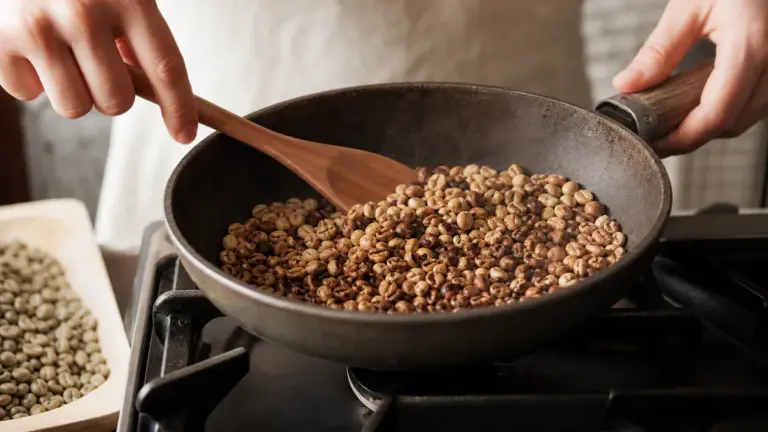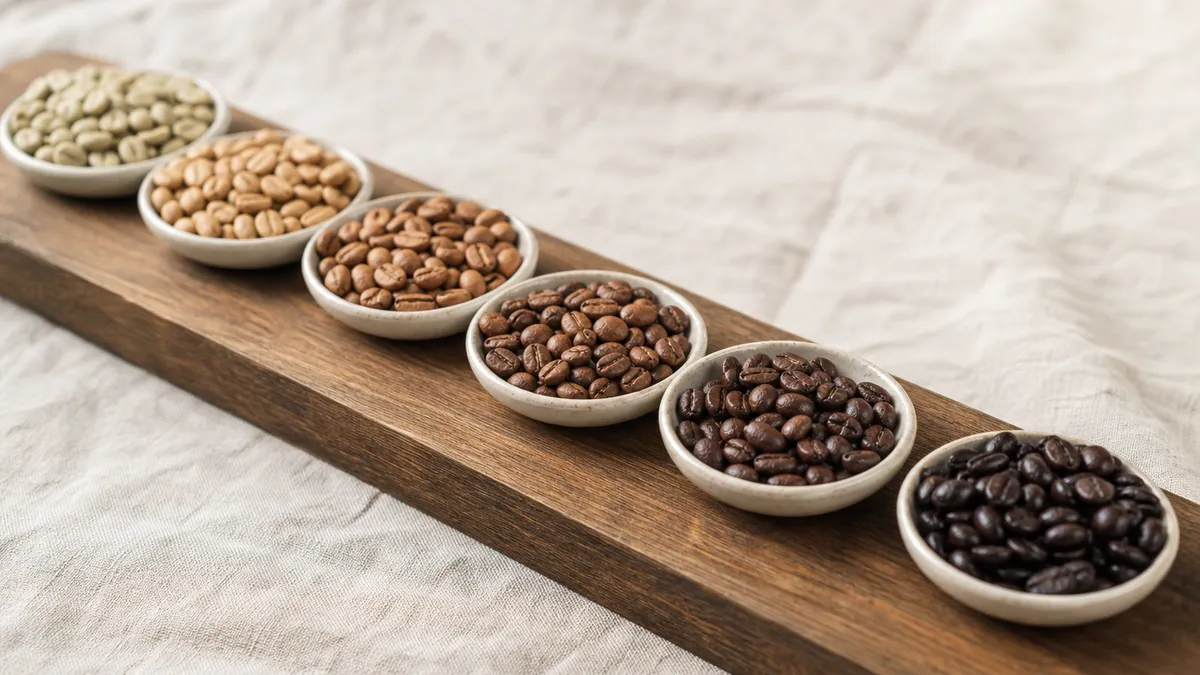
Coffee roast levels describe how far beans have been roasted, from pale brown cinnamon roast through City and Full City to dark, oily French roast and beyond. Lighter roasting generally preserves more fruit-like acidity, while darker roasting brings stronger bitter, smoky and roasted flavours. These traditional names are conventions, not universal colour specifications, so use them as signposts rather than guarantees.
In short
- Cinnamon is very light; City is light to medium; Full City is medium to medium-dark; French is dark. The boundaries vary between roasters.
- Compare colour, surface appearance and tasting notes together, rather than judging a bag by its roast name alone.
- On the Agtron Gourmet scale, higher readings indicate lighter roasting and lower readings indicate darker roasting.
- Body does not increase indefinitely with darkness: extremely dark coffee can taste thinner as well as more burnt.
- Darker flavour does not reliably mean more caffeine. The coffee, dose and brewing conditions also matter.
Understanding coffee roast levels
Roast level describes the degree of roasting, not the bean’s origin, quality or brewing method. The broader coffee roasting guide puts these distinctions in context.
The table below compares traditional names using appearance and likely sensory character. These are broad tendencies, not promises about every coffee carrying the label.
| Traditional name | Typical colour and surface | Likely flavour direction | Consider it if you enjoy |
|---|---|---|---|
| Cinnamon | Pale to light brown, dry | Grain-like notes and pronounced acidity | Very light roasting and bright flavours |
| City | Light to medium brown, usually dry | Fruit, sweetness and clearer origin character | A brighter cup without much smoky roast flavour |
| Full City | Medium to deeper brown, sometimes slight oil | Bittersweetness alongside some origin character | A balance between brightness and roast flavour |
| French | Dark brown, usually oily | Strong roast flavour, bitterness and smoke | A distinctly dark-roasted cup |
| Beyond French | Very dark brown to almost black, often shiny | Increasingly burnt, ashy or charcoal-like | Very dark roast character rather than delicate distinctions |
Two roasters can use “medium” for visibly different coffees. Even traditional naming schemes disagree: one guide may put Italian beyond French, while another groups them together or reverses their order.
That is not necessarily careless labelling. Roast names developed as trade conventions, whereas an instrumental reading describes a sample measured under particular conditions. Ask what a roaster means by its label, especially when changing supplier.
Cinnamon Roast
Cinnamon roast takes its name from its light brown colour, not from added spice. The beans generally look dry rather than glossy.
In traditional roast guides, this is at the very light end of the spectrum, around the early first-crack stage. First crack is the audible popping that marks a major physical change during roasting. The detailed sequence belongs in first and second crack, rather than in a colour chart.
Expect pronounced acidity, sometimes with toasted-grain or bread-like notes. A very pale roast can taste sour and cereal-like rather than sweet and expressive, so “light” should not automatically be read as “better”.
Choose cinnamon roast for exploration, not simply because you want a mild drink. Light colour and gentle flavour are different things: a pale coffee can be quite assertive in its acidity.
City Roast
City roast moves further into brown while generally retaining a dry surface. It is often described as light to medium, although some traditional guides simply call it medium.
In Sweet Maria’s visual convention, City follows the completion of first crack. It leaves more room for the coffee’s distinctive character than the darker stages that follow.
Depending on the beans, the cup may suggest fruit, floral aromas or a clear, lively sweetness. Those are possibilities, not ingredients created by the name “City”.
For a useful first comparison, ask a roaster for its interpretation of City alongside its next darker roast of the same coffee. Taste them black before adding anything. This makes the difference easier to describe in your own words: brighter, sweeter, more bitter, more roasted, or simply more enjoyable.
Full City Roast
Full City is deeper brown, usually with a smoother appearance and sometimes a slight sheen or small spots of oil. It commonly sits around the medium to medium-dark part of a roaster’s range.
Here, naming precision matters. Sweet Maria’s distinguishes Full City, on the verge of second crack, from Full City+, which has entered its first few snaps. Other guides place the boundary differently.
The cup generally moves towards greater bittersweetness while retaining some recognisable origin character. Acidity becomes less prominent than in lighter roasting, although it need not disappear.
If City tastes too bright but French tastes overwhelmingly smoky, Full City is a sensible comparison to request. Treat that as a starting point for tasting, not a rule that this roast must suit everyone.
French Roast
French roast is dark brown and generally has visible surface oil. In traditional roast descriptions, it is well into second crack, rather than merely a little darker than City.
Roast character now takes a leading role. Expect more bitterness, smoke and burnt undertones, with less emphasis on bright fruit flavours. At the darker end, ash-like notes can become conspicuous.
French roast is a flavour preference, not a quality grade. Someone who enjoys that profile need not be persuaded to drink a pale roast, but should still distinguish a pleasing dark cup from one they find acrid or flat.
Nor does French roast necessarily make the heaviest-bodied drink. Extreme roasting can produce a thinner cup despite its forceful aroma and bitterness.
Beyond French Roast
Names encountered beyond French include Italian, dark French and Spanish. They are particularly unreliable as a fixed sequence: Sweet Maria’s terminology places Italian or dark French before Spanish, while the Quest handbook lists Italian before French.
This article therefore uses beyond French descriptively, for roasting darker than the French example under discussion, not as a standardised category.
The beans can become nearly black and very shiny. Burnt and charcoal-like flavours increasingly dominate, leaving less scope for distinguishing the original coffees.
There is also a practical limit. Continuing towards carbonisation is not an endless progression through useful flavour options, and severe over-roasting presents a fire risk. Do not treat the darkest end of a roast chart as a target to reproduce.
How roast level changes flavour and body
The most consistent broad shift is from brighter, fruitier acidity towards bitter, roasted and smoky character. Controlled sensory research supports this direction, rather than merely repeating traditional tasting descriptions.
In a controlled study published in 2024, darker-roasted brews had greater bitter, burnt, smoky and cocoa intensities, while lighter-roasted brews were more sour, citrus-like and fruity. That describes the coffees and conditions studied, not a universal tasting prescription.
Body means the perceived weight or thickness of the drink. It is separate from bitterness, aroma intensity and caffeine. Traditional sensory guidance describes reduced body at both very light and extremely dark roast levels, so a simple “darker equals thicker” ladder is misleading.
Roast level also cannot explain everything about sweetness. Controlled research on roast development time found that changing the roasting process shifted fruity, sweet, acidic, nutty and bitter characteristics. Colour alone does not capture all those decisions.
For the wider craft, read the art of roasting. The chemistry behind browning belongs in Maillard reaction and caramelisation.
Agtron colour measurement: beyond the marketing name
Agtron readings give roasters a numerical way to assess roast development and consistency. Although commonly discussed as roast-colour measurement, Agtron’s coffee analyser uses near-infrared measurements rather than simply copying what the eye sees.
On the Gourmet scale, higher numbers represent lighter roasting. As an illustration, Agtron’s reference chart associates ground-coffee readings of 85 to 90 with cinnamon-like roasting, and 30 to 35 with Italian or French classifications. These are the manufacturer’s reference descriptions, not universal definitions for bags on a shelf.
Three details make a quoted reading more useful:
- The scale: Agtron Gourmet and Commercial are different scales.
- The sample: whole beans and ground coffee can give different readings.
- The preparation: measurements need a consistent method if batches are to be compared meaningfully.
Whole-bean appearance can conceal differences inside the beans. SCA-reported research found that grounds were lighter than whole beans for the light and medium roasts examined.
Use a reading as a measurement, not a tasting score. It does not tell you whether you will enjoy the coffee, and it cannot fully replace the time-and-heat information explained in roasting profiles.
Does dark roast contain more caffeine?
Dark roast does not reliably contain more caffeine just because it tastes stronger. Equally, “light roast always has more” is too sweeping.
Controlled laboratory research published in 2024 found that the relationship depended on roast degree and extraction. Under otherwise identical brewing conditions, darker samples yielded less caffeine, but comparisons at equal extraction yields produced a different relationship.
Roasting also changes bean mass, expansion and density, making a scoop-based comparison different from one based on weighed coffee.
The practical lesson is straightforward: do not use roast colour as a caffeine calculator. Weighing your dose makes comparisons more consistent, but it does not establish the caffeine content of the finished drink. Choose roast levels for flavour, not as a reliable way to control caffeine.
FAQ
Is espresso a roast level?
No, espresso is a brewing method rather than a fixed roast level. A coffee sold as an “espresso roast” expresses the roaster’s intended use, not a universally defined colour. Ask for its flavour description and position within that roaster’s range instead of assuming it must be French-dark or visibly oily.
Does visible oil prove that coffee is stale?
No, visible oil alone does not prove staleness. Traditional descriptions include surface oil as a normal feature of darker roasts. It is therefore a poor standalone freshness test. Consider the roast date, storage history and the coffee’s aroma and taste rather than rejecting beans solely because their surface shines.
Can I identify a roast level accurately from a photograph?
Only approximately. A photograph can show relative differences, but lighting, glare and screen reproduction affect apparent colour. It also shows the outside of the beans, not a prepared ground sample. Use photographs to understand the broad progression from light brown to nearly black, not to assign a precise Agtron reading.
Where to go next
Read The Art of Roasting for the decisions behind the finished beans, then Roasting Profiles for the importance of time and heat. First Crack and Second Crack explains the audible milestones, while Maillard Reaction and Caramelisation follows the browning chemistry behind changing roast levels.
Sources
- Sweet Maria’s, Coffee Flavor Terminology, 2008. Traditional roast names, colours and sensory descriptions. Source.
- Sweet Maria’s, Thompson Owen, Using Sight to Determine Degree of Roast, 2022. Visual stages, crack-related conventions, limitations of photographs and extreme-roast cautions. Source.
- Sweet Maria’s-hosted Quest Coffee Roaster Handbook, first edition, April 2021. Non-standardised roast names and differing Italian/French ordering. Source.
- Agtron Incorporated, M-BASIC/II Coffee Roast Analyzer Operation Manual, 2020 cover, classification chart updated June 2018. Measurement principle, scales and ground-coffee reference classifications. Source.
- Specialty Coffee Association, The Color in Your Cup: Roast Level and Brew Temperature Significantly Affect the Color of Brewed Coffee, 25, issue 17, publication year not stated on the retrieved page. Agtron direction and whole-bean versus ground-colour findings. Source.
- Liang and colleagues, Sensory analysis of the flavor profile of full immersion hot, room temperature, and cold brewed coffee over time, Scientific Reports, 2024. Controlled sensory experiment. Source.
- Alstrup and colleagues, The Effect of Roast Development Time Modulations on the Sensory Profile and Chemical Composition of the Coffee Brew as Measured by NMR and DHS-GC-MS, Beverages, 2020. Controlled roast-development research, retrieved through the authors’ university research portal. Source.
- Lindsey and colleagues, Caffeine content in filter coffee brews as a function of degree of roast and extraction yield, Scientific Reports, 2024. Controlled brewing and chemical analysis. Source.
Research combined primary sensory and caffeine studies, manufacturer measurement documentation, SCA research reporting and specialist roasting references, with disagreements between naming conventions stated explicitly.
Last checked: November 2026