Specialty coffee festivals bring together tastings, talks, brewing demonstrations and competitions so visitors can explore coffee beyond their usual order. For a first visit, choose a public session, pick a few activities that genuinely interest you and leave time to talk to the people serving the coffee. The London Coffee Festival’s published programme illustrates this mix, with roaster stands, workshops and live latte art.
In short
- Check public admission days, session lengths and workshop booking arrangements before travelling.
- Choose a tasting, a learning session and something to watch rather than trying to cover every stand.
- At cupping tables, ask how the host wants you to sample and handle spoons.
- Take small samples selectively, with breaks for water, food and time away from tasting.
- Record the coffee’s name and brewing details, not just the roaster’s name.
What makes specialty coffee festivals different?
The emphasis is on discovering what distinguishes one coffee from another. The Specialty Coffee Association’s definition of specialty coffee considers distinctive attributes, including flavour, aroma and texture, alongside information such as origin, producer and processing method. It is broader than a single quality score.
For an enthusiast, that gives a festival a useful purpose: you can ask questions while experiencing the coffee being discussed. Rather than asking a roaster to recommend their “best” coffee, explain what you enjoy and how you brew. “I like chocolate-like sweetness in a cafetière” gives them something practical to work with.
The format matters as much as the event’s name. London, for example, distinguishes dedicated industry days from its public weekend. Check the organiser’s current admission conditions rather than assuming every session welcomes general visitors.
For the wider distinction between festivals, exhibitions and other gatherings, start with coffee events and festivals. This guide concentrates on enjoying the visit rather than listing destinations.

What you can taste, learn and watch
A useful programme should give you reasons both to explore and to stop. London’s published activities include tastings, talks, interactive demonstrations, brewing workshops and latte art sessions, although the exact mix belongs to each edition. Treat these as examples of what to look for, not promises about every festival.
| Activity | What to look for | A useful visitor approach |
|---|---|---|
| Roaster tasting | A chance to discuss the coffee being served | Describe your usual drink and ask for a contrasting recommendation |
| Guided tasting or cupping | A hosted comparison of coffees | Tell the host you are new and follow the tasting sequence |
| Talk or discussion | A clear topic and relevant speakers | Bring one question you would like answered |
| Brewing workshop | A stated skill and participation format | Check whether you will brew or watch |
| Latte art session | Demonstrations, workshops or a throwdown | Watch the technique as well as the finished pattern |
Tastings and cuppings
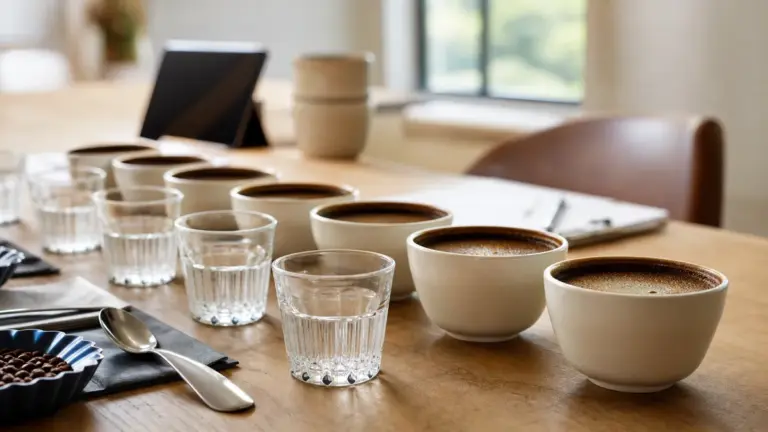
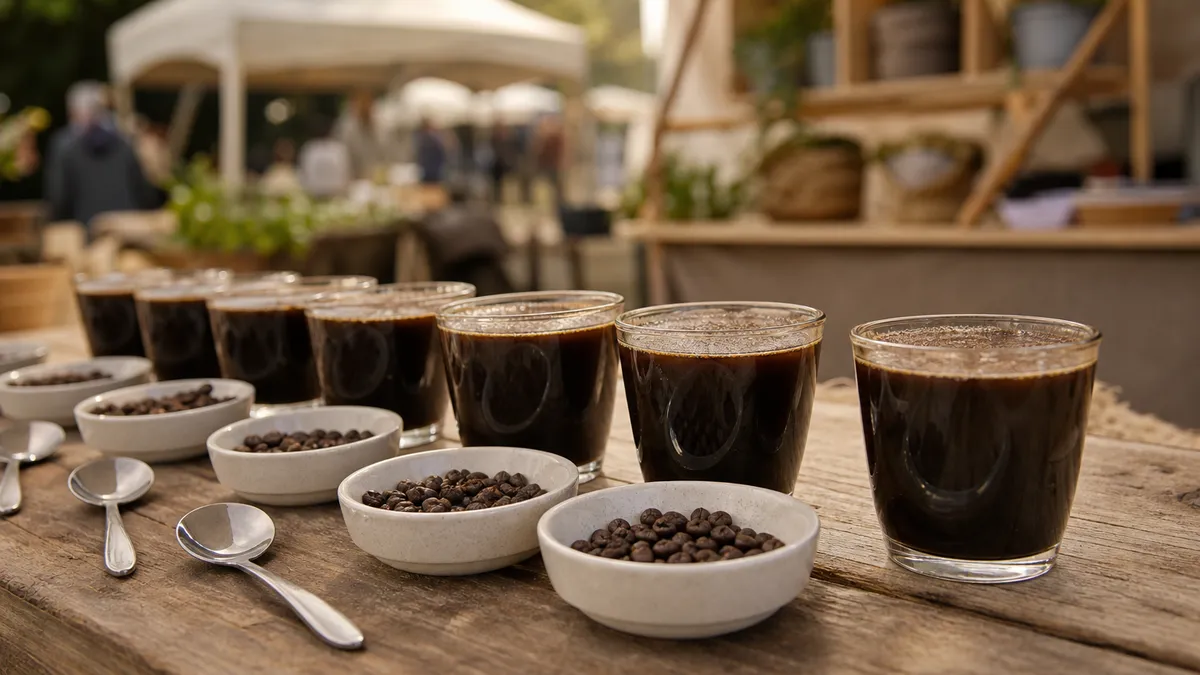
Cupping is a structured way of assessing coffee through smelling and tasting. Formal SCA procedures cover preparation and tasting mechanics, but do not assume a public festival session is a professional grading exercise. Ask the host what you will be comparing and how to take part.
For a beginner, a useful aim is simply to notice differences. Does one sample seem brighter, heavier, sweeter or more drying than another? “This reminds me of cocoa” is a perfectly serviceable observation. You do not need an elaborate flavour description before you are entitled to an opinion.
Ask whether the coffees offer a particular comparison, such as processing method or roast approach. If several things differ at once, enjoy the contrast without attributing everything you taste to the country of origin.
Talks and brewing workshops
Use the session description to decide what you want to take away. A demonstration can help you understand a technique; a participatory workshop may let you practise it. London’s programme explicitly identifies Brew School as a bookable experience, so check arrangements for individual activities rather than relying on admission alone.
Good questions are concrete: “What should I change first if this tastes too sharp at home?” or “Would this recipe work with my grinder?” Ask the presenter to separate the essential adjustment from the optional equipment.
For talks about sourcing or environmental issues, listen for evidence behind the claim. Ask which producer, practice or part of the supply chain the speaker means, rather than treating a broad promotional description as a complete answer.
Latte art throwdowns
A throwdown is a head-to-head latte art contest. London’s Latte Art Live programme includes heats, a final, demonstrations and hands-on sessions, making it an example of how competition and teaching can share a festival stage. Entry arrangements are event-specific, so do not assume you can join on arrival.
Watch how competitors control the jug and position the cup, not just the final photograph. If watching skilled preparation catches your interest, the World Brewers Cup is a useful next subject, rather than a rulebook you need before attending a festival.
Festival etiquette without the awkwardness
The following is practical visitor advice, not a universal festival code. The simplest rule is to let the host explain the activity before you handle anything.
At a tasting table, ask before sampling. Check where clean utensils belong and where used cups should go. If separate serving and tasting vessels are provided, keep them separate. The SCA’s sanitary modification uses a designated spoon to transfer coffee into a personal vessel, avoiding direct mouth contact with the shared brew. Follow the host’s arrangement rather than improvising.
Keep questions considerate. Have your first question ready, listen to the answer and make room when others are waiting. If you want a longer technical conversation, ask whether there is a quieter moment to return.
Be honest about your experience. “I have never tried this before” helps a host pitch the explanation. There is no need to perform expertise or claim to recognise a flavour you cannot find.
Ask before touching equipment or filming closely. Keep bags clear of working surfaces and routes around the stand. A demonstration is easier to enjoy when everyone can see and the person brewing has room to work.
Explain allergies before accepting a sample. Ask about ingredients and shared preparation equipment. Do not assume a vegan drink is safe for someone with a milk allergy: the Food Standards Agency warns that vegan labelling does not rule out allergen cross-contamination.
How to get the most from a visit
Use this checklist to give the day some shape without turning it into an inspection.
- Set a purpose. Choose something specific, such as finding a filter coffee you enjoy or understanding milk pouring.
- Check the current programme. Confirm your admission session and any separate activity bookings. Save the organiser’s information before travelling.
- Check practical access. Ask about step-free routes, seating, quieter spaces and any assistance you need. Use the venue’s current information rather than photographs of previous editions.
- Pack lightly. Bring a charged phone, a way to take notes and water where permitted. Check the organiser’s rules before bringing reusable tasting equipment.
- Choose a few priorities. Identify an activity to learn from, something to watch and roasters you want to meet. Leave gaps rather than scheduling every available minute.
- Taste selectively. Ask what is being served before accepting it. You can decline a sample or leave a drink unfinished.
- Make useful notes. Record the coffee name, roaster, producer or origin information, processing description and brew method where supplied.
- Choose a next step. Before leaving, identify one coffee to revisit or one technique to practise.
For a UK visit, the London Coffee Festival guide provides the event-specific companion. Use its organiser’s current programme for actual admission and activity arrangements.
Pace the caffeine, not just the programme
There is no reliable universal number of festival samples that suits everyone. EFSA notes that caffeine content varies with the drink and its preparation, so a small serving should not be treated as a known caffeine dose. Include coffee, tea and other caffeine consumed before and after the event when considering your intake.
EFSA’s 2015 scientific risk assessment found that single doses up to 200 mg, and habitual intake up to 400 mg a day spread across the day, raise no safety concerns for healthy non-pregnant adults. It also found that 100 mg close to bedtime may affect sleep in some adults. These are population benchmarks, not tasting targets or guarantees for an individual.
The NHS advises no more than 200 mg a day from all sources during pregnancy. If pregnancy, sensitivity, medication or a medical condition affects your choices, speak to a midwife, pharmacist or GP as appropriate.
Practical ways to make the visit less coffee-intensive include choosing talks and demonstrations between tastings, asking whether decaffeinated samples are available and taking breaks away from the stands. Water is useful to have with you, but it does not provide a reason to disregard caffeine intake.
Turn an interesting tasting into useful knowledge
For the more experienced enthusiast, separate what you noticed, what you preferred and what you were told. The SCA’s approach distinguishes sensory attributes from information such as origin and processing. A compelling producer story and a coffee you particularly enjoy are both worth recording, but they are not the same observation.
Try writing a brief tasting impression before discussing it with the server. Then add the explanation and your preference separately. This keeps your notes useful even if you disagree with the suggested flavour description.
When comparing equipment, ask what stayed the same: coffee, recipe, water and preparation. Treat a stand demonstration as a starting point for investigation, not a complete test of every claim.
The most useful result from specialty coffee festivals is something you can act on afterwards: a clearer preference, a better question or a technique worth practising. You need not taste everything to leave knowing more.
FAQ
Can I go alone?
Yes, going alone is a sensible way to visit at your own pace. Give yourself a starting point, such as a scheduled talk or hosted tasting, rather than expecting every conversation to happen spontaneously. You can spend longer on your own interests, take breaks when you choose and leave without negotiating a group itinerary.
Do I have to buy beans after accepting a sample?
Treat a sample as an invitation to explore, not a personal commitment to buy. Thank the server, ask a relevant question if you have one and make space for the next visitor. If you are interested, record the exact coffee details so you can make a considered decision later.
Will the coffee taste the same when I brew it at home?
Do not assume it will match automatically. Ask for the preparation details and record them alongside the coffee name, rather than taking the beans alone as the complete explanation. The SCA’s tasting standard controls preparation precisely; your most useful follow-up is therefore a reproducible recipe, not merely a remembered flavour description.
Where to go next
Read Coffee Events and Festivals for the wider event formats, then coffee festivals worldwide to explore destinations. London Coffee Festival is the UK companion for planning a visit around a specific event.
Sources
-
Specialty Coffee Association, What is Specialty Coffee, undated, current page retrieved November 2026.
https://sca.coffee/what-is-specialty-coffee -
The London Coffee Festival, Visit The London Coffee Festival, current visitor information retrieved November 2026.
https://www.londoncoffeefestival.com/visiting -
The London Coffee Festival, What’s On, programme overview retrieved November 2026. The page contains material referring to both the 2026 and 2027 editions; activities are used as examples, not a confirmed future timetable.
https://www.londoncoffeefestival.com/whats-on -
The London Coffee Festival, Latte Art Live, published 2026 programme material retrieved November 2026.
https://www.londoncoffeefestival.com/whats-on/latte-art-live-watch-pros-action -
Specialty Coffee Association, SCA Standard 102: Coffee Value Assessment, Sample Preparation and Tasting Mechanics, 2024 edition, including section 7.6 on sanitary modification.
https://sca.coffee/s/AW_SCA-102_Sample-Preparation_281024_Secured.pdf -
Food Standards Agency, Vegan food and allergens, undated, current PDF retrieved November 2026.
-
European Food Safety Authority, Caffeine, current summary of the 2015 Scientific Opinion on the Safety of Caffeine, retrieved November 2026.
https://www.efsa.europa.eu/en/topics/topic/caffeine -
NHS, Foods to avoid in pregnancy, current guidance retrieved November 2026.
https://www.nhs.uk/pregnancy/keeping-well/foods-to-avoid/
This article was researched using organiser information, SCA definitions and tasting procedures, and authoritative UK food-safety and European caffeine guidance; visitor recommendations are editorial advice, not first-hand event testing.
Last checked: November 2026