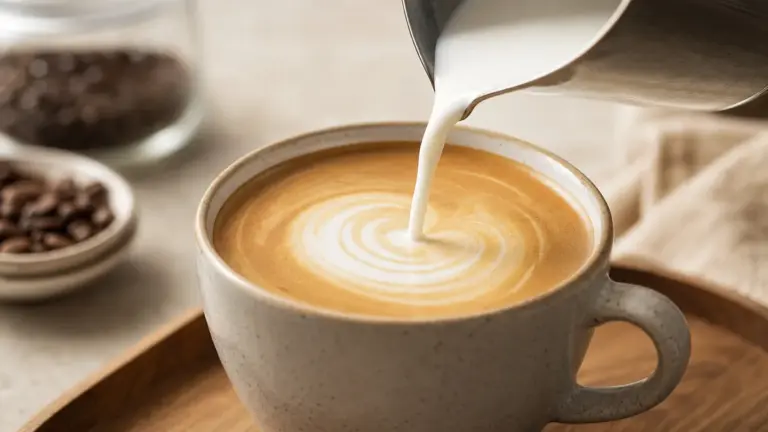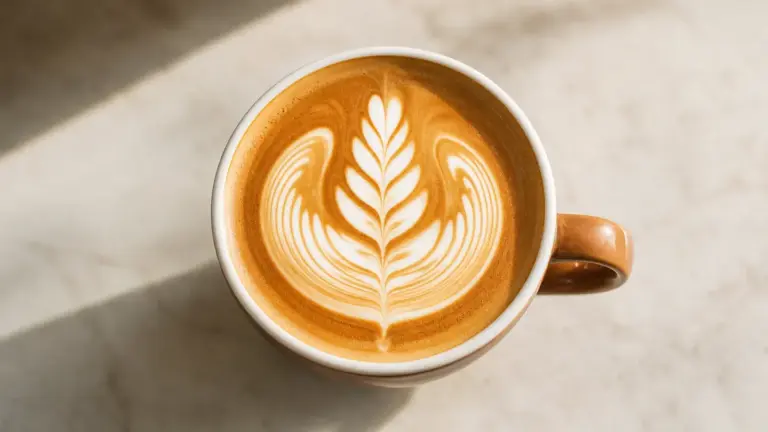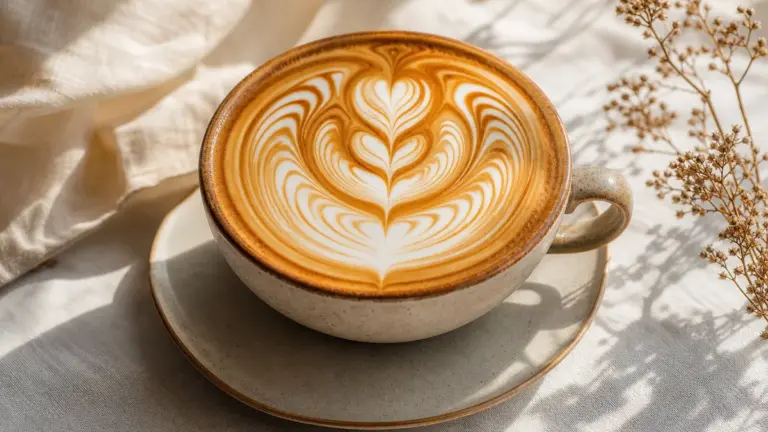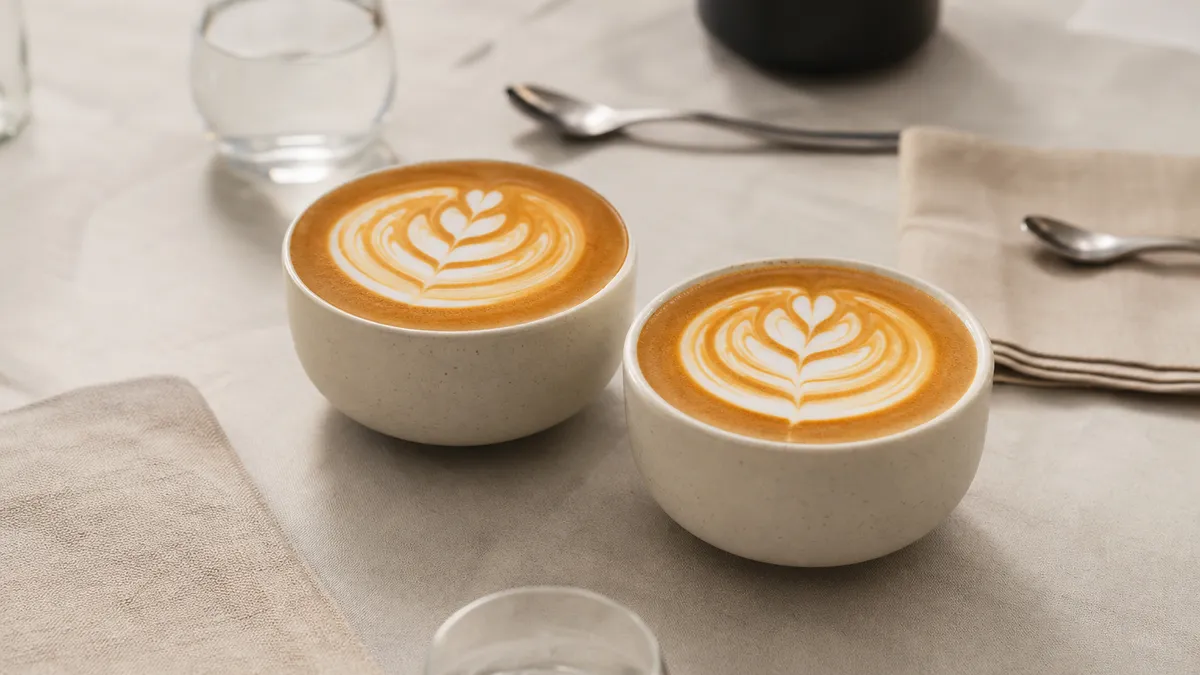
Latte art competitions challenge baristas to create patterns in espresso and steamed milk, either against another competitor or against a published scoresheet. They range from informal local throwdowns to national championships that lead to the World Latte Art Championship, but entry requirements, permitted techniques and judging rules differ between events.
In short
- A throwdown may use head-to-head knockout rounds, with judges choosing which cup advances.
- National championships use published rules, timed performances and more detailed assessment.
- Check the exact rulebook edition: the 2026 UK championship followed the 2025 world rules.
- Free-pouring creates the design directly from the milk jug; etching uses a tool to alter the surface and is not permitted in every category.
- Choose an event first, then practise its requirements rather than assuming every competition rewards the same thing.
The main types of latte art competition
The useful distinction is not simply local versus international. It is whether competitors are trying to beat the cup beside them, achieve a scored performance, or qualify through an officially sanctioned championship.
| Format | How it works | What to check | Who it suits |
|---|---|---|---|
| Local throwdown | Head-to-head pouring, often through a knockout bracket | Attempts allowed, milk, pattern restrictions and judging method | Someone seeking a first competitive experience |
| Festival or independent contest | The organiser sets its own entry and competition format | Application process, rules and whether it has any qualifying role | Pourers looking for a particular challenge |
| Sanctioned national championship | Timed performances assessed under published championship rules | Eligibility, adopted rulebook and national variations | Competitors pursuing structured assessment and world qualification |
| World Latte Art Championship | Qualified representatives compete under the world rules | Current registration, format and scoresheets | Eligible competitors selected through licensed competition bodies |
A festival title is not automatically a national qualifying title. Coffee Fest’s Latte Art World Championship Open, for example, is a separate head-to-head competition, not another name for the World Latte Art Championship.
If the terminology is unfamiliar, the coffee art and latte art guide provides the wider context. Here, the focus is what happens when a pour becomes a competitive performance.
How a latte art throwdown works
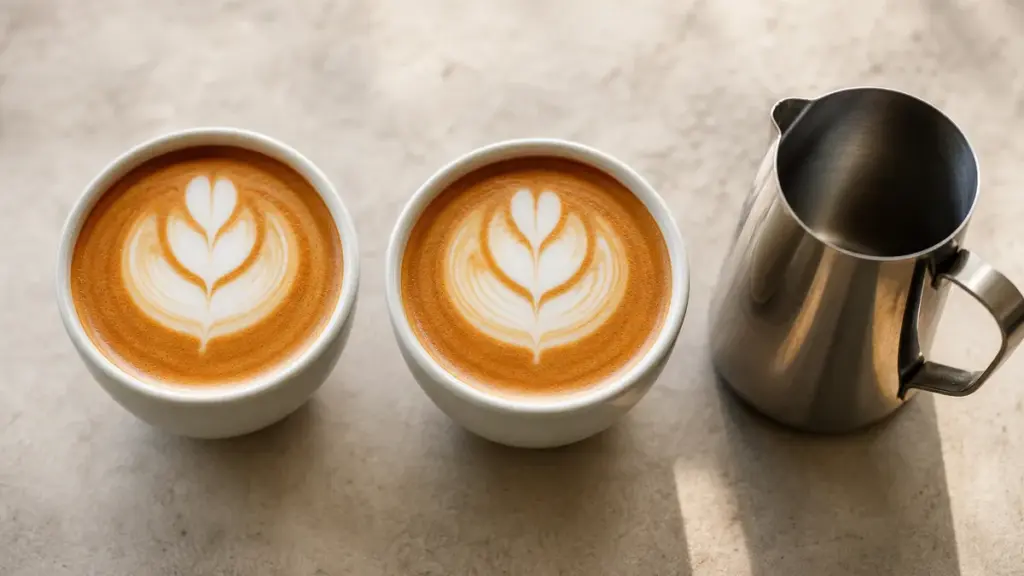
A throwdown puts the comparison directly in front of the judges: competing cups are presented, a decision is made, and the winner moves through the bracket. The atmosphere may be informal, but the organiser’s rules still determine what counts.
The Cincinnati Coffee Festival’s published 2026 format illustrates this clearly. Competitors poured head-to-head for three judges, with two votes needed to advance. It was a one-pull, one-pour contest, so making another drink and choosing the better result was not part of that format.
The same event allowed competitors to bring their own steaming jug and specified a round using oat drink. These are event-specific conditions, not universal throwdown rules.
Before entering, ask:
- Do I choose the pattern, or is one assigned?
- Is the round free-pour only?
- Can I make another attempt?
- Which milk or plant-based drink must I use?
- Does judging use votes, points or both?
- When must the finished cup reach the judging area?
For a first event, our advice is to favour clear rules and an approachable organiser over an impressive title. Knowing exactly what you must produce is more useful than guessing from photographs of previous winners.
National championships and the route to the world stage
National championships add formal structure: an adopted rulebook, entry conditions, specified rounds and scoresheets. They also require competitors to distinguish between the rules for that national event and those for the subsequent world championship.
SCA UK’s published 2026 competition page stated that its UK Latte Art Championship followed the 2025 World Latte Art Championship rules. Public places were allocated through a ballot. That is a useful warning against downloading whichever world document has the newest year on its cover and assuming it governs your national entry.
For the world championship, the official route is through a World Coffee Events licensed competition body. Winning an unrelated local throwdown does not itself confer qualification.
Ask the national organiser which world championship its event qualifies for and which documents establish eligibility. Do not assume that living or working locally automatically settles the question.
The world championship guide covers that particular event in depth. For entering any national competition, the immediate priority is simpler: establish the correct rules, confirm eligibility and obtain written confirmation of your place.
What judges look for
Judging is not just a search for the busiest pattern. Championship assessment separates several qualities that a casual glance can blur together.
Surface, contrast and composition
The world rules describe a smooth, glossy surface without visible bubbles. Contrast concerns the distinction between coffee and milk foam; unintended blurring weakens definition. Composition considers the pattern’s size, position, balance and use of empty space.
When reviewing practice cups, separate these questions. Is the surface clean? Are the edges distinct? Does the design sit deliberately within the cup? A recognisable animal or elaborate rosetta is not the only thing to inspect.
Repeatability and successful execution
Matching pairs test whether the barista can reproduce an intended pattern, rather than produce one fortunate cup. Reference images give judges something specific against which to compare the result.
Difficulty matters through successful execution. An ambitious design that does not resolve clearly should not be treated as automatically superior to a simpler, controlled pour.
Use the latte art masterpieces collection for visual inspiration, but choose competition designs by asking what you can reproduce on demand.
The wider performance
The published 2026 semi-final and final visual scoresheet includes matching patterns, surface quality, contrast, harmony, successful execution and overall appeal. It also assesses hospitality, equipment use and the overall performance.
For training, this suggests a broader task than practising the final wrist movement. Rehearse setting out your tools, presenting the cup and leaving the work area orderly.
These championship criteria are not a universal throwdown scoresheet. A local organiser may instead ask judges simply to choose their preferred cup.
How to enter latte art competitions
Use this checklist before committing to a competition.
-
Find the organiser’s own announcement. Start with SCA UK for the UK national championship and with the café, roaster or festival hosting an independent contest. Check whether you are viewing a current entry notice or an archive.
-
Confirm the entry route. Establish whether places are allocated by registration, ballot, application review or a qualifying event. Coffee Fest, for example, publishes a photo-based application process rather than treating every application as an accepted place.
-
Read the eligibility section. Check age, representation requirements, any experience categories and restrictions involving judges or organisers. Ask about ambiguous circumstances before submitting an entry.
-
Save the correct documents. Keep the rulebook, scoresheets, event amendments and competitor instructions together. Write down the edition the organiser has adopted.
-
List what is supplied and what you may bring. Confirm the machine, cups, coffee, milk and permitted personal equipment. Ask whether practice access is available rather than assuming it will be.
-
Check practical requirements. Note arrival time, briefing arrangements, required photographs and how the organiser communicates changes. Make a packing list from those instructions.
-
Rehearse the complete task. Practise under the published time limit, including service and any required clearing. Do not count only the seconds during which milk enters the cup.
Keep a short list of unanswered questions and send it to the organiser together. A clear written answer is easier to use during preparation than a remembered conversation.
Preparing for a judged performance
Our recommended approach is to build a routine you can assess honestly.
Choose a design, photograph the intended result, then practise reproducing it without changing the target after each attempt. For paired drinks, place the cups together and compare their scale, orientation and spacing before deciding whether the session went well.
Record complete practice runs. Look for unnecessary movements and moments when you search for equipment. Review the ordinary attempts, not just the photograph you would choose to share.
Ask a practice partner for specific observations: “Which edges are blurred?” or “Where do these cups differ?” gives you something to work on. “Does this look good?” often produces encouragement rather than useful detail.
Keep technique practice separate from performance rehearsal. One session can focus on an individual movement; another should follow the competition sequence without stopping to repair every weakness.
Reading advanced rules without getting caught out
At championship level, separate preparation time from performance time and distinguish stage rounds from other activities.
Under the 2026 world rules, the preliminary stage performance requires four drinks in eight minutes. The final requires six drinks in ten minutes. These are performance allowances, not the complete time assigned at the station, and they should not be transferred to another event without checking.
The 2026 Art Bar is also a separate audience-judged contest whose result does not contribute to the main stage total. That differs from treating every activity as part of one combined score.
Free-pour and designer categories must be kept distinct too. Free-pouring forms the pattern by pouring steamed milk directly into the cup; etching means working the surface with a tool. Designer categories can permit techniques that free-pour categories prohibit.
The practical lesson is to annotate your routine against the actual rules. Mark the required drinks, permitted techniques, service order and relevant penalties. For latte art competitions, understanding the task is part of preparing the performance.
FAQ
Can a home enthusiast enter?
Possibly, but the organiser’s eligibility rules decide. Do not assume that an event welcomes home enthusiasts simply because it is described as a throwdown, or that café employment is required because it takes place in a coffee shop. Explain your experience honestly and ask whether the format is suitable before applying.
What if I disagree with the judges?
Ask which review or appeal process applies. The world championship rules provide procedures for scoring questions and appeals, but an independent contest need not use that system. Seek clarification through the organiser’s stated channel, distinguish a possible scoring error from a subjective preference, and keep your account specific and factual.
Is watching useful before entering?
Yes, watching is a sensible preparation exercise. Follow the briefing, timing and cup presentation rather than concentrating only on the winning design. The London Coffee Festival’s Latte Art Live programme includes throwdowns alongside demonstrations and workshops, offering different ways to observe the craft. Check each organiser’s arrangements for spectator access.
Where to go next
Read World Latte Art Championship for the international event’s structure and qualification route, then Latte Art Masterpieces to study ambitious designs with a more critical eye. Coffee Art Exhibitions explores settings where coffee art is displayed rather than judged in a competitive round.
Sources
-
World Coffee Championships, 2026 World Latte Art Championship Rules and Regulations, 2026 edition, particularly sections 1, 2 and 15.
https://static1.squarespace.com/static/65fb773fac2112270b71798a/t/68e6b8f6143df370b6695c96/1759951094843/2026%2BWorld%2BLatte%2BArt%2BChampionship%2BRules%2Band%2BRegulations.pdf
Primary source for qualification, round requirements and appeals. -
World Coffee Championships, 2025 World Latte Art Championship Rules and Regulations, 2025 edition, particularly sections 2.5 and 14.
https://wcc.coffee/s/2025-World-Latte-Art-Championship-Rules-and-Regulations.pdf
Primary source for the edition adopted by the 2026 UK event, beverage categories and judging definitions. -
World Coffee Championships, WLAC Visual Scoresheet: Semi-Final / Final Round, file published in the 2026 rules collection.
https://static1.squarespace.com/static/65fb773fac2112270b71798a/t/68e6ba781d720c6b23e0051b/1759951480926/2026%2BWLAC%2B-%2BVisual%2BScoresheet%2B-%2BSemi%2Band%2BFinals.pdf
Category names checked against the rendered scoresheet. -
Specialty Coffee Association / World Coffee Championships, Rules & Regulations Released for the 2026 World Latte Art Championship in San Diego, 2025.
https://wcc.coffee/latest-news/2026-wlac-rules-regulations-released
Official explanation of the separate audience-judged Art Bar contest. -
SCA UK, Latte Art Championship, 2026 competition information, undated.
Official page retrieved through its indexed text; used for the adopted rulebook and ballot entry method. -
Ohio River Foundation / Cincinnati Coffee Festival, Latte Art Throwdown, 2026 event information.
https://cincinnaticoffeefestival.com/schedule/latte-art-throwdown/
Primary example of head-to-head voting, attempt restrictions and supplied milk. -
Coffee Fest, Latte Art World Championship Open, undated, retrieved November 2026.
https://www.coffeefest.com/latte-art-world-championship-open
Primary source for the separate competition format and photo-based application process. -
The London Coffee Festival, Latte Art Live: Watch the Pros in Action, page containing the 2026 programme.
https://www.londoncoffeefestival.com/whats-on/latte-art-live-watch-pros-action
Primary example of throwdowns, demonstrations and workshops.
Research used official competition rules, a visually inspected scoresheet and organisers’ published entry information; preparation recommendations are editorial guidance, not claims of first-hand testing.
Last checked: November 2026