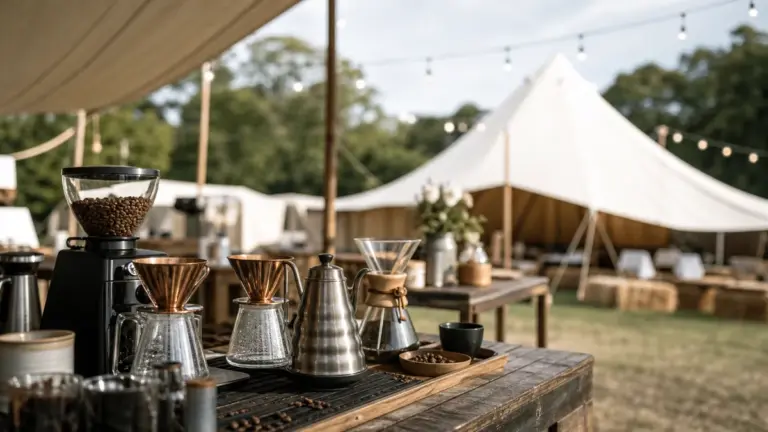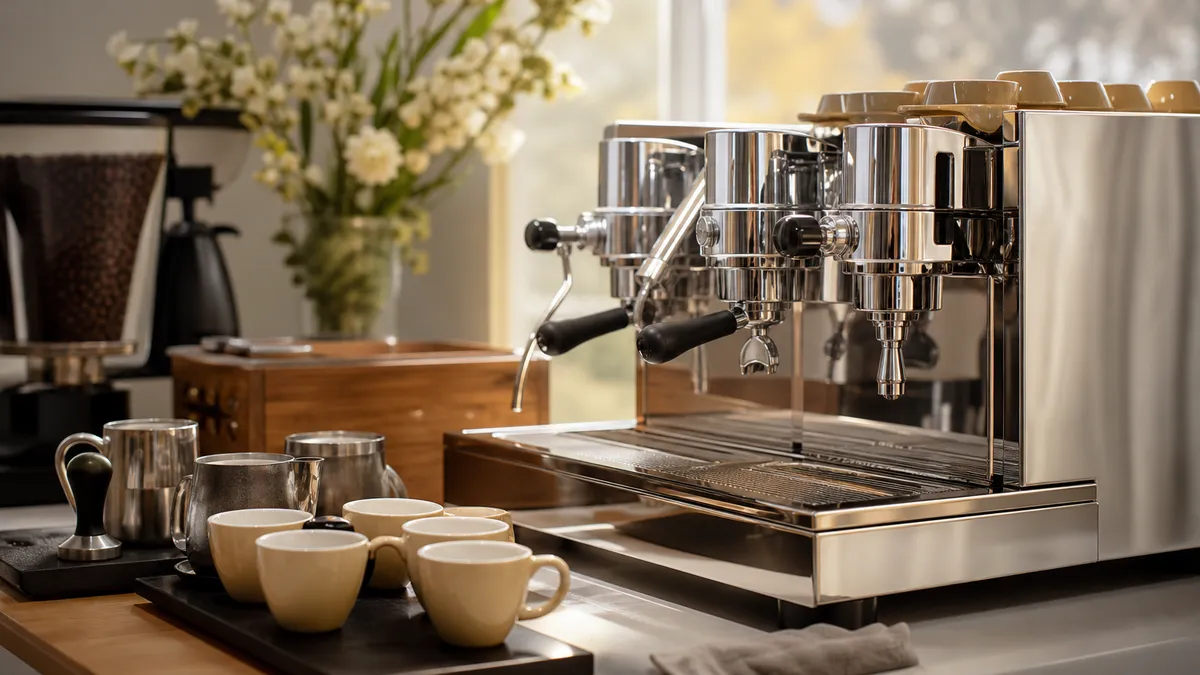
The World Barista Championship (WBC) is an international competition in which baristas demonstrate espresso preparation, drink creation and service under pressure. Each competitor has 15 minutes to serve four espressos, four milk beverages and four signature beverages, with judges assessing both the drinks and the performance.
In short
- Competitors normally qualify through a sanctioned national or regional championship, rather than entering the world final directly.
- The routine combines coffee preparation, accurate flavour descriptions, technical discipline and hospitality.
- Four sensory judges receive the drinks. A head judge oversees the evaluation, with a technical judge also present in the first round.
- The competition progresses through an opening round, semi-finals and a final.
- As checked in November 2026, the reigning champion is Pan Wei, representing China, who won in Panama on 25 October 2026.
Who organises the World Barista Championship?
The Specialty Coffee Association (SCA) produces the World Coffee Championships (WCC), the portfolio that includes the World Barista Championship. WCC is the umbrella name, while WBC identifies this particular competition.
World Coffee Events (WCE) remains relevant, rather than simply being an obsolete name. Although current public-facing material describes the championships as SCA-produced, the 2026 WBC rulebook identifies the competition as a programme of World Coffee Events Ltd, a wholly owned SCA subsidiary. These descriptions concern different organisational levels, not rival organisers.
The distinction is useful when searching for rules or older results: official documents may carry WCE, WCC or SCA branding. Our coffee events guide places the championship within the wider programme of competitions and gatherings.
The World Barista Championship format
Think of a routine as a short, carefully planned coffee service. The barista must prepare the drinks while explaining what the judges should experience, rather than merely delivering a rehearsed speech beside an espresso machine.
There are three beverage categories, often called courses:
| Course | Drinks served | What to watch |
|---|---|---|
| Espresso | Four | How clearly the barista connects the coffee’s flavour and texture with the drink served |
| Milk beverage | Four | The relationship between coffee, milk and the finished drinking experience |
| Signature beverage | Four | How the barista develops an original drink around coffee and explains its preparation |
The signature course is not a separate competition in elaborate garnishes. Its purpose is to show a considered beverage, supported by an explanation of the ingredients and preparation. A complicated recipe is not, by itself, evidence of a successful drink.
The same applies to presentation. Attractive cups and orderly service can support a routine, but viewers should keep returning to the central question: what experience is the competitor trying to deliver?
How the rounds work
The published WBC overview describes an opening round followed by semi-finals and a final. The top 15 opening-round competitors advance alongside a wild-card competitor, with the top six from the semi-finals progressing to the final.
There is therefore more to following the championship than watching the eventual winner’s last performance. Earlier rounds show the wider field and make useful comparisons between different approaches to coffee and service.
For the distinctions between this event and other disciplines, see barista competitions and winners. A title in another coffee competition should not be mistaken for the World Barista Champion title.
How judging works
WBC judging separates several questions that an audience might otherwise bundle together: does the drink taste good, does it match its description, and was it prepared and served competently?
In the 2026 format, the first round has four sensory judges, one technical judge and one head judge. The semi-finals and final have four sensory judges and one head judge; the head judge takes responsibility for specified station-management and cleanliness assessments when there is no technical judge.
Sensory judging: the drink and its description
Sensory judges evaluate what they taste and experience. The scoresheet distinguishes descriptor accuracy, meaning how closely the drink matches the competitor’s description, from the quality of the taste experience itself.
That distinction makes the competition easier to understand. Describing an espresso convincingly and producing an enjoyable espresso are related skills, but they are not interchangeable.
The sensory framework also considers tactile experience, or mouthfeel, alongside presentation, attention to detail and coffee knowledge. For milk beverages, visual appeal is one component of a broader assessment, not a substitute for taste.
A useful viewing habit is to write down the competitor’s promised flavours and texture. You cannot verify those sensations through a screen, but you can follow how clearly the barista explains the intended experience.
Technical judging: the work behind the drinks
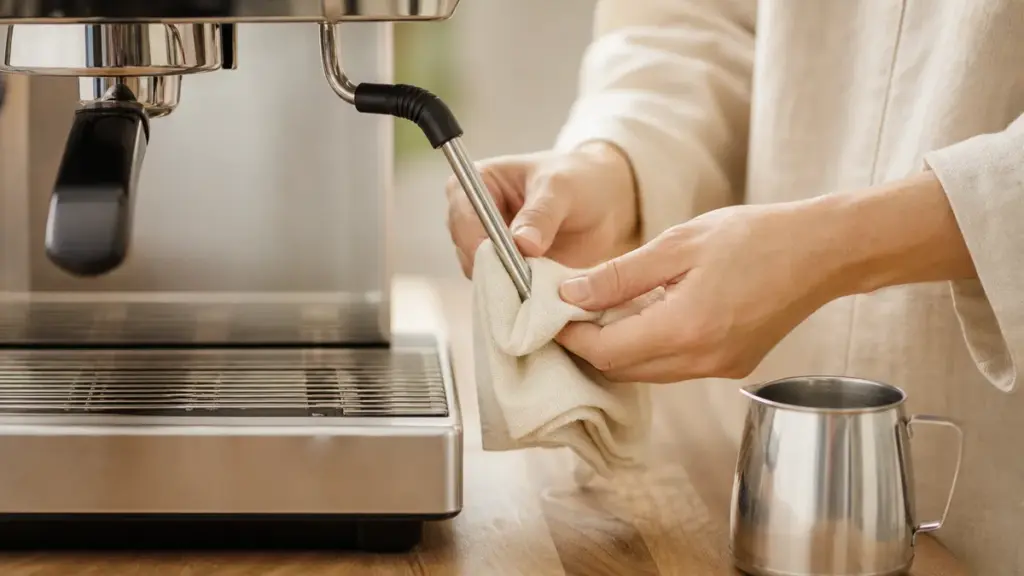
The technical scoresheet makes otherwise unobtrusive actions visible. It includes clean filter baskets, consistent dosing and tamping, prompt brewing after inserting the portafilter, steam-wand cleaning, hygiene and management of coffee and milk waste.
This is why a polished routine contains so much quiet housekeeping. Cleaning and organising are not interruptions to the performance; they form part of the assessed work.
For a learner, these details may be more useful than an elaborate signature recipe. Watch where the barista places tools, how they move between tasks and whether cleaning happens naturally as the service progresses.
How baristas qualify
The usual route is to win the championship run by a licensed Competition Body, the organisation authorised to hold the relevant qualifying competition. The world championship is not an open-entry event where any interested barista can register for a stage slot.
The rules allow one representative per licensed Competition Body in a competition year, with provisions governing substitutions and eligible deferrals. “National champion” is useful shorthand, but the formal rules use Competition Body terminology.
For UK competitors, the domestic route is the UK Barista Championship, which sits within SCA UK’s competition programme. Read our UK championship guide for that pathway rather than treating the world rules as a complete guide to local entry arrangements.
A sensible first step is to read both sets of documents: the current domestic entry information and the world championship rules. They answer different questions, and neither should be replaced by an old competitor’s checklist.
A short history and recent champions
The format has developed over time rather than remaining fixed since the first event. The SCA’s historical account records several useful milestones:
- 2000: the first World Barista Championship took place in Monte Carlo.
- 2003: the competition adopted the format of 12 drinks and four sensory judges.
- 2011: World Coffee Events was formed, with international consistency in competitions and judging among its objectives.
Recent results provide a manageable introduction to the championship’s winners:
| Year | Champion | Represented | Host |
|---|---|---|---|
| 2024 | Mikael Jasin | Indonesia | World of Coffee Busan, South Korea |
| 2025 | Jack Simpson | Australia | HostMilano, Italy |
| 2026 | Pan Wei | China | World of Coffee Panama, Panama City |
These are championship results, not a ranking of coffee-producing countries. The represented Competition Body and the origin of the coffee used are separate pieces of information.
Where is the next championship?
As checked on 2 November 2026, the WBC event page lists the next championship at World of Coffee Tokyo, Japan, from 28 April to 1 May 2027.
For clarity, the Panama championship took place from 22 to 25 October 2026 and has already finished. Check the organiser’s final daily programme before arranging attendance, because headline event dates do not necessarily describe every competitor activity.
Our worldwide coffee events guide covers the broader calendar without turning this explainer into an event directory.
How to watch a routine and understand it
Start with a complete performance rather than a highlights montage. The sequence matters: the introduction, preparation and service together show how the competitor connects an idea with the drinks.
Use this simple viewing method:
- Identify the central idea. Write a sentence describing what the competitor wants the judges to discover.
- Separate description from explanation. “Peach” describes an intended flavour; an account of why a preparation choice supports that experience is an explanation.
- Follow the workflow. Notice how brewing, milk preparation, ingredient handling and cleaning fit together.
- Use the scoresheet as a viewing guide. Look beyond the most theatrical moment to the less conspicuous assessed skills.
- Keep a boundary around what you can judge. You can assess clarity and observe technique, but you cannot taste the beverages through a recording.
For a first viewing, do not try to memorise every ingredient or movement. Choose one thing to follow, such as service organisation. On a second viewing, concentrate on how the barista communicates flavour.
Why the championship matters to coffee
The WBC gives coffee professionals a public setting in which to demonstrate and explain their work. Its influence is not limited to the winning drink.
The SCA’s historical account describes the competition format being used as a training tool in cafés. Breaking preparation into deliberate actions, then explaining the reason for each, provides a useful teaching model.
The same account traces the growing importance of producers’ stories and information about how coffee was grown and processed. The stage can connect the person serving the drink with the people behind the beans, although a compelling presentation should still be distinguished from independently verified production claims.
A more recent example is the organiser’s WBC 2025 in Numbers report. Using equipment telemetry, meaning automatically recorded machine data, it shared extraction information from the Milan competition. This offers material for technical discussion beyond what spectators can observe during a routine.
That does not make competition data a universal brewing prescription. Our editorial view is that the championship is most useful as a source of questions: what was the barista trying to achieve, what did they change, and how did they evaluate the result?
Nor should a championship routine be treated as a complete model for everyday service. Delivering a tightly assessed presentation and running a busy coffee service are different tasks. The most transferable lessons are purposeful preparation, accurate communication, cleanliness and attention to the person receiving the drink.
FAQ
Can I watch the World Barista Championship online?
Yes, the organiser publishes competition performances on the World Coffee Championships YouTube channel. Its 2026 winner announcement directs viewers to recordings, making a complete routine a useful starting point. For a future championship, check the official event page for livestream arrangements rather than relying on the previous year’s broadcast schedule.
Does winning prove someone makes the best coffee in the world?
No, it establishes that the competitor won this championship under its rules and judging framework. That is a substantial achievement, but it is not a test of every brewing method or every possible customer preference. The title is best understood in relation to the specific drinks, preparation skills and service being assessed.
What should a home coffee maker copy from a routine?
Start with the working habits rather than the signature-drink ingredients. As a practical learning exercise, organise your tools, describe the drink you intend to make and compare the result with that intention. Choose one observable habit to practise at a time, rather than trying to reproduce an entire championship performance.
Where to go next
Read Coffee Events and Festivals for the wider context, then Barista Competitions and Winners to distinguish the main titles. UK Barista Championship explains the domestic pathway to the World Barista Championship.
Sources
-
Specialty Coffee Association / World Coffee Championships, About, undated, current page checked November 2026. Public-facing organiser and championship portfolio.
https://wcc.coffee/about -
World Coffee Championships, World Barista Championship, undated, current page checked November 2026. Routine, progression and announced Tokyo dates.
https://wcc.coffee/world-barista-championship -
WCC Rules and Regulations Committee, 2026 World Barista Championship Official Rules and Regulations, 2026 edition. Corporate organisation, qualification and judging-panel composition.
https://static1.squarespace.com/static/65fb773fac2112270b71798a/t/69f0e4b0d4db0c64912308d8/1777394866548/2026%2BWorld%2BBarista%2BChampionship%2BOfficial%2BRules%2Band%2BRegulations.pdf -
World Coffee Championships, 2026 WBC Technical Scoresheet, 2026 edition. Technical assessment criteria.
https://static1.squarespace.com/static/65fb773fac2112270b71798a/t/69f0e4fb4d4fb73079b81443/1777394939298/2026%2BWBC%2BTechnical%2BScoresheet.pdf -
World Barista Championship, Sensory Scoresheet, updated 2024 file hosted by the New Zealand Specialty Coffee Association. Sensory categories, cross-checked against the 2026 rulebook’s evaluation sections.
https://nzsca.org/wp-content/uploads/2024/08/2024-WBC-Sensory-Scoresheet-UPDATED.pdf -
SCA UK, SCA UK Competitions, undated, current page checked November 2026. UK qualifying competition programme.
https://scauk.coffee/pages/sca-uk-competitions -
Specialty Coffee Association, Kelsey Kudak, Calling the Shots: 20 Years of the World Barista Championship, 25 Magazine, issue 9, 2019. Historical milestones and reported influence on training and producer narratives.
https://sca.coffee/sca-news/25-magazine/issue-9/english/calling-the-shots-20-years-of-the-world-barista-championship-25-magazine-issue-9-wkzbr -
World Barista Championship, 2024 WBC Combined Rankings, 2024. Final result and Busan venue.
-
World Coffee Championships, Announcing the 2025 World Barista Champion: Jack Simpson representing Australia, 21 October 2025. Champion and Milan host.
https://wcc.coffee/latest-news/announcing-the-2025-world-barista-champion -
World Coffee Championships, Announcing the 2026 World Barista Champion, Pan Wei, 25 October 2026. Champion, represented Competition Body and venue.
https://worldcoffeechampionships.squarespace.com/latest-news/announcing-the-2026-world-barista-champion-pan-wei -
Specialty Coffee Association / World Coffee Championships, Rules & Regulations Released for the 2026 World Barista Championship in Panama, 28 April 2026. Panama event dates.
https://worldcoffeechampionships.squarespace.com/latest-news/rules-regulations-released-for-the-2026-world-coffee-championships-in-panama -
World Coffee Championships, WBC 2025 in Numbers: Exploring Live Espresso Data from Milan’s World Stage, 19 December 2025. Publication of competition extraction telemetry.
https://worldcoffeechampionships.squarespace.com/latest-news/wbc-2025-in-numbers-exploring-live-espresso-data-from-milans-world-stage
Research used the current official championship pages, the 2026 rulebook and technical scoresheet, a published sensory scoresheet, organiser results and the SCA’s historical account; viewing advice and practical interpretations are editorial synthesis.
Last checked: November 2026