The UK Barista Championship (UKBC) is the national competition for espresso preparation, coffee service and presentation, organised by the Specialty Coffee Association UK Chapter. It selects the UK representative for the World Barista Championship, with competitors assessed on their drinks, technical work and ability to explain the coffee they serve.
In short
- The latest UK champion is Daria Bila, winner in 2026, ahead of Laura Metcalfe and Ted Longden.
- The full championship routine involves 12 drinks in 15 minutes: four espressos, four milk beverages and four signature beverages.
- UK qualifying heats can use an adapted format. The published 2027 qualifiers require six drinks in 10 minutes.
- The 2027 championship cycle begins with qualifiers in November and December 2026, not in 2027.
- Enter through SCA UK’s official competition listings and read the UK adaptations, not just the world rulebook.
Who organises the UK Barista Championship?
The Specialty Coffee Association UK Chapter, usually shortened to SCA UK, organises the UK national coffee championships. Its stated role includes running the competitions that lead into the world championships, and the chapter is run by volunteers through its committee structure.
The UKBC belongs to that national programme. It is not interchangeable with another event using “barista championship” in its name: check the organiser and qualification route before entering or interpreting a result. SCA UK’s own competition directory identifies the UKBC alongside its other championship disciplines.
For the wider context, our coffee events guide provides the starting point. This article concentrates on the UK national competition, rather than surveying festivals or international contests.
What happens in a competition routine?
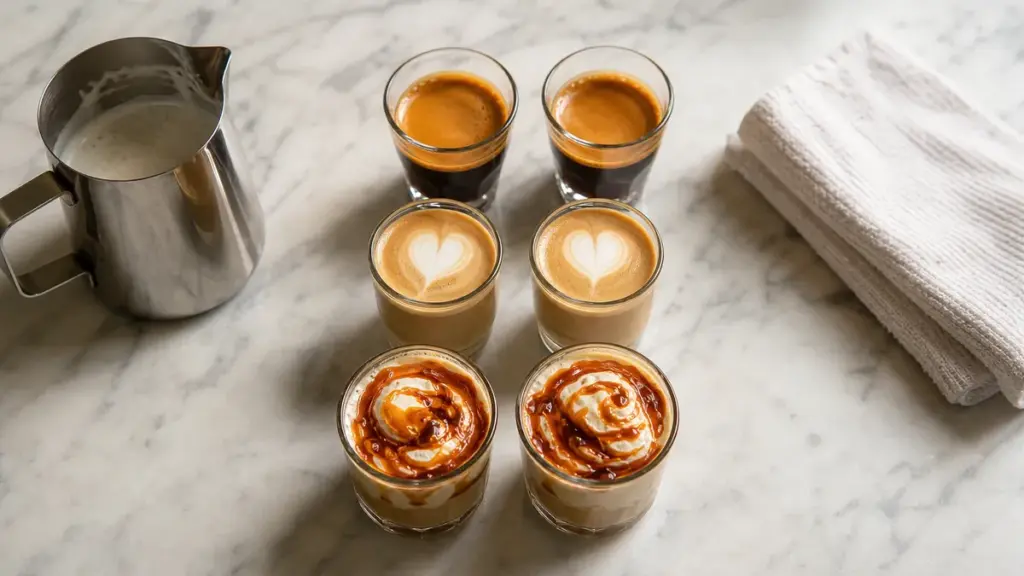
The full barista championship format combines drink preparation with a spoken presentation. Competitors prepare four examples of each beverage category during a 15-minute performance, while judges assess taste, cleanliness, technical proficiency, creativity and presentation.
| Beverage course | Full-format requirement | Published 2027 UK qualifier requirement |
|---|---|---|
| Espresso | Four drinks | Two drinks |
| Milk beverage | Four drinks | Two drinks |
| Signature beverage | Four drinks | Two drinks |
| Total performance | 12 drinks in 15 minutes | Six drinks in 10 minutes |
The full-format figures come from World Coffee Championships; the shorter qualifying format is SCA UK’s published adaptation for the 2027 cycle. Do not assume that every stage uses the same drink count or timing.
A signature beverage is the competitor’s own espresso-based creation. Under the 2026 rules, espresso flavour must remain present, and alcohol is prohibited. The milk course permits commercially available plain plant-based or animal milks, subject to the detailed ingredient rules.
For a newcomer watching a performance, try following the coffee through the courses. Ask what the competitor wants the judges to notice, then listen for how each preparation supports that explanation. This is a more useful viewing approach than treating the presentation as a sequence of unfamiliar ingredients.
The international competition has its own progression and administration, covered separately in our world championship guide.
How do heats, semi-finals and finals work?
The UK route begins with qualifying events and progresses towards the national championship’s later rounds. However, venues, available places and adaptations belong to a particular season. SCA UK explicitly says that it will identify the rules used for each championship and any UK-specific changes, including adaptations for barista heats.
The published 2027 qualifying schedule
As checked on 2 November 2026, SCA UK lists these qualifiers for the 2027 UKBC:
| Qualifier | Date | Published host |
|---|---|---|
| Huddersfield | 29 November 2026 | Dark Woods Coffee |
| Edinburgh | 1 December 2026 | Tanifiki |
| London | 4 December 2026 | Dalla Corte Hub |
| Cardiff | 7 December 2026 | Boss & Brew Academy |
These dates are the organiser’s published schedule, not a recurring annual calendar. Recheck the individual event listing before making travel arrangements.
The listings specify 10 places per qualifier, with the 12 highest-scoring competitors across the four qualifiers advancing to semi-finals planned for January 2027. That wording matters: it does not promise an equal number of advancing competitors from each location. The semi-final venue remained unconfirmed in the retrieved listing.
What the qualifying session includes
For the 2027 heats, SCA UK publishes separate allocations for off-stage practice, stage preparation, competition and clean-up: 30, 10, 10 and five minutes, respectively. The performance follows the 2026 WBC rules with the stated UK adaptations.
Treat these as separate tasks when practising. Rehearse unpacking and arranging equipment as well as making drinks, and write a packing list that follows the order in which you need each item. A polished speech is little help if your essential serving vessel is still in its transport box.
Do not build a later-round routine around an assumed final date or equipment arrangement. Obtain the current competitor instructions first, then keep your practice plan aligned with them.
Past UK champions and notable winners
The most useful historical distinction is between winning the UK title and winning the world title. A national victory earns the qualification route; the international result is a separate achievement.
A short selection of verified milestones:
- 2006 and 2007: James Hoffmann won the UK Barista Championship. He also won the World Barista Championship in 2007, as recorded in his own competition history.
- 2009: Gwilym Davies won the World Barista Championship. His professional coaching profile records that world title.
- 2017: Dale Harris won the World Barista Championship representing the United Kingdom, according to the official final rankings.
- 2025: Will Woodhouse-Banks won the UK Barista Championship. His employer’s annual review confirms the national title.
- 2026: SCA UK announced Daria Bila as champion, Laura Metcalfe second and Ted Longden third.
This is a selected timeline, not a complete roll of honour. It also avoids presenting a historical winner as the current champion: Will Woodhouse-Banks is the 2025 winner; Daria Bila is the 2026 winner.
Our competition and winners overview places such results alongside other disciplines without confusing their titles.
How to enter the UK Barista Championship
Start with the SCA UK competition directory and follow its UKBC entry route. For the published 2027 qualifiers, the listings were showing sold out when checked in November 2026, with instructions for requesting a waiting-list place. Availability can change, so use the individual listing rather than an old announcement.
A sensible entry process is:
- Identify the correct championship year. Save the listing and its latest competitor instructions together.
- Check eligibility before committing. Read the participation conditions and ask the organiser about any uncertainty.
- Choose the qualifier carefully. The published terms allow one entry per competitor and say places are non-transferable, with no later switch between qualifiers.
- Use the stated waiting-list process if necessary. The current instructions require an email naming the relevant qualifier.
- Check what is supplied and what you must bring. The 2027 heat listing requires competitors to bring their own crockery and additional equipment.
Under the 2026 rulebook adopted for these heats, competitors must be at least 18. Representation requires a valid passport from the place represented or qualifying documentation covering 24 months of residency, employment or scholastic enrolment, with some portion within the preceding 12 months. Ask SCA UK to confirm how the documentation requirements apply to your circumstances.
For preparation, first make a routine you can repeat, then refine its presentation. Record practice runs and ask a taster to write down what they actually experience before showing them your intended flavour descriptions. Use the difference as useful feedback rather than trying to persuade them that your script is right.
What judges assess beyond the drinks
Technical judging makes otherwise easily missed details visible. The published technical scoresheet includes clean baskets, consistent dosing and tamping, acceptable waste, steam-wand cleaning and purging, hygiene and station management. It is an assessment of working practice, not simply a reward for moving quickly.
Sensory assessment separates the experience of a drink from the accuracy of its description. The rules distinguish taste, aftertaste and tactile qualities, meaning the weight and texture felt in the mouth. Presentation also includes clear communication and the relationship between what the competitor explains and delivers.
As a practical interpretation, this favours an honest, coherent routine over an over-written one. If your practice drink tastes like soft stone fruit with a light, silky texture, describe that clearly. Do not add a long list of flavours merely because it sounds more ambitious.
For deeper viewing, pay attention to the small actions between courses. Watch where the competitor puts used equipment, how they keep the work area organised and whether their movements support the service rather than interrupt it. These are useful observation exercises drawn from the technical assessment categories.
FAQ
Can I watch previous UKBC performances online?
Yes, SCA UK publishes championship recordings through its official YouTube channel, including the 2026 semi-finals and final. Start with a complete performance rather than a short highlights clip. For learning, watch once for the overall presentation, then again to follow the competitor’s preparation and service decisions.
Is a championship routine a recipe to copy at home?
Treat it as inspiration rather than an automatic recipe recommendation. The championship assesses drinks within a timed service and presentation, so copying ingredients alone leaves out part of the exercise. A useful home experiment is to take one idea from a performance, compare it with your usual preparation and judge the result for yourself.
Where should I ask about an unclear UK rule?
Ask SCA UK before building your routine around an interpretation. Its rules page directs competitors to the world documents but says the chapter will specify the applicable edition and UK adaptations. Send a precise question identifying the rule, competition stage and proposed action, so the reply addresses your actual situation.
Where to go next
Read World Barista Championship for the international stage reached through the UK Barista Championship, and Barista Competitions and Winners to distinguish the different titles. For another preparation discipline, choose World Brewers Cup; return to Coffee Events and Festivals for the broader events guide.
Sources
-
SCA UK Chapter, “About Us”, undated, current page retrieved November 2026.
https://scauk.coffee/pages/about-us -
SCA UK Chapter, “SCA UK Competitions” and “Competition Rules”, undated, current pages retrieved November 2026.
https://scauk.coffee/pages/sca-uk-competitions
https://scauk.coffee/pages/rules -
SCA UK Chapter, “Barista Championship”, 2027 cycle.
https://scauk.coffee/pages/ukbc -
SCA UK Chapter, UKBC 2027 qualifier listings, 2026. The Huddersfield listing retains an older URL, but its retrieved title and content concern the 2027 qualifier.
https://scauk.coffee/products/ukbc-2024-heat-6-london-3rd-february-2024
https://scauk.coffee/products/ukbc-2027-heat-4
https://scauk.coffee/products/ukbc-2027-heat-2
https://scauk.coffee/products/ukbc-2027-heat-3 -
World Coffee Championships, “World Barista Championship”, current overview, retrieved November 2026.
https://wcc.coffee/world-barista-championship -
World Coffee Championships, 2026 World Barista Championship Official Rules and Regulations, 2026 edition, released April 2026; 2026 WBC Technical Scoresheet.
https://wcc.coffee/rules-regulations
https://static1.squarespace.com/static/65fb773fac2112270b71798a/t/69f0e4fb4d4fb73079b81443/1777394939298/2026%2BWBC%2BTechnical%2BScoresheet.pdf -
World Coffee Championships, 2025 World Barista Championship Official Rules and Regulations, 2025 edition. Used to cross-check the explanation of sensory and presentation assessment against the retrieved 2026 text.
https://static1.squarespace.com/static/65fb773fac2112270b71798a/t/67effe3e8185a43c00fa45e5/1743781439506/2025%2BWorld%2BBarista%2BChampionship%2BOfficial%2BRules%2Band%2BRegulations.pdf -
SCA UK Chapter, official 2026 UK Barista Championship season retrospective and results post, 2026.
https://www.linkedin.com/posts/scaukchapter_what-an-unforgettable-2026-season-of-the-activity-7491149646883475457-dCGE -
James Hoffmann, “Work”, competition history, undated.
https://www.jameshoffmann.co.uk/work -
Barista Hustle, “Coaching Profile: CZ Gwilym Davies”, undated professional profile.
https://www.baristahustle.com/find-a-coach/coaching-profile-cz-gwilymdavies/ -
World Coffee Championships, 2017 World Barista Championship Rankings, 2017.
https://static1.squarespace.com/static/65fb773fac2112270b71798a/t/66821403d90ab50817cd2734/1719800835333/2017%2BWBC.pdf -
Bettys & Taylors Group, Annual Review 2025, “Our Great British Barista”, page 9.
https://bettysandtaylors.co.uk/wp-content/uploads/EXTERNAL_BTG-ANNUAL-REVIEW_2025.pdf -
SCA UK Chapter, “2026 UK Barista Championship: Semi Finals” and “Final”, official recordings, July 2026.
https://www.youtube.com/watch?v=RF-TsgZFzso
https://www.youtube.com/watch?v=EpfNpdqtWsU
This article was researched using SCA UK’s current listings and announcements, World Coffee Championships documents, and primary professional records for selected historical results.
Last checked: November 2026