Climate change is making coffee harder to grow reliably through rising temperatures, disrupted rainfall and greater exposure to pests and extreme weather. Models project substantial losses of climatic suitability by the 2050s, but these are warnings about changing growing conditions, not predictions that coffee will disappear in 2050.
In short
- Check what a projection measures: suitable land, suitability scores and harvested production are different things.
- Heat and drought can reinforce each other, affecting both plant growth and the developing beans.
- Warmer conditions can allow coffee berry borer to reproduce in previously cooler growing areas.
- Adaptation includes locally tested varieties, carefully managed shade, water conservation and, where feasible, changes in growing location.
- Wild coffee conservation protects potential breeding resources, not just plants outside commercial farms.
Why coffee is vulnerable to climate change
Coffee depends on more than a suitable annual average temperature. The timing of rain, the severity of the dry season and conditions during flowering and bean development all matter. A year with apparently adequate rainfall can still be difficult if water arrives at the wrong time.
Arabica, Coffea arabica, generally favours cooler growing conditions than robusta, the coffee traded from Coffea canephora. However, neither species has one fixed temperature limit: varieties, soil, water availability and management influence how plants respond.
Heat also changes the plant’s water balance. Warmer air can increase the demand for water from leaves; when water becomes scarce, coffee closes its stomata, the tiny pores through which it exchanges gases. This conserves water but can restrict photosynthesis, the process that supplies energy for growth and fruit development.
Climate change is therefore not simply a question of plants becoming too hot. It changes the combination of stresses they face. For the wider environmental context, start with coffee and the environment.
What projections of suitable land loss actually mean
The widely repeated claim that coffee could lose half its suitable growing area needs qualification. These studies model relationships between climate and coffee’s distribution. They do not directly predict harvested tonnage, farmers’ decisions or the effectiveness of future adaptation.
Two influential papers published in 2015 are often grouped together, although their results are not interchangeable.
| Study | Coverage and period | Scenarios and method | Main finding |
|---|---|---|---|
| Bunn and colleagues, A bitter cup (2015) | Global arabica and robusta; 2040 to 2069 compared with 1950 to 2000 | Five climate models; RCP 2.6, 6.0 and 8.5; an ensemble trained on production locations | About half of global climatic suitability lost, with important regional differences |
| Ovalle-Rivera and colleagues (2015) | Major arabica-producing regions worldwide; the 2050s | Twenty-one climate models; SRES A2a; MaxEnt distribution modelling | Declines concentrated at lower elevations, with some gains higher up; not a single global 50% land-loss result |
RCPs, or Representative Concentration Pathways, describe different greenhouse-gas concentration trajectories. SRES A2a belongs to an earlier scenario framework. Neither is a prediction that one particular future must happen.
A necessary correction: Bunn’s headline concerns both commercial species and aggregates changes in suitability scores. It should not be presented as a precise forecast that half of currently cultivated arabica hectares will disappear. Ovalle-Rivera’s paper supports the broader warning, but does not independently establish that identical headline.
Reduced suitability means a location’s projected climate becomes less favourable according to the model. It does not automatically mean production ceases there, and a newly suitable location is not automatically available farmland.
Why the estimates remain uncertain
Distribution models infer tomorrow’s possibilities from where coffee grows today. They cannot fully represent every future variety, irrigation decision or change in shade management.
Researchers reviewing coffee physiology have also argued that elevated carbon dioxide could partly offset some heat effects by supporting photosynthesis. Controlled experiments and field enrichment studies provide evidence for that mechanism, but not a guarantee of protection against drought, pests or damaging weather.
The disagreement concerns the size of the damage and how much adaptation can achieve, rather than whether growing conditions are changing. Treat a global suitability map as a guide to broad risk, not a planting prescription for an individual farm.
Rising temperatures, pests and extreme weather
Heat affects the crop and its enemies
Higher temperatures can accelerate fruit development, potentially compressing the period available for bean filling and affecting quality. Water shortages can make the consequences worse. Survival alone is therefore an inadequate measure of success: farmers need a harvest with acceptable yield and quality.
Coffee berry borer, Hypothenemus hampei, is a small beetle whose larvae damage the beans inside coffee cherries. Temperature influences its development and reproduction.
Jaramillo and colleagues’ 2011 study combined distribution modelling with evidence of expansion into higher-elevation coffee areas in East Africa. Warming can make previously cool locations more favourable to the insect and permit additional generations. This does not mean every high-altitude farm will become infested, but it weakens the assumption that elevation alone provides protection.
Too little water and too much water can both damage harvests
Prolonged drought restricts growth and can be particularly damaging during bean filling. Heatwaves add stress when plants are already short of water.
Excessive rain creates different problems. FAO’s assessment published in March 2025 linked reduced Vietnamese production to prolonged dry weather, while excessive rain damaged Indonesian coffee cherries. Hot, dry conditions also affected Brazilian production expectations.
These examples show why “a warmer climate” is an incomplete description of the risk. Farms must cope with rainfall disruption and extremes as well as rising averages.
However, evidence that weather damaged a harvest is not, by itself, proof that human-caused climate change caused that particular event. Event attribution requires a separate analysis comparing its likelihood or intensity with and without human influence.
How coffee farming can adapt
There is no universal climate-proof production system. Effective adaptation starts with the local constraint: heat, unreliable rain, water shortage, disease pressure or a combination.
Better varieties, including F1 hybrids
Breeding can combine useful traits such as disease resistance, yield potential and tolerance of environmental stress. An F1 hybrid is the first generation produced by crossing selected parents; it is a breeding category, not a promise of drought tolerance.
World Coffee Research lists Centroamericano as an F1 hybrid well adapted to agroforestry, meaning cultivation alongside trees. Starmaya is another F1 hybrid, distinguished by its suitability for professional seed production rather than relying on tissue-culture propagation.
These are examples of breeding options, not universal replacements for existing varieties. A variety described as rust-resistant or high-yielding should not automatically be described as heat-resistant. Local trials need to establish how it performs under the farm’s actual conditions.
Shade and water management
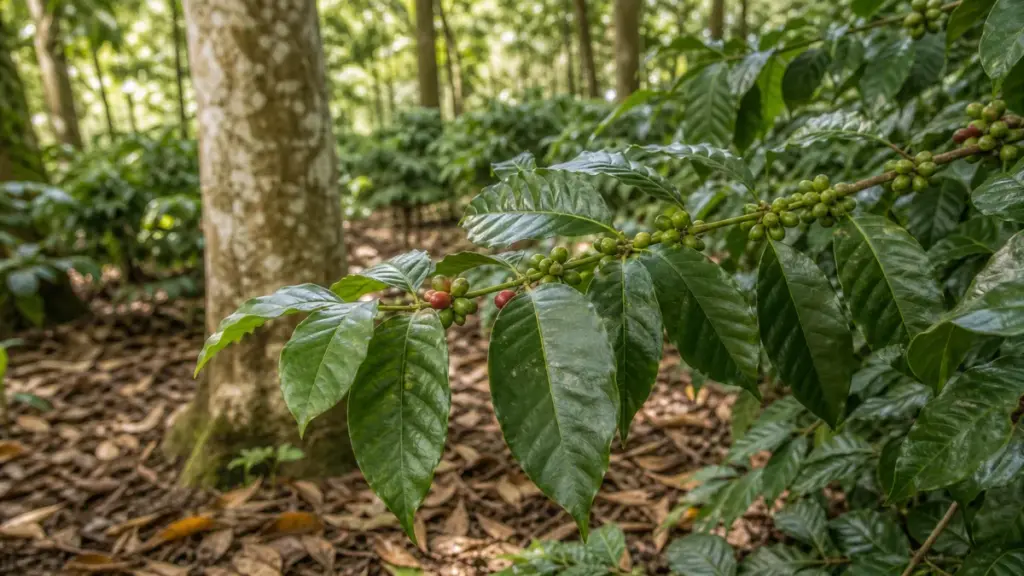
Shade trees can soften temperature extremes around coffee plants. In a field study on Mount Elgon, Uganda, shaded systems had lower maximum temperatures than open-grown coffee.
However, trees also use water. That study found lower soil moisture in shaded systems and identified potential competition during drier years. More shade is therefore not always better: tree species, rooting patterns, spacing and pruning matter.
Water storage, carefully targeted irrigation and management that improves water-use efficiency can complement shade. Research on Indian robusta agroforestry systems stresses that the most useful response depends on the scale and location of the risk. An approach suitable for a region may still need substantial adjustment on a particular farm.
Higher altitude, where relocation is feasible
Moving uphill can provide access to cooler conditions, but it is not a simple solution. Farmers need suitable soil, access to land and the practical means to establish production elsewhere.
Potentially suitable higher ground may also be forested or protected. Clearing it would turn an adaptation response into another environmental problem. Deforestation and coffee explains that separate issue in detail.
The practical priority is to assess how much adaptation is possible on existing agricultural land before treating expansion as the answer.
Wild coffee species: valuable resources, not instant replacements
A 2019 assessment led by Aaron Davis at the Royal Botanic Gardens, Kew found that at least 60% of the 124 wild coffee species assessed were threatened with extinction. This was an assessment of the species recognised and evaluated at that time, not a permanent total for the genus.
The threats included habitat loss, climate change, pests and disease. Conserving wild populations preserves genetic resources that may help breeders develop future crops.
Coffea stenophylla illustrates the potential. Rediscovered in the wild in Sierra Leone in 2018, it attracted renewed attention through research published in 2021, rather than being rediscovered that year.
Davis and colleagues combined sensory assessment with climate analysis and reported an arabica-like flavour profile from a species associated with substantially warmer growing conditions. That makes stenophylla a promising research resource, not proof of a ready replacement for commercial arabica. Flavour and climatic tolerance are only part of what a dependable crop needs.
What climate change means for coffee prices and UK buyers
Weather-related harvest losses can tighten supplies and put upward pressure on coffee prices. FAO’s July 2026 analysis identifies drought, frost and excessive rainfall as important triggers of market shocks.
The effect is not a simple upward line. Supply, demand, expectations and the structure of the supply chain influence how international movements reach farmers and consumers. A higher market price also does not automatically compensate a farmer whose harvest has failed.
For a UK workplace buyer, the useful response is to ask suppliers practical questions rather than demand an unsupported “climate-proof” claim:
- Which producing regions and varieties supply the blend?
- What happens if a familiar component becomes unavailable?
- What evidence supports any claims about farmer adaptation or breeding support?
- How will substitutions be communicated and checked for flavour and machine suitability?
These are suggested purchasing checks, not a certification scheme. Keep adaptation separate from emissions reduction: helping a farm withstand heat is not the same as reducing the emissions associated with coffee. The latter belongs in carbon footprint.
Coffee and climate change is ultimately a question of both plants and people. Promising breeding and farming responses need to work under local conditions, with farmers able to put them into practice.
FAQ
Should I switch from arabica to robusta?
Not simply because robusta is generally associated with warmer conditions. Robusta also faces climate risks, and tolerance varies among plants and locations. Species alone is not enough to assess a coffee’s resilience. For purchasing, ask about its origin, growing system and evidence of adaptation rather than assuming one species is the environmentally correct choice.
Can shade-grown coffee still suffer from drought?
Yes, shade-grown coffee can still experience serious water stress. Shade may reduce heat around the plant, but companion trees also draw water from the soil. Field research shows that cooling benefits and water competition can occur together. Tree selection and management need to match rainfall, soil and the severity of the dry season.
What evidence should support a “climate-resilient coffee” claim?
It should identify the trait, location and evidence behind the claim. Useful supporting information might include local variety trials, monitored shade management or documented water-conservation work. Ask what was measured and compared. Resistance to one disease, or survival in one hot season, is not enough to demonstrate dependable performance under all future conditions.
Where to go next
Read Coffee and the Environment: The Complete Guide for the broader environmental picture, then Carbon Footprint to distinguish adaptation from emissions reduction. Deforestation and Coffee explains why shifting production must not become an excuse to clear forests.
Sources
- Springer Nature, Climatic Change. Bunn and colleagues, “A bitter cup: climate change profile of global production of Arabica and Robusta coffee” (2015; published online December 2014). Retrieved article.
- PLOS ONE. Ovalle-Rivera and colleagues, “Projected Shifts in Coffea arabica Suitability among Major Global Producing Regions Due to Climate Change” (2015). Retrieved article.
- American Chemical Society, Journal of Agricultural and Food Chemistry. DaMatta and colleagues, “Physiological and Agronomic Performance of the Coffee Crop in the Context of Climate Change and Global Warming: A Review” (2018). Retrieved paper, hosted by BREEDCAFS.
- Springer Nature, Climatic Change. “Why could the coffee crop endure climate change and global warming to a greater extent than previously estimated?” (2018). Retrieved article.
- PLOS ONE. Jaramillo and colleagues, “Some Like It Hot: The Influence and Implications of Climate Change on Coffee Berry Borer (Hypothenemus hampei) and Coffee Production in East Africa” (2011). Retrieved paper, hosted by USDA.
- World Coffee Research. Varieties Catalog: Starmaya and Centroamericano, undated online entries, checked November 2026.
- Elsevier, Agricultural and Forest Meteorology. “Water use of Coffea arabica in open versus shaded systems under smallholder’s farm conditions in Eastern Uganda” (2019). Retrieved publisher abstract.
- Nature Portfolio, Scientific Reports. “Assessing scale-dependency of climate risks in coffee-based agroforestry systems” (2024). Retrieved article.
- Royal Botanic Gardens, Kew. “Kew scientists reveal that 60% of wild coffee species are threatened with extinction, causing concern for the future of coffee production” (2019), reporting Davis and colleagues’ assessment. Retrieved research announcement.
- Royal Botanic Gardens, Kew. “‘Forgotten’ coffee species that grows at higher temperatures and boasts a superior flavour could help to futureproof the coffee industry under climate change, says new study” (2021), reporting Davis and colleagues’ Nature Plants research. Retrieved research announcement.
- Food and Agriculture Organization of the United Nations. “Adverse climatic conditions drive coffee prices to highest level in years” (2025). Retrieved assessment.
- Food and Agriculture Organization of the United Nations. “A new FAO report examines how shocks affect global coffee, cocoa and tea markets and outlines policy options to address structural vulnerabilities” (2026). Retrieved report announcement.
Researched through live retrieval of peer-reviewed modelling and physiology papers, field-study findings, World Coffee Research variety records, Kew research announcements and FAO market assessments.
Last checked: November 2026