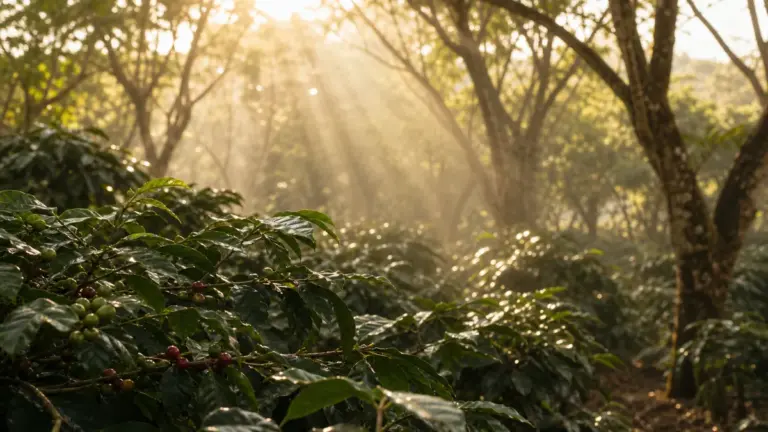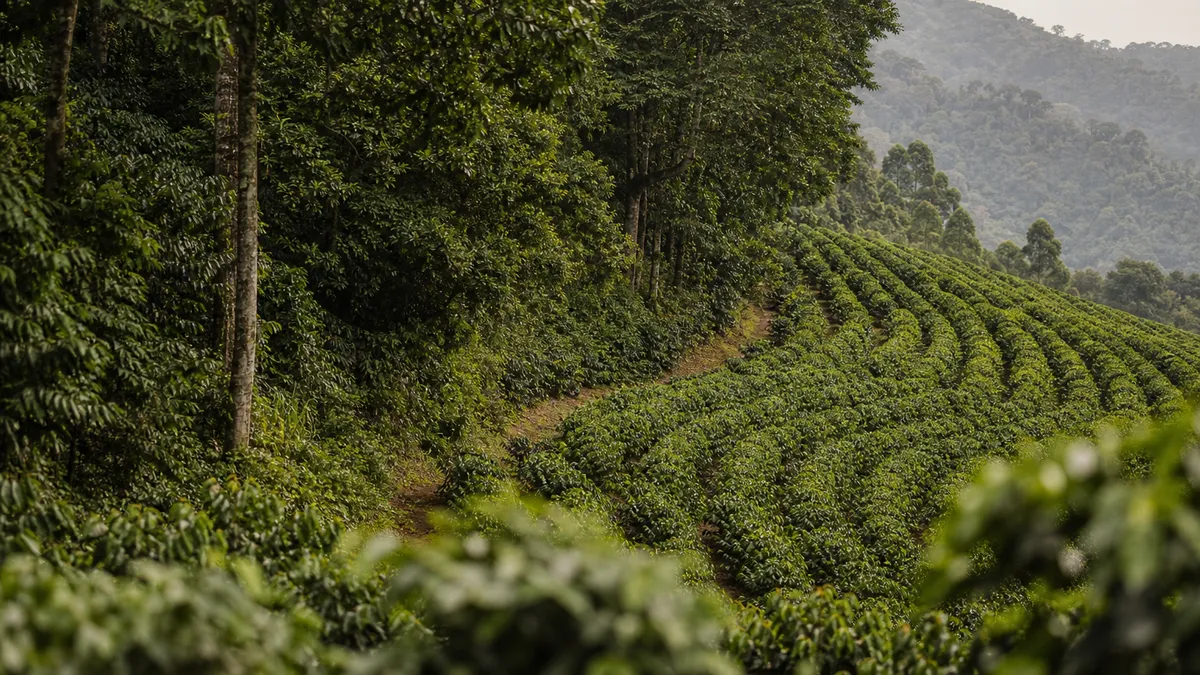
Coffee is linked to deforestation when forests are converted into coffee farms, including some farms that retain shade trees. The strongest buying question is therefore not simply whether coffee is shade-grown, but where it grew and what occupied that land before: new EU rules make this distinction central, while Great Britain is developing a separate approach.
In short
- Forest protection and tree planting are different: adding trees to an existing coffee farm does not undo the conversion of natural forest.
- Agroforestry, growing coffee alongside trees, can support biodiversity, but its benefits depend on the trees, farming practices and surrounding habitat.
- The EU deforestation cut-off is 31 December 2020. This is separate from the dates when businesses must start complying.
- Main EU obligations apply from 30 December 2026, with a later start for qualifying micro and small operators. Newly added soluble coffee products follow from 30 December 2027.
- Northern Ireland follows the EUDR framework. Great Britain’s proposed coffee requirements are still under development as checked in November 2026.
How coffee production can replace forests
Deforestation means converting forest to another land use. For coffee, the clearest example is clearing forest and planting coffee bushes, but conversion does not always leave a bare hillside. A farm can retain some large trees and still represent a change from forest to agricultural production.
This matters because a green canopy is not proof of an intact ecosystem. Coffee agroforestry may provide valuable habitat, yet replacing natural forest with a managed crop changes the vegetation and the conditions available to wildlife. Under the EU framework, converting forest into coffee agroforestry still counts as deforestation.
The environmental question also depends on the starting point. Planting shade trees on an established agricultural field is different from thinning natural forest to establish coffee beneath the remaining canopy. Photographs of leafy farms cannot establish that history on their own.
For the wider context, start with coffee and the environment. Here, the focus is specifically on land conversion, alternatives and evidence that can follow the beans through the supply chain.
What does the evidence show?
The World Resources Institute’s Global Forest Review estimates that nearly 2 million hectares of forest were replaced by coffee plantations between 2001 and 2015. Its assessment includes both arabica and robusta, so neither category should be assumed free from forest-conversion risk.
That figure needs careful interpretation. It describes forest loss on land subsequently associated with coffee, not a current annual rate or proof that every clearing event was immediately caused by coffee planting. The assessment also identifies limitations in crop maps, geographic resolution and attribution.
The defensible conclusion is that coffee has a documented connection to forest replacement, but a global estimate cannot determine whether a particular bag contributed to it. That requires evidence about the producing plots.
Forest conversion also connects to greenhouse-gas accounting, but that is a separate measurement problem. See carbon footprint rather than treating deforestation statistics as ready-made emissions figures.
Can agroforestry offer an alternative?
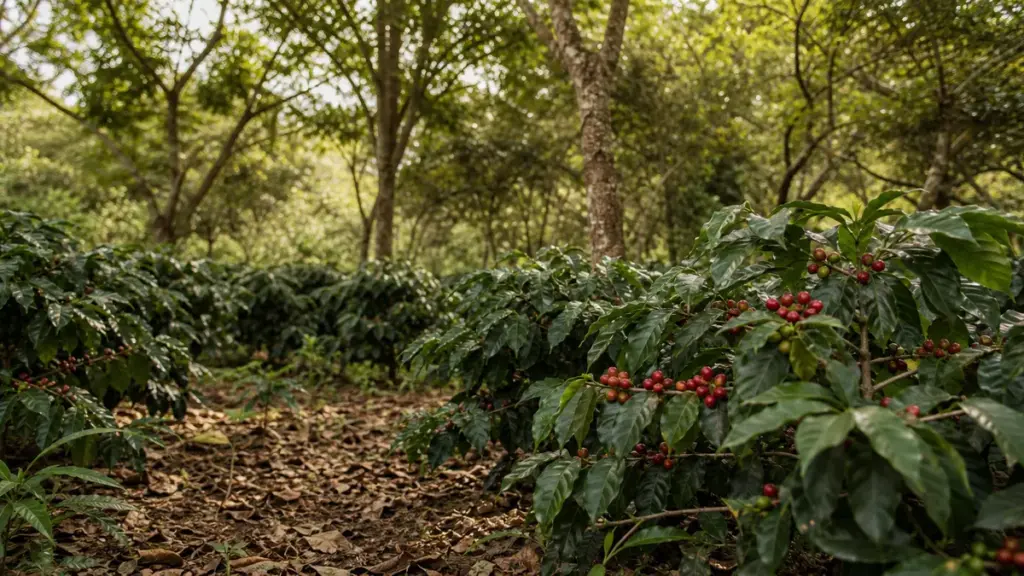
Agroforestry means deliberately growing coffee with trees on the same land. The useful comparison is between improving existing farmland and expanding into remaining forest, not simply between “trees” and “no trees”.
A 2024 meta-analysis, a study combining results from other studies, found higher species diversity overall in highly shaded coffee farms than in sun-grown farms. However, outcomes differed between animal groups and regions. This supports agroforestry as a conservation tool, not a universal guarantee.
Trees can provide habitat, and their arrangement can help connect patches of vegetation. The practical priorities are to protect remaining natural forest, retain useful existing trees and improve the ecological quality of farms already in production. Agroforestry should complement forest protection, not provide a justification for clearing.
Why more shade is not always better
Farmers also need productive coffee plants. A 2022 meta-analysis of arabica cultivars found different yield responses to shade: some were broadly neutral, some benefited up to a point, and others declined as shade increased.
There is therefore no single canopy prescription suitable for every farm. Advice should reflect the cultivar, local conditions and management system rather than copying a percentage from another region.
This is where apparently conflicting claims need separating. Evidence that shade can improve biodiversity does not establish that maximum shade produces the best crop. Nor does evidence of productive sun-grown coffee show that removing natural forest is acceptable. These studies answer different questions.
For the relationship between growing conditions and adaptation, continue with coffee and climate change.
What the EU Deforestation Regulation requires
The EU Deforestation Regulation, usually shortened to EUDR, is Regulation (EU) 2023/1115, as amended. For products within its scope, the central requirements are that they are deforestation-free, comply with relevant legislation in the producing country and have the required due diligence coverage.
Due diligence means collecting evidence, assessing the risk of non-compliance and addressing risks where necessary. A supplier’s general sustainability promise is not the same thing.
For coffee, the deforestation cut-off is 31 December 2020. Coffee grown on land converted from forest after that date cannot satisfy the deforestation-free condition simply because the clearance was locally permitted or shade trees were retained.
The timetable as checked in November 2026
The application dates have changed, so older guidance can be misleading.
| Product or operator category | Application date | Qualification |
|---|---|---|
| Green and roasted coffee, large and medium operators | 30 December 2026 | Includes coffee within heading 0901 |
| Qualifying micro and small operators | 30 June 2027 | The statutory deferral concerns operators established as such by 31 December 2024 |
| Micro and small operators dealing with products already covered by the EU Timber Regulation | 30 December 2026 | Specific exception to the later timetable |
| Newly added coffee extracts, essences and concentrates, including soluble coffee | 30 December 2027 | Added under Delegated Regulation (EU) 2026/2102 |
The main timetable follows amendments made in December 2024 and December 2025. The soluble-coffee addition is a separate 2026 change, not another postponement for green or roasted coffee.
Businesses should establish both their product classification and their supply-chain role. The rules distinguish operators first placing products on the market from downstream operators and traders, whose obligations differ.
Northern Ireland and Great Britain are not the same
Northern Ireland
EUDR will apply in Northern Ireland. This includes relevant movements into Northern Ireland, not just direct imports from coffee-producing countries.
A business supplying coffee from Great Britain to Northern Ireland should therefore check the movement-specific guidance and identify who is responsible for the relevant obligations. GOV.UK gives a Northern Ireland coffee shop buying beans from a Great Britain wholesale roastery as an example requiring attention to operator status.
Private consumers buying for personal use do not have to undertake these business compliance procedures.
Great Britain
EUDR does not apply directly in England, Scotland or Wales. However, Great Britain businesses supplying relevant products to EU or Northern Ireland markets can still encounter its requirements through those activities.
Separately, Defra’s policy announced on 23 June 2026, updated on 2 September 2026, proposes a Great Britain regime covering coffee and other forest-risk commodities. It anticipates due diligence, reporting and origin geolocation evidence, with implementing legislation expected in 2027.
These are proposals and an expected legislative timetable, not an already-operational coffee regime. The Environment Act 2021, Schedule 17, provides a framework requiring further regulations to specify its operation.
There is also a substantive distinction: the proposed initial Great Britain approach centres on compliance with relevant local laws. Defra states an intention to move towards a deforestation-free standard in due course. Local legality and an absolute no-deforestation requirement should not be presented as identical.
Traceability: connecting the beans to the land
Traceability is the ability to connect a coffee lot to its production origin through the businesses handling it. For deforestation checks, knowing only the exporting country or the cooperative’s address is insufficient: the producing land matters.
Under the ordinary EUDR geolocation requirement, coffee plots larger than 4 hectares need boundary polygons, meaning coordinates describing their perimeter. Smaller plots can use a location point. The claim that every coffee plot must have a polygon is therefore too broad.
There are also specific simplifications for qualifying micro or small primary operators. These should not be confused with a general exemption for coffee grown by smallholders.
A practical evidence-checking sequence
For a roaster, importer or workplace buyer assessing a supplier, use this sequence:
- Identify the coffee. Ask which origins and lots make up the product, including each component of a blend.
- Ask how plots are identified. Establish whether production locations are recorded and connected to the supplied coffee.
- Ask how land history is checked. Request an explanation of the forest baseline, subsequent monitoring and investigation of alerts.
- Check the chain of custody. Ask how the supplier prevents coffee of unknown origin entering the documented supply.
- Establish responsibility. Identify who performs due diligence and holds the relevant records or statement references.
These are purchasing questions, not a substitute for a business’s own legal assessment. An office sourcing coffee should request a clear supplier explanation rather than assume it must personally map farms.
What satellite checks and certification can establish
Satellite monitoring is useful for identifying possible changes in tree cover, but an alert is not automatically proof of unlawful conversion or EUDR non-compliance. Rainforest Alliance describes its mapping as risk assessment requiring investigation, including field verification where appropriate.
Certification can contribute data and assurance. It does not replace the legal duties: Rainforest Alliance explicitly states that its certified coffee cannot automatically be considered EUDR-compliant.
A reasonable buying preference is therefore documented origin, credible land-history checks and support for producers to supply the evidence. Ask how buyers help farmers and cooperatives collect usable information, rather than treating missing paperwork as proof of deforestation.
For deforestation and coffee, the decisive evidence connects the actual supply to the actual land. Packaging choices address a different issue, covered in eco-friendly packaging.
FAQ
Can old coffee farms still meet the EU rules?
Yes, historic forest conversion does not automatically disqualify a coffee farm under the EUDR cut-off. The relevant deforestation-free test concerns conversion after 31 December 2020, alongside the other legal requirements. This is a market-access baseline, not a claim that earlier habitat loss was environmentally harmless.
Is a single-origin coffee automatically easier to verify?
No, the description alone does not establish plot-level traceability. For a purchasing decision, ask what “single-origin” identifies and whether the supplier can connect the delivered lot to production plots. A specific-sounding description should not substitute for records linking the coffee through its supply chain.
Does planting trees elsewhere make recently deforested coffee compliant?
No, planting trees elsewhere does not change the production plot’s land-use history. The EUDR test concerns where the relevant coffee was grown and whether forest conversion occurred after the cut-off. Restoration may have its own value, but it cannot substitute for satisfying that condition.
Where to go next
Read Coffee and the Environment for the wider set of environmental questions, then Carbon Footprint for emissions accounting and Coffee and Climate Change for growing conditions and adaptation. Coffee Pods and the Environment addresses a different decision: the environmental implications of the brewing format.
Sources
-
World Resources Institute, Global Forest Review: Deforestation Linked to Agriculture, live reference, accessed 2026. Coffee estimate covers 2001 to 2015; methodology limitations also consulted.
https://gfr.wri.org/forest-extent-indicators/deforestation-agriculture. -
Manson and colleagues, Oxford Brookes University repository, Effect of shade on biodiversity within coffee farms: A meta-analysis, Science of the Total Environment, 914, 169882, 2024.
https://radar.brookes.ac.uk/radar/file/d1a2eac0-ce82-4701-96cb-141fd05f2935/1/1-s2.0-S0048969724000160-main.pdf. -
Koutouleas and colleagues, Springer Nature, Shade effects on yield across different Coffea arabica cultivars: how much is too much? A meta-analysis, Agronomy for Sustainable Development, 2022.
https://link.springer.com/article/10.1007/s13593-022-00788-2. -
European Union, EUR-Lex, Regulation (EU) 2023/1115, consolidated version dated 18 September 2026, particularly Articles 2, 3, 5 and 9.
https://eur-lex.europa.eu/eli/reg/2023/1115/2026-09-18/eng/pdf. -
European Union, EUR-Lex, Regulation (EU) 2025/2650 amending Regulation (EU) 2023/1115 as regards certain obligations of operators and traders, 19 December 2025.
https://eur-lex.europa.eu/legal-content/EN/TXT/PDF/?uri=CELEX%3A32025R2650. -
European Commission, EUR-Lex, Commission Delegated Regulation (EU) 2026/2102, 13 July 2026, published 17 September 2026, Annex coffee entry.
https://eur-lex.europa.eu/legal-content/EN/TXT/PDF/?uri=CELEX%3A32026R2102. -
European Commission, Regulation on Deforestation-free products, live implementation overview, 2026.
https://environment.ec.europa.eu/topics/forests/deforestation/regulation-deforestation-free-products_en. -
Defra, The UK’s approach to deforestation regulations, published 23 June 2026, updated 2 September 2026.
https://www.gov.uk/government/publications/the-uks-approach-to-deforestation-regulations/the-uks-approach-to-deforestation-regulations. -
Defra, Moving, exporting or placing deforestation-free products on the market in Northern Ireland, published 17 July 2026, updated 27 August 2026.
https://www.gov.uk/guidance/moving-exporting-or-placing-deforestation-free-products-on-the-market-in-northern-ireland. -
UK Parliament, legislation.gov.uk, Environment Act 2021, Schedule 17.
https://www.legislation.gov.uk/ukpga/2021/30/pdfs/ukpga_20210030_en.pdf. -
European Forest Institute, Unpacking the EU Deforestation Regulation for the coffee sector, 2026 factsheet. Used for the forest-to-agroforestry distinction and supply-chain explanation, not subsequent legislative changes.
https://efi.int/sites/default/files/2026-01/eudr_coffee_factsheet.pdf. -
Rainforest Alliance, EUDR Compliance Support, live guidance, accessed November 2026. Used for its own certification, mapping and producer-support procedures.
https://www.rainforest-alliance.org/business/certification/supporting-eudr-compliance-from-farm-to-retailer/.
This article was researched through live checks of legislation, official implementation guidance, research syntheses and the organisations’ own descriptions of their assurance systems.
Last checked: November 2026