Used coffee grounds are best reused through mixed composting, rather than tipped straight onto plants or washed down the sink. Cascara is a different coffee by-product: dried coffee-cherry skin and pulp used to make a fruity infusion, but UK businesses must establish the lawful supply route before selling or serving it.
In short
- Compost grounds with other materials, not as a heap of coffee alone. Washington State University recommends no more than 20% grounds by volume.
- Avoid adding uncomposted grounds to seed trays or treating them as ready-made houseplant fertiliser.
- Keep grounds out of drains. For cleaning, they are not a substitute for suitable detergents or disinfectants.
- England’s workplace food-waste separation rules began on 31 March 2025; qualifying micro-firms have until 31 March 2027.
- The EU authorised specified dried coffee-cherry pulp and infusion products in 2022. That permission does not automatically establish authorisation in Great Britain.
Coffee grounds and cascara are different materials
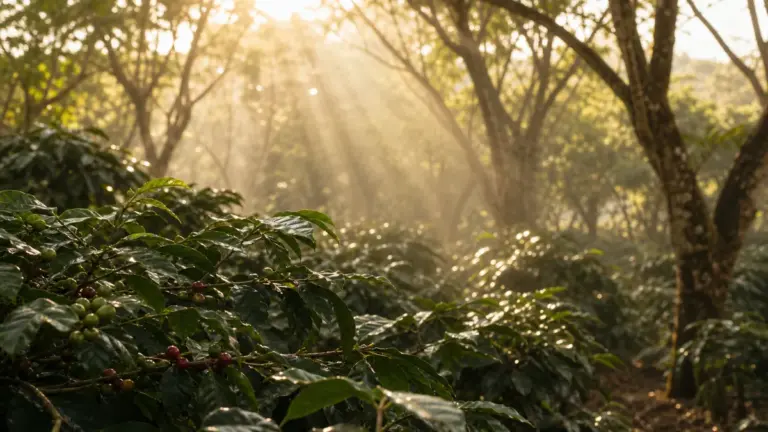
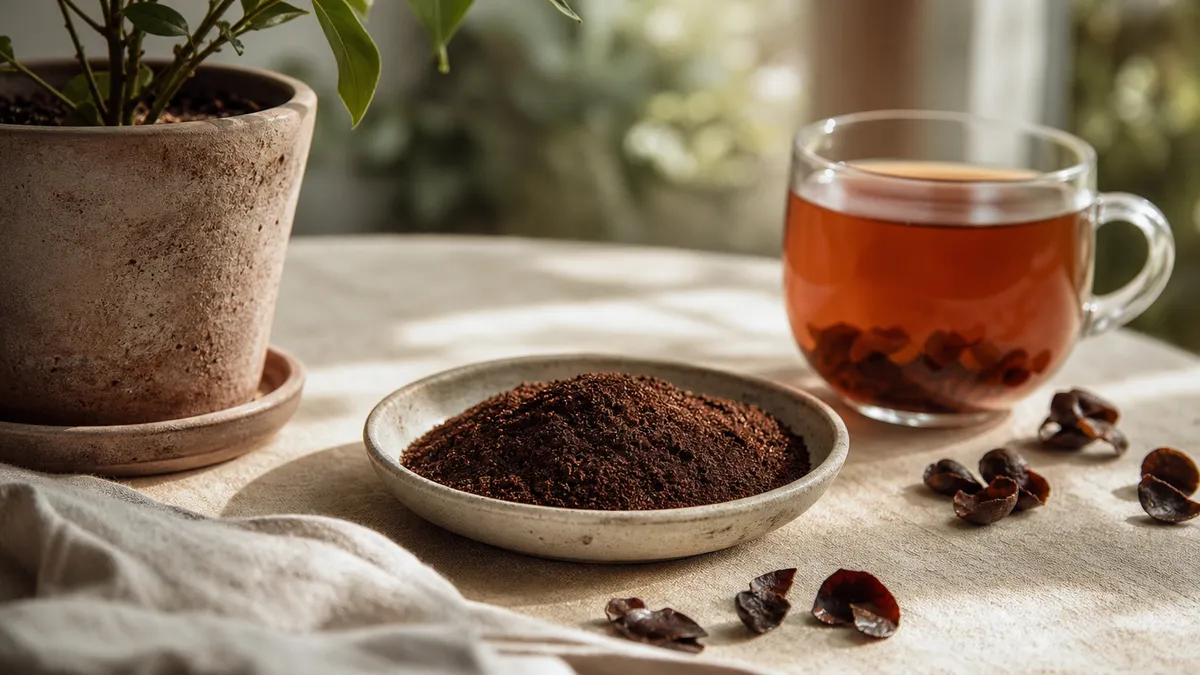
Spent coffee grounds are the particles left after brewing roasted, ground coffee. Cascara comes from processing the coffee fruit before roasting: it is principally the dried outer skin and fleshy pulp of the coffee cherry, the fruit containing the seeds we call coffee beans.
The terminology needs care. Parchment is the papery inner layer surrounding the seed, while silverskin is the thin seed covering released largely during roasting. Neither is simply another name for coffee-cherry pulp.
Cascara from whole cherries dried before hulling can include parchment alongside the skin and pulp. That does not make arbitrary milling husks or roasting chaff suitable ingredients for tea. Food-grade cascara needs an identified composition, controlled production and an appropriate legal basis for sale.
These distinctions matter when choosing a second use. Garden composting, food manufacture and beverage preparation have different requirements, even when the starting materials all come from coffee. The wider context belongs in coffee and the environment.
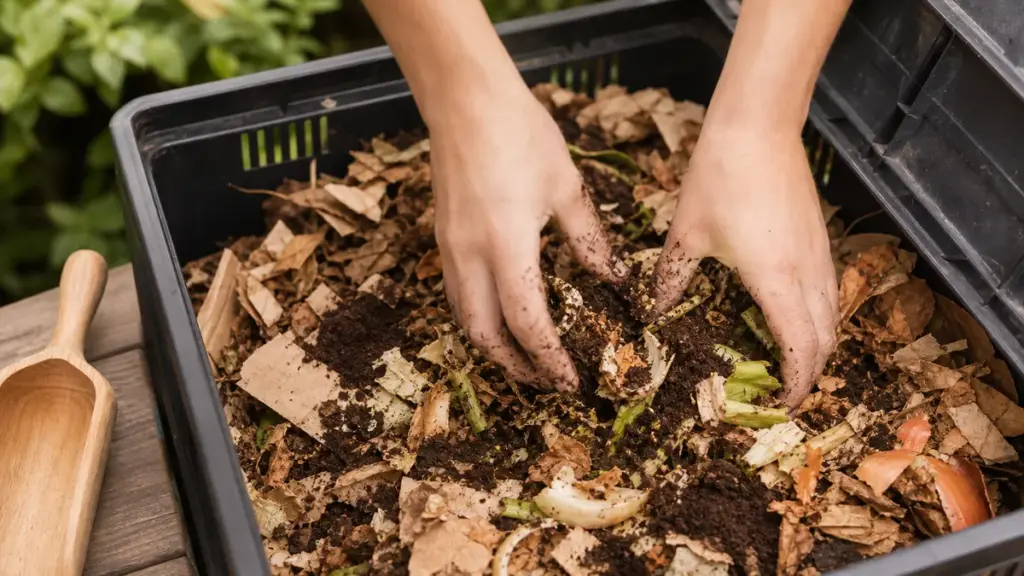
Reusing coffee grounds in the garden
Compost first, rather than feeding plants directly
Coffee grounds contain organic matter and nutrients, but that does not make them an instant, balanced fertiliser. Their effects depend on the plant, growing medium, quantity and whether the grounds have decomposed.
In controlled growing experiments, Hardgrove and Livesley found that directly applied spent grounds suppressed the growth of several tested plants. The results did not support the simple explanation that coffee merely made the soil too acidic. The researchers instead identified phytotoxicity, meaning an adverse effect on plants, as a likely explanation.
Residual caffeine and other compounds are reasons for caution, but there is no universal dose that benefits every garden. Experimental results for a particular crop and soil should not become a blanket recommendation for houseplants, vegetables or seedlings.
Our practical recommendation is to compost grounds with a varied mixture of other materials before using the finished compost. Washington State University Extension recommends keeping grounds to no more than 20% of a compost pile’s volume. Treat that as a ceiling, not a target to reach.
A straightforward home-composting method
- Let the grounds cool. Break up compacted espresso pucks before mixing them into the heap.
- Add them alongside other ingredients. Include dry leaves or shredded plain cardboard as well as suitable green garden and kitchen materials.
- Mix rather than pile. Do not leave successive batches as a dense, coffee-only layer.
- Keep the compost mixture varied. If coffee is becoming its dominant ingredient, use your food-waste collection for the surplus.
- Use the finished compost, not fresh grounds, around plants. Follow normal guidance for the composting system you use.
Grounds count as a nitrogen-containing compost ingredient despite their brown colour. Their appearance is not a guide to their role in the heap.
Do not rely on them to acidify soil for blueberries or other acid-loving plants. Their effect on soil acidity is variable and does not provide a dependable way to manage the whole root zone.
Be sceptical of pest-control promises
A ring of grounds is not an established replacement for effective slug management. Washington State University distinguishes claims about grounds from experiments involving caffeine solutions: evidence about a measured caffeine treatment does not demonstrate that a scatter of used coffee will produce the same result.
Likewise, avoid putting grounds into seed compost because a social-media tip calls them “plant food”. Seeds and young roots are precisely where growth inhibition is especially unwelcome.
Cleaning and handling: useful limits
Coffee grounds are often suggested as a scouring material. For routine household or office cleaning, however, our recommendation is to compost them instead and use a cleaner appropriate to the surface.
The distinction is between rubbing away dirt and disinfecting. Grounds should not replace a documented cleaning process, particularly on food-contact equipment. Food businesses must be able to demonstrate effective cleaning and use suitable disinfectants where required.
Do not use grounds as a drain cleaner. Southern Water advises that they clump rather than dissolve and can contribute to pipe blockages. Scrape grounds into the appropriate container before washing a cafetière, filter basket or collection drawer.
| Proposed use | Practical judgement | Main caution |
|---|---|---|
| Mixed home compost | A sensible default for small quantities | Keep the mixture varied |
| Direct application around plants | Not the recommended starting point | Uncomposted grounds can suppress growth |
| Scouring kitchen equipment | Prefer a surface-appropriate cleaner | Do not confuse abrasion with disinfection |
| Drain cleaning | Do not use | Grounds can accumulate and block pipes |
| Specialist collection | Worth investigating for workplaces | Confirm acceptance and handling requirements |
Handle damp grounds as a perishable material
Warm, moist grounds can support mould growth. Empty the machine’s collection drawer regularly, keep collection containers clean and avoid accumulating a warm stockpile while waiting for a reuse project.
Keep grounds intended for any food use separate from waste and cleaning chemicals from the outset. Commercial food reuse needs food-safety controls, not simply a judgement that the grounds still smell acceptable.
For this guide, the recommended home routes are mixed composting or the appropriate food-waste collection. It does not provide a method for turning stored grounds into an edible ingredient.
Workplace food waste: England’s Simpler Recycling rules
In England, in-scope workplaces with 10 or more full-time-equivalent employees have had to separate food waste since 31 March 2025. Coffee grounds are explicitly included. The requirement applies even where a workplace does not serve meals or have a kitchen, and however little food waste it produces.
Micro-firms with fewer than 10 full-time-equivalent employees have until 31 March 2027. The headcount is assessed across the business, not separately at each office or branch.
For an office coffee point:
- Put a food-waste container beside the machine or grounds-emptying area.
- Follow the collector’s instructions on containers and liners.
- Keep packaging out of the food waste.
- Include grounds handling in the cleaning team’s instructions.
- Check that the waste carrier is registered.
Defra says workplaces should not ask staff to take food waste home. A voluntary gardening arrangement should therefore not become the office’s substitute for a compliant waste system.
On-site composting can be an alternative, but relevant composting rules still apply. It also needs sufficient capacity for the materials generated.
Compostable packaging is not the same as food waste. Under Defra’s workplace guidance, packaging labelled compostable or biodegradable cannot go into the ordinary food-waste stream, although food-waste caddy liners are permitted. See coffee pods and the environment for the separate packaging questions.
England’s household requirements began on 31 March 2026, with transitional arrangements allowing some councils longer to introduce food-waste collections. These are not UK-wide deadlines: Scotland, Wales and Northern Ireland have separate systems and requirements.
What is cascara tea?
Cascara tea is an infusion of dried coffee-cherry skin and pulp, rather than brewed roasted beans. “Tea” describes how it is prepared, not the plant it comes from.
Expect a fruit-led drink, potentially with dried-fruit, berry and molasses notes and a little tartness. The International Coffee Organization describes variation with the coffee material and processing, so it should not be expected to taste identical from one product to another.
For a lawfully supplied, food-grade product:
- Check that the packaging identifies it as coffee-cherry cascara intended for infusion.
- Follow the supplier’s stated quantity, water temperature and steeping instructions.
- Strain as directed and observe the storage instructions.
- Check the caffeine information rather than assuming that a fruit infusion is caffeine-free.
There is no dependable caffeine figure for every mug. Product composition and preparation matter, so a figure borrowed from filter coffee or ordinary fruit tea would be misleading.
The NHS advises no more than 200 mg of caffeine daily from all sources during pregnancy. That is population guidance, not a drinking target. If pregnant, breastfeeding, sensitive to caffeine or taking medicines that may interact with it, discuss an unfamiliar caffeinated product with a midwife, GP or pharmacist.
Cascara’s UK novel-food position
EU and Northern Ireland
Commission Implementing Regulation (EU) 2022/47, dated 13 January 2022, authorised specified dried cherry pulp from Coffea arabica and/or Coffea canephora, and its infusion, as a traditional food from a third country.
The permission has product specifications, conditions of use and labelling requirements. Products containing more than 150 mg of caffeine per litre, including after reconstitution, require the specified high-caffeine warning and caffeine declaration. This is a labelling threshold, not a recommended intake.
The FSA directs businesses placing novel foods on the Northern Ireland market to the EU authorisation system.
Great Britain
EU authorisation alone is not evidence that cascara is authorised in England, Scotland or Wales. Great Britain has its own authorisation system and FSA register.
This research did not verify a current GB authorisation entry for coffee-cherry cascara. The register could not be fully retrieved, so this guide does not claim either unrestricted GB approval or a blanket ban.
Before selling or serving it in Great Britain, obtain evidence of the applicable authorisation or other lawful supply route. A pending application is not permission to market a novel food, and an authorisation for coffee-leaf infusion does not cover cherry pulp.
Qualifying Northern Ireland goods can benefit from access to the GB market. However, suppliers must establish that the particular goods qualify; an EU authorisation or dispatch through Northern Ireland is not, by itself, sufficient evidence.
Choosing a worthwhile second life
Start with a route you can manage consistently: mixed composting at home, compliant food-waste handling at work, or a specialist collector with clear acceptance conditions.
The International Coffee Organization documents uses for coffee by-products in materials, fuels and food ingredients. Those possibilities do not prove that every product containing coffee waste has a lower environmental impact. Ask what processing is needed, what the product replaces and what happens at the end of its life.
For products made from coffee residues, eco-friendly packaging explains why material content and disposal instructions need separate scrutiny. Reusing coffee grounds and cascara is most useful when the second life is safe, lawful and genuinely practical.
FAQ
Can mouldy grounds still go into home compost?
Yes, ordinary mould growth on plain spent grounds does not automatically rule out composting. Oregon State University Extension notes that mouldy grounds can be added to compost, where fungi contribute to decomposition. Do not use visibly mouldy grounds for food preparation, and do not assume that composting makes grounds contaminated with cleaning chemicals acceptable.
Do grounds need drying before they go into compost?
No, drying is not a prerequisite for adding cooled grounds to a mixed compost heap. Grounds can be incorporated while damp alongside other suitable materials. Avoid collecting far more than your system can accommodate, and do not turn a straightforward composting task into an energy-intensive drying project without a specific reason.
Can a coffee-waste collection accept pods as well as grounds?
Only if the operator explicitly accepts those pods. Loose grounds, aluminium capsules and compostable capsules are different materials and may need different routes. In England, ordinary workplace food-waste collection does not accept compostable packaging. Obtain written acceptance instructions rather than relying on a recycling symbol or the word “compostable”.
Where to go next
Read Coffee and the Environment for the wider environmental decisions surrounding coffee. Eco-Friendly Packaging helps assess material and disposal claims, while Coffee Pods and the Environment explains why capsule collection needs separate attention.
Sources
-
International Coffee Organization, Coffee Development Report 2022-23: Beyond Coffee, Towards a Circular Coffee Economy, fourth edition, report period 2022 to 2023. Definitions, cascara flavour and by-product applications.
https://ico.org/documents/cy2024-25/coffee-development-report-2022-23.pdf -
Hardgrove, S. J. and Livesley, S. J., “Applying spent coffee grounds directly to urban agriculture soils greatly reduces plant growth”, Urban Forestry & Urban Greening, 2016. Controlled growing experiments.
https://www.sciencedirect.com/science/article/pii/S1618866716300103 -
Washington State University Extension, Using Coffee Grounds in Gardens and Landscapes, Home Garden Series, online edition retrieved November 2026.
https://pubs.extension.wsu.edu/product/using-coffee-grounds-in-gardens-and-landscapes-home-garden-series/ -
Oregon State University, “Used appropriately, coffee grounds improve soil and kill slugs”, 2023. Used here for handling and composting, not as grounds-based pest-control advice.
https://news.oregonstate.edu/news/used-appropriately-coffee-grounds-improve-soil-and-kill-slugs -
Compass Group UK & Ireland, Guidance for use of spent coffee grounds as a food ingredient, document FS.G.029.01, undated. Commercial handling guidance, not a universal domestic storage standard.
https://www.mycompasshse.co.uk/media/f15ngenk/guidance-for-use-of-spent-coffee-grounds.pdf -
GOV.UK, Food hygiene for businesses: Cleaning, live guidance retrieved November 2026.
https://www.gov.uk/food-hygiene-businesses/cleaning -
Southern Water, How to prevent blockages, live guidance retrieved November 2026.
https://www.southernwater.co.uk/help-and-support/how-to-prevent-blockages/ -
Defra, Simpler recycling: workplace recycling in England, updated 2025; Simpler recycling: household recycling in England, updated May 2025; and workplace commencement announcement, March 2025.
https://www.gov.uk/guidance/simpler-recycling-workplace-recycling-in-england
https://www.gov.uk/guidance/simpler-recycling-household-recycling-in-england
https://www.gov.uk/government/news/new-rules-simplifying-recycling-for-workplaces-in-england-come-into-force -
European Commission, Commission Implementing Regulation (EU) 2022/47 of 13 January 2022, including its annex.
https://eur-lex.europa.eu/legal-content/EN/TXT/?uri=CELEX:32022R0047 -
Food Standards Agency, Novel foods authorisation guidance, live edition retrieved November 2026; and How to use the novel foods authorisation process flowchart, updated July 2026.
https://www.gov.uk/government/publications/novel-foods-authorisation-guidance/novel-foods-authorisation-guidance
https://www.gov.uk/government/publications/how-to-use-the-novel-foods-authorisation-process-flowchart/how-to-use-the-novel-foods-authorisation-process-flowchart -
Food Standards Agency, Authorised Regulated Food and Feed Products for Great Britain: Infusion from coffee leaves, entry NOVEL-74, updated April 2025. Retrieved through indexed register content.
https://data.food.gov.uk/regulated-products/novel_authorisations/novel-74 -
Northern Ireland business information service, Novel foods: Safety assessment and authorisation, live guidance retrieved November 2026.
https://www.nibusinessinfo.co.uk/content/novel-foods-safety-assessment-and-authorisation -
NHS, Foods to avoid in pregnancy, live guidance retrieved November 2026.
https://www.nhs.uk/pregnancy/keeping-well/foods-to-avoid/
Researched using official regulatory guidance, original experimental research, university extension advice and the ICO reference report; the complete GB register was inaccessible, leaving coffee-cherry cascara’s current GB authorisation entry unverified.
Last checked: November 2026