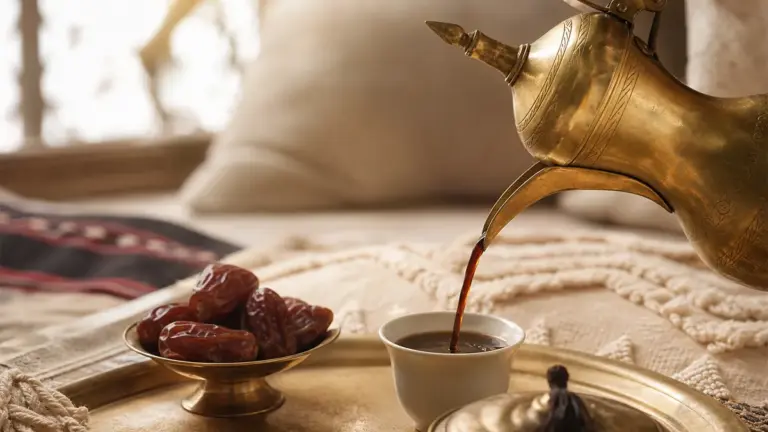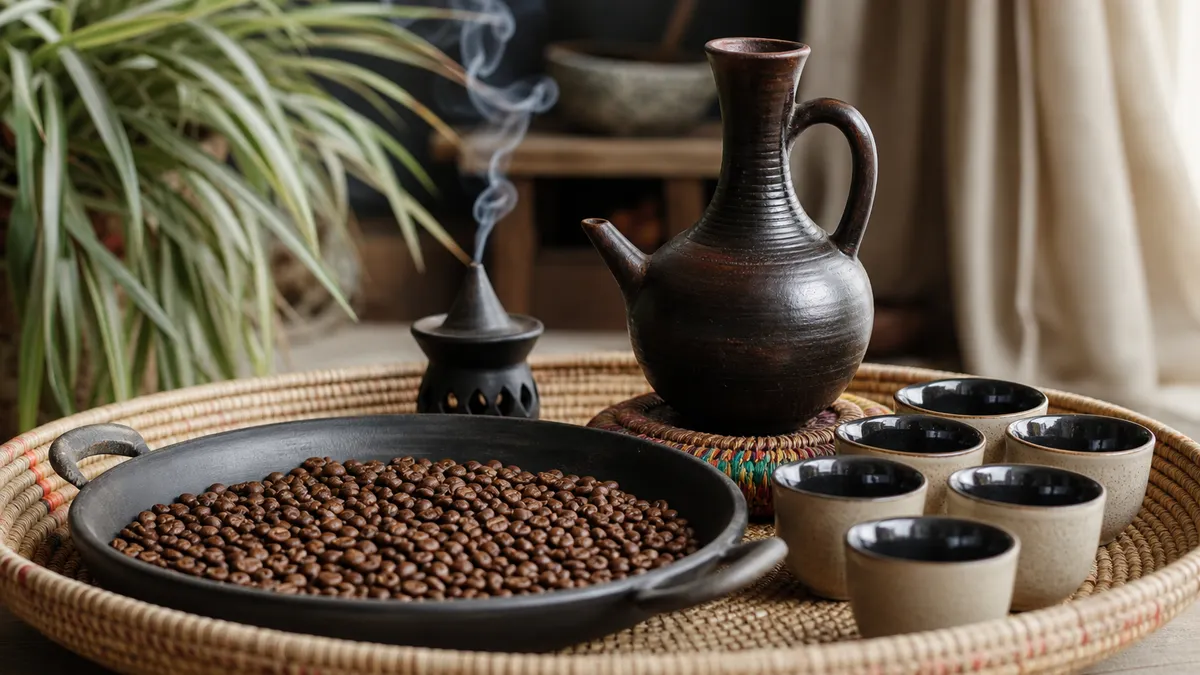
The Ethiopian coffee ceremony is a way of welcoming people through coffee prepared in their company, from washing and pan-roasting green beans to brewing in a clay pot called a jebena. It commonly includes three rounds, abol, tona and baraka, with conversation and hospitality at its heart; a closely related tradition is also practised in Eritrea.
In short
- The preparation is part of the gathering: guests watch the beans being roasted, ground and brewed.
- Abol is the first round, tona the second and baraka the third, associated with blessing.
- Small handleless cups are commonly called sini in Ethiopian settings and finjal in Eritrean settings.
- Incense, fresh greenery and snacks such as popcorn help create the welcome.
- Details vary between households and communities, so follow your host rather than a rigid etiquette checklist.
What the ceremony means
The ceremony turns making coffee into time spent together. Rather than preparing a drink out of sight and bringing it to the table, the host carries out the work among the guests. The Ethiopian Coffee and Tea Authority describes it as an occasion for hospitality, celebration, mourning and discussion, including conversations about shared problems.
“Ceremony” need not mean a rare or grand occasion. Anthropologist Sarah Howard describes coffee preparation as an ordinary part of daily life in the rural Ethiopian community where she conducted fieldwork. The care involved can be substantial even when the gathering itself is informal.
For a beginner, the essential point is simple: the invitation is to company, not merely to a drink. Watch the preparation, make room for conversation and acknowledge the person doing the work. The wider coffee culture guide provides a starting point for understanding other traditions without treating them as interchangeable.
The Ethiopian coffee ceremony, step by step
The following sequence describes a widely documented form, not a rulebook for every Ethiopian household. Bunna Cafe, which performs the ceremony, explicitly acknowledges regional and ethnic variations in its own account.
1. Prepare the gathering place
Small cups are arranged near the brewing equipment, often on a low serving stand. Fresh green grass or reeds may be spread around the setting, sometimes with flowers. Ketema is a term used for this greenery: anthropologist Alexandra Antohin records reeds bearing that name scattered around living spaces and thresholds as an accompaniment to festive coffee ceremonies.
Incense adds another layer of scent. Frankincense is well documented, and Bunna Cafe also names myrrh in its description of the ceremony it practises. Neither the precise incense nor the decoration should be presented as identical in every home.
2. Wash the green beans
Preparation begins with green coffee beans, meaning beans that have not yet been roasted. The host washes them before they go into the pan. Howard describes rubbing the beans between the hands in water to remove dust and remnants of husk.
This is a useful distinction for anyone encountering the ceremony for the first time: roasting happens during the gathering, rather than being an earlier, invisible stage. Guests see the raw ingredient become the coffee they will drink.
3. Roast the beans in a pan
The beans are roasted in a shallow metal pan, traditionally over charcoal. Names and English spellings differ: menkeshkesh appears in an Eritrean account published by Selam Ethiopian & Eritrean Cuisine, while The Ethiopian Herald uses menkeshkesha.
The host keeps the beans moving as their colour deepens. Kerchanshe, an Ethiopian coffee producer, describes regularly shaking the pan to prevent scorching. This is skilled roasting performed in front of the guests, not simply warming already roasted coffee.
4. Share the aroma
The freshly roasted beans are brought towards the guests so that their aroma can be appreciated. Kerchanshe describes this as a moment to compliment the host; the fragrance is deliberately shared before the coffee is brewed.
There are two distinct sources of scent here: the roasted coffee and the separately burning incense. Noticing that difference makes the sequence easier to follow. You need not copy an elaborate gesture to show appreciation; an attentive response and a sincere thank-you are sensible starting points.
5. Pound the roasted beans
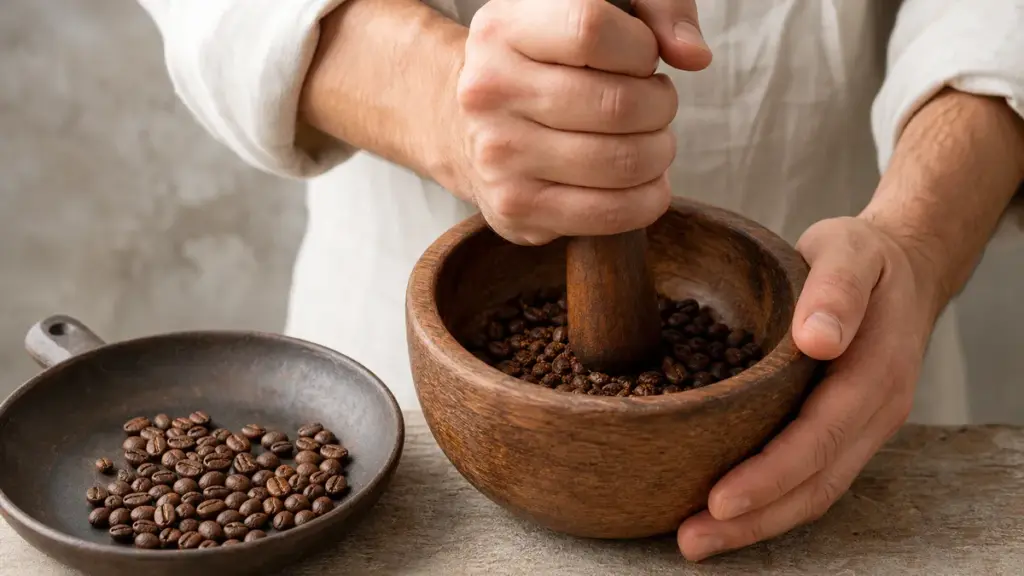
The roasted beans are ground using a mortar and pestle. In Amharic terminology recorded by Selam, the mortar is the mukecha and the pestle the zenezena. This is the hand-pounding stage between roasting and brewing.
The equipment has a practical purpose as well as a place in the ceremony. It breaks down the roasted beans so they can be brewed with water. Watch the host’s method rather than expecting the preparation to follow the adjustments of a modern espresso grinder.
6. Brew in the jebena
The grounds are brewed with water in the jebena, an earthenware coffee pot. Many examples have a rounded body and long neck, although shapes differ between regions and communities. Selam distinguishes Eritrean pots that fill and pour through the same opening from styles with a separate pouring spout.
The Ethiopian Coffee and Tea Authority describes heating the coffee and water until they bubble. This is pot brewing, not espresso: the recognisable vessel and the work around it belong to a different preparation tradition.
7. Let the grounds settle and serve
Bunna Cafe describes allowing the grounds to settle in the jebena before pouring. Coffee is then served in small handleless cups, with a controlled stream from the pot. The careful pour is a learned skill, so there is no need for a newcomer to attempt a dramatic pouring height.
The cups are commonly called sini in Ethiopian accounts, with cini another spelling; finjal is used in Eritrean settings. These names are useful vocabulary, but the host’s own terminology takes precedence over a visitor’s glossary.
8. Continue through the rounds
After the first service, water is added to the grounds and the coffee is reheated for subsequent servings. Éloi Ficquet’s account in The UNESCO Courier describes this sequence through the third round. They are successive services, not three separately roasted coffees.
Think of the steps as a way to recognise what is happening, not instructions for directing your host. The gathering continues through the preparation and between the cups.
Abol, tona and baraka: understanding the three rounds
The names most often encountered in descriptions of the Ethiopian ceremony are abol, tona and baraka. Spelling and terminology vary, including across Ethiopian and Eritrean settings.
| Round | Name used here | What to expect |
|---|---|---|
| First | Abol | The initial service, generally the strongest |
| Second | Tona | A further brewing, usually lighter |
| Third | Baraka | The final customary round, associated with blessing |
The strength progression is described in Selam’s account, while Ficquet explains baraka as “blessing”. The third round therefore carries a significance beyond the strength of the drink remaining in the pot.
Do not confuse these three servings with every return of the pot to the heat. Howard records tasting, settling, reheating and adjusting the water as part of the coffee maker’s judgement. Several actions may occur before a round is served.
For the interested coffee drinker, this is a useful change of perspective. Instead of judging the sequence solely by the concentration of each cup, notice what the repeated servings make possible: more time with the same company.
Why incense, popcorn and hospitality belong together
Popcorn is a customary accompaniment, not a garnish added for visitors. Kerchanshe names fendisha, popcorn, alongside kolo, dry roasted grain. Bunna Cafe also records bread and cooked barley among the foods served with coffee.
The snacks make the gathering something to share beyond the drink. Meanwhile, greenery, incense, roasting aromas and the arranged cups mark out a welcoming space. Eritrea’s cultural visitor information likewise describes coffee served with popcorn, bread and other accompaniments as a gathering for families and guests.
There is no single explanation that should be imposed on every detail. Kerchanshe gives frankincense a protective spiritual meaning; Howard’s fieldwork records both fragrant wood and manufactured incense sticks in use. These accounts show why “incense is customary” is more accurate than insisting on one material or one universal belief.
Avoid imagining that every gathering is solemn. Hospitality and meaningful ritual can coexist with ordinary conversation. For a contrasting way of making time for company, explore Swedish fika, without assuming the two customs have identical purposes.
Taking part respectfully
Use this short checklist as practical advice rather than a test of cultural knowledge:
- Ask about timing beforehand if you have another commitment.
- Let the host lead the order of serving and any accompanying gestures.
- Thank the person preparing the coffee, not just the person who invited you.
- Ask before photographing, especially in someone’s home.
- Explain politely if you cannot drink another cup, rather than accepting an obligation you cannot comfortably fulfil.
Descriptions often encourage guests to stay through the final round. Selam distinguishes that domestic expectation from its restaurant service, where guests need not remain for all three. Ask about the gathering you are actually attending rather than assuming that every venue follows the same format.
If you want to explore the Ethiopian coffee ceremony at home, learn from someone who practises it. Do not reproduce an indoor charcoal setup: Scottish Fire and Rescue Service warns that lit charcoal indoors can cause a fatal build-up of carbon monoxide. Choose an appropriate indoor cooking appliance and use brewing equipment according to its supplier’s instructions.
FAQ
Is the ceremony only performed by women?
Women traditionally undertake much of the preparation, but “only women” is too absolute. Howard describes considerable skill and labour usually exercised by women in her fieldwork setting, while Selam records men sometimes taking the role in Eritrean households. Recognise the tradition without treating a particular host as an exception who needs to justify themselves.
Is sugar allowed in the coffee?
Yes, sugar is a customary addition in many accounts of the ceremony. Kerchanshe also records salt or butter in some settings, so there is no single addition that defines every cup. Follow what your host offers and ask if you are unsure; do not assume that an unfamiliar serving is a mistake.
Can a museum demonstration be a useful introduction?
Yes, a practitioner-led demonstration can help explain the equipment and sequence. The Peabody Essex Museum, for example, has programmed a ceremony led by a coffee practitioner, bringing together preparation, tasting and socialising. Ask who is leading any event and what it includes, rather than judging it solely by its decorative setting.
Where to go next
Read Turkish Coffee Rituals for another pot-brewed tradition with its own serving customs, then Italian Espresso Culture for a different relationship between coffee preparation and social space. Viennese and French Café Culture takes the comparison into public cafés, a useful next step after understanding the hospitality of the Ethiopian coffee ceremony.
Sources
-
Ethiopian Coffee and Tea Authority, Ethiopia: Taste of Origins, “Coffee Ceremony”, undated, p. 4.
-
Sarah Howard, Anthropology Matters, “Coffee and the State in Rural Ethiopia”, 2018, volume 18, number 1, particularly pp. 88 to 89.
https://www.anthropologymatters.com/index.php/anth_matters/article/download/510/630/2071 -
Éloi Ficquet, UNESCO, “Ethiopia, the home of coffee”, The UNESCO Courier, April to June 2023, pp. 19 to 21.
https://www.unesco.at/fileadmin/user_upload/385026eng.pdf -
Alexandra E. S. Antohin, University College London, Expressions of Sacred Promise: Ritual and Devotion in Ethiopian Orthodox Praxis, doctoral thesis, 2014, p. 117.
https://discovery.ucl.ac.uk/1436745/2/Alexandra_Edjigaheu_Sellassie_Antohin_Antohin2014PhD%5B1%5D.pdf._REDACTED.pdf -
Bunna Cafe, “What is the Coffee Ceremony?”, undated. Practitioner description.
https://www.bunnaethiopia.net/thecoffeeceremony -
Kerchanshe, “Coffee Ceremony”, undated. Ethiopian producer’s cultural account.
https://www.kerchanshecoffee.com/ethiopia/coffee-ceremony -
Selam Ethiopian & Eritrean Cuisine, “The Ethiopian & Eritrean Coffee Ceremony in Orlando: Steps, Rounds and Price”, 27 September 2026. Practitioner account used for terminology and variation, not commercial figures.
https://www.ethiopianrestaurantorlando.com/blog/an-ethiopian-coffee-ceremony -
Ethiopian Press Agency, The Ethiopian Herald, Bitania Tadele, “The Delicate Process of Coffee Ceremony and Life”, 28 December 2023, p. 7.
-
Experience Eritrea, “Culture”, undated.
https://www.experienceeritrea.com/culture -
Peabody Essex Museum, “Traditional Ethiopian Coffee Ceremony”, undated event page.
https://www.pem.org/events/traditional-ethiopian-coffee-ceremony -
Scottish Fire and Rescue Service, “Guide to safer barbecues”, updated 24 June 2024.
https://www.firescotland.gov.uk/outdoors/guide-to-safer-barbecues/
This article was researched by comparing Ethiopian institutional guidance, ethnographic research, cultural reporting and practitioner accounts, with separate verification of charcoal safety advice.
Last checked: November 2026