Barista training programmes range from learning on the job to college courses, independent practical classes, SCA Barista Skills and apprenticeships. For someone becoming a barista, the best starting point is a route that combines supervised practice with customer service, cleaning and safe working, rather than a certificate alone.
In short
- You can apply directly for entry-level barista jobs and learn through employer training.
- Compare programmes by individual machine time, feedback, assessment and opportunities to practise afterwards.
- SCA Barista Skills has three levels: Foundation, Intermediate and Professional.
- In England, the current relevant apprenticeships include Level 2 Food and Beverage Team Member and the Level 2 Catering and Hospitality Foundation Apprenticeship.
- Ask for an itemised written quotation covering tuition, assessment, materials and any additional requirements before booking.
Which barista training programmes suit you?
Start with your immediate goal: getting your first job, developing existing skills or preparing for greater responsibility. The National Careers Service identifies direct application, college, apprenticeships and professional-body training as routes into barista work.
The following comparison uses four criteria: access to workplace experience, structure, practical learning and suitability for your next step. It is a decision aid, not a ranking of providers.
| Route | Best suited to | Main attraction | What to check |
|---|---|---|---|
| Employer training | Beginners ready to apply for work | Learning the employer’s equipment, menu and service routines | Who teaches you and when supervised practice happens |
| Independent practical course | Beginners wanting preparation or workers addressing a specific gap | Focused instruction on selected skills | Individual machine time and whether competence is assessed |
| College course | Learners wanting a structured introduction | A route into coffee or broader hospitality learning | Exact qualification, syllabus and practical facilities |
| SCA Barista Skills | Learners wanting a defined coffee-skills pathway | Progressive specialist learning | Appropriate level, delivery format and assessment arrangements |
| Apprenticeship | Eligible applicants wanting employment alongside structured learning | Workplace experience with organised training | Current standard, eligibility, employer and coffee-specific content |
If you are still deciding between professional training and learning for enjoyment, use the wider coffee education guide to establish your direction first.
Learning on the job
Applying directly is a valid route into barista work. The National Careers Service explains that employers can provide training in barista skills and product knowledge, while previous customer service, retail or catering experience may help an application.
Before accepting a role, ask what “training provided” actually means. Request a description of the induction, the person responsible for teaching you and how your progress will be reviewed. A named trainer and clear practice opportunities give you something more useful to assess than a general promise.
As a proposed learning sequence, ask to work through:
- Safe setup and cleaning: identifying equipment, following operating instructions and learning opening and closing routines.
- Following a drink recipe: measuring ingredients and repeating the employer’s preparation method.
- Milk preparation: practising texture, pouring and the workplace’s allergen procedures.
- Customer service: taking accurate orders, explaining the menu and knowing when to ask for help.
- Service practice: preparing an order while keeping the station organised and communicating with colleagues.
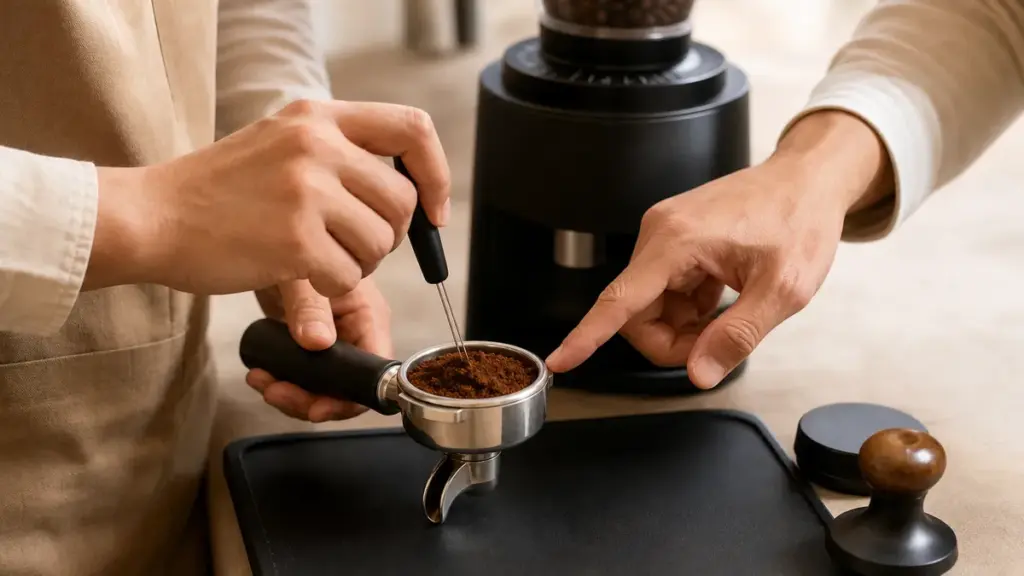
Treat this as a discussion checklist, not a universal employer syllabus. Ask your trainer to demonstrate a task, watch your attempt and explain what to change.
Keep a short learning record: the task, the feedback and what you will practise next. “I need to improve milk preparation” is less actionable than “I need my trainer to check my jug position and pouring control”.
Independent courses and college training
The National Careers Service lists college courses in barista skills, food and beverage service, and retail skills as possible preparation, with entry requirements varying between courses. For any independent class or college programme, compare the actual syllabus rather than relying on its title.
For a first professional course, ask whether you will personally practise espresso preparation, grinder adjustment, milk texturing, drink assembly and equipment cleaning. Also request a sample lesson plan. A demonstration can introduce a technique, but your booking decision should account for how much of the session involves your own attempts and feedback.
Ask what the certificate represents:
- Attendance or completion only?
- A practical assessment?
- A named qualification or external certification?
- A provider’s own record of achievement?
Do not assume these mean the same thing. Request the awarding organisation’s name where one is claimed, and ask how the result can be verified.
Our guide to coffee courses covers the wider course-selection question. Here, the priority is narrower: will the programme help you perform the work expected in the role you want?
Where SCA Barista Skills fits
The Specialty Coffee Association, or SCA, offers Barista Skills at Foundation, Intermediate and Professional levels. Its current course listings describe a progression from basic espresso drinks, cleaning and service through extraction, milk texture and workflow to advanced coffee-service skills.
For a beginner, Foundation is the sensible level to investigate first. If you already work behind a bar, ask the trainer to compare your experience with the learning outcomes before choosing Intermediate. Do not choose Professional simply because its name sounds more useful on an application.
The SCA’s detailed course catalogue includes subjects such as grinder calibration, espresso recipes, sensory analysis, milk handling, water quality and workplace organisation. “Dialling in” means adjusting the grinder and preparation recipe to achieve the intended espresso result.
For career preparation, ask how you will demonstrate understanding. Can you explain an adjustment, repeat a preparation method and identify when you need help, rather than merely copy the trainer once?
Check practical access and assessment arrangements for the particular delivery format. Read SCA Barista Skills for the detailed pathway rather than treating this career guide as a substitute for the course requirements.
Barista apprenticeships in the UK
Apprenticeship arrangements differ across the UK. The standards below apply to England, not automatically to Scotland, Wales or Northern Ireland. GOV.UK directs employers in those nations to their respective apprenticeship authorities.
Food and Beverage Team Member, Level 2
As checked in November 2026, Skills England lists Food and Beverage Team Member, ST1488, version 1.0, as approved for delivery and available for starts, while also marking it as under revision.
It was approved on 18 December 2024. The published typical training duration is 12 months, followed by a typical three-month assessment period.
The occupation includes coffee shops and cafés, but it is broader than specialist coffee preparation. It covers food and beverage service, customer interaction and related workplace responsibilities. Ask the employer and provider to show exactly where espresso preparation, milk practice and coffee-quality feedback appear in your training plan.
The old Hospitality Team Member standard, ST0233, included a Barista option but is now retired. Its published latest start date was 11 June 2025. Do not use an old course advertisement as evidence that it remains available to new starters.
Catering and Hospitality Foundation Apprenticeship, Level 2
The Catering and Hospitality Foundation Apprenticeship, FA0008, version 1.0, was approved for delivery from 1 April 2026. Skills England lists a typical duration to gateway of eight months, with entrants normally aged 16 to 21, subject to exceptions in the funding rules.
It provides broad introductory experience across catering and hospitality. It is not a specialist barista qualification or simply another name for ST1488.
The distinction matters: ST1488 is a relevant occupational successor to the former food-and-beverage and barista provision; the foundation apprenticeship is a broader entry route that can support progression.
Questions to ask before applying
Ask which standard and version your vacancy follows, who provides the training and how coffee preparation fits your duties. Request the training plan and assessment arrangements before committing.
For England, current GOV.UK employer guidance requires apprentices to be paid for both work and apprenticeship training. It also distinguishes off-the-job learning from ordinary job duties. Ask how that learning is scheduled and recorded, rather than assuming every shift counts as structured training.
What employers look for
The National Careers Service highlights teamwork, flexibility, customer service and a positive outlook. It also identifies communication, accepting criticism and working under pressure as relevant skills.
Use these as prompts for your application. Instead of writing “excellent team player”, describe a situation where you helped colleagues complete a busy service or resolved a customer problem calmly.
For practical preparation, use this self-check:
- Can I listen to an order and clarify an uncertainty?
- Can I follow instructions without concealing a mistake?
- Can I keep my workspace organised while completing a task?
- Can I receive feedback and show what I changed?
- Can I explain my actual experience without exaggerating it?
For a technical interview, ask what equipment and tasks will be involved. Describe the methods you have learned, but remain willing to follow the employer’s recipe and procedures.
Our editorial view is that beginners should prioritise safe, repeatable preparation and good service before elaborate latte art. That is a training priority, not a claim that every employer recruits in the same way.
Comparing training costs without missing the extras
Request itemised written quotations for the same learning objective. List tuition, practical sessions, assessment, certification, materials, travel, accommodation where relevant, and any further practice you would need.
Ask whether each item is included or separate, whether VAT applies, and what happens if you postpone, miss a session or need another assessment attempt. Record the answers alongside the course outcomes.
For an employer arranging staff training, also account for staff attendance time, shift cover, equipment access and practice ingredients. Compare the complete training commitment, not just the advertised classroom element.
You can calculate your own training cost per learner by adding all applicable items and dividing by the number of people attending. Keep individual travel or assessment differences separate where they would make that average misleading.
A practical plan for choosing your next step
- Write down the role you want. An entry-level café position and a role training other staff need different preparation.
- Read local vacancies. Note repeated requirements without assuming they apply to every employer.
- Identify your main gap. Separate coffee technique, customer service, workplace experience and confidence.
- Compare suitable programmes. Request the syllabus, practical arrangements, assessment details and written quotation.
- Arrange continued practice. Decide where you will apply the learning and who can give feedback.
- Keep evidence of progress. Record completed training and describe the tasks you can perform reliably.
Choose barista training programmes that address your next genuine skill gap. Before booking another course, ask what you need to practise, not just what certificate you could collect.
FAQ
Can I apply for a barista job without a certificate?
Yes, direct application is a recognised route into barista work. The National Careers Service says employers can provide training, although some prefer relevant customer service, retail or catering experience. Check each vacancy individually and be precise about what you have done. Do not describe yourself as independently competent on equipment you have only watched someone demonstrate.
Can home coffee experience help my application?
Use home experience as supporting evidence, not as proof of workplace competence. Describe what you actually practise, such as following a recipe, recording adjustments or cleaning equipment. Then ask what additional training the employer provides. Home Brewing Workshops can help structure personal learning, but choose career preparation around the duties in your target role.
Do I need a food hygiene certificate before starting?
Food handlers do not automatically have to hold a food hygiene certificate, according to GOV.UK guidance. Businesses must nevertheless ensure staff have appropriate, up-to-date skills and training, including managing allergies. Ask the employer what induction and training your duties require. A coffee course should not be assumed to replace workplace-specific food-safety instruction.
Where to go next
Read Coffee Education to understand the wider learning routes, then Coffee Courses to compare course formats and provider claims. SCA Barista Skills explains the specialist pathway, while Home Brewing Workshops helps you decide where personal practice fits alongside preparation for employment.
Sources
- S1. National Careers Service, “Barista”, current online profile, checked 2026.
https://nationalcareers.service.gov.uk/job-profiles/barista
Used for entry routes, employer training, college options and employment skills. - S2. Specialty Coffee Association, “Education: Courses”, current online listings, checked 2026.
https://sca.coffee/education/courses/
Used for current Barista Skills levels and their stated learning focus. - S3. Specialty Coffee Association, “SCA Coffee Skills Certificate Program Course Catalog”, August 2021.
https://education.sca.coffee/s/SCA-CSP-Course-Catalog.pdf
Used for detailed topic coverage, not current administrative requirements. - S4. Skills England, “Food and beverage team member”, ST1488, version 1.0, updated 9 September 2026, including assessment information.
https://skillsengland.education.gov.uk/apprenticeship-standards/st1488
Used for availability, revision status, approval date, duration and occupation scope. - S5. Skills England, “Hospitality team member”, ST0233, version 1.1, updated 17 June 2025.
https://skillsengland.education.gov.uk/apprenticeship-standards/st0233
Used for the former Barista option, retirement and latest start date. - S6. Skills England, “Catering and hospitality foundation apprenticeship”, FA0008, version 1.0, approved 1 April 2026.
https://skillsengland.education.gov.uk/foundation-apprenticeships/FA0008
Used for level, duration, normal entry ages, scope and progression. - S7. Department for Work and Pensions, “How to take on an apprentice”, updated 8 October 2026.
https://www.gov.uk/guidance/how-to-take-on-an-apprentice
Used for England-specific guidance, paid training and devolved arrangements. - S8. GOV.UK, “Running a food business: Staff training, illness and hygiene”, current online guidance, checked 2026.
https://www.gov.uk/running-food-business/staff-training-illness-hygiene
Used for staff-training responsibilities and food hygiene certificates.
This piece was researched using official careers guidance, SCA programme information, Skills England standards and current government guidance; no training providers were tested.
Last checked: November 2026