
Coffee is acidic, with brewed samples commonly measuring around pH 5, but that number does not tell you how sharp the coffee will taste or whether it will trigger heartburn. The pH myth is the idea that one measurement can predict flavour, stomach comfort and the benefits of “low-acid” coffee.
In short
- A widely cited laboratory study measured hot and cold brews at pH 4.85 to 5.13, not a universal range for every coffee.
- pH, titratable acidity and perceived acidity describe different things.
- Cold brew can contain less titratable acid without having a substantially different pH.
- Coffee can trigger reflux in some people, but a higher-pH drink is not automatically easier to tolerate.
- Treat “low-acid” as a claim to investigate, not a guarantee of symptom relief.
What is the pH of coffee?
Brewed black coffee is generally acidic. Rao and Fuller’s 2018 laboratory study, published in Scientific Reports, found pH values of 4.85 to 5.13 across the hot and cold brews tested.
You may see this shortened to “coffee has a pH of 4.85 to 5.10”. That is a useful rough indication, but too precise as a rule for all coffee. The researchers tested particular light-roasted coffees under specified brewing conditions, not every roast, instant coffee, espresso or bottled drink.
For perspective, coffee is less acidic by pH than orange juice and normal stomach fluid. Orange juice is sometimes described as approximately pH 3.5, although several orange juices in Reddy and colleagues’ beverage survey measured closer to pH 3.8. MedlinePlus gives a normal stomach-fluid range of pH 1.5 to 3.5.
These comparisons establish scale, not safety rankings. A drink being less acidic than stomach fluid does not prove that it cannot provoke symptoms.
This distinction between a true observation and an overextended conclusion runs through our coffee myths and facts.
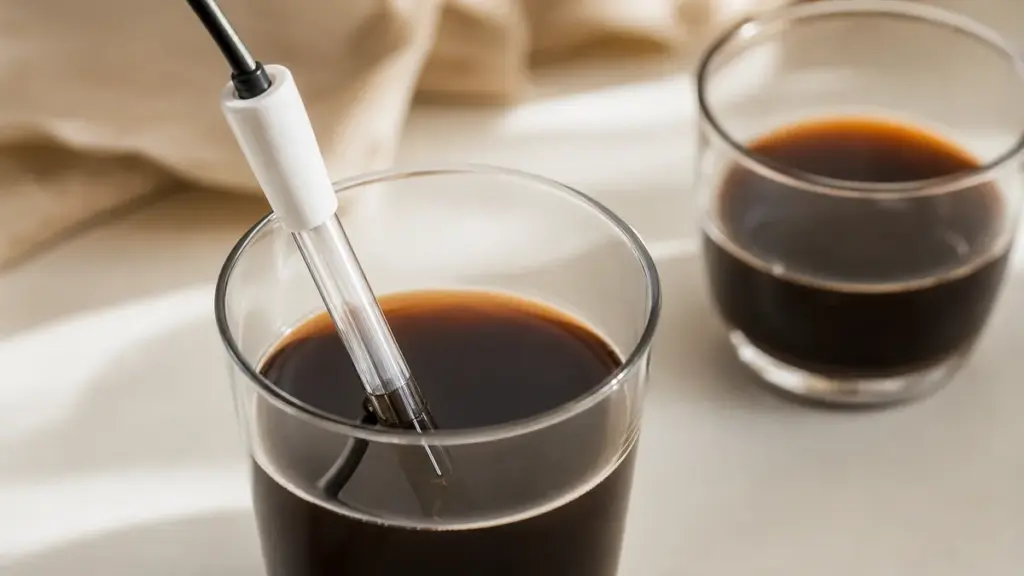
Coffee acidity: three different meanings
The word acidity causes confusion because a chemist, a coffee taster and someone with heartburn may use it to mean different things.
| Term | What it describes | What it cannot establish |
|---|---|---|
| pH | How acidic the liquid is, based on hydrogen-ion activity | Its complete acid content, flavour or effect on reflux |
| Titratable acidity | The amount of alkali needed to bring a sample to a specified endpoint pH | Exactly how pleasant or unpleasant it will taste |
| Perceived acidity | The sourness or brightness experienced when tasting | A reliable pH value or medical diagnosis |
pH: the chemical measurement
In everyday explanations, pH is often described in terms of hydrogen-ion concentration. Strictly, the international chemistry definition uses hydrogen-ion activity, which accounts for how ions behave in solution.
The scale is logarithmic: a difference of one pH unit represents a tenfold difference in hydrogen-ion activity. It does not mean ten times the total acid content, ten times the sourness or ten times the likelihood of heartburn.
Titratable acidity: the neutralisation measurement
Titratable acidity, often shortened to TA, measures how much standardised alkali must be added to reach a chosen endpoint. It captures acid-neutralising demand that a pH reading alone does not describe.
The endpoint matters. Results obtained by titrating to different endpoint pH values are not automatically interchangeable, even when both reports call their result “total acidity”.
Perceived acidity: the tasting experience
In coffee tasting, acidity can mean a pleasant, lively brightness rather than an unpleasant sour bite. Neither description is a direct reading from a meter.
A controlled brewing and sensory study by Batali and colleagues found that perceived sourness correlated strongly with titratable acidity but only weakly with pH. That makes TA useful, but it does not make “titratable acidity” another name for brightness: one is a laboratory measurement, the other a sensory judgement.
Why a pH reading cannot describe the whole cup
Coffee contains a mixture of compounds, not a single acid dissolved in water. Measuring its pH answers one chemical question, rather than explaining the entire drink.
Research comparing different brewing methods has found relationships between acid composition, measured acidity and perceived sourness. Those relationships are not simple enough to turn one pH value into a dependable flavour description.
The practical consequence is straightforward: do not choose coffee by pH alone if your aim is a particular taste. A number cannot tell you whether you will enjoy a cup’s sharpness, balance or finish.
Nor should “smooth” be treated as a chemical result. Ask whether the description comes from tasting, a pH measurement or a titration. Each may be useful, but they are different kinds of evidence.
For the broader problem of laboratory findings being stretched into sweeping claims, see coffee science explained.
Coffee, stomach acid and reflux
Acid reflux happens when stomach contents travel back into the oesophagus, the tube connecting your mouth to your stomach. Heartburn is the burning sensation this can cause; persistent reflux may be called gastro-oesophageal reflux disease, or GORD.
The NHS lists coffee among foods and drinks that can trigger or worsen symptoms. That does not mean every coffee drinker will develop reflux, or that the drink’s own pH explains every reaction.
There is also a distinction between the acidity already present in your cup and the acid your stomach produces. NHS digestive-health guidance notes that caffeinated drinks can increase stomach acid and cause heartburn in some people. A pH measurement of brewed coffee cannot measure that response inside your body.
What does the research show?
A systematic review and meta-analysis published in 2026 found a small association between coffee drinking and GORD. However, the included observational studies differed substantially, and the authors considered the clinical significance uncertain.
This is evidence of an association, not proof that coffee causes reflux in every person. It also does not demonstrate that changing coffee’s pH prevents symptoms.
Clinical guidance therefore needs some nuance. The American College of Gastroenterology suggests avoiding foods that trigger an individual’s symptoms, but grades the supporting evidence as low quality. Its guideline also describes limited and variable evidence behind many blanket dietary restrictions.
The sensible position is neither “coffee always causes reflux” nor “coffee cannot cause reflux because stomach acid is stronger”. Coffee can be a trigger, and your own reproducible symptoms matter.
When to seek help
Speak to a pharmacist about occasional heartburn and to a GP if symptoms occur most days or do not improve with lifestyle changes and pharmacy treatment. The NHS also advises seeing a GP if food gets stuck, you are frequently sick or you lose weight without an explanation.
Do not use a supposedly gentler coffee as a substitute for assessment or prescribed treatment.
Does cold brew really have less acid?
Sometimes, but the answer depends on what was measured.
In Rao and Fuller’s 2018 comparison, hot and cold brews had comparable pH values, while the hot brews had higher titratable acidity. Describing the cold brews as “less acidic” was therefore defensible for TA, but misleading if taken to mean a large pH difference.
A 2020 follow-up by Rao, Fuller and Grim examined different roast levels. Cold brews had higher pH and lower titratable acidity than their hot-brewed counterparts, while darker roasting also reduced measured acidity within that experiment.
These findings are not necessarily contradictory. They concern different coffees and roast conditions, and show why a result from one brewing experiment should not become a universal rule.
Crucially, both were laboratory chemistry studies, not clinical trials of reflux treatment. They cannot establish that cold brew prevents heartburn.
Choose cold brew because you enjoy it, rather than because the brewing temperature promises stomach comfort. If someone claims a fixed percentage reduction in acidity, ask which measurement, comparison coffee and preparation method produced it.
What “low-acid coffee” claims actually tell you
Treat the phrase as an incomplete description until the seller explains it. A claim might concern higher pH, lower titratable acidity, a particular group of compounds or simply a less sharp taste.
Those are not equivalent. A chemical difference may be genuine without proving a health benefit.
Before accepting a claim, ask:
- What was measured? Request pH, TA or the named compounds, rather than an unexplained acidity percentage.
- How was the drink prepared? Look for the coffee dose, water quantity, brewing method and any dilution.
- What was the comparison? A result needs a defined reference coffee prepared under comparable conditions.
- Was stomach comfort actually studied? Chemical testing is not a substitute for a controlled trial measuring symptoms.
A useful technical report should also explain its measurement procedure. For titratable acidity, that includes the endpoint; for comparative brewing results, preparation conditions need to be sufficiently clear to repeat.
Darker roasting may change acidity, but it does not establish a medical benefit. It also answers a different question from caffeine content, covered separately in dark roast and caffeine.
A practical way to separate taste from symptoms
Start by naming the problem. “I dislike this coffee’s sourness” and “I get burning behind my breastbone after coffee” require different responses.
For taste, compare coffees on enjoyment rather than assuming the lowest pH reading is the worst cup. If you prefer less brightness, describe that preference directly instead of looking for a health claim.
For possible reflux, NHS advice supports identifying and avoiding personal triggers. A food-and-drink diary can help you discuss patterns with a pharmacist or GP. Record what you drank, the serving size, timing, accompanying food and symptoms, rather than writing only “acidic coffee”.
Avoid changing the beans, brewing method, serving size and meal timing together if your aim is to understand a pattern. That is a practical comparison principle, not a diagnostic test, and there is no need to provoke symptoms deliberately.
The pH myth disappears once the questions are separated: chemistry describes the drink, tasting describes your experience of it, and clinical evidence informs advice about symptoms.
FAQ
Should I stop drinking coffee if it does not give me symptoms?
Coffee’s acidic pH alone is not a reason to stop drinking it. Reflux guidance focuses on identifying personal triggers rather than treating every acidic drink as unsuitable for everyone. If you have a diagnosed condition or have been given individual advice, follow that advice rather than using this general explanation to change your care.
Can decaf still trigger reflux?
Decaf is not guaranteed to be symptom-free. The American College of Gastroenterology guideline describes the evidence for routinely choosing decaffeinated drinks as equivocal. Decaffeination and acidity are different properties, so a decaf label does not establish low acidity or personal tolerance. Discuss persistent symptoms with a pharmacist or GP.
Does a lower pH mean coffee is worse for my bones?
A drink’s pH alone cannot establish its effect on bone health. That would require evidence about consumption and relevant health outcomes, not simply a measurement in the cup. Keep claims about flavour, reflux and bones separate; our article on coffee and bone health addresses that different question.
Where to go next
Read Coffee Myths and Facts for the wider guide, then Coffee Science Debunked for help distinguishing measurements from unsupported conclusions. Does Dark Roast Have More Caffeine? separates roast colour from caffeine, while Coffee and Bone Health examines another health question that coffee’s pH cannot answer.
Sources
-
International Union of Pure and Applied Chemistry. “pH”, Compendium of Chemical Terminology, the Gold Book, online version 5.0.0. Definition of hydrogen-ion activity and the logarithmic scale.
https://goldbook.iupac.org/terms/view/P04524 -
Rao, N. Z. and Fuller, M., Thomas Jefferson University. “Acidity and Antioxidant Activity of Cold Brew Coffee”, Scientific Reports, 2018. Primary laboratory comparison of pH and titratable acidity.
https://www.nature.com/articles/s41598-018-34392-w -
Batali, M. E. and colleagues, University of California, Davis. “Titratable Acidity, Perceived Sourness, and Liking of Acidity in Drip Brewed Coffee”, ACS Food Science & Technology, 2021. Controlled brewing and sensory research.
https://pubs.acs.org/doi/full/10.1021/acsfoodscitech.0c00078 -
Reddy, A. and colleagues, University of Alabama at Birmingham. “The pH of beverages in the United States”, Journal of the American Dental Association, 2016. Primary beverage measurements, including orange juices.
https://www.boriodental.com/wp-content/uploads/2016/04/PH-Beverages-Website.pdf -
US National Library of Medicine, MedlinePlus. “Stomach acid test”, reviewed 2020, retrieved from its hosted reference page. Normal stomach-fluid pH reference.
https://medlineplus.awsqa.nlm.nih.gov/ency/article/003883.htm -
Santanatoglia, A. and colleagues. “Comprehensive investigation of coffee acidity on eight different brewing methods through chemical analyses, sensory evaluation and statistical elaboration”, Food Chemistry, 2024. Primary chemical and sensory research.
https://www.sciencedirect.com/science/article/pii/S0308814624013670 -
NHS. “Heartburn and acid reflux”, reviewed 2023. UK advice on symptoms, triggers and seeking medical help.
https://www.nhs.uk/conditions/heartburn-and-acid-reflux/ -
NHS. “Good foods to help your digestion”, current online guidance retrieved November 2026. Advice on caffeinated drinks and symptom diaries.
https://www.nhs.uk/live-well/eat-well/digestive-health/good-foods-to-help-your-digestion/ -
Muftah, M. and colleagues. “Association of Coffee Intake With Risk of Gastroesophageal Reflux Disease and Complications: A Systematic Review and Meta-Analysis”, Clinical and Translational Gastroenterology, 2026. Synthesis of observational reflux evidence.
https://pubmed.ncbi.nlm.nih.gov/41677121/ -
American College of Gastroenterology, Katz, P. O. and colleagues. “ACG Clinical Guideline: Guidelines for the Diagnosis and Management of Gastroesophageal Reflux Disease”, 2022. Evidence-graded clinical guidance.
https://pmc.ncbi.nlm.nih.gov/articles/PMC8754510/ -
Rao, N. Z., Fuller, M. and Grim, M. D., Thomas Jefferson University. “Physiochemical Characteristics of Hot and Cold Brew Coffee Chemistry: The Effects of Roast Level and Brewing Temperature on Compound Extraction”, Foods, 2020. Primary roast-level and brewing comparison.
https://www.mdpi.com/2304-8158/9/7/902/pdf
This article was researched using retrieved primary chemistry and sensory studies, current NHS guidance, an evidence-graded clinical guideline and a recent systematic review, keeping laboratory findings separate from clinical outcomes.
Last checked: November 2026