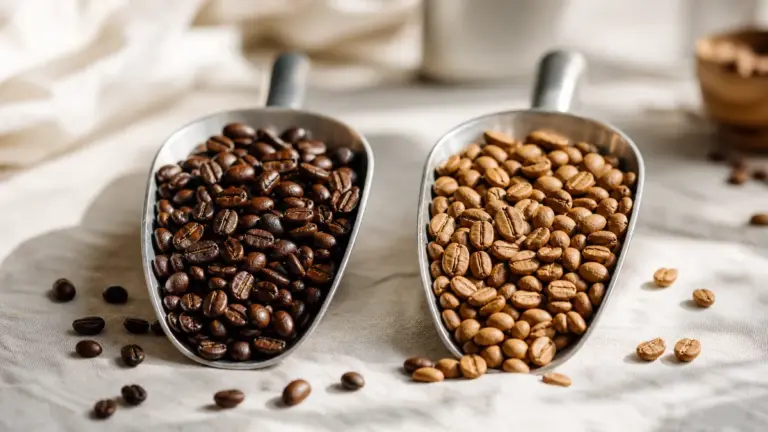
Coffee is not clearly shown to damage bones when consumed in moderation as part of a diet containing enough calcium. Caffeine can slightly affect calcium balance, but research on coffee and bone health is mixed: your overall diet, caffeine intake and existing risk of osteoporosis matter more than whether you drink coffee at all.
In short
- The UK reference nutrient intake for calcium is 700 mg a day for most adults, although osteoporosis treatment may require individual advice.
- EFSA’s general caffeine benchmark is up to 400 mg a day, spread across the day, for healthy, non-pregnant adults. It is not a bone-specific guarantee or a target.
- The Royal Osteoporosis Society advises no more than four cups of coffee daily if calcium intake is low or other osteoporosis risk factors are present.
- A small change in calcium absorption or urinary calcium does not, by itself, demonstrate bone loss or an increased fracture risk.
- Adding milk can contribute calcium, but the useful question is whether your whole diet supplies enough.
How caffeine affects calcium
Calcium helps give bones their strength, while also supporting functions including muscle contraction. Getting enough through food matters because the body needs a continuing supply, not simply an occasional calcium-rich meal.
Caffeine can affect calcium in two different ways: by slightly reducing how much is absorbed from the intestine and by increasing calcium excretion in urine after consumption. These are measurable physiological effects, but their size and duration matter. They should not be described as coffee simply “washing calcium out of your bones”.
What does “a few milligrams per cup” actually mean?
The often-repeated claim that each cup causes about 4 to 6 mg of urinary calcium loss needs qualification. A primary study published in 1995 found that calcium balance was about 4.6 mg a day more negative for each 177.5 ml serving of caffeinated coffee. That association was on the intake and absorption side of the calculation, not evidence of a fixed urinary loss.
Calcium balance means the difference between calcium entering and leaving the body. It is not the same measurement as calcium appearing in urine immediately after a drink.
Research does not give one universal daily urinary-loss figure. A small controlled-diet study found increased daily urinary calcium after caffeine, whereas a later review reported no overall effect on total daily urinary excretion across the controlled balance evidence it assessed. Different doses, participants and measurement periods help explain why these findings should not be compressed into a single rule.
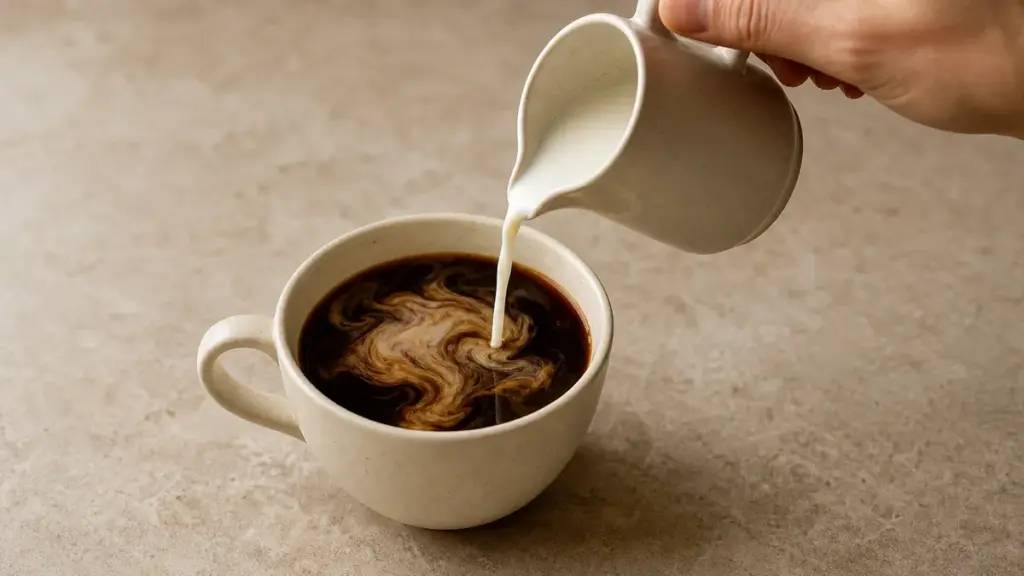
A 2002 review estimated that the small effect on calcium absorption could be offset by the calcium in roughly 15 to 30 ml of milk, described in the paper as one to two tablespoons. This is a useful illustration of scale, not a prescription to measure milk into every coffee.
What studies of coffee and bone health show
The longer-term evidence is less tidy than the underlying calcium mechanism. Studies have reported adverse associations, no association and apparently favourable associations.
An earlier Swedish cohort study, published in 2006, found that higher coffee consumption was associated with more osteoporotic fractures among women whose calcium intake was below 700 mg a day. This supports taking the combination of high intake and poor calcium intake seriously, but it does not establish that coffee caused those fractures.
A larger Swedish study published in 2013 followed 61,433 women. Drinking at least four cups daily, compared with less than one, was associated with bone mineral density around 2% to 4% lower, depending on the skeletal site. However, higher coffee intake was not associated with a higher fracture rate after adjustment for other factors.
More recent work has not produced a simple verdict either. A 2025 repeated-measures analysis of older women found no significant overall association between coffee consumption and hip or femoral-neck bone mineral density, although its modelling suggested lower density above five cups daily.
In the other direction, a UK Biobank study published in 2024 associated moderate coffee consumption with fewer osteoporosis diagnoses. That does not make coffee a preventive treatment.
The sensible reading is neither “coffee destroys bones” nor “coffee protects them”. For more on separating plausible claims from established findings, see coffee science explained.
Why observational studies cannot settle the question alone
Most long-term coffee research is observational. Researchers record what people drink and examine later health outcomes rather than randomly assigning a coffee habit over many years.
That approach is useful, especially for fractures, but several difficulties remain:
- Coffee drinkers differ in other ways. Smoking, alcohol, physical activity, body size, illness and diet can influence the results.
- A cup is not a standard caffeine dose. Serving size, preparation and strength vary, so identical cup counts can represent different exposures.
- Food questionnaires are imperfect. People may misremember their intake, and habits can change during follow-up.
- Different outcomes answer different questions. Calcium balance, bone mineral density, osteoporosis diagnoses and fractures are related, but not interchangeable.
Researchers adjust statistically for measured differences, but adjustment cannot remove every source of bias. Even a large study can measure an exposure imprecisely.
The Swedish studies also should not be treated as completely independent confirmations or contradictions: they used related cohort populations, with differences in follow-up and analysis. Their changing findings demonstrate why a single alarming result should not become a permanent dietary rule.
This is the broader lesson behind many common coffee misconceptions: a mechanism can be real without producing the large health effect claimed for it.
Current guidance: separate calcium needs from caffeine limits
The figures below answer different questions. None means that meeting one number cancels every other risk.
| Guidance | What it says | How to use it |
|---|---|---|
| NHS calcium guidance | Most adults need 700 mg daily | Assess calcium across your whole diet |
| EFSA caffeine assessment, 2015 | Up to 400 mg daily raises no safety concerns for healthy, non-pregnant adults | Count caffeine from all sources and spread intake across the day |
| Royal Osteoporosis Society | No more than four cups daily if calcium intake is low or osteoporosis risk factors are present | Treat this as practical moderation advice, not a standard caffeine dose |
| NHS pregnancy guidance | No more than 200 mg caffeine daily | Pregnancy advice takes precedence over the general adult benchmark |
EFSA also concluded that single caffeine doses up to 200 mg raise no safety concerns for most healthy adults. These population benchmarks are not personal targets; sensitivity, medicines and medical conditions can change what is appropriate.
Crucially, 400 mg caffeine and 700 mg calcium are separate guidance figures. They are not a clinically proven formula guaranteeing bone safety for every individual. Adequate calcium intake is reassuring, but it does not make unlimited caffeine sensible.
Calcium sources include milk, yoghurt, cheese, calcium-fortified soya drinks, some leafy vegetables and fish eaten with their bones. If you use a plant-based drink in coffee, check its calcium information rather than assuming every alternative supplies the same amount.
Vitamin D helps the body absorb calcium. NHS advice is to consider a daily 10 microgram supplement during autumn and winter; some people need supplementation throughout the year. If you have osteoporosis, follow your clinician’s calcium and vitamin D advice rather than automatically adopting the general adult figures.
Who should be more careful?
Closer attention is worthwhile if you have osteoporosis, low bone density or a previous fracture after a relatively minor fall or impact. Do not interpret a reassuring coffee headline as a reason to stop treatment or ignore an assessment of fracture risk.
Other reasons to review your intake and diet include:
- Menopause, particularly early menopause: falling oestrogen affects bone density.
- Long-term high-dose steroid treatment: this is an established osteoporosis risk factor.
- Low body weight, an eating disorder or restricted food intake: these can accompany inadequate nutrition and greater skeletal risk.
- Conditions affecting nutrient absorption: examples include coeliac disease and Crohn’s disease.
- Low calcium intake alongside frequent coffee drinking: this is the combination highlighted in Royal Osteoporosis Society advice.
These factors call for an individual assessment, not necessarily a complete coffee ban. A GP, pharmacist or registered dietitian can help distinguish a caffeine issue from a wider dietary or medical problem.
During pregnancy, follow the lower caffeine limit and speak to your midwife about personal concerns. Adult caffeine guidance should not be applied automatically to children.
A practical check of your coffee habit
You do not need to calculate milligrams of calcium “lost” after each drink. A short review of your usual routine is more useful.
- Record the drinks you actually have. Include coffee, tea, cola, energy drinks and other caffeine sources. Note serving sizes and use published caffeine information where available rather than assigning every coffee the same value.
- Check your usual calcium foods. Look across meals and drinks, not just the milk in coffee. Use packaging information or the Royal Osteoporosis Society’s food chooser to estimate whether your normal pattern meets your needs.
- Look for displacement. Does repeated coffee drinking replace meals or calcium-containing drinks? Adding milk may help, but it cannot stand in for an otherwise adequate diet.
- Act on the combination. If intake is high, calcium is low or you have bone-health risk factors, review the pattern with a healthcare professional. Do not start supplements solely to compensate for coffee without checking whether they are needed.
Keep the wider prevention measures in view too. NHS guidance emphasises weight-bearing and resistance exercise, adequate nutrition and avoiding smoking. Removing coffee while overlooking these measures would address only a small part of bone health.
Questions about urine output and fluid balance belong to a different discussion, covered in coffee and hydration.
Understanding bone density versus fracture risk
Bone mineral density, often shortened to BMD, measures mineral content in a scanned area of bone. It helps assess osteoporosis, but a fracture is a clinical event influenced by more than that measurement alone.
The 2013 Swedish findings illustrate the distinction: a small density difference did not translate into a demonstrably higher fracture rate. Equally, the absence of a statistically significant fracture association does not prove that every intake is harmless for every person.
When reading future research, ask what was measured, how coffee intake was defined and which population was studied. A result in older women cannot automatically describe younger adults, men or people already receiving osteoporosis treatment.
For coffee and bone health, the most useful decision is therefore personal and practical: check caffeine exposure, maintain adequate nutrition and take established fracture risks seriously.
FAQ
Do I have to put milk in every coffee?
No, milk in every coffee is not necessary if your overall diet supplies enough calcium. The small-milk estimate illustrates the modest size of caffeine’s effect on calcium absorption, rather than a compulsory pairing. You can obtain calcium elsewhere, including from yoghurt, cheese or suitable calcium-fortified foods and drinks.
Should I take a calcium supplement because I drink coffee?
Not automatically. NHS guidance says most adults should be able to obtain enough calcium from their diet, while people with osteoporosis may need individual supplementation advice. Review your food intake first and speak to a GP or pharmacist if you are unsure, particularly if you take prescribed medicines.
Should I stop coffee after an osteoporosis diagnosis?
An osteoporosis diagnosis does not automatically require giving up coffee. The Royal Osteoporosis Society advises moderation, especially when calcium intake is low or other risk factors are present. Discuss your actual drinks, diet and treatment with your clinician rather than treating a cup-count rule as a substitute for personalised care.
Where to go next
Start with Coffee Myths and Facts for the wider evidence-led guide, then read Coffee Science Debunked for help interpreting scientific claims. Coffee and Dehydration addresses fluid-balance concerns, while The pH Myth examines the separate claims made about coffee and acidity.
Sources
-
NHS, “Calcium”, Vitamins and minerals, live guidance, accessed 2026.
https://www.nhs.uk/conditions/vitamins-and-minerals/calcium/ -
Royal Osteoporosis Society, “Are there any foods I should avoid?”, undated live guidance, accessed 2026.
https://theros.org.uk/information-and-support/food-and-supplements/are-there-any-foods-i-should-avoid/ -
EFSA Panel on Dietetic Products, Nutrition and Allergies, “Scientific Opinion on the safety of caffeine”, EFSA Journal, 2015, 13(5):4102.
https://efsa.onlinelibrary.wiley.com/doi/10.2903/j.efsa.2015.4102 -
Barger-Lux MJ and Heaney RP, Creighton University, “Caffeine and the calcium economy revisited”, Osteoporosis International, 1995. Primary research abstract retrieved.
https://pubmed.ncbi.nlm.nih.gov/7599455/ -
Kynast-Gales SA and Massey LK, Washington State University, “Effect of caffeine on circadian excretion of urinary calcium and magnesium”, Journal of the American College of Nutrition, 1994. Primary research abstract retrieved.
https://pubmed.ncbi.nlm.nih.gov/7836625/ -
Heaney RP, Creighton University, “Effects of caffeine on bone and the calcium economy”, Food and Chemical Toxicology, 2002. Review abstract retrieved.
https://pubmed.ncbi.nlm.nih.gov/12204390/ -
Hallström H and colleagues, “Coffee, tea and caffeine consumption in relation to osteoporotic fracture risk in a cohort of Swedish women”, Osteoporosis International, 2006. Primary research abstract retrieved.
https://pubmed.ncbi.nlm.nih.gov/16758142/ -
Hallström H and colleagues, “Long-term coffee consumption in relation to fracture risk and bone mineral density in women”, American Journal of Epidemiology, 2013. Primary research abstract retrieved.
https://pubmed.ncbi.nlm.nih.gov/23880351/ -
Liu RY and Liu E, Flinders University, “Longitudinal Association of Coffee and Tea Consumption with Bone Mineral Density in Older Women: A 10-Year Repeated-Measures Analysis in the Study of Osteoporotic Fractures”, Nutrients, 2025, 17(23):3660. Primary research abstract retrieved.
https://pubmed.ncbi.nlm.nih.gov/41373951/ -
Zhang S and colleagues, “Association of coffee and tea consumption with osteoporosis risk: A prospective study from the UK biobank”, Bone, 2024. Research abstract retrieved through UK Biobank, record updated 2025.
https://www.ukbiobank.ac.uk/publications/association-of-coffee-and-tea-consumption-with-osteoporosis-risk-a-prospective-study-from-the-uk-biobank/ -
NHS, osteoporosis guidance, live pages accessed 2026:
“Causes”: https://www.nhs.uk/conditions/osteoporosis/causes/
“Prevention”: https://www.nhs.uk/conditions/osteoporosis/prevention/
“Treatment”: https://www.nhs.uk/conditions/osteoporosis/treatment/ -
NHS, “Foods to avoid in pregnancy”, live guidance, accessed 2026.
https://www.nhs.uk/pregnancy/keeping-well/foods-to-avoid/ -
Royal Osteoporosis Society, “Calcium-rich food chooser”, 2025.
https://strwebprdmedia.blob.core.windows.net/media/qpbnqjcq/calcium-rich-food-chooser-2025-printable-version.pdf
This article was researched using current UK public-health and osteoporosis guidance, EFSA’s caffeine assessment, and retrieved abstracts of human calcium-balance and longitudinal studies, distinguishing physiological effects from observational associations.
Last checked: November 2026