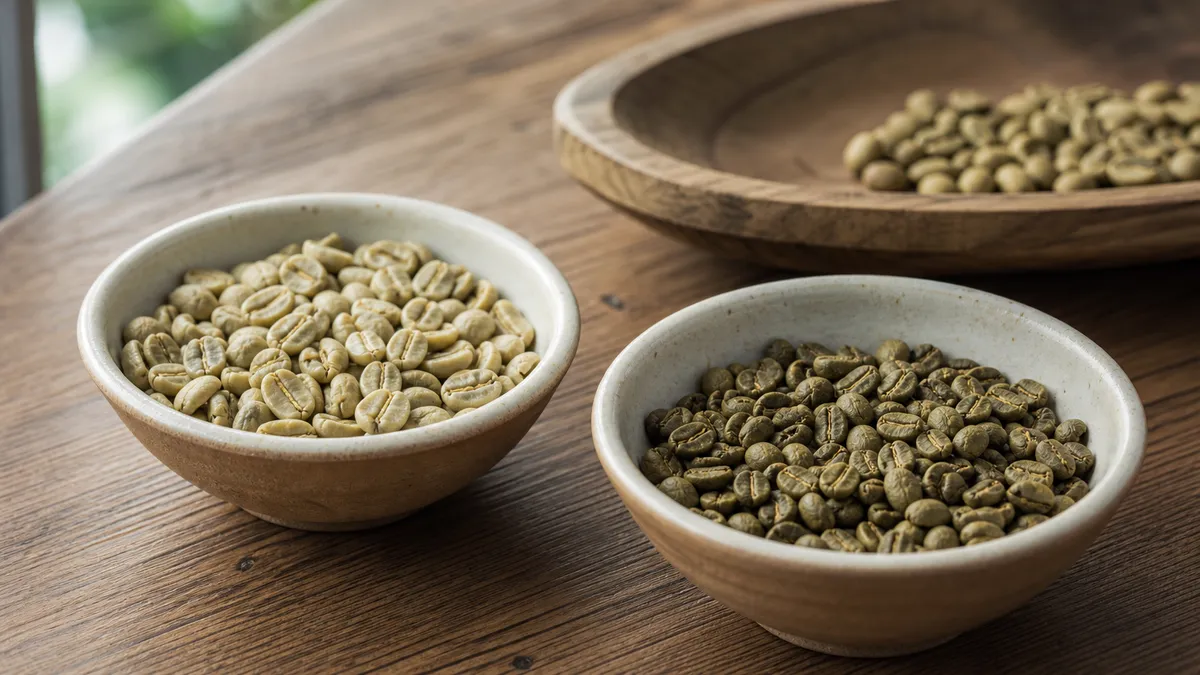
Coffee is decaffeinated by removing caffeine from green, unroasted beans using water, organic solvents or pressurised carbon dioxide. The beans are then dried and roasted, with each method aiming to remove caffeine while retaining as much of the coffee’s flavour potential as possible.
In short
- Direct-solvent methods treat the beans themselves; indirect-solvent methods treat water that has first extracted caffeine from the beans.
- Methylene chloride and ethyl acetate are extraction solvents. “Sugarcane decaf” describes an ethyl acetate process, not a separate water-only method.
- Swiss Water and Mountain Water use water-based coffee extracts, but they are distinct proprietary processes.
- Carbon dioxide methods use pressurised CO₂. Some use a supercritical fluid; others use liquid CO₂.
- Safety depends on the substance, exposure and manufacturing controls, not simply whether a process is described as “natural”.
How coffee is decaffeinated before roasting
Decaffeination is a separation process. Caffeine must move out of the bean into another substance, which is then removed or cleaned so extraction can continue.
A solvent is simply a substance that dissolves something else. Water is a solvent too, so “solvent-free decaf” is usually shorthand for coffee processed without organic solvents such as methylene chloride or ethyl acetate.
The main commercial methods follow a shared sequence:
- Moisten the green beans. Water or steam hydrates the beans and helps caffeine move through their structure.
- Extract the caffeine. An organic solvent, coffee-rich water or pressurised CO₂ carries caffeine away.
- Separate the caffeine from the extraction medium. Depending on the process, this involves filtration, distillation or changing operating conditions.
- Dry the beans. They are prepared for subsequent roasting.
The difficult part is selectivity: removing caffeine without carrying away too much of everything else. For the wider context, our caffeine and decaf guide connects processing with the questions drinkers commonly ask.
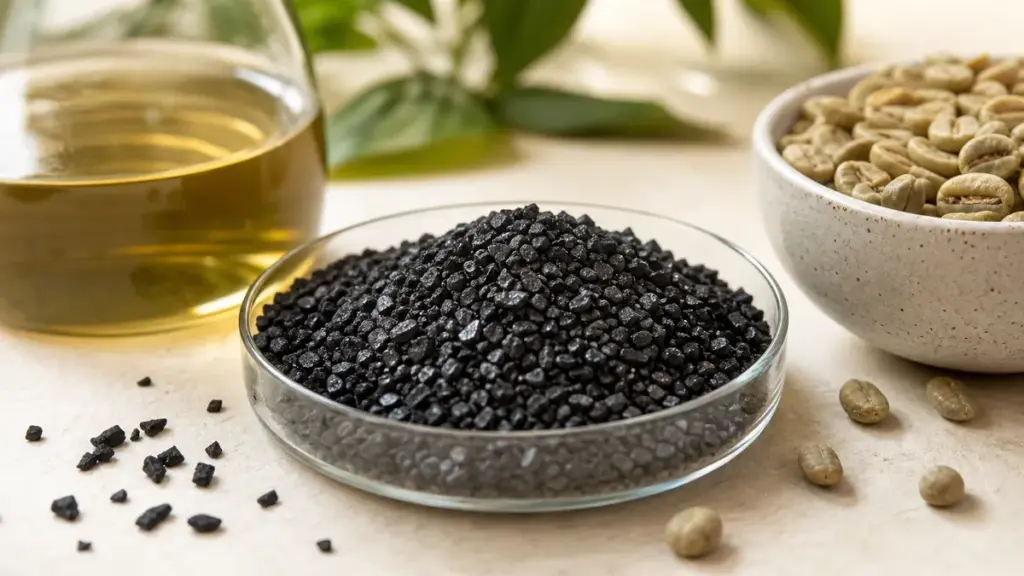
Solvent methods: methylene chloride and ethyl acetate
Two organic solvents used in decaffeination are methylene chloride, also called dichloromethane or DCM, and ethyl acetate, often shortened to EA. Both dissolve caffeine, allowing it to be separated from the coffee.
“Organic” here is a chemistry term. It does not mean that the coffee is certified organically produced.
Direct-solvent decaffeination
In a direct process, the solvent contacts the moistened green beans. Caffeine moves from the beans into the solvent, which is drained away and processed for reuse.
After extraction, the beans undergo solvent-removal steps, including steaming, before drying. The intention is to remove the processing solvent, not leave it as an ingredient in the finished coffee.
Methylene chloride is valued by processors for its selectivity for caffeine. Ethyl acetate is also used in direct-contact processes, including coffees marketed as sugarcane decaf.
Indirect-solvent decaffeination
In an indirect process, hot water first extracts caffeine and other soluble substances from the beans. The beans are separated from this liquid, and the solvent is used to remove caffeine from the water-based extract rather than being applied directly to the beans.
After solvent removal, the coffee-rich water returns to the beans, allowing extracted coffee substances to be reabsorbed. This additional separation stage is what makes the method indirect.
The distinction matters when reading labels. Water plays a substantial part in indirect-solvent processing, but that does not make it the same as a process that avoids organic extraction solvents.
What “sugarcane decaf” means
Sugarcane decaffeination uses ethyl acetate whose production is based on sugarcane. Descafecol, a processor using this method, describes contact between coffee, water and sugarcane-derived EA.
The source of the EA explains the name, but it does not change its role: it remains an extraction solvent. Nor does the word “natural” establish that a particular coffee tastes better or has a better safety profile.
Our CO₂ and sugarcane comparison examines those two approaches in greater detail.
Water methods: Swiss Water and Mountain Water
Water can extract caffeine, but plain water also draws out other soluble coffee substances. Water-based decaffeination therefore needs more control than simply washing beans repeatedly.
Swiss Water
Swiss Water uses green coffee extract, or GCE: water containing soluble substances from green coffee, with its caffeine removed.
Prepared beans meet this coffee-rich extract. Because the surrounding liquid contains little caffeine, caffeine moves out of the beans by diffusion, the movement of molecules down a concentration difference.
Loading the extract with other coffee substances helps limit their net movement out of the beans. It is a strategy for reducing flavour loss, not a reason to assume every non-caffeine molecule remains untouched.
The extract passes through activated-carbon filters, which trap caffeine and allow the extract to circulate again. Adsorption is the technical term for molecules sticking to a surface, in this case the porous carbon.
Mountain Water
Mountain Water is a separate process operated by Descamex in Mexico. The processor describes steaming the beans, extracting caffeine with a water-based solution saturated with soluble coffee solids, then drying and polishing the beans.
Descamex controls flow, temperature, pressure and vacuum during extraction. Although the broad principle resembles other coffee-extract water methods, it should not be presented as an alternative name for Swiss Water.
The practical distinction is the named processor and its process controls, not simply the presence of water. Our water-process guide covers the two systems without treating their branding as interchangeable.
Carbon dioxide decaffeination
Carbon dioxide becomes an extraction medium under controlled pressure and temperature. The moistened beans sit in a pressure vessel, where CO₂ dissolves caffeine and carries it away.
In a supercritical CO₂ process, the carbon dioxide is above its critical temperature and pressure. In this state, it combines useful properties associated with gases and liquids, allowing it to penetrate material and dissolve substances.
The caffeine is subsequently separated from the CO₂, which can be recirculated. After extraction, the beans are depressurised and dried.
Not every CO₂ process is supercritical. CR3 describes its Carbonic Natural method as using subcritical liquid CO₂, a different operating state.
For a shopper, the useful question is therefore not just “Does this use CO₂?” but “Which CO₂ process does the supplier identify?” Both liquid and supercritical systems belong within carbon dioxide decaffeination, but their operating conditions are not identical.
The main decaffeination methods compared
This comparison uses three criteria: what carries caffeine away, how the process works and what the description helps you establish. It is not a flavour ranking.
| Method | Extraction medium | Defining feature | Who the information helps |
|---|---|---|---|
| Direct solvent | Methylene chloride or ethyl acetate | Solvent contacts prepared beans | Readers wanting to identify the actual solvent used |
| Indirect solvent | Water, followed by an organic solvent | Solvent treats the separated coffee extract | Readers distinguishing indirect processing from water-only claims |
| Swiss Water | Green coffee extract | Caffeine removal through activated-carbon filtration | Readers seeking a named process without DCM or EA |
| Mountain Water | Water-based coffee-solids solution | Descamex’s controlled extraction and drying process | Readers seeking another named water-based option |
| CO₂ | Pressurised carbon dioxide | Liquid or supercritical CO₂ extracts caffeine | Readers seeking a process without DCM or EA |
A clearly named method is more informative than a vague promise of “gentle” processing. It tells you what was done, although it cannot, by itself, tell you how the finished coffee will taste.
Are decaffeination solvents safe?
The useful distinction is between hazard and risk. Hazard describes a substance’s ability to cause harm; assessing risk also requires knowing how much exposure occurs and under what conditions.
What the safety evidence establishes
Methylene chloride has genuine hazards. The International Agency for Research on Cancer classifies it as probably carcinogenic to humans, Group 2A, following an expert review of the evidence.
That classification is not a study showing that drinking compliant decaffeinated coffee causes cancer. Equally, it should not be dismissed merely because the substance is used during food processing.
Food regulation addresses a different, practical question: which uses are permitted, and what residues may remain? The Food Standards Agency explains that extraction solvents are removed during production, but technically unavoidable residues or derivatives can remain.
For example, the revised regulations applicable in England specify a maximum DCM residue of 2 mg/kg in roasted coffee. This is a limit in the coffee material, not a concentration permitted in the brewed drink.
Ethyl acetate is listed for use under good manufacturing practice. That requires technically unavoidable residues to present no danger to human health; it does not mean unrestricted use. Scotland and Wales have separate domestic regulations governing extraction solvents.
What measurements show, and their limits
A 2024 analytical study examined 34 retail decaffeinated coffees from EU markets. It reported DCM residues below the EU maximum in every sample, with an average of 0.127 mg/kg.
The researchers also measured transfer into filter coffee and cafetière brews, finding that only part of the residue transferred under their preparation conditions. This supports measuring exposure rather than assuming either complete transfer or complete evaporation.
However, this was a small analytical study published in conference proceedings, not a long-term clinical safety trial. It also had coffee-industry funding and authors with relevant commercial affiliations.
The reasonable interpretation is neither “all chemicals are dangerous” nor “processing removes absolutely everything”. Permitted use, residue controls and measured exposure are more useful than either slogan. EFSA’s extraction-solvent work similarly considers safety and maximum residue limits, rather than relying on whether a substance sounds natural.
What the method tells you about flavour
Decaffeination is designed to preserve flavour potential, but method names are not tasting notes. Starting bean quality, the blend and roasting remain important determinants of the finished coffee.
There is also a difference between a processor explaining its mechanism and independently demonstrating superior flavour. Claims such as “retains every flavour compound” should be treated more cautiously than a clear description of extraction and filtration.
For choosing a coffee, ask the roaster:
- Which decaffeination method and processor were used?
- What origin and roast information is available?
- What does this particular coffee taste like?
- Is any residual-caffeine information based on testing, and what exactly was tested?
As an editorial rule, choose a named water or CO₂ process if avoiding DCM and EA is your priority. If your priority is flavour, compare the coffees themselves rather than assuming one process must always win.
The broader decaf explainer covers residual caffeine and everyday drinking questions. Understanding how coffee is decaffeinated helps you interpret the packet, but the process label is only part of the coffee’s story.
FAQ
Can I decaffeinate ordinary coffee at home?
Not reliably using the industrial methods described here. They depend on controlled extraction, separation and drying, with caffeine and sometimes solvent-residue measurements. Soaking beans in water would also extract other coffee substances without establishing how much caffeine remained. Buying coffee already decaffeinated is the practical alternative.
What happens to the caffeine removed from coffee?
Some processors recover and refine it for other uses. Coffein Compagnie describes purifying extracted caffeine for applications including soft drinks, medicines and cosmetics. Recovery arrangements depend on the process and facility, so it is better not to assume that every decaffeination plant produces the same saleable caffeine product.
Does the decaffeination method guarantee that no caffeine remains?
No, a process name does not guarantee zero caffeine. Decaffeination can leave small amounts behind, and a percentage removed is not the same measurement as milligrams in a prepared drink. If caffeine restriction is medically important, discuss your needs with a GP or pharmacist and seek product-specific information rather than relying on branding.
Where to go next
Read Decaffeinated Coffee Explained for the wider drinking questions, then Swiss Water and Mountain Water Process for a closer comparison of water-based systems. CO2 and Sugarcane Decaf explains two other labels you may encounter, while Caffeine Withdrawal addresses a different question: what can happen when you reduce your intake.
Sources
-
Specialty Coffee Association, Coffee Decoded: The Chemistry of Decaffeination, undated, retrieved 2026. Expert explanation of dissolution, solvents and activated-carbon adsorption.
https://sca.coffee/sca-news/coffee-decoded-21-chemistry-of-decaf -
University of Queensland, Lauren Ball and Emily Burch, How is decaf coffee made? And is it really caffeine-free?, 2023. Direct and indirect processing, and residual caffeine.
https://public-health.uq.edu.au/node/11382 -
Coffein Compagnie, Our Services, undated, retrieved 2026. Processor descriptions of DCM and EA methods, finished-coffee quality factors and caffeine recovery.
https://www.coffein-compagnie.de/en/unsere-leistungen/ -
Swiss Water Decaffeinated Coffee, Our Coffee Decaffeination Process, undated, retrieved 2026. Manufacturer’s account of hydration, green coffee extract, carbon filtration and drying.
https://www.swisswater.com/pages/coffee-decaffeination-process -
Descamex, MountainWater Process, undated, retrieved 2026. Processor’s description of steaming, saturated coffee-solids solution, extraction controls and drying.
https://en.descamex.com.mx/mountainwaterprocess -
Descafecol, Natural decaffeination process, undated, retrieved 2026. Processor’s account of water and sugarcane-derived ethyl acetate.
https://descafecol.com/en/decaffeinated-products/ -
Royal Society of Chemistry, Nina Notman, Decaffeination: how does it work?, 2021. Chemistry explanation and original interviews about supercritical CO₂ and decaffeination controls.
https://edu.rsc.org/feature/decaffeination-how-does-it-work/4013450.article -
CR3 Kaffeeveredelung, Carbonic Natural: frequently asked questions, undated, retrieved 2026. Processor confirmation that its method uses subcritical liquid CO₂.
https://carbonic-natural.com/ -
UK legislation, The Food Additives, Flavourings, Enzymes and Extraction Solvents (England) Regulations 2013, revised text, Schedule 6. DCM residue limit and good manufacturing practice requirements for EA.
https://www.legislation.gov.uk/uksi/2013/2210 -
Food Standards Agency, Extraction solvents authorisation guidance, 2020. Removal of extraction solvents, unavoidable residues and separate domestic legislation in Great Britain.
https://www.gov.uk/government/publications/extraction-solvents-authorisation-guidance/extraction-solvents-authorisation-guidance -
European Food Safety Authority, Extraction solvents, reviewed 2025. EFSA’s role in evaluating extraction-solvent safety and recommending maximum residue limits.
https://www.efsa.europa.eu/en/topics/extraction-solvents -
International Agency for Research on Cancer, IARC Monographs Volume 110: evaluation of five chemicals, 2014. Expert-review classification of dichloromethane as Group 2A.
https://www.iarc.who.int/news-events/iarc-monographs-volume-110-evaluation-of-five-chemicals/ -
Fabian, Süße-Herrmann, McGaffin and Hielscher, Mass Transfer of Dichloromethane from EU Retail Roast and Ground Decaffeinated Coffee into Prepared Beverages, Proceedings, 2024, 109(1), 33. Original analytical study, including its funding and commercial-interest disclosures.
https://sciforum.net/paper/18166
https://www.mdpi.com/2504-3900/109/1/33
This article was researched using regulatory guidance, revised legislation, original analytical research, chemistry explanations and processors’ published method descriptions; processor claims were not treated as independent proof of superior flavour or safety.
Last checked: November 2026