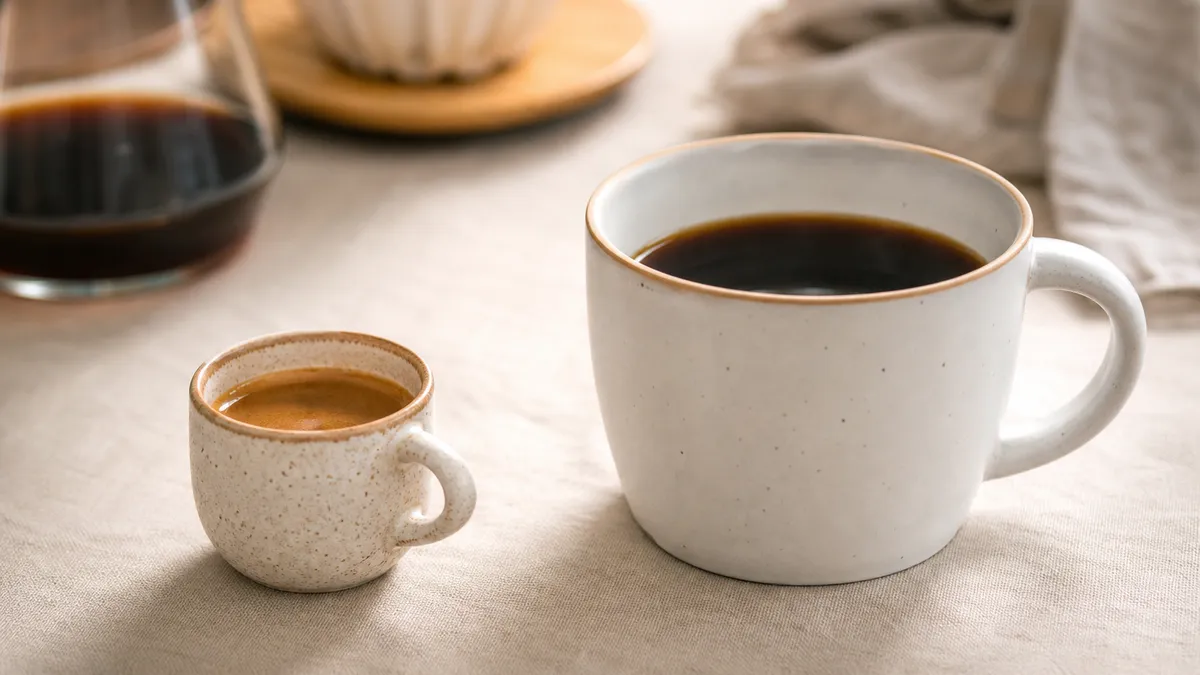
Espresso is stronger than filter coffee per millilitre: it is more concentrated and usually tastes more intense. But a larger serving of filter coffee can contain more caffeine overall, so the useful distinction is strength per sip versus caffeine in the whole drink. EFSA’s illustrative figures are 80 mg of caffeine in 60 ml of espresso and 90 mg in 200 ml of filter coffee, although actual drinks vary considerably.
In short
- Concentration, flavour intensity and total caffeine are different measurements, not interchangeable meanings of “strong”.
- Using EFSA’s examples, espresso contains approximately 1.33 mg of caffeine per ml, compared with 0.45 mg per ml for filter coffee. These are calculated examples, not fixed specifications.
- Published ranges overlap: a small espresso is not automatically a lower-caffeine choice than a large brewed coffee.
- For caffeine, compare the actual serving and recipe, rather than the cup’s size or how forceful the coffee tastes.
What does “stronger” mean in coffee?
The question becomes clearer when you separate three things:
- Brew strength: how concentrated the coffee is.
- Flavour intensity: how powerful its aroma, taste and mouthfeel seem.
- Caffeine content: the amount of caffeine in the portion you drink.
These can move together, but they do not measure the same thing. A laboratory and sensory comparison of nine brewing methods found higher concentrations of coffee constituents in espresso, while the amounts delivered by a whole serving depended on its volume.
For choosing a drink, start with your aim. If you want concentrated flavour in a small portion, compare taste and texture. If you want to manage caffeine, compare milligrams per serving where reliable information is available, not simply whether the menu calls the drink espresso or filter.
This distinction sits within the broader habit of separating familiar coffee sayings from measurable claims, explored in coffee myths and facts.
Why espresso is stronger per millilitre
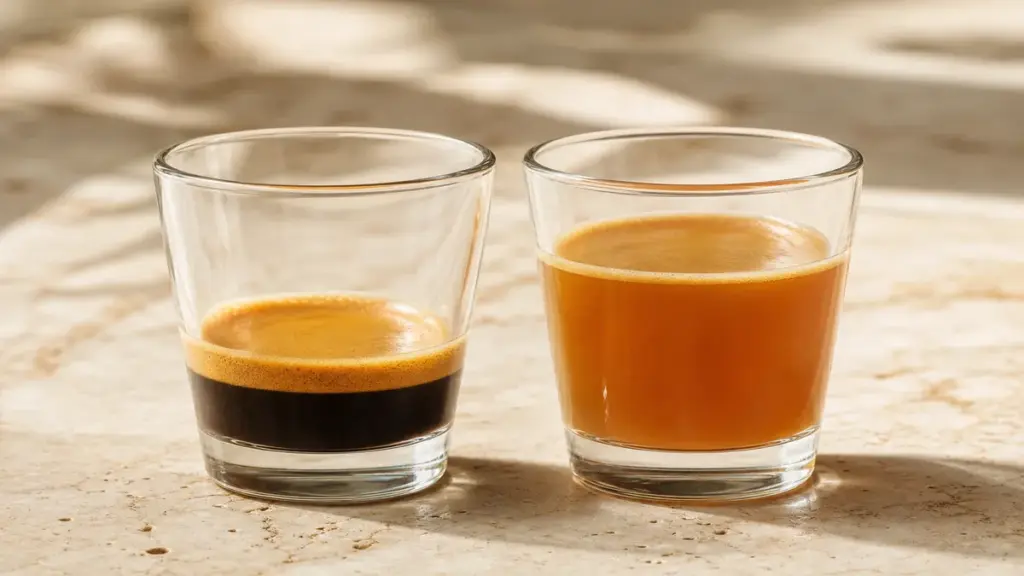
Espresso brewing uses pressurised water and finely ground coffee to produce a concentrated drink. Filter brewing produces a more dilute beverage; the important point here is how much extracted coffee ends up in a given amount of liquid, not pressure alone.
For caffeine concentration, the calculation is straightforward:
Caffeine per millilitre = caffeine in the serving ÷ serving volume
Using EFSA’s illustrative values:
| Drink | Example serving | Caffeine in serving | Calculated caffeine per ml |
|---|---|---|---|
| Espresso | 60 ml | Approximately 80 mg | 1.33 mg |
| Filter coffee | 200 ml | Approximately 90 mg | 0.45 mg |
In this particular comparison, espresso has approximately three times the caffeine concentration. Yet the filter coffee supplies slightly more caffeine overall because its serving is much larger. The figures illustrate the arithmetic, not a universal relationship between every espresso and every filter brew.
There is also a technical distinction between caffeine concentration and total dissolved solids, often shortened to TDS. TDS describes the dissolved material in the drink as a whole, not just caffeine. The SCA’s Brewing Control Chart treats strength, meaning solubles concentration, separately from extraction, meaning the proportion of the ground coffee dissolved during brewing.
That distinction prevents another misunderstanding: “strong” does not necessarily mean “over-extracted”. A concentrated drink and a highly extracted drink are different things.
Caffeine per serving: the ranges overlap
A single reference figure is useful for explanation, but it cannot tell you exactly what is in an unfamiliar drink. Published measurements and official guidance show why:
| Coffee and evidence basis | Serving size | Caffeine per serving |
|---|---|---|
| Espresso samples from Glasgow outlets, Ludwig and colleagues, 2014, Table 3 | Actual servings ranged from 13 to 90 ml | 66 to 276 mg |
| Regular brewed, non-speciality coffee, FDA guidance | Approximately 355 ml, equivalent to the source’s 12 US fluid ounces | 113 to 247 mg |
The espresso range is calculated from the lowest and highest individual serving results in that study’s Scottish table, not from outlet averages. The FDA range describes regular brewed coffee as a broader category, rather than one specified UK filter recipe. These are separate evidence sets, not a controlled head-to-head trial, but they demonstrate substantial overlap.
So “filter contains more caffeine” is a useful possibility, not a dependable rule. Some of those measured espressos contained more caffeine than the upper end of the FDA’s brewed-coffee guidance range. Equally, a large brewed coffee can supply considerably more caffeine than a modest espresso.
The main variables include the beans, the amount of ground coffee used and the preparation method. Serving volume matters too, but volume alone cannot reveal how much coffee went into making the drink. EFSA specifically identifies bean type, processing and preparation as reasons caffeine concentrations differ.
Do not use roast darkness as a shortcut for this comparison. For that separate question, see dark roast and caffeine.
Why espresso tastes punchier
Espresso’s concentrated composition helps explain why a small mouthful can feel so substantial. In the nine-method comparison, higher total solids were associated with fuller body, while aroma measurements were associated with perceived aroma intensity. The researchers also found relationships between measured coffee constituents and bitterness. These were findings within that study, not a formula for predicting every coffee’s flavour.
This is why taste is a poor caffeine meter. A forceful impression combines aroma, texture, acidity and bitterness, whereas caffeine content is the amount of one particular compound. An intense sip does not tell you the caffeine total in the cup.
Nor is flavour intensity a quality ranking. When comparing the drinks, ask which experience you prefer: a concentrated mouthful or a longer, more dilute drink. “Stronger” is only useful once you have said what you are measuring.
How to compare your own drinks fairly
Use this short checklist when choosing between espresso and filter coffee:
- Identify the serving. Ask what the café means by a shot and how much filter coffee the cup holds. Published espresso measurements show that the name does not guarantee one serving volume.
- Check the recipe where possible. Record the amount of ground coffee used and whether an espresso-based drink contains additional shots. Preparation and bean choice affect caffeine content.
- Look for caffeine information for that drink. Ask the operator or manufacturer rather than assigning every espresso the same caffeine figure. The FDA recommends contacting manufacturers when product information is needed.
- Compare whole servings for intake. Use milligrams per millilitre only when you want to compare concentration. Multiply that concentration by the volume actually consumed to estimate the serving total.
If no reliable caffeine information exists, treat reference figures as estimates rather than measurements. That uncertainty matters more when you are deliberately limiting caffeine than when you are simply deciding which drink tastes best.
FAQ
Does adding water to espresso reduce its caffeine?
Adding plain water reduces caffeine concentration, but not the caffeine already present, provided you drink the whole result. This is dilution: the same caffeine is spread through more liquid. It is different from passing additional water through the grounds, which can extract more caffeine, as laboratory espresso experiments have demonstrated.
Is decaf a better choice if I want less caffeine?
Decaf is generally a more useful starting point than choosing between espresso and filter by taste alone. It contains less caffeine than its regular counterpart, although it is not necessarily caffeine-free. Check information for the particular product if your intake needs close control, especially if you react strongly to caffeine.
How should I use these figures if I am limiting caffeine?
Use them as estimates, not targets or guarantees. EFSA’s 2015 safety review found no safety concerns for healthy non-pregnant adults at up to 400 mg daily, spread across the day. The NHS advises no more than 200 mg daily from all sources during pregnancy. Sensitivity and medicines vary; ask a GP, pharmacist or midwife for personal advice.
Where to go next
Read Coffee Myths and Facts for the wider guide to checking coffee claims, then Does Dark Roast Have More Caffeine? to separate roast character from caffeine content. For another caffeine-related claim, continue with Does Coffee Stunt Growth?.
When asking “is espresso stronger than filter coffee?”, make the comparison specific: concentration, flavour or caffeine in the serving.
Sources
-
European Food Safety Authority: Caffeine, official topic page summarising the Scientific Opinion on the safety of caffeine (2015), including illustrative beverage figures and safety conclusions.
https://www.efsa.europa.eu/en/topics/topic/caffeine -
Ludwig, I. A., and colleagues, Royal Society of Chemistry: Variations in caffeine and chlorogenic acid contents of coffees: what are we drinking? (2014), Food & Function, volume 5, pages 1718 to 1726. Table 3 checked against the rendered PDF.
https://pubs.rsc.org/en/content/articlepdf/2014/fo/c4fo00290c -
US Food and Drug Administration: Spilling the Beans: How Much Caffeine is Too Much? Current online guidance retrieved November 2026; its brewed-coffee table draws on research published in 2015.
https://www.fda.gov/consumers/consumer-updates/spilling-beans-how-much-caffeine-too-much -
Gloess, A. N., and colleagues: Comparison of nine common coffee extraction methods: instrumental and sensory analysis (2013), European Food Research and Technology, volume 236, pages 607 to 627.
-
Specialty Coffee Association: Coffee Brewing Control Chart, version 3, file labelled revised March 2019.
https://static1.squarespace.com/static/587af1d4db29d69a1a226b95/t/60aece65e4f2134d99f6e646/1622068839009/SCA%2BBrewing%2BChart%2B-%2BRevised%2BMarch%2B2019-US-Letter.pdf -
NHS: Foods to avoid in pregnancy (2026), reviewed 15 June 2026.
https://www.nhs.uk/pregnancy/keeping-well/foods-to-avoid/
This article was researched using official caffeine guidance, original analytical and sensory research, and the SCA brewing chart; calculations and comparisons are identified separately from measured findings.
Last checked: November 2026