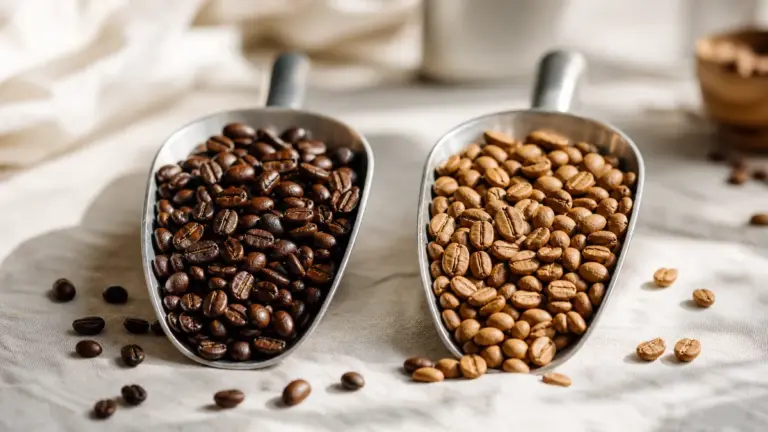
Coffee is not established as a cause of cancer, and claims that it detoxes the body or guarantees weight loss go beyond the evidence. Mycotoxins and stomach symptoms need a more careful answer: genuine hazards and individual reactions are not proof that every cup is harmful.
In short
- A cancer hazard classification describes the strength of evidence, not your personal chance of developing cancer.
- Very hot drinks, above 65°C, raise a separate concern from coffee itself. This is drinking temperature, not brewing temperature.
- A short-term rise in energy expenditure does not establish lasting weight loss.
- Mycotoxin claims need a named substance, a measured concentration and an exposure assessment, not just the word “detected”.
- Coffee can trigger reflux in some people, but a drink’s acidity alone does not explain everyone’s symptoms.
Coffee science debunked: what counts as evidence?
Start by asking what the researchers actually measured. A change in a cell, a temporary metabolic response and a reduction in diagnosed disease are different findings. A claim becomes misleading when it quietly swaps one for another.
Observational studies follow people’s habits and health without assigning their coffee intake. They can identify associations, but other differences between drinkers and non-drinkers may influence the result. Controlled trials assign an intervention and a comparison, making them better suited to testing cause and effect, although their size, duration and chosen measurements still matter.
A review is only as useful as the evidence it assesses. Combining observational studies does not turn them into an experiment, and an authoritative assessment may reasonably conclude that the answer remains uncertain.
| Popular claim | Verdict | Evidence and its limit |
|---|---|---|
| “Coffee causes cancer” | Not established | IARC’s assessment places coffee in Group 3, not classifiable |
| “Coffee burns away body fat” | Exaggerated | Controlled studies show metabolic effects, not guaranteed lasting weight loss |
| “Coffee detoxes you” | Unsupported as a general health promise | Detox research does not establish the advertised benefits |
| “Ordinary coffee is dangerous because of mould toxins” | An unjustified generalisation | Toxicology establishes hazards; concentration and exposure determine the relevance |
| “Coffee’s acidity damages everyone’s stomach” | Too broad | Physiological studies and clinical guidance support a more individual answer |
For the wider collection of everyday claims, use coffee myths and facts. Here, the focus is on what scientific evidence can actually establish.
Does coffee cause cancer, or prevent it?
Verdict: neither a blanket cancer warning nor a cancer-prevention promise is justified.
In June 2016, the International Agency for Research on Cancer, the World Health Organization’s cancer agency, changed coffee’s classification from Group 2B, “possibly carcinogenic”, to Group 3, “not classifiable as to its carcinogenicity to humans”. The full assessment appeared in IARC Monographs, Volume 116, published in 2018. Calling it a “2016 monograph” confuses the evaluation date with the publication date.
Group 3 does not mean “proved harmless”. It means the available evidence does not support classifying coffee as carcinogenic to humans. Equally, the earlier classification should not be presented as if it remains the current assessment.
Temperature is a separate question
IARC classified drinking very hot beverages, above 65°C, as Group 2A, “probably carcinogenic to humans”, principally concerning cancer of the oesophagus, the food pipe. This applies to very hot beverages generally, not uniquely to coffee.
The relevant temperature is the drink as swallowed. A brewing-water temperature tells you neither how hot the coffee will be when you drink it nor your personal cancer risk. Let a scalding drink cool rather than treating rapid drinking as part of the recipe.
What about protective associations?
IARC reported lower risks of liver and endometrial cancer among coffee drinkers in epidemiological research. Those findings should not become “coffee prevents cancer”: observational associations do not establish that prescribing coffee would produce the same benefit.
Evidence strength: a major expert assessment drawing on human, animal and mechanistic research. The temperature hazard and the protective associations answer different questions; neither supplies an individual risk calculation.
Does coffee boost metabolism enough to cause weight loss?
Verdict: a measurable metabolic effect is real, but the guaranteed slimming claim is not.
Metabolic rate is the rate at which the body uses energy. In a controlled study published in 1989, 100 mg of caffeine increased resting metabolic rate by approximately 3% to 4% over 150 minutes. That supports a short-term physiological effect, not a promise about what happens to body weight over months.
A more substantial coffee trial, published in 2020, assigned 126 adults with overweight and reduced insulin sensitivity to instant coffee or a coffee-like placebo for 24 weeks. It found no significant improvement in insulin sensitivity, although the coffee group had a modest reduction in fat mass relative to placebo. The trial was sponsored by Nestlé Research, a relevant detail when assessing its independence.
It would therefore be inaccurate to say coffee has no metabolic effects. It would be equally inaccurate to turn those findings into a reliable weight-loss prescription for everyone.
Notice the endpoint: energy expenditure, fat oxidation, fat mass and body weight are not interchangeable measurements. A study can support one without establishing the others.
Evidence strength: controlled human evidence supports short-term effects, with some longer trial evidence suggesting modest body-composition changes. That is narrower than the commercial promise that a particular coffee will make its drinkers slim.
Can coffee detox your body?
Verdict: “detox” is not a demonstrated benefit unless the claim specifies what is removed and shows that removal matters.
Ask three questions: which toxin, measured where, and compared with what? “Cleansing” without these details is not a testable explanation.
The US National Center for Complementary and Integrative Health reports no compelling research supporting detox diets for eliminating toxins or managing weight. It also describes weaknesses in the available studies. This is an assessment of detox programmes generally, not a direct trial of every coffee product.
Coffee’s association with better liver outcomes does not establish that it flushes unidentified toxins from the body. Nor would feeling more alert demonstrate toxin removal.
Evidence strength: weak evidence for commercial detox programmes, with no basis in the sources reviewed for treating ordinary coffee as a general detox treatment. A credible product-specific claim would need controlled human evidence measuring the named substance and a meaningful health outcome.
Are mould and mycotoxins making coffee unsafe?
Verdict: mycotoxins are real food-safety hazards, but that does not validate blanket scare-marketing about coffee.
Mycotoxins are substances produced by certain moulds. Ochratoxin A, often shortened to OTA, is relevant to coffee and other foods. Finding the toxin is not the same as finding living mould, and neither result should be described without its measurement context.
EFSA’s 2020 risk assessment identified kidney toxicity and kidney tumours in animal studies, while finding that the available human epidemiological evidence could not establish a causal relationship with adverse effects. EFSA also identified concerns about dietary exposure. Dismissing OTA as imaginary would therefore be as misleading as declaring every coffee dangerous.
The missing step in many alarming claims is exposure: how much is present, how much of the food or drink is consumed, and over what period?
Coffee is already subject to contaminant controls
Maximum levels for OTA apply to coffee. The legal framework differs across the UK: Great Britain uses assimilated Regulation (EC) No 1881/2006, as amended, while the EU framework applicable in Northern Ireland is Regulation (EU) 2023/915. The latter should not be described as a UK-wide assimilated regulation.
Those controls are a reason to ask precise questions, not a guarantee that contamination can never occur.
For a “mycotoxin-free” claim, ask for the named toxins, batch identification, laboratory method, numerical results and reporting limits. “Not detected” is bounded by a test’s detection capability; it is not proof of absolute absence.
Evidence strength: substantial animal toxicology and regulatory risk assessment establish the hazard. They do not, by themselves, demonstrate that choosing a coffee carrying a special marketing label improves human health.
Does coffee’s acidity explain stomach trouble?
Verdict: coffee can aggravate symptoms, but acidity is not a complete explanation.
Reflux happens when stomach contents travel back towards the throat. The NHS lists coffee among the foods and drinks that can make it worse. That is different from saying every coffee drinker develops reflux or that coffee’s own acidity is necessarily the cause.
There is also a distinction between acid already present in a drink and gastric acid secretion, the stomach’s production of acid. A controlled physiological study published in 2014 compared two coffee blends in nine healthy volunteers. The dark-roasted blend stimulated less gastric acid secretion than the medium-roasted blend.
That is an interesting mechanism, but a small study measuring stomach acidity does not establish that every dark roast prevents heartburn. Nor does it prove that a “low-acid” product will relieve symptoms in people with diagnosed reflux.
For the chemistry behind acidity claims, see the pH myth. Roast-related caffeine claims belong in does dark roast have more caffeine?, rather than being used as a shortcut to predicting stomach comfort.
If coffee repeatedly brings on symptoms, consider reducing or avoiding it and discuss persistent heartburn with a pharmacist or GP. Seek medical advice if heartburn occurs most days, treatment is not helping, food sticks when swallowing, vomiting is frequent or weight falls without explanation.
Evidence strength: human physiological evidence supports effects on acid secretion, while NHS guidance recognises coffee as a possible symptom trigger. Neither supports a universal rule based only on acidity.
How to check the next scientific coffee claim
Use this sequence before accepting either a frightening headline or a reassuring product promise.
- Write down the exact claim. “Contains an antioxidant” and “prevents disease” require different evidence.
- Identify what was tested. Was it brewed coffee, isolated caffeine, an extract, a cell culture or a commercial blend?
- Find the comparison. A change after drinking coffee is less informative without knowing what happened in the comparison group.
- Check the endpoint and duration. A brief physiological response cannot establish a lasting health outcome.
- Read the limitations and funding. Sponsorship is relevant, but does not automatically invalidate a result. Look at design, reporting and independent confirmation rather than using funding as the entire verdict.
The most useful distinction is between evidence of a mechanism and evidence of a benefit or harm in people. Coffee science debunked properly preserves that distinction, including when the honest answer is “not established”.
FAQ
How much caffeine is consistent with current guidance?
EFSA’s 2015 assessment found no safety concerns for healthy non-pregnant adults consuming up to 400 mg daily, spread across the day, or single doses up to 200 mg. These are population benchmarks, not targets; 100 mg near bedtime can affect sleep in some people. The NHS advises no more than 200 mg daily from all sources in pregnancy. Ask a GP, pharmacist or midwife about individual circumstances.
Why can two coffee studies appear to contradict each other?
They may be asking different questions. A trial measuring energy expenditure shortly after caffeine is not directly comparable with a study tracking body composition over months. Differences in participants, preparation, dose, comparison and measurement can also matter. Before deciding that science has reversed itself, check whether the studies actually tested the same claim.
If coffee gives me symptoms, does that prove the research is wrong?
No: a population finding does not mean everyone responds alike. NHS guidance recognises coffee as a possible reflux trigger, and EFSA notes individual effects on sleep. Your symptoms deserve attention without being treated as proof of a universal danger or a particular contaminant. Discuss persistent or troublesome reactions with a healthcare professional rather than relying on a marketing explanation.
Where to go next
Read The pH Myth for the distinction between acidity measurements and health claims. Coffee and Dehydration examines fluid-balance arguments, while Coffee and Bone Health considers another topic where dose, context and evidence strength matter.
Sources
-
International Agency for Research on Cancer. IARC Monographs evaluate drinking coffee, maté, and very hot beverages. Press release, 15 June 2016.
https://www.iarc.who.int/en/media-centre/pr/2016/pdfs/pr244_E.pdf -
International Agency for Research on Cancer. Drinking Coffee, Mate, and Very Hot Beverages. IARC Monographs on the Evaluation of Carcinogenic Risks to Humans, Volume 116, 2018; evaluation conducted in 2016.
https://www.ncbi.nlm.nih.gov/sites/books/NBK543953/pdf/Bookshelf_NBK543953.pdf -
King’s College, University of London, Dulloo and colleagues. Normal caffeine consumption: influence on thermogenesis and daily energy expenditure in lean and postobese human volunteers. American Journal of Clinical Nutrition, 1989.
https://pubmed.ncbi.nlm.nih.gov/2912010/ -
National University of Singapore and collaborating institutions, Alperet and colleagues. The effect of coffee consumption on insulin sensitivity and other biological risk factors for type 2 diabetes: a randomized placebo-controlled trial. American Journal of Clinical Nutrition, 2020.
https://pubmed.ncbi.nlm.nih.gov/31891374/ -
National Center for Complementary and Integrative Health. “Detoxes” and “Cleanses”: What You Need To Know. Updated March 2025.
https://www.nccih.nih.gov/health/detoxes-and-cleanses-what-you-need-to-know -
European Food Safety Authority, CONTAM Panel. Risk assessment of ochratoxin A in food. EFSA Journal, 18(5):6113, 2020.
https://efsa.onlinelibrary.wiley.com/doi/10.2903/j.efsa.2020.6113 -
Food Standards Scotland and Fera Science Ltd. Chemical Contaminants in Plant Based Protein Survey, background section and comparison of GB and EU/NI legislation. Published 25 May 2026. Used for the regulatory distinction, not coffee occurrence data.
https://www.foodstandards.gov.scot/science-and-evidence/chemical-contaminants-in-plant-based-protein-survey/section-2 -
NHS. Heartburn and acid reflux. Reviewed 20 November 2023.
https://www.nhs.uk/conditions/heartburn-and-acid-reflux/ -
Technical University of Munich research record, Rubach and colleagues. A dark brown roast coffee blend is less effective at stimulating gastric acid secretion in healthy volunteers compared to a medium roast market blend. Molecular Nutrition & Food Research, 2014.
https://portal.fis.tum.de/en/publications/a-dark-brown-roast-coffee-blend-is-less-effective-at-stimulating-/ -
European Food Safety Authority. Caffeine. Current topic page summarising the Scientific Opinion on the safety of caffeine, 2015.
https://www.efsa.europa.eu/en/topics/topic/caffeine -
NHS. Foods to avoid in pregnancy. Reviewed 15 June 2026.
https://www.nhs.uk/pregnancy/keeping-well/foods-to-avoid/
This article was researched using retrieved cancer assessments, controlled human studies, toxicological risk assessments, UK regulatory information and current NHS guidance, distinguishing measured findings from editorial interpretation.
Last checked: November 2026