Common misconceptions about coffee include the ideas that it inevitably dehydrates you, dark roast always contains more caffeine, and the freshest beans must make the best drink. The evidence is more useful than those simple rules: caffeine dose, brewing method, storage conditions and individual circumstances all matter.
In short
- Judge caffeine by the amount in the whole drink, not its bitterness, colour or name.
- EFSA’s guidance for healthy, non-pregnant adults is up to 400 mg of caffeine across the day, not a target to reach.
- A roast date gives useful context, but it is not a universal countdown to perfect flavour or sudden staleness.
- Protect stored coffee from air, moisture, heat and light.
- When comparing brewing advice, distinguish concentration, extraction and personal preference.
Health myths: coffee is either harmful or a health treatment
Verdict: neither blanket description is justified. Health headlines often turn a finding about a particular population, dose or outcome into a claim about everyone.
Take dehydration. In a controlled crossover study, 50 men who regularly drank coffee consumed coffee or water during separate trial periods. Researchers found no significant differences across several measures of hydration, including total body water.
That supports a limited but practical conclusion: moderate coffee drinking need not dehydrate habitual male drinkers under the conditions studied. It does not establish that every caffeine dose has the same effect in every person, particularly during illness, extreme heat or strenuous exercise. Our guide to coffee and hydration examines those distinctions.
The opposite claim, that coffee prevents disease, also needs care. An umbrella review, which brings together existing research reviews, found coffee consumption was more often associated with favourable than harmful health outcomes. Much of that evidence was observational: researchers followed people’s habits rather than assigning coffee as a treatment.
An association cannot establish that coffee caused the outcome. Other habits, differences between participants and changes in drinking caused by illness can complicate the picture.
Bone health deserves similar restraint. The review reported a fracture association in women but not men, rather than a simple finding that coffee damages everyone’s bones. Read coffee and bone health for the fuller discussion instead of treating a headline as a personal risk assessment.
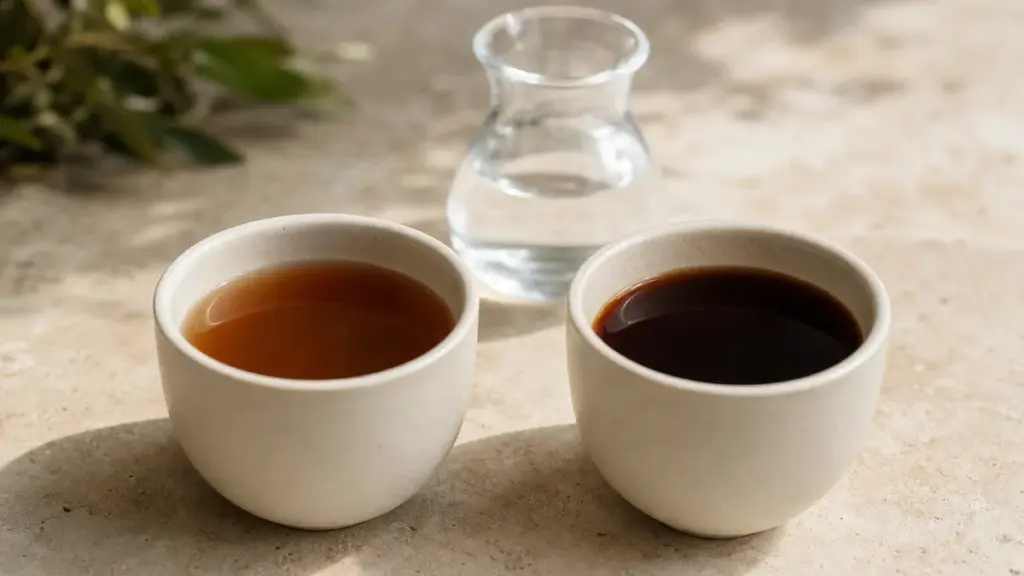
Caffeine myths: dark, bitter or “strong” means more caffeine
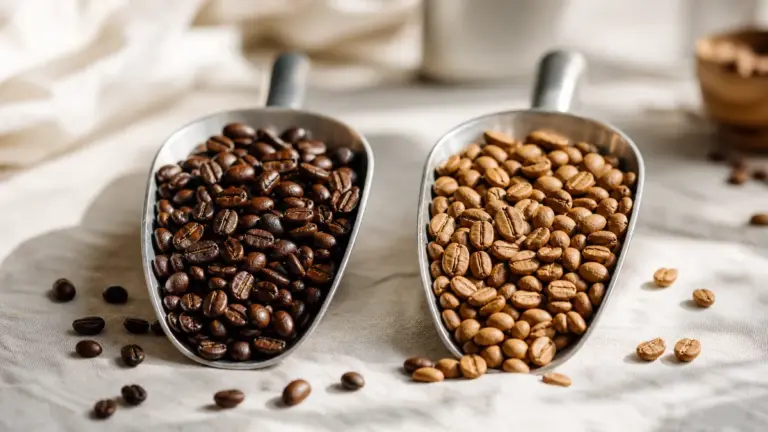
Verdict: flavour intensity is not a caffeine measurement. Calling a drink “strong” can mean several different things:
- It tastes intensely roasted or bitter.
- It contains a high concentration of dissolved coffee.
- It delivers a large amount of caffeine.
Those descriptions are not interchangeable. A useful comparison must specify the drink, the serving size and what is being measured.
Roast colour alone is an unreliable shortcut. A controlled laboratory study found that darker roasts generally produced less caffeine under identical brewing conditions, but more at an equivalent extraction yield. Extraction yield means the proportion of the dry coffee that dissolves during brewing.
This helps explain apparently conflicting advice: changing what is held constant can change the result. “Dark roast has more caffeine” and “light roast has more caffeine” are both too broad without the brewing conditions.
Decaffeinated coffee introduces another common misconception. It contains substantially less caffeine than regular coffee, but it is not necessarily caffeine-free. If you need to restrict caffeine closely, use product-specific information rather than assuming that decaf contributes nothing.
For context, EFSA’s assessment found no safety concerns for healthy, non-pregnant adults at habitual intakes up to 400 mg daily, spread across the day, or single doses up to 200 mg. It also found that 100 mg close to bedtime can affect sleep in some adults.
These are population benchmarks, not personal targets. The NHS advises no more than 200 mg daily from all sources during pregnancy. Speak to a GP, pharmacist or midwife about individual circumstances, medicines or symptoms.
Freshness myths: the newest roast must taste best
Verdict: freshness matters, but “newer” is not a complete quality measure. Roasting produces gases, including carbon dioxide, some of which remain trapped inside the beans.
Their gradual release is called degassing. Laboratory measurements show that gas escapes during storage and is released more abruptly during grinding and brewing. This affects extraction and contributes to espresso crema, the foam on top of the drink.
Consequently, a dramatic filter-coffee bloom or abundant crema tells you something about gas release, not everything about flavour. Neither is a substitute for tasting the coffee.
It is also worth separating time since roasting from time since grinding. Grinding accelerates changes that proceed more slowly in whole beans. “Roasted recently” therefore does not tell the whole story if the coffee was also ground well before brewing.
The useful response is not to replace one rigid rule with another, such as declaring every coffee perfect after a fixed number of days. Record the roast date, follow the roaster’s starting advice and compare how the coffee tastes as it ages.
Treat a freshness window as guidance for a particular coffee and storage arrangement, not a guarantee that every bean follows the same timetable.
Storage myths: a handsome jar or a fridge guarantees freshness
Verdict: protection matters more than the container’s appearance. A clear jar beside a sunny window may look appealing, but it exposes coffee to light and potentially heat.
The National Coffee Association advises airtight, opaque storage in a cool, dark location. Moisture is another concern: coffee can absorb moisture and odours from its surroundings.
Refrigeration and freezing should not be confused with simply putting a loosely closed bag somewhere cold. Packaging and handling matter, particularly when condensation can form.
For a straightforward everyday arrangement, keep coffee tightly closed in a cool cupboard away from the oven, dishwasher and direct sunlight. Grind what you need shortly before brewing.
Freezing is not automatically forbidden, but neither is it a cure for poor packaging. If you choose cold storage, use genuinely airtight packaging and minimise exposure to damp air.
At an office tea point, the same principle suggests a useful habit: keep reserve beans sealed rather than emptying the entire supply into a display container. Convenience should not mean leaving tomorrow’s coffee exposed all day.
Brewing myths: one temperature or one taste tells you everything
Verdict: brewing variables work together. A temperature, grind setting or brewing time can be a useful starting point without being a universal answer.
A controlled sensory study compared drip coffee brewed at 87, 90 and 93 degrees Celsius. Researchers adjusted other brewing settings to achieve matching concentrations and extraction yields. Within those conditions, temperature had little appreciable effect on the sensory profile.
That does not mean temperature is irrelevant. It means the study did not support treating temperature as an independent guarantee of flavour when concentration and extraction were controlled. Keeping everything else unchanged while altering temperature is a different experiment.
For practical troubleshooting, separate two measurements:
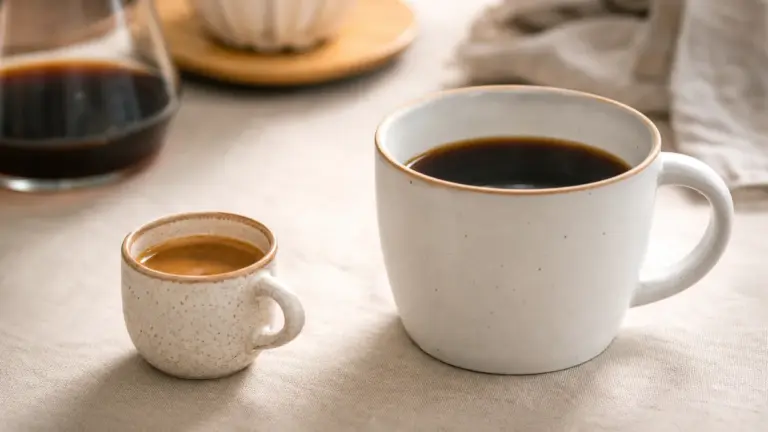
Brew strength is the concentration of dissolved coffee in the finished drink. It is commonly expressed as total dissolved solids, or TDS.
Extraction yield is the proportion of the original dry coffee that has dissolved into the drink.
A concentrated drink is not necessarily highly extracted, and a dilute drink is not necessarily under-extracted. This distinction explains why “too strong” is an incomplete diagnosis: it does not tell you whether the problem is concentration, flavour balance or simply a preference for a gentler drink.
Nor should bitterness be treated as a single-cause fault. Sensory research shows that concentration and extraction both influence flavour attributes. A taste description is useful evidence, but it is not a laboratory reading.
A practical table for checking common misconceptions
| Claim you hear | Missing distinction | Better next step |
|---|---|---|
| “This tastes stronger, so it has more caffeine.” | Flavour, concentration and caffeine dose | Look for caffeine information for the actual serving. |
| “This coffee is too old.” | Roast age, grind age and storage | Check all three before blaming the date alone. |
| “A fridge keeps everything fresh.” | Temperature versus moisture protection | Check the seal and condensation risk. |
| “The water temperature ruined it.” | Temperature versus the complete recipe | Compare brews while recording the other settings. |
| “A study proves coffee is healthy.” | Association versus cause | Check the study design and who took part. |
Use the table as a prompt for investigation, not another set of absolute rules. The aim is to ask a better question before changing what you drink or how you brew it.
How to judge the next coffee claim
Start by identifying the comparison. Does “more caffeine” mean per gram of dry coffee, per millilitre of drink or per complete serving? Does “better extraction” mean more material dissolved, a preferred taste or both?
Then ask what the evidence can establish. A controlled brewing experiment can isolate particular variables, but its findings still belong to the coffees, equipment and conditions tested. A health study following people over time can identify associations without proving that changing one habit will produce the same result.
Finally, separate a measured result from an interpretation. Researchers may measure caffeine chemically, while a tasting panel describes bitterness. Those findings can complement each other, but one cannot stand in for the other.
Our coffee myths overview provides the route into individual questions. The most useful answer to common misconceptions is rarely “everything you heard is wrong”; it is knowing which qualification makes the advice accurate.
FAQ
Does decaf count towards my daily caffeine intake?
Yes, any caffeine remaining in decaf contributes to your total intake. Decaffeinated does not necessarily mean caffeine-free, and the amount varies between products and preparations. If you have been advised to restrict caffeine closely, seek product-specific information and discuss suitable choices with your GP, pharmacist or midwife.
Should I throw coffee away as soon as it tastes stale?
Staleness alone does not necessarily mean dry roasted coffee is unsafe. The National Coffee Association distinguishes declining aroma and flavour from spoilage associated with moisture and mould. Do not use visibly mouldy coffee. Follow the packaging instructions, and do not apply advice about dry beans to prepared drinks containing milk.
Is there one scientifically correct flavour for coffee?
No, a measured brewing result does not establish a flavour that everyone must prefer. Controlled sensory research distinguishes descriptions of flavour from judgements about liking. Measurements can help you repeat a drink or understand a change, but a preference for a lighter, heavier, brighter or more bitter cup is not itself a brewing error.
Where to go next
Read Coffee and Dehydration for a closer look at fluid balance, then Coffee and Bone Health for the evidence behind another persistent health claim. Return to Coffee Myths and Facts to choose the next question by topic rather than relying on a general rule.
Sources
-
European Food Safety Authority, Caffeine, official topic page summarising the 2015 Scientific Opinion on the safety of caffeine.
https://www.efsa.europa.eu/en/topics/topic/caffeine -
NHS, Foods to avoid in pregnancy, current online guidance, publication year not stated.
https://www.nhs.uk/pregnancy/keeping-well/foods-to-avoid/ -
Killer, Blannin and Jeukendrup, PLOS ONE, No Evidence of Dehydration with Moderate Daily Coffee Intake: A Counterbalanced Cross-Over Study in a Free-Living Population, 2014.
https://journals.plos.org/plosone/article?id=10.1371/journal.pone.0084154 -
Poole and colleagues, The BMJ, Coffee consumption and health: umbrella review of meta-analyses of multiple health outcomes, 2017.
https://www.bmj.com/content/359/bmj.j5024%20 -
Lindsey and colleagues, Scientific Reports, Caffeine content in filter coffee brews as a function of degree of roast and extraction yield, 2024. Retrieved author-hosted paper.
https://pages.uoregon.edu/chendon/coffee_literature/coffee_lit_rev/2024_ep20_caffeine.pdf -
US Food and Drug Administration, Spilling the Beans: How Much Caffeine is Too Much?, 2024 update.
https://www.fda.gov/consumers/consumer-updates/spilling-beans-how-much-caffeine-too-much -
Smrke and colleagues, Journal of Agricultural and Food Chemistry, Time-Resolved Gravimetric Method To Assess Degassing of Roasted Coffee, 2018. Retrieved university repository record and abstract.
https://digitalcollection.zhaw.ch/items/4789f6f9-a182-4840-a313-54a3e8445aec -
Specialty Coffee Association, Coffee Decoded: What is “freshly roasted” coffee?, publication year not displayed.
https://sca.coffee/sca-news/coffee-decoded-9-fresh-coffee -
National Coffee Association, Storage and shelf life, current online guidance, publication year not stated.
https://www.aboutcoffee.org/beans/storage-and-shelf-life/ -
Batali, Ristenpart and Guinard, Scientific Reports, Brew temperature, at fixed brew strength and extraction, has little impact on the sensory profile of drip brew coffee, 2020.
https://www.nature.com/articles/s41598-020-73341-4.pdf
This article was researched using official health guidance, peer-reviewed studies and coffee-industry technical explanations, distinguishing controlled findings from observational associations and practical recommendations.
Last checked: November 2026